 Skip to content

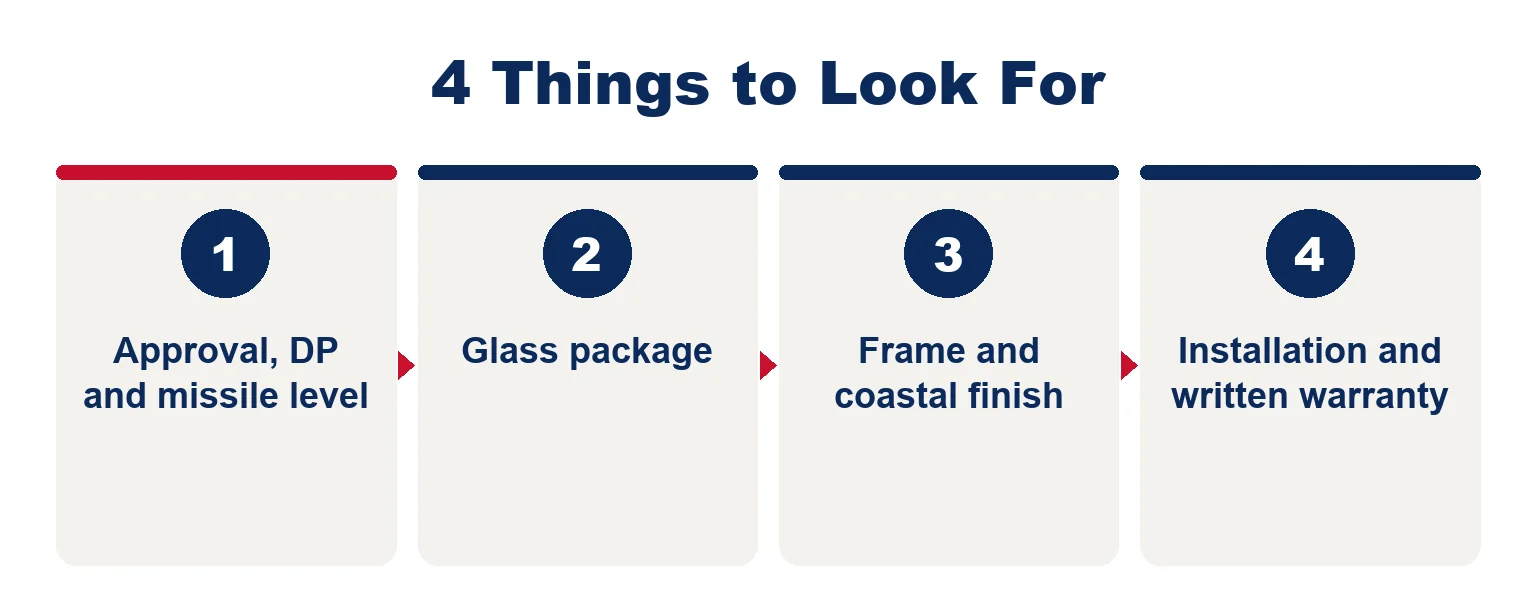
The four things to look for in hurricane impact windows are: a product approval and design pressure that fit each opening, the right glass package, a strong frame with a finish that survives salt air, and professional installation backed by a written warranty.
Check all four on every window in your quote, because a great brand name does not fix a unit that is rated too low for the opening it goes into.
This checklist walks through each part in plain terms, with the questions to ask before you sign. For the bigger picture on types, costs and county rules, start with our complete South Florida impact window guide.
1. Hurricane Rating: Approval, Design Pressure and Missile Level for Each Opening
The first thing to check is whether each window is approved, rated and tested for the exact opening it will fill.
In South Florida, that means three items on paper for every window: a product approval number, a design pressure that meets what the opening needs, and an impact rating for its height on the house.
Check the Product Approval for Your County
Every impact window sold for a Florida home should carry a product approval. In Miami-Dade and Broward, which are in the High-Velocity Hurricane Zone (HVHZ), look for a Miami-Dade Notice of Acceptance (NOA) or a Florida Product Approval approved for HVHZ use.
In Palm Beach County and most of the rest of the state, a Florida Product Approval (an FL number) is the usual document.
The approval is more than a stamp. It lists the sizes the product was tested at, the design pressures it is approved for, the glass it can use and how it must be anchored. NOAs also carry expiration dates, so check that the approval is current.
If you are not sure what your existing windows carry, see how to read a window’s hurricane rating.
Match the Design Pressure to Each Opening
Design pressure (DP) is the wind load a window is rated to hold, in pounds per square foot (psf), and it is set per opening, not per house. It is written as two numbers: positive pressure pushing in and negative pressure pulling out.
A rating of +50/-60, for example, means 50 psf inward and 60 psf of suction.
The DP an opening needs depends on four things:
- Wind speed: the design wind speed the Florida Building Code sets for your location.
- Exposure: open, coastal or waterfront sites face stronger wind than homes sheltered by other buildings and trees.
- Height: windows higher on the building see higher loads.
- Wall zone: windows near the corners and edges of a wall face stronger suction than windows in the middle of the wall.
Engineers and installers calculate these loads using ASCE 7 and the Florida Building Code. That is why two windows on the same house can need different ratings.
Size changes the answer too. The same product often carries a lower DP at a larger size, because a bigger pane flexes more under the same wind.
A unit approved at a high DP in a small size may be approved at a lower DP in a big size, so wide openings and large fixed picture impact windows need the closest check. Your quote should list the approved DP for each window at its actual size.
One common myth to drop: a DP number is not a hurricane category. A window rated DP 50 is not “Category 5 proof”, and no single DP fits every Florida home. The right number is whatever each opening requires, with the approval to prove the unit meets it.
Confirm the Missile Rating
Impact windows are tested by firing debris at the glass and then cycling wind pressure on the damaged unit. In the HVHZ, the tests are TAS 201, 202 and 203; elsewhere, products are commonly tested to ASTM E1886 and E1996.
For most homes, the rating to look for is large missile. The Florida Building Code requires large missile protection for glass within 30 feet of the ground, which covers the first and second floor of almost every house.
The large missile is a 9-pound two-by-four fired at 50 feet per second, which ASTM E1996 calls missile level D.
Level E fires the same two-by-four at 80 feet per second and is generally used for essential buildings such as shelters and hospitals, according to Engineering Express’s overview of missile levels. Small missile ratings apply to glass higher up the building.
For what these tests look like and what happens when debris hits, see how missile tests and design pressure work.
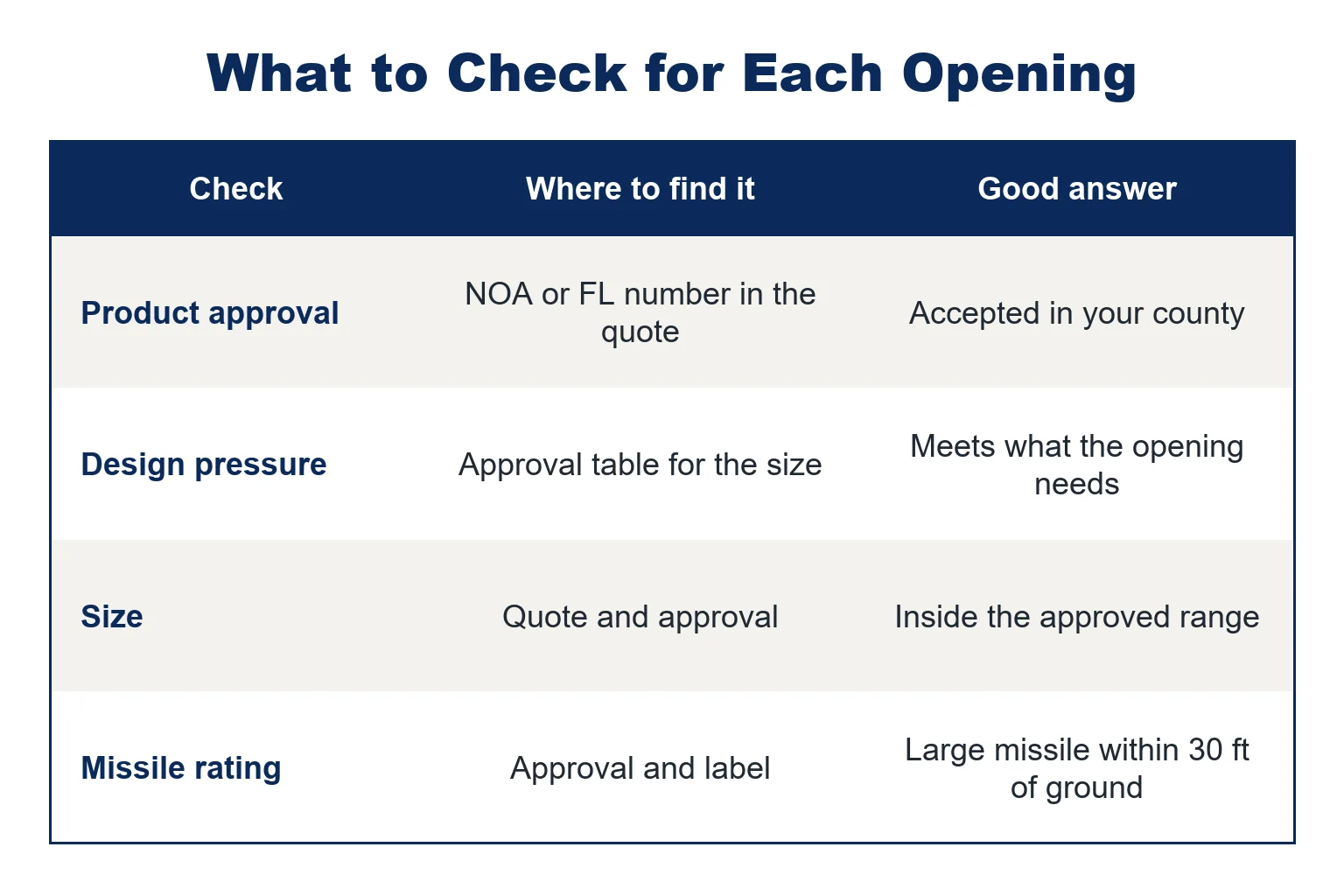
| What to check | Where to find it | What a good answer looks like |
|---|---|---|
| Product approval | NOA or FL number in the quote | Current approval accepted in your county |
| Design pressure | Approval table for the unit size | Meets or beats what that opening needs |
| Size | Quote and approval | Window size is inside the approved range |
| Missile rating | Approval and label | Large missile for glass within 30 feet of the ground |
Once the ratings are right, the style is a matter of the room. You can browse the impact window styles we install, from single-hung to casement and custom shapes, and check each one against this table.
2. The Glass Package: Laminated Interlayer, Low-E and Tint
The second thing to look for is the glass package, because the glass decides how the window holds up after a hit and how your rooms feel every day. Impact glass is laminated: glass layers bonded to a clear plastic interlayer.
If debris cracks the glass, the interlayer is designed to hold the pieces in the frame so the opening stays closed.
Laminated Interlayer: PVB or SGP
The two interlayers you will hear about most are:
- PVB (polyvinyl butyral): the most common interlayer. It holds broken glass in place and also helps cut outside noise.
- SGP (an ionoplast interlayer): a stiffer interlayer often used for larger openings and higher design pressures, because the glass flexes less.
Which one you get is usually set by the size and DP of the opening, not by preference alone. The product approval lists the glass makeups the window was tested with, so the glass in your quote should match one of them. If quiet rooms matter to you, read how impact glass reduces outside noise.
Insulated Glass and Low-E Coatings
Many impact windows can be ordered with insulated laminated glass, which adds a sealed air space and a second pane. Paired with a Low-E coating, it reflects heat from the sun and keeps cooled air inside. Both matter in South Florida, where air conditioning runs most of the year.
To compare energy performance, look at the NFRC label or product sheet. The National Fenestration Rating Council rates windows on U-factor (how much heat passes through, lower is better) and solar heat gain coefficient, or SHGC (how much sun heat gets in, lower is better for hot climates).
Tint and Privacy
Tinted or reflective impact glass adds shade and daytime privacy, which helps on west-facing rooms and street-facing bathrooms. The interlayer already filters much of the UV that fades floors and furniture, so tint is mainly about glare, heat and privacy.
Check your HOA rules before ordering a dark or mirrored tint, and confirm the tinted glass is listed in the product approval.

3. Heavy-Duty Frames: Aluminum or Vinyl, With a Coastal Finish
The third thing to look for is a frame strong enough to hold impact glass under hurricane loads, made from a material and finish that suits your location. Most impact windows sold in South Florida have aluminum or vinyl frames, and both can be fully approved. The difference is in strength at large sizes, insulation and upkeep.
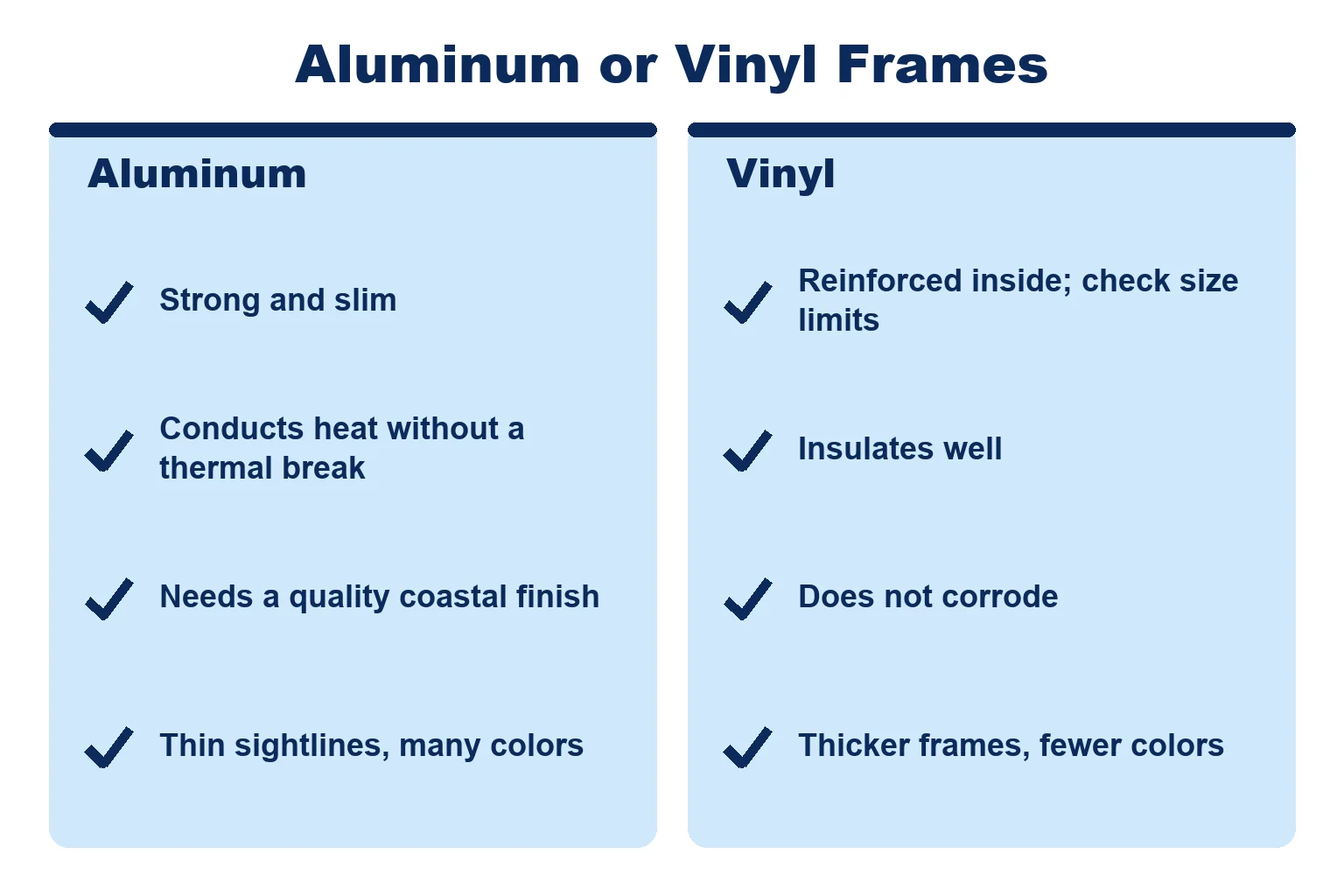
| Point | Aluminum frames | Vinyl frames |
|---|---|---|
| Strength | Strong and slim, common for large openings | Usually reinforced inside; check size limits |
| Heat | Conducts heat unless it has a thermal break | Insulates well |
| Salt air | Needs a quality coastal finish | Does not corrode |
| Look | Thin sightlines, many colors | Thicker frames, fewer colors |
A good rule: choose by opening. Aluminum is often the pick for big sliding units and wide picture windows, while vinyl can make sense for standard-size bedroom and bathroom windows where insulation matters more. Whatever the frame, the approval has to cover your largest openings at the DP they need.
To see how manufacturers differ on frames and sizes, compare which impact window brands to consider.
Finishes and Hardware for Salt Air
If you live near the Atlantic, Biscayne Bay or the Intracoastal, salt air attacks bare metal. Ask for aluminum with a powder-coated or anodized finish.
For painted finishes, the Fenestration and Glazing Industry Alliance (FGIA) publishes the AAMA 2604 and 2605 specifications, which set higher performance levels for coatings on aluminum; ask which one the finish meets.

Look past the frame too. Locks, hinges, rollers and screws can corrode before the frame does, so ask whether the hardware and fasteners are stainless steel or rated for coastal use. Some finish warranties also have conditions for homes close to salt water, so read the coastal terms before you choose.
Common Impact Window Styles
Every style below can be made as an impact window. The style changes how the window opens and where it works best; the four checks above still apply to each one.
Single-hung: the bottom sash slides up while the top sash stays fixed. It is a simple, common choice for standard openings, and many homeowners pick single-hung impact windows for bedrooms.

Horizontal roller: one sash slides sideways along a track, so nothing swings into the room or outside. It suits wide, short openings, and horizontal roller impact windows for wide openings are common in living areas.

Fixed picture: the glass does not open at all. It is used where the view and the light matter more than airflow, such as living rooms and stairwells.

Casement: the sash is hinged on one side and cranks outward, so the whole opening can let air in. It works well over kitchen counters, where reaching up to lift a sash is awkward; see casement impact windows that crank open.

Architectural: custom shapes such as arches, half-rounds and angled tops, usually fixed and set above or beside other windows. They let you protect unusual openings with architectural impact windows in custom shapes.

Awning: the sash is hinged at the top and swings out from the bottom, so it can stay open in light rain. It is often placed high on a wall or over a sink, as with awning impact windows for kitchens and baths.

4. Professional Installation and a Written Warranty
The fourth thing to look for is an installer who fits the window exactly as its approval requires and puts the warranty in writing. A correctly rated window that is anchored wrong can fail inspection, leak, or perform below its rating in a storm.
Installation That Matches the Approval
The product approval spells out the anchors, their spacing and how the window attaches to the wall or buck. A professional installer follows those details, seals and waterproofs the opening, and repairs the stucco and trim around it.
Window replacement in South Florida normally needs a building permit, and the inspector checks that the installed product matches its approval and the required design pressure.
Before you hire, confirm the contractor’s license on MyFloridaLicense.com and ask who pulls the permit. For the details that separate a good job from a bad one, see what proper impact window installation involves.

Warranty Terms to Get in Writing
An impact window comes with two warranties, and you want both on paper:
- Manufacturer’s warranty: covers the product itself. Ask what it says about the glass seal, the frame, the finish, the hardware and screens, and whether coastal homes have different terms.
- Workmanship warranty: covers the installer’s work, such as leaks from the installation. Ask how long it lasts and who you call.
- Transfer: ask whether each warranty passes to the next owner if you sell.
- Paperwork: keep the approvals, permit, final inspection and warranty documents together. A wind mitigation inspector uses them to confirm your opening protection for possible insurance credits.
For which upgrades insurers look at, read about impact upgrades that can lower insurance rates.
Bring This Checklist to Your Quote
The simplest way to use these four checks is to hold every quote to them, window by window. A strong quote lists the approval number, DP and size for each opening, the glass makeup, the frame and finish, the permit, and both warranties.
When you have more than one, compare impact window quotes from different companies line by line.
If the total is more than you planned, you can phase the work or look at financing options for an impact window project, such as $0 down plans and loans up to $100,000 for qualified homeowners. Call (877) 554-6373 or request a measured estimate that lists every opening.
USA Home Improvement is licensed (CGC1526707) and insured and has served Florida homeowners for more than 15 years.