 Skip to content

Yes, impact windows usually make a home noticeably quieter than old single-pane windows. Their laminated glass is heavier than ordinary glass, and the plastic layer inside it damps vibration, so less outside sound gets through.
They are not soundproof, and how much quieter your rooms get depends on the glass package, the installation and the walls and doors around each window.
This guide explains the two noise ratings to look for, STC and OITC, compares impact glass with standard single-pane and insulated glass, shows what else lets noise in, and gives you a simple way to compare noise ratings on quotes.
Impact Windows Do More Than Protect Your Home From Storms
Impact windows are built to protect the opening in a hurricane, and the same construction that stops debris also cuts everyday noise. In South Florida’s wind-borne debris region, the Florida Building Code requires glass openings to have opening protection: either impact-rated windows and doors, or approved shutters or panels.
That difference matters for noise. Shutters protect the glass only while they are closed, so on a normal day your old windows are still letting traffic and lawn equipment in. Impact windows protect the opening and quiet the room every day. Our impact windows versus shutters comparison covers the storm side of that choice.
If you are new to the product, our beginner’s guide to hurricane impact windows explains ratings, types and county rules. The rest of this page is about one question: how much quieter will your home be?
How Impact Windows Reduce Noise in Your Home
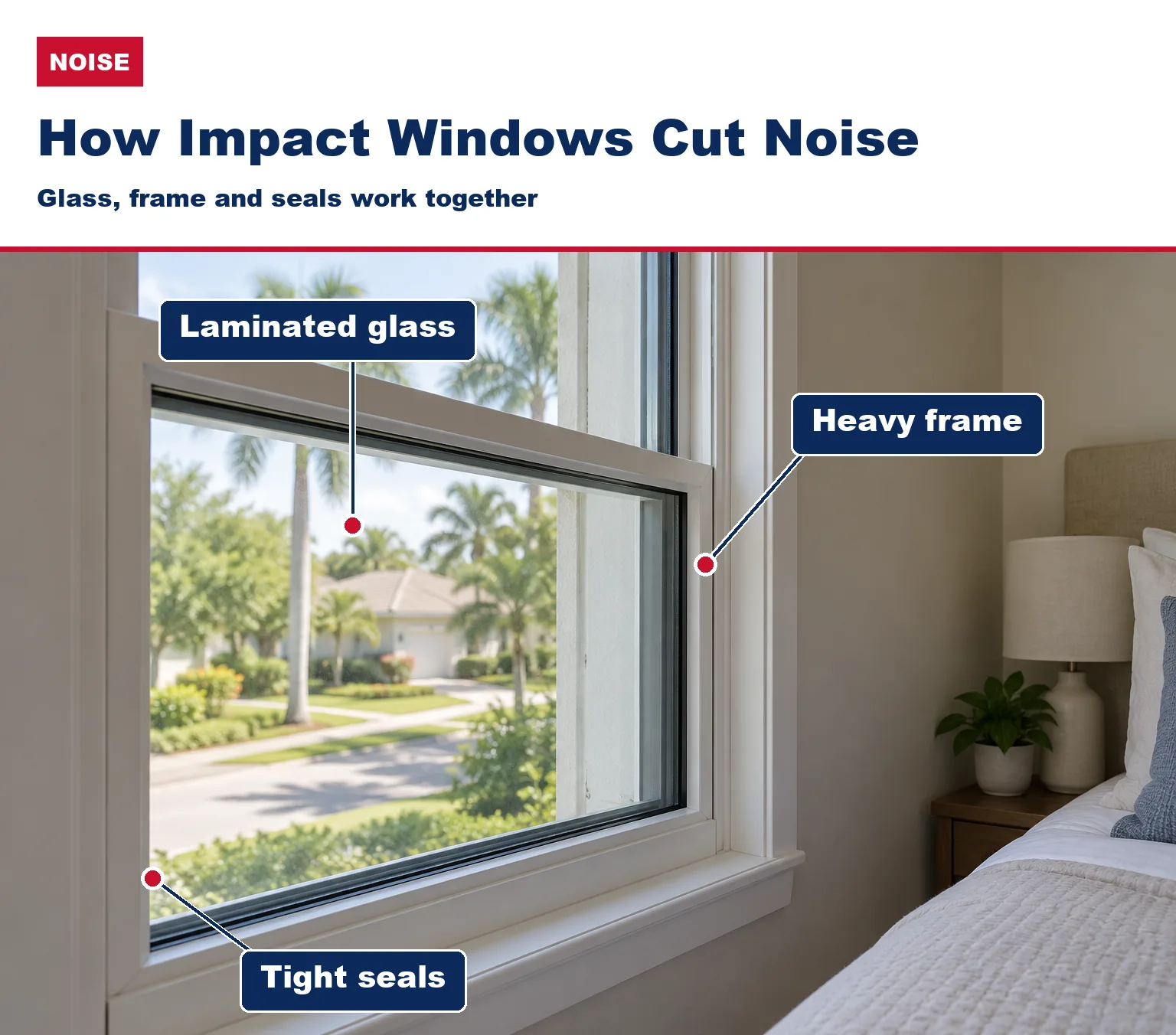
Impact windows reduce noise through mass and damping. Impact glass is laminated: two layers of glass bonded to a clear plastic interlayer, most often PVB (polyvinyl butyral). Heavier glass is harder for sound waves to shake, and the soft interlayer soaks up part of the vibration that does get into the glass.
Ordinary glass has a weak spot. At certain frequencies, a single sheet of glass flexes in step with the sound wave and lets more sound through. Acousticians call this the coincidence dip.
The National Research Council of Canada’s digest on sound transmission through windows explains that laminated glass performs better in that range, apparently because the plastic interlayer damps the vibration.
The frame and seals matter as much as the glass. Impact windows use heavy frames and tight seals because they must pass air and water tests as well as impact tests, and a tight seal also keeps sound out. You can see the styles we install on our impact window styles and options page.
STC and OITC: What the Window Noise Ratings Mean
STC and OITC are the two single-number ratings that tell you how well a window blocks sound. For both, a higher number means more sound is blocked. They are measured in a laboratory, on a specific window size and glass build, so a rating belongs to that exact product, not to a brand.
- STC (Sound Transmission Class) is calculated under ASTM E413 from lab tests run to ASTM E90. ASTM E413 says STC tracks how people hear speech, radio, television and similar sounds. The same standard says STC is not suited to motor vehicle, aircraft and train noise, because those sounds carry much of their energy at low frequencies.
- OITC (Outdoor-Indoor Transmission Class) is calculated under ASTM E1332. Its reference sound is an average of aircraft takeoff, road traffic and train noise, so it is the better rating for outside noise coming into a home.
| Rating | Standard | Best for judging | Watch out for |
|---|---|---|---|
| STC | ASTM E413 (tests to ASTM E90) | Voices, TV, music, barking dogs | Not meant for traffic, aircraft or trains |
| OITC | ASTM E1332 | Traffic, aircraft, trains | Same number can sound different with other noise sources |
A common question is what STC number counts as good. There is no single official cut-off for homes.
The useful comparison is between the actual windows you are being quoted, at the same size and configuration, with OITC given extra weight if your noise comes from a road, an airport or a rail line.
ASTM E1332 itself says its rating is for ranking products, not for predicting exactly what you will hear indoors.
Impact Glass vs Single Pane vs Insulated Glass for Noise
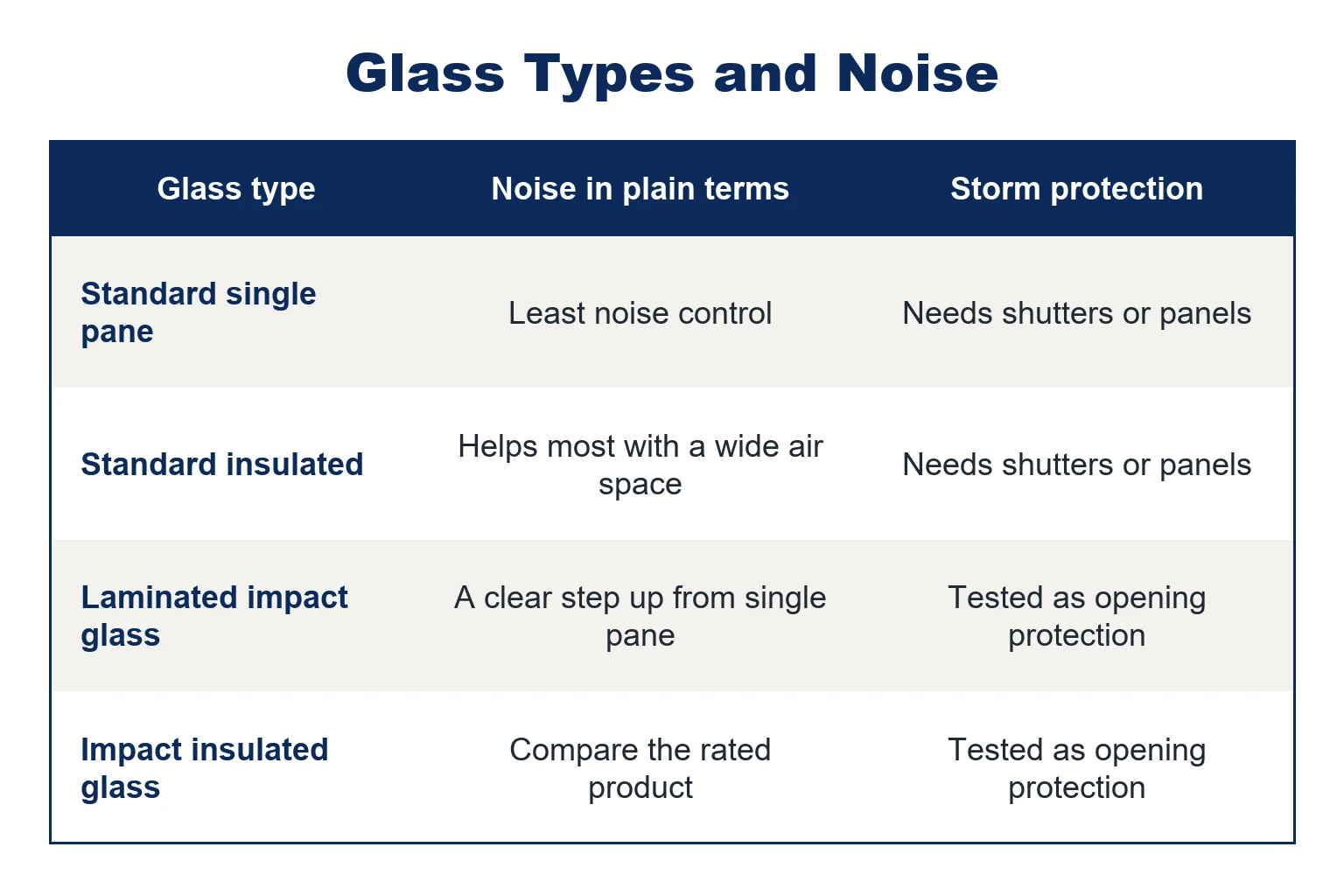
Laminated impact glass usually blocks more noise than the standard single pane it replaces, and it can match or beat a basic insulated (double-pane) unit for some kinds of noise. The reason is that a second pane only helps a lot when the air space between the panes is wide.
The NRC Canada digest found that sealed double glazing with a small air space can rate only slightly higher than a single layer of the same glass, or even lower.
The air between the panes acts like a spring, and the dip it causes falls in the range where traffic and aircraft noise are strong. Wider air spaces raise the rating.
| Glass type | How it is built | Noise in plain terms | Storm protection |
|---|---|---|---|
| Standard single pane | One sheet of ordinary glass | Least noise control; weak spot at some frequencies | Needs shutters or panels |
| Standard insulated (double pane) | Two panes with a sealed air space | Helps most when the air space is wide; a narrow gap adds little | Needs shutters or panels |
| Laminated impact glass | Two glass layers bonded to a plastic interlayer | Heavier and damped; a clear step up from single pane | Tested as opening protection |
| Impact insulated glass | Laminated glass plus a second pane and air space | Combines lamination and an air space; compare the rated product | Tested as opening protection |
Impact insulated glass is also chosen for heat and energy reasons, so ask for its noise ratings rather than assuming it is quieter. Our checklist of features to compare in impact windows covers the full glass package, including Low-E coatings and interlayer types.
What Else Lets Noise Into Your Home
New windows only quiet a room if the windows were the loudest path for sound. Noise takes the weakest route in, so a gap, a thin door or an attic vent can undo part of what good glass achieves.
The NRC Canada digest notes that windows often limit a room’s sound insulation, and that sound passing through cracks can drastically reduce noise reduction.
- Gaps and air leaks: if air can get through, so can sound. Worn weatherstripping, unsealed frame edges and gaps around pipes or cables all leak noise.
- Window style: windows that open lose some sound insulation through their seals. The NRC digest puts openable windows a few STC points below an equivalent sealed window. Where you do not need ventilation, non-opening picture impact windows are the tightest option.
- Doors: sliding glass doors are often the largest and leakiest glass in the house, and hollow entry doors let sound straight through. Upgrading to impact-rated sliding patio doors closes that path at the same time.
- Installation: the joint between the window frame and the wall must be sealed all the way around. Our guide to installing impact windows the right way explains what a careful installer does at that joint.
- Walls, roof and openings: concrete-block walls block sound well, while frame walls, attic vents, wall AC units, mail slots and pet doors can let noise in around the new windows.
What Kinds of Noise Can Impact Windows Buffer?
Impact windows can soften most everyday outdoor noise, and they do best with mid and high-pitched sounds. Deep, rumbling sounds are harder to stop with any window, which is why OITC matters if low-frequency noise is your main complaint.
- Traffic: road noise from streets and highways such as I-95 has a strong low rumble. Look at OITC.
- Aircraft and trains: also low-frequency heavy. Look at OITC.
- Barking dogs, voices and noisy neighbours: mostly mid-range sounds. STC is a fair guide.
- Lawnmowers, leaf blowers and pool equipment: a mix of high-pitched whine and engine rumble. Both ratings help.
- Construction: saws and beeping drop off well; heavy machinery rumble is harder.
- Thunder and bass from loud music: very low frequencies. Expect them to be quieter, not gone.
Which Rooms to Prioritise for Quieter Windows
Start with the rooms where noise costs you sleep or focus, on the side of the house that faces the noise. You do not have to replace every window at once to feel a difference where it matters most.
- Bedrooms facing the street or a flight path: sleep is where most people notice noise, and night traffic stands out when everything else is quiet.
- Nursery and children’s rooms: naps happen during the day, when lawn crews and construction are loudest.
- Home office: video calls pick up outside noise, and a quieter room helps you focus.
- Living room with a large sliding door: the slider is often the biggest noise path in the house.
- Rooms near pool pumps, AC condensers or a neighbour’s driveway: constant equipment hum is tiring over time.
Replacing the noisiest side first can fit a tighter budget, but every glass opening still needs storm protection. Our guide to deciding whether impact windows suit your house covers phased replacement, and financing for impact windows and doors can spread the cost for qualified homeowners.
How to Compare Noise Ratings on Impact Window Quotes
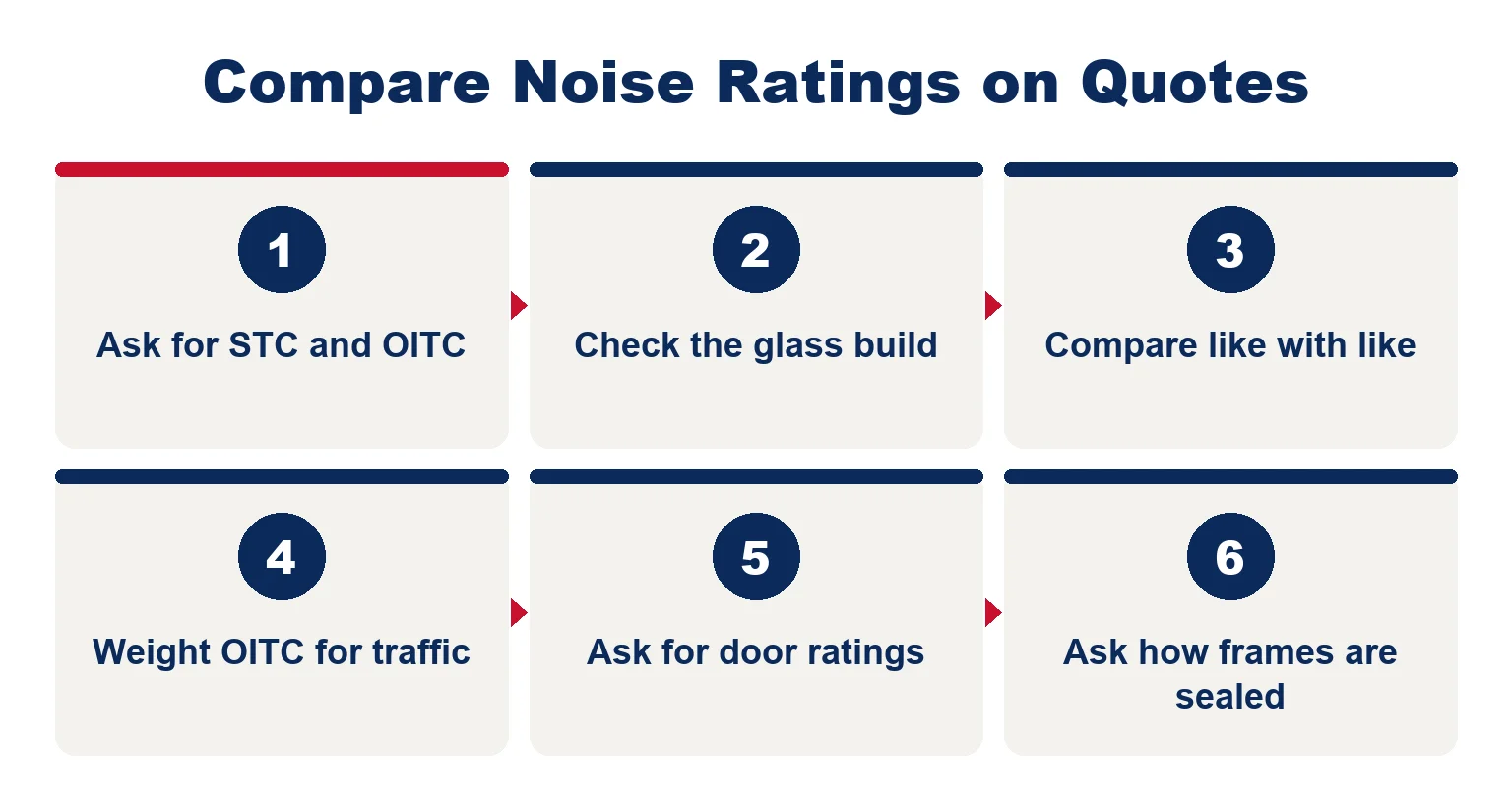
Compare noise ratings only between the exact products on your quotes, using the manufacturer’s test data. A rating printed for a brand or a product line tells you little, because the number changes with glass build, size and window type.
- Ask for STC and OITC for each window type quoted, from the manufacturer’s spec sheet or test report.
- Check the glass build behind the number: laminated only or impact insulated, and the interlayer type.
- Compare like with like: same window type, a similar size and the same glass on every quote.
- Give OITC more weight if your noise is traffic, aircraft or trains.
- Ask for the door ratings too, especially for sliding glass doors.
- Ask how the installer will seal the frame to the wall all the way around.
Noise is one line among many on a quote. Our walkthrough on comparing impact window quotes side by side covers approvals, design pressure, permits and warranty as well.
Impact Window Noise FAQs
Are impact windows soundproof?
No. Impact windows reduce outside noise, often by a clear margin compared with old single-pane windows, but no window makes a room soundproof. Sound also travels through walls, doors, gaps and vents. For the quietest result, pair rated windows with a sealed installation and deal with the other noise paths in the room.
Are impact windows quieter than double-pane windows?
Often, but not always. Laminated impact glass can outperform a standard double-pane unit with a narrow air space, especially at frequencies where ordinary glass is weak. A double-pane unit with a wide air space, or impact insulated glass, may rate higher.
Compare the STC and OITC of the actual products instead of the glass type.
Do impact doors reduce noise too?
Yes. Impact doors use the same laminated glass and heavy frames, so an impact sliding or French door usually blocks more noise than an old slider with worn seals. Because doors are large openings with moving seals, ask for their noise ratings and check that the seals close tightly when you test them.
Will impact windows stop bass from a neighbour’s music?
Impact windows will make loud music quieter, but deep bass is the hardest sound for any window to block. Low frequencies pass through glass, walls and roofs more easily than voices or high-pitched sounds. Expect the beat to be softer, not gone.
For other topics, see our short answers to common impact window questions.
Ready for a Quieter, Storm-Ready Home?
If noise is your main reason to replace windows, start with the noisiest rooms, ask every installer for STC and OITC on the exact products quoted, and make sure the installation is sealed all the way around. You get storm protection and quieter rooms from the same upgrade.
Call USA Home Improvement at (877) 554-6373 to talk through the windows and doors that face your noise.
USA Home Improvement is licensed (CGC1526707) and insured and has served Florida homeowners for more than 15 years.