Skip to content

Hurricane impact windows are strong enough to take a hit from a 9-pound 2×4 fired at 50 feet per second, then stay in the frame while wind pressure pushes and pulls on them thousands of times. That is the test the Florida Building Code sets for most home windows in South Florida.
The glass can still crack. What it should not do is break open. This article explains each strength test, what design pressure means for your windows, what happens when impact glass is hit, and the limits you should know before you buy.
For ratings, styles, county rules and cost in one place, start with our homeowner’s guide to impact windows.
How Impact Window Strength Is Measured
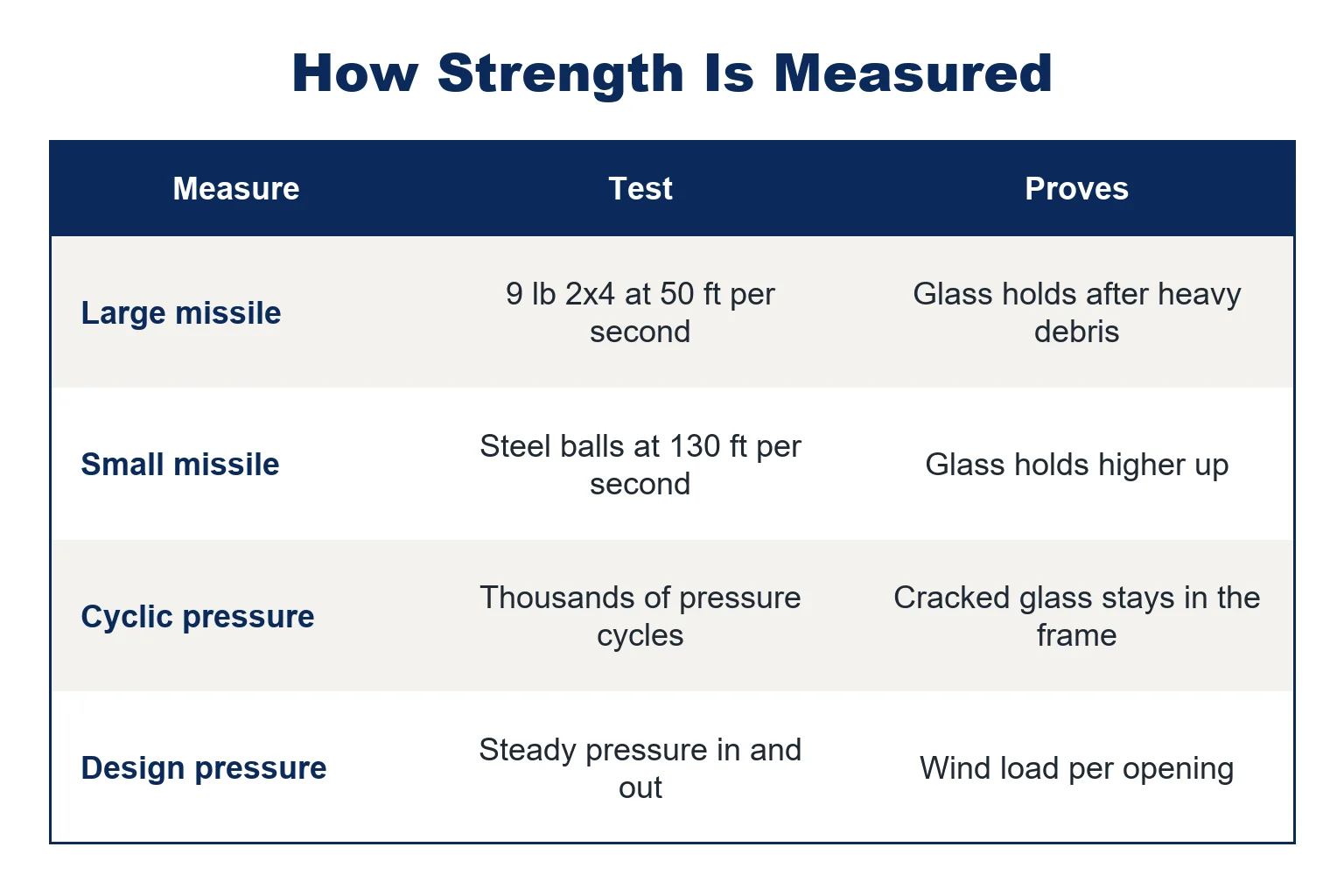
Impact window strength is measured by four things: a missile impact test, a cyclic pressure test that follows the impact, a static pressure test, and the design pressure rating that comes out of that testing. A window is only impact rated when it passes the impact and cyclic tests together.
| Measure | What happens in the test | What it proves |
|---|---|---|
| Large missile (TAS 201 or ASTM E1886 and E1996) | A 9-pound 2×4 is fired at the glass at 50 feet per second | The glass holds after a hit from heavy debris |
| Small missile (TAS 201 or ASTM E1996) | Small steel balls are fired at the glass at 130 feet per second | The glass holds against gravel and roof debris higher up |
| Cyclic pressure (TAS 203 or ASTM E1886) | The damaged unit is pushed and pulled by thousands of pressure cycles | The cracked glass stays in the frame through gusts |
| Design pressure (TAS 202 and the product approval) | Steady air pressure is applied inward and outward | The wind load, in pounds per square foot, the unit is rated to hold |
TAS (Testing Application Standards) are the Florida Building Code tests used in the High-Velocity Hurricane Zone, which covers Miami-Dade and Broward. The ASTM standards are the national versions accepted elsewhere in Florida. The impact windows we install in South Florida carry these ratings in their product approvals.
The Large Missile Test: a 9-Pound 2×4 at 50 Feet per Second
The large missile test fires a 9-pound piece of 2×4 lumber at the glass at 50 feet per second, about 34 miles per hour. It copies the kind of debris a hurricane really throws: broken fence boards, framing and branches.
Intertek’s TAS 201 test overview describes the missile and notes that the code also allows a faster 80 feet per second shot.
The missile hits each test unit at locations the code defines, including near the corners where glass is weakest. In ASTM E1996, this 9-pound, 50 feet per second shot is called Missile D, and it is the level most homes need.
Under the Florida Building Code (Section 1609.1.2), glass openings within 30 feet of the ground in the wind-borne debris region must pass the large missile test. That covers the first and second floor of almost every South Florida house.
The Small Missile Test for Glass Above 30 Feet
The small missile test fires 2-gram steel balls at the glass at 130 feet per second, about 89 miles per hour. The balls stand in for roof gravel and small fragments that wind can carry high up a building. In ASTM E1996 this is Missile A.
The Florida Building Code allows small missile products only for glass more than 30 feet above the ground, such as upper floors of a condo or office tower. A small missile rating is not enough for a ground-floor or second-floor window in a house.
If a quote or label says “small missile”, ask which openings it is meant for.
The Cyclic Pressure Test After the Impact
The cyclic pressure test is what separates an impact window from strong glass. After the missile hits, the same damaged unit goes into a pressure chamber.
Under TAS 203, it is pushed by 4,500 cycles of positive pressure and pulled by 4,500 cycles of negative pressure, in stages set from its design pressure, according to Intertek’s TAS 203 test summary.
This copies hours of gusting wind against a window that has already been hit. To pass, the cracked glass must stay in the frame without tearing open beyond the small limits the standard allows. A window that survives the missile but fails the cycles is not impact rated.
Design Pressure: How Much Wind Each Opening Can Hold
Design pressure (DP) is the wind load a window is rated to resist, in pounds per square foot (psf). It is written as two numbers: positive pressure pushing in on the glass and negative pressure pulling it out.
A label reading +40/-50, for example, means the unit is rated for 40 psf inward and 50 psf of suction.
Design pressure is set per opening, not per house. An engineer works out what each opening needs from the wind speed for your area, the height of the window, how exposed the home is and where the window sits on the wall.
Corners of the house see higher suction, so a corner window can need a higher rating than one in the middle of the same wall. The method comes from ASCE 7, the wind load standard the Florida Building Code uses.
Size matters too. The same product can carry a lower DP rating at a larger size, which is why the approval lists ratings by size. Large picture windows with impact glass and wide sliding glass doors are where this most often decides which product can be used.
DP is not a hurricane category. A window is not “rated for Category 5”. It is rated to hold a specific load, and that load must meet or beat what the opening requires.
Matching approval, DP and missile level to every opening is the first item on our four-point impact window buying checklist.
Why Are Broken Windows So Dangerous?
A broken window is dangerous because it lets the storm inside the house. Once debris breaks an ordinary window, wind rushes in through the opening and pressure builds inside the home.
That inside pressure pushes up on the roof and out on the walls at the same time as the wind outside pulls on them. Roofs and walls are not designed for that combined load, which is how one broken window can lead to a lifted roof or blown-out walls.
Rain pours in through the same opening, along with glass shards that can injure anyone nearby.
This is why the code treats every glass opening as part of the building envelope. Impact windows are designed to keep the envelope closed even after they are hit, which ordinary glass cannot do.
What Happens When Impact Glass Is Hit
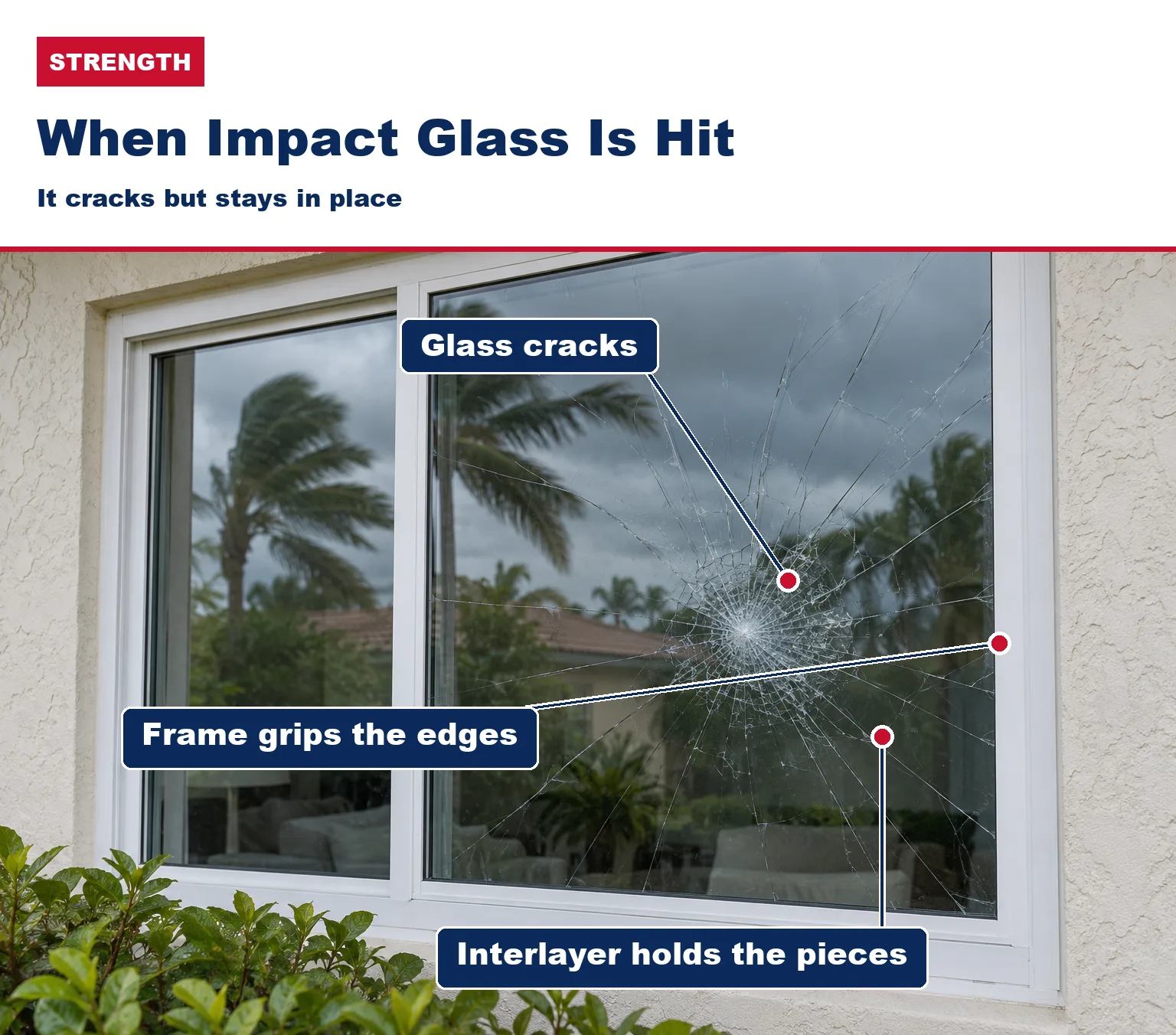
When impact glass is hit hard enough, it cracks but stays in one piece inside the frame. You will usually see a spider-web pattern of cracks around the point of impact, and the glass may bulge slightly, but the opening stays closed.
The reason is laminated glass. Impact glass is made of two or more layers of glass bonded to a tough, clear plastic interlayer, usually PVB or a stiffer SGP layer for larger openings.
When the glass layers crack, the interlayer holds the pieces together and the frame keeps the edges gripped. Wind and rain stay outside, and there are no loose shards flying into the room.
Ordinary tempered glass behaves the other way. It is stronger than plain glass but breaks into small pieces, leaving an open hole.
So “impact-proof” is the wrong word. Impact windows are designed to be damaged without failing. That difference is what the missile and cyclic tests measure.
The Frame Is Just as Important
The frame is just as important as the glass, because a hurricane-rated window is tested and approved as a complete unit. The glass, frame, glazing bead, seals and anchors all go through the tests together.
Impact frames are usually heavy-wall aluminum or reinforced vinyl. During the cyclic test, the frame has to keep its grip on cracked, flexing glass, and the anchors have to hold the whole unit to the wall.
If a strong window is fastened with the wrong screws or spacing, the frame can pull out even though the glass holds.
That is why the approval includes installation instructions, and why the inspector checks them. Our page on what a proper impact window install requires explains anchoring, sealing and what goes wrong when it is rushed.
What Impact Windows Do Not Protect Against
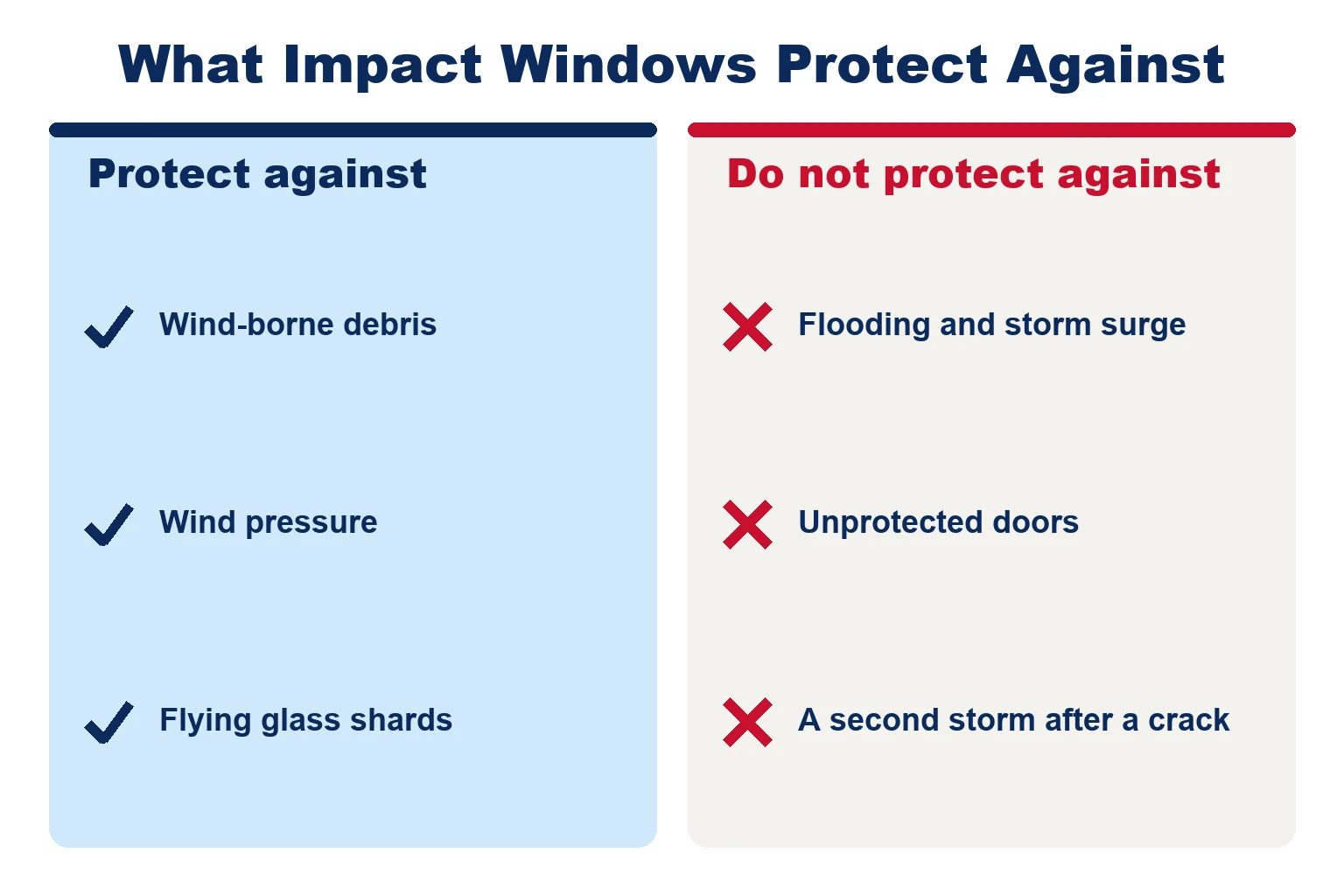
Impact windows protect openings against wind-borne debris and wind pressure. They do not protect your home against flooding or storm surge, and a cracked unit is not ready for the next storm.
- Flooding and storm surge: rising water comes in through doors, floors, walls and drains, and it pushes with a force no window is tested for. The National Hurricane Center’s storm surge overview explains why surge is often the deadliest part of a hurricane. Follow evacuation orders whatever windows you have.
- Cracked units: a hit window has done its job, but the laminated glass is weakened. Plan to replace the glass or the unit before the next storm.
- Other openings: one unprotected door, sliding door or garage door can still let wind into the house. Protect every opening, including impact-rated sliding glass doors on the back of the home.
- Wind-driven rain at the edges: water resistance depends on the product rating and on the sealing around the frame, which comes down to installation.
- Testing beyond the rating: a window rated for one design pressure is not proven for higher loads or for debris larger than the test missile.
Hurricane Windows Can Help Prevent Theft
Impact windows make break-ins harder, because laminated glass does not fall out when it cracks. A burglar who hits the glass gets a cracked pane still held by the interlayer, and getting through it takes time and noise most intruders try to avoid.
Impact windows are not bulletproof or break-in proof, and they are not tested for security. The added protection comes from the same laminated glass and frame that hold up in a storm. Good locks on every window still matter.
How to Check the Strength of Your Own Windows
To check how strong your windows are, look for the product approval number and the test standards on the label or etching, then look up that approval. In Miami-Dade and Broward this is usually a Miami-Dade Notice of Acceptance (NOA), searchable through Miami-Dade Product Control. Elsewhere it is often a Florida Product Approval number.
The approval lists the sizes, design pressures, missile level and installation method for that product. Our guide on confirming a window’s NOA and test ratings walks through each step. If you only want a quick look first, these visual signs of impact-resistant windows help.
Proof of rated windows also matters for insurance, since opening protection is one of the credits on a Florida wind mitigation inspection. Our guide to insurance discounts for storm-ready homes covers how that works.
Impact Window Strength FAQs
Can impact windows withstand a Category 5 hurricane?
Impact windows are not rated by hurricane category. They are tested against a debris missile and rated for a design pressure, which must meet the load your opening needs under the Florida Building Code.
A correctly rated and installed window is built for the design wind speed for your area, which in South Florida is set for very strong hurricanes.
Are impact windows bulletproof?
No. Impact windows are tested against wind-borne debris and wind pressure, not bullets. Bullet-resistant glass is a different product built to different standards. Impact glass does slow down a break-in, because it cracks and stays in the frame instead of falling out.
Will a cracked impact window protect me in the next storm?
Do not count on it. A cracked impact window kept the storm out once, but the glass is weakened and has no rating left to rely on. Have it inspected and replace the glass or the unit before the next hurricane.
Until then, cover it with an approved shutter or emergency plywood, as described in our guide on ways to protect your windows during a hurricane.
Do I still need hurricane shutters with impact windows?
No, not if every window is impact rated and approved for its opening. Code requires opening protection, and rated impact glass meets that on its own. Shutters are the other way to comply.
Our comparison of impact windows versus hurricane shutters covers cost, effort and protection.
Get Windows Tested for South Florida Storms
The strength that matters is the strength proven for each of your openings: the right missile level, a design pressure that meets what the opening needs, and an installation that follows the approval. Ask for those three things in writing on any quote.
If cost is the hurdle, flexible financing for qualified homeowners can help you phase the work.
USA Home Improvement is licensed (CGC1526707) and insured and has served Florida homeowners for more than 15 years. Call (877) 554-6373 or Get a free estimate.