 Skip to content


In Florida, the home upgrades most likely to lower your homeowners insurance are the ones a wind mitigation inspection can verify: protected windows and doors, a stronger roof attachment, and a sealed roof deck. State law requires insurers to offer discounts for these features, but the size of the credit depends on your insurer and your home.
This guide shows which upgrades count, what the 2026 inspection form checks, and what proof to keep so the credit actually lands on your policy.
Which Home Upgrades Lower Homeowners Insurance in Florida
The upgrades that move a Florida premium the most are the ones tied to windstorm damage. They show up as line items on the state’s wind mitigation inspection form, so an insurer can see them and price them.
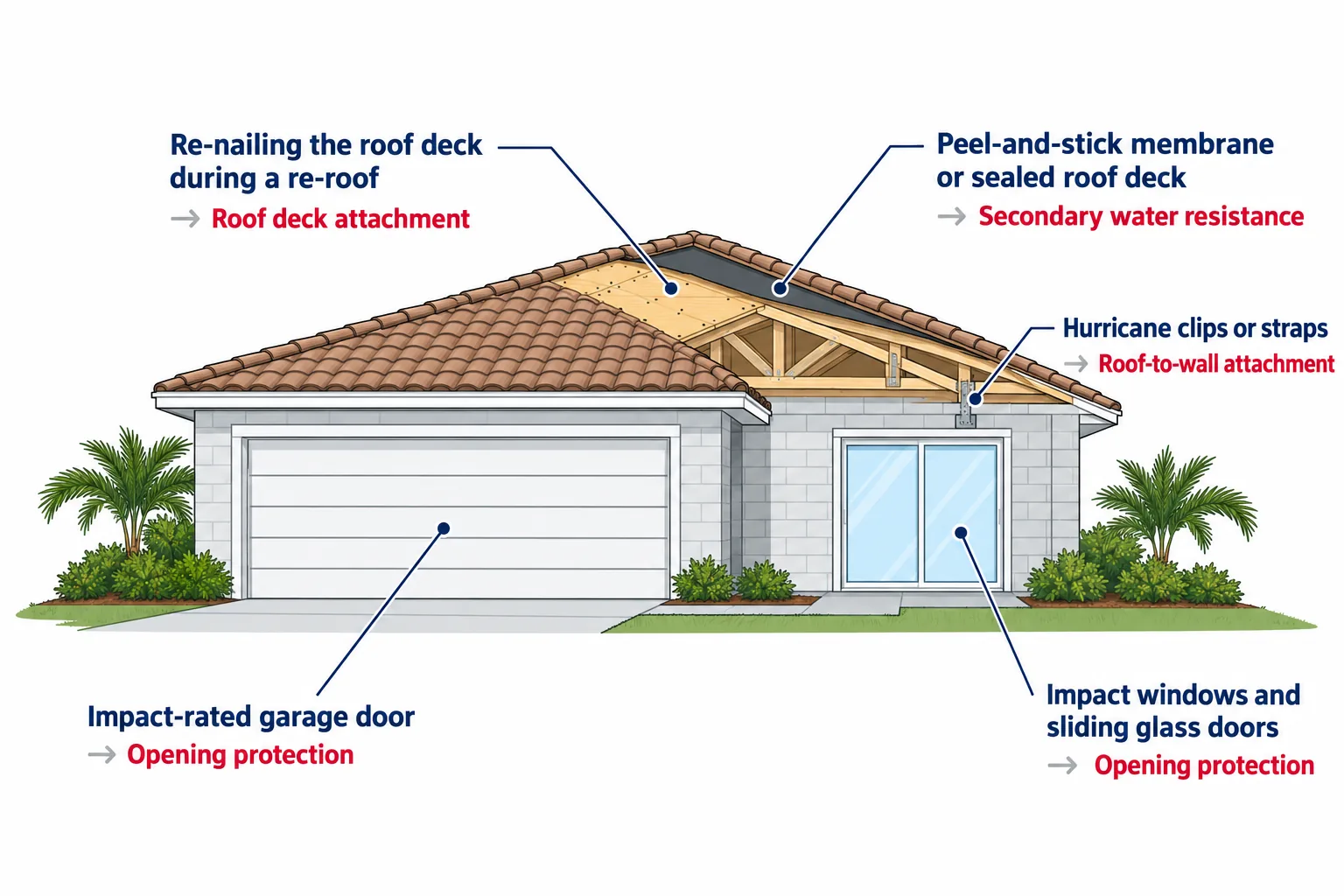
| Upgrade | What it changes on the inspection form | Who usually does the work |
|---|---|---|
| Impact windows and sliding glass doors | Opening protection | Window and door contractor |
| Impact entry and French doors | Opening protection | Door contractor |
| Impact-rated garage door | Opening protection | Garage door or impact door contractor |
| Approved hurricane shutters | Opening protection | Shutter contractor |
| New roof covering to current code | Roof covering | Roofer |
| Re-nailing the roof deck during a re-roof | Roof deck attachment | Roofer |
| Hurricane clips or straps | Roof-to-wall attachment | Roofer or framing contractor |
| Peel-and-stick membrane or sealed roof deck | Secondary water resistance | Roofer |
Roof shape also counts, but it is a feature of the house, not something most owners change. Other upgrades such as alarms or leak sensors can help with some insurers, and they are covered further down.
How Wind Mitigation Credits Work Under Florida Law
Florida law requires insurers to offer discounts, credits or other rate differentials for building features that reduce windstorm loss. The rule is in Section 627.0629, Florida Statutes.
Insurers verify those features with the Uniform Mitigation Verification Inspection Form, form OIR-B1-1802, published by the Florida Office of Insurance Regulation (OIR). A qualified inspector fills it out with photos, and you send it to your insurer or agent.
The credit applies to the wind part of your premium, not to the whole bill. Each insurer sets its own amounts, so the same roof or window upgrade can be worth more with one company than another.
What the 2026 Wind Mitigation Inspection Form Checks, Item by Item
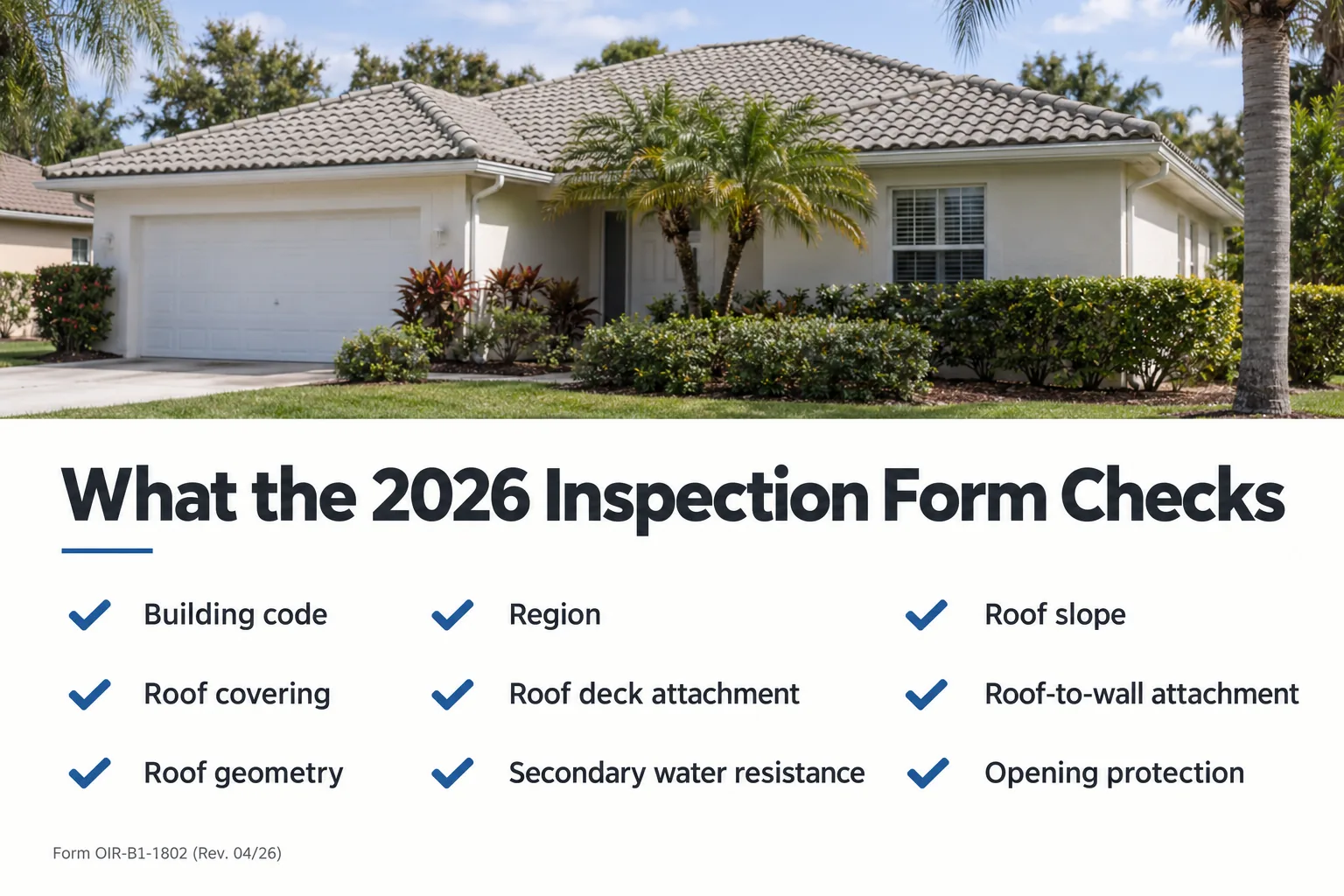
Since April 1, 2026, inspections must use the revised form, OIR-B1-1802 (Rev. 04/26), according to a Citizens Property Insurance bulletin on the form change. The revised form records these features:
- Building code: which edition of the code the home was permitted under.
- Region: where the home sits, based on design wind speed.
- Roof slope: the slope of the main roof area.
- Roof covering: the type of roofing and the paperwork that shows it meets code.
- Roof deck attachment: how the roof sheathing is fastened, rated by the weakest form present.
- Roof-to-wall attachment: how the roof framing is tied to the walls, rated by the weakest connection present.
- Roof geometry: the shape of the roof, such as hip or gable.
- Secondary water resistance: a sealed roof deck or membrane that keeps out water if shingles or tiles blow off.
- Opening protection: protection against wind-borne debris for the windows, doors and other openings.
The revised form also lets a FORTIFIED Home Roof, Silver or Gold certificate support specific features. Citizens says these changes do not alter the credits it applies at this time.
Opening Protection: Impact Windows, Doors and Garage Doors
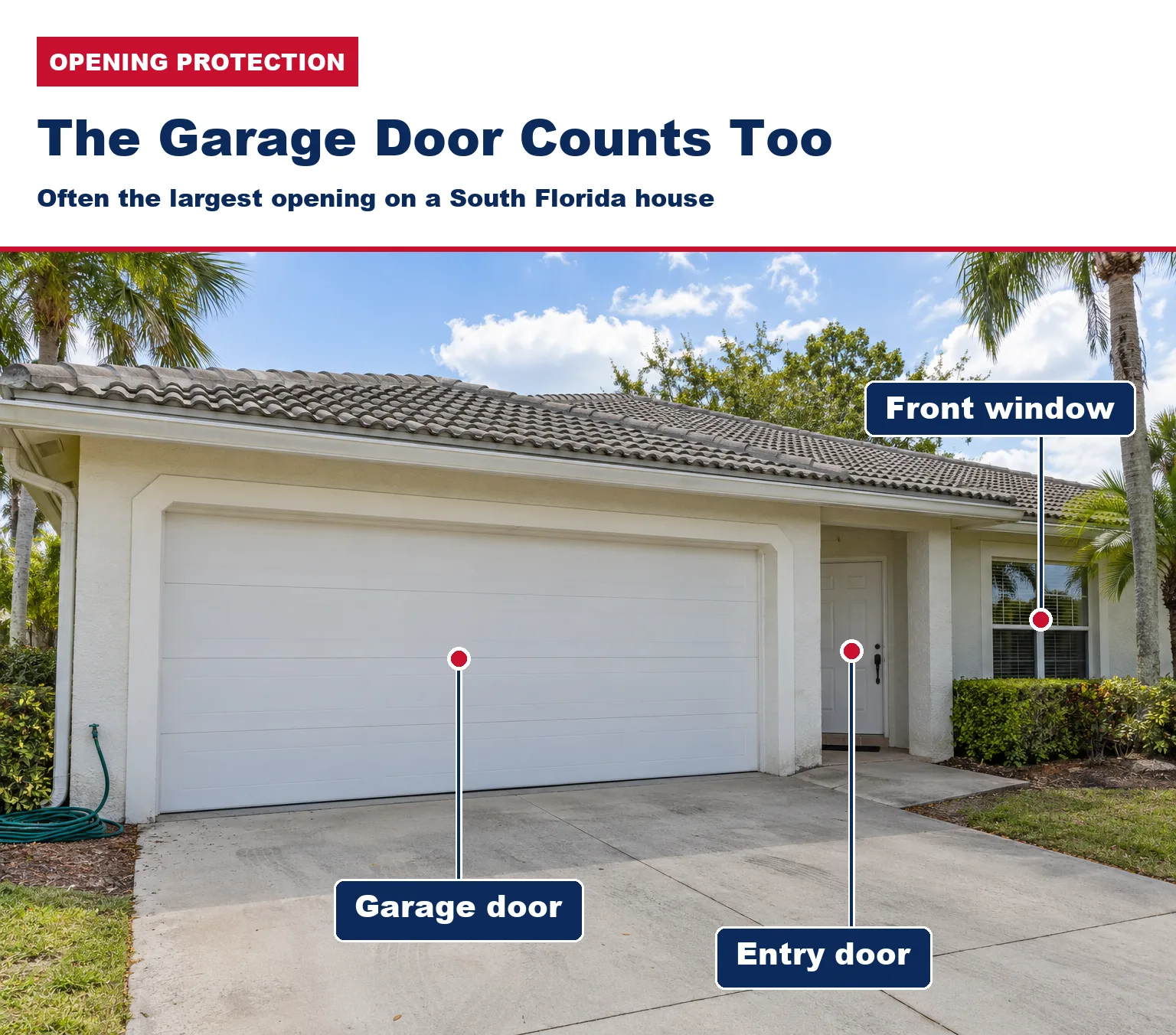
Opening protection is the item most homeowners can improve, and it is where impact windows for South Florida homes earn their insurance value. The inspector looks at every window, glass door, skylight, entry door and garage door, and the weakest opening can set the rating for the whole house.
That is why partial projects disappoint. Replacing the front windows but leaving an old bathroom window or a standard garage door can mean little or no change on the form.
The inspector needs proof that each product is rated, such as a Florida Product Approval or Miami-Dade Notice of Acceptance (NOA) number and the permanent label on the glass. If you are not sure what you already have, our guide on how to tell if your windows and doors are hurricane rated walks through the labels and paperwork.
In Miami-Dade and Broward, the High-Velocity Hurricane Zone has the strictest product rules, so the approval on file matters for both the permit and the credit.
Impact Windows vs Hurricane Shutters for the Insurance Credit
Both impact windows and approved shutters can count as opening protection on the form. The difference is in daily life and in how easy the paperwork is.
| Question | Impact windows and doors | Approved hurricane shutters |
|---|---|---|
| Can it count for the credit? | Yes, with a rated product and proof | Yes, with a rated product and proof |
| Protection when you are away | Always in place | Only if someone closes or installs them |
| Storm prep work | None for the glass | Panels, tracks or motors before each storm |
| Other benefits | Noise, security, energy, view | Usually lower upfront cost |
| Common gap on the form | One opening left unprotected | Missing panels, labels or approvals |
If you split time between Florida and somewhere else, the “always in place” row usually decides it. For a deeper side-by-side, see our comparison of impact-resistant windows versus hurricane shutters.
Why the Garage Door and Entry Doors Can Decide Your Rating
The garage door is often the largest opening on a South Florida house, and it is easy to forget. A standard garage door can hold back the opening protection rating even when every window is impact glass.
Plan the doors with the windows. Impact entry, French and sliding doors and impact-rated garage doors close the gaps an inspector would otherwise note.
Roof Upgrades That Earn Credits: Shape, Deck, Straps and Water Barrier
A roof replacement is the best chance to improve several form items at once. Several of these items are hidden once the roof is finished.
- Roof covering: a new roof installed to current code, with the permit and product approval on file.
- Roof deck attachment: the nail type and spacing that hold the sheathing down. Re-nailing the deck is simplest while the old roof is off.
- Roof-to-wall attachment: clips, single wraps or double wraps that tie the roof framing to the walls. Stronger connections rank higher on the form.
- Secondary water resistance: a self-adhered membrane or sealed deck that limits water intrusion if the covering fails.
- Roof geometry: hip roofs, which slope down on all sides, are rated differently from gable roofs. This is usually fixed by the house design.
Ask your roofer to photograph the deck nailing, the membrane and any straps before the tiles or shingles go on. Those photos can be the difference between a credit and an “unable to verify” on the form. If you are weighing timing, these signs that you need a new roof help, and our roof replacement service for hurricane-force winds covers the work itself.
Cost vs Savings: How to Decide Which Upgrade Pays Off
There is no single payback number for a wind mitigation upgrade, because credits vary by insurer, home and coverage. The useful question is what your own insurer would charge with and without the feature.
- Get your current wind mitigation report, or a new one, so you know which items are already credited.
- Ask your agent to quote the premium with the next item upgraded, such as full opening protection or a new roof with a sealed deck.
- Compare that yearly difference with the project price, then add the benefits that are not on the policy: storm protection, noise, energy and resale.
Many South Florida owners do one project per season, often the roof first if it is near the end of its life, then the openings. Our client savings calculator for financing, energy and insurance helps frame the numbers, and home improvement financing options or how PACE financing works in Florida can spread the cost.
My Safe Florida Home: Free Inspection and Matching Grants
My Safe Florida Home is the state program that offers free wind mitigation inspections and grants for hardening upgrades. According to the My Safe Florida Home FAQ, the basic requirements are:
- A homestead exemption granted on the home.
- A home built before January 1, 2008, as shown on the county property appraiser’s website.
- An insured value of $700,000 or less.
The program pays $2 for every $1 the homeowner contributes, up to a state contribution of $10,000, on a reimbursement basis. Eligible low-income homeowners can receive grants of up to $10,000 with no match.
Eligible work includes roof improvements, secondary water barriers, impact windows and doors, and garage door upgrades. Do not start construction before you receive your official grant approval, and check the My Safe Florida Home website for current openings, because the program opens in phases and funding has filled quickly in past cycles.
Citizens Policyholders: What the 2026 Form Change Means
Citizens Property Insurance accepts the revised OIR-B1-1802 (Rev. 04/26) for inspections done on or after April 1, 2026. Citizens will still accept the older Rev. 01/12 form if it was completed within five years before April 1, 2026 and the structure has not changed.
If you replace the roof, windows or doors, the structure has changed. Order a new inspection after the work so the credit reflects the upgrade.
Citizens also expects every field to be completed by the inspector and the required photos to be attached. Incomplete forms are a common reason a credit is delayed.
How to Get a Wind Mitigation Inspection, Step by Step
- Check whether you already have a report. Your agent, the seller’s documents or a past My Safe Florida Home inspection may have one.
- Book a qualified inspector who completes the OIR-B1-1802. The form lists who can sign it, including licensed home inspectors, building code inspectors, engineers, architects and certain contractors.
- Gather your proof before the visit: permits, product approvals and invoices.
- Give the inspector access to the attic, garage and every opening.
- Review the finished form for blank fields and missing photos.
- Send it to your agent or insurer and ask when the credit will apply. Many changes show up at renewal.
What Proof to Keep After the Work Is Done
Keep a simple folder, paper or digital, for every hardening project. It saves time at the next inspection, at renewal and when you sell.
- Building permits and the final inspection sign-off
- Florida Product Approval or Miami-Dade NOA numbers for each window, door and garage door
- Invoices that list the products and openings covered
- Photos of glass labels, garage door labels and shutter labels
- Roofer photos of deck nailing, the water barrier and roof-to-wall straps
- Your latest wind mitigation inspection form
2026 Florida Rate Decreases: What They Mean for You
Florida’s homeowners insurance market is starting to ease. On September 22, 2026, the Florida Office of Insurance Regulation announced approved rate decreases affecting more than 62,000 policies.
| Insurer | Approved rate change | Policies affected |
|---|---|---|
| One Alliance North America | -10.4% | 17,148 |
| Vyrd | -10.4% | 26,751 |
| Safe Harbor | -4.1% | 10,501 |
| Unique | -3.2% | 8,266 |
The same OIR release mentioned Kin Insurance, which announced average decreases of more than 20% in Broward, Miami-Dade and Palm Beach counties.
A rate decrease applies to one insurer’s base rates, so it changes nothing if your company is not on the list. A mitigation credit is different: you earn it for verified features on your own home, with any insurer.
Other Upgrades Insurers May Credit
Wind features carry the most weight in Florida, but some insurers also credit upgrades that lower theft, fire and water risk. Ask your insurer which of these it recognizes before you buy.
Home Security and Fire Protection
Deadbolts and a monitored security system with cameras and door and window alarms can qualify with some insurers. Upgraded smoke and carbon monoxide detectors, and especially a home fire sprinkler system, may also earn discounts.
New HVAC
Newer HVAC systems are more efficient and less likely to leak or cause electrical damage. A new system can lower energy bills, and some insurers view it as lower risk.
Upgraded Plumbing, Electric and Leak Shutoff
Old pipes are more prone to leaks, and old wiring is a fire hazard. Updating them, or adding a leak detection system that shuts off the water automatically, can make you a candidate for a discount.
Ask Your Insurance Company Before You Begin Renovations
Some renovations raise your rates, because a more valuable home costs more to rebuild. Before any project, ask your insurer how it may affect your premium.
Shopping for a new policy in 2026? Ask whether the insurer recently filed a rate change with the Florida Office of Insurance Regulation, and when that rate would apply to your renewal.
Frequently Asked Questions
Do impact windows lower homeowners insurance in Florida?
Impact windows can lower your premium when they complete the opening protection item on a wind mitigation inspection. The credit depends on your insurer and on whether every opening, including doors and the garage door, is protected. Ask your agent to quote the premium with full opening protection before you buy.
How long is a wind mitigation inspection good for?
A wind mitigation form is generally accepted for five years if the home has not changed. Citizens still accepts the older Rev. 01/12 form completed within five years before April 1, 2026. After a new roof, windows or doors, get a new inspection so the upgrade is credited.
Can I get a discount for upgrades the previous owner made?
Yes, if the features can be verified. The inspector rates what is on the house today, so permits, product approvals and labels left by the previous owner help. Ask the seller for any past wind mitigation report and project paperwork at closing.
Is a hip roof enough to get a big discount?
A hip roof is one item on the form, rated alongside the roof covering, deck attachment, roof-to-wall connections, water barrier and openings. It can help, but the largest overall change usually comes from improving several items, especially opening protection.
Do I need impact windows by law?
The Florida Building Code requires protected openings in wind-borne debris regions, which includes all of Miami-Dade and Broward. Protection can be impact-rated windows and doors or approved shutters. Your contractor or local permit office can confirm what your project needs.
Your Next Step Toward a Lower Premium
Start with your current wind mitigation report and find the weakest item. For most South Florida homes, that is either an unprotected opening or an older roof.
USA Home Improvement handles permits, coordinates HOA approval where there is an HOA, and prepares the product paperwork your inspector needs for impact windows, impact doors, garage doors and roofing. Book a free consultation and we will tell you which upgrade addresses your report first.
USA Home Improvement is licensed (CGC1526707) and insured and has served Florida homeowners for more than 15 years.