 Skip to content

The best impact window brand for your home is the one whose exact product is approved for your county, rated for the wind pressure at each opening, and installed by a licensed contractor who stands behind the work. Brand names come after those checks.
This guide shows you what to check, in what order, so you can compare quotes from different brands fairly and ask the right questions before you sign.
Does the Impact Window Brand Matter?
The impact window brand matters less than most homeowners expect. Several Florida manufacturers, including PGT, CGI and ES Windows, make impact windows that are tested and approved for South Florida, and each brand sells several product lines that perform differently.
So the real question is whether the specific product on your quote passes the checks below. Two windows from the same brand can have very different ratings, and two different brands can be close to equal.
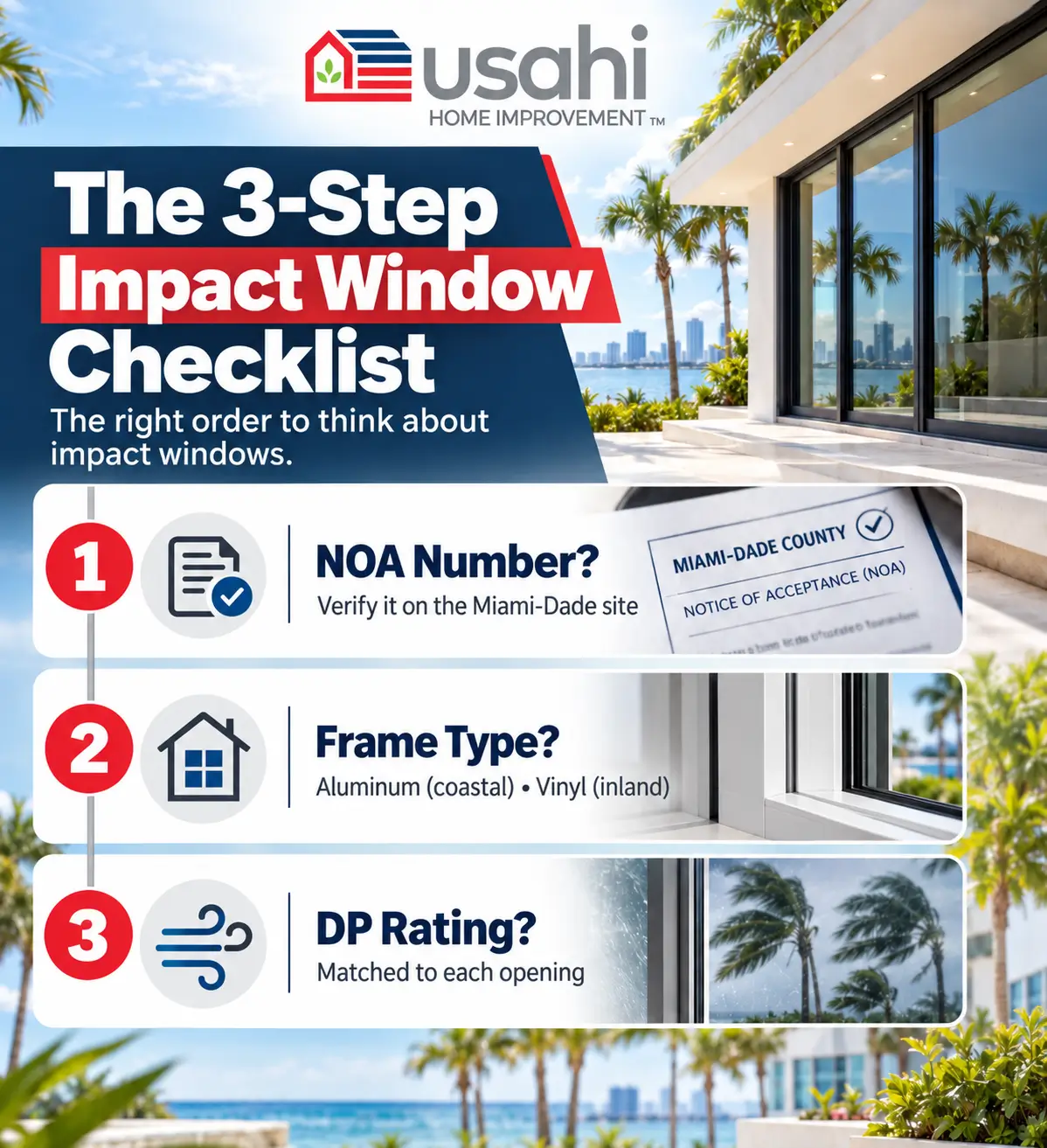
Here is the right order to think about it:
First: Does It Have an NOA Number?
NOA stands for Notice of Acceptance. It is issued by Miami-Dade County and means the window has been physically tested to the hurricane standards used in the High Velocity Hurricane Zone, the toughest in Florida.
In Miami-Dade and Broward, the window must be approved for High Velocity Hurricane Zone (HVHZ) use. A Miami-Dade NOA is the most common way to show that. In Palm Beach County, a Florida Product Approval is also accepted.
The Florida Product Approval is the statewide version, listed with an FL number. One important difference:
- A Miami-Dade NOA works anywhere in Florida
- A Florida Product Approval does not automatically work in Miami-Dade
You can verify an NOA yourself on the Miami-Dade product approval page. For an FL number, use the Florida Building Commission product approval search.
Not sure how to read the label on a window you already own? See our step-by-step guide on how to tell if your windows and doors are hurricane rated.
Second: Aluminum or Vinyl Frame?
The frame decides how your windows look and hold up for years, and both aluminum and vinyl impact windows can carry an NOA. Here is the short version for South Florida:
| Aluminum | Vinyl | |
|---|---|---|
| Salt air | Needs a good finish and coastal hardware | Does not corrode; check the hardware |
| Heat | Conducts heat (look for thermally broken) | Insulates well |
| Big openings | Suits wide and tall openings | Check the DP rating closely |
| Looks | Slimmer frames, more glass | Thicker frames |
| Cost | Usually higher upfront | Usually lower upfront |
Aluminum is the common choice in Miami-Dade, Broward and coastal Palm Beach, especially for large openings. Vinyl with a current approval is a legitimate option on a tighter budget, as long as it meets the DP your openings need.
For the full side-by-side, read our guide to vinyl vs aluminum windows for Florida homes.
Third: What Is a DP Rating and What Do You Need?
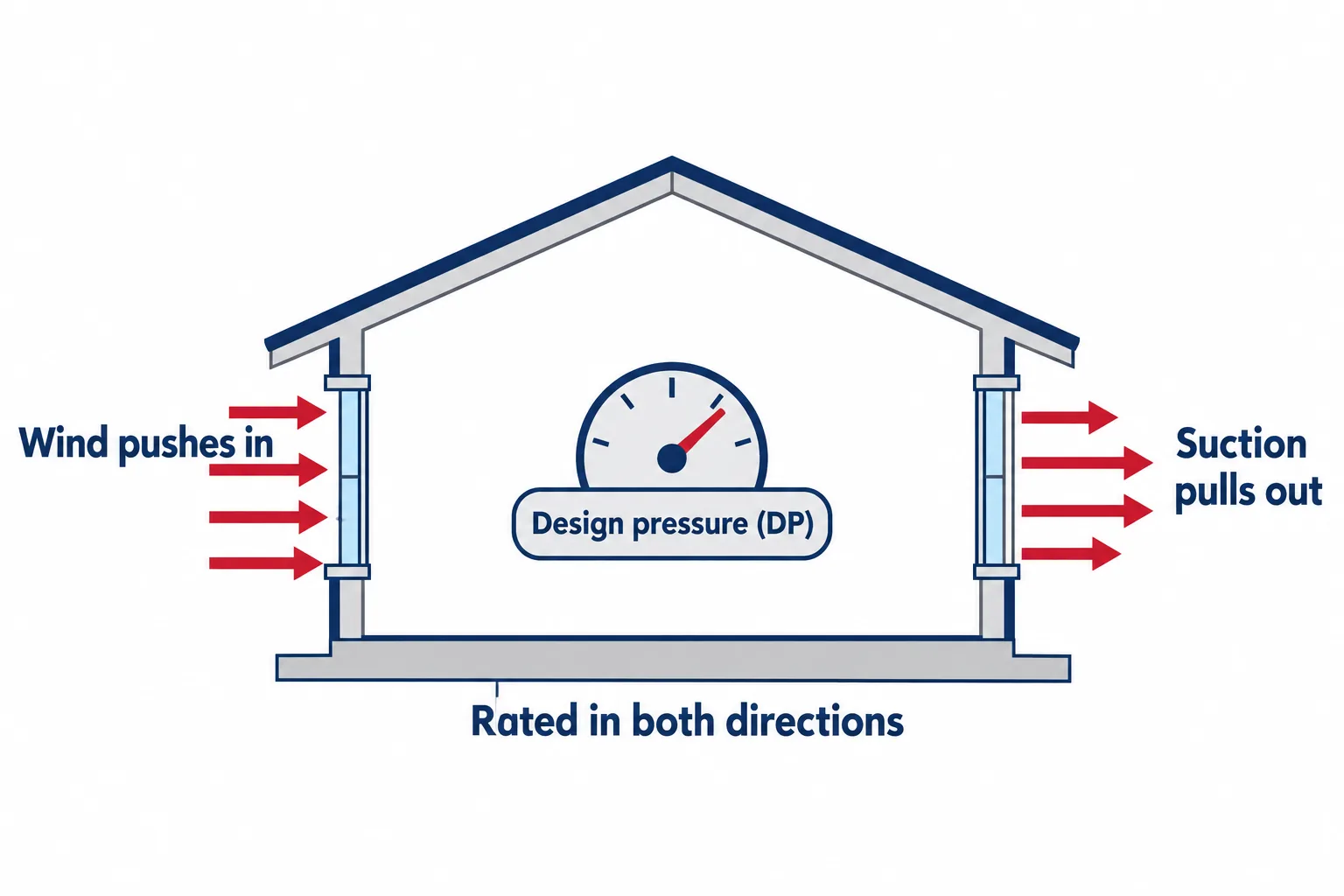
You will see “DP 40” or “DP 50” on your quote. DP means design pressure: the wind load, in pounds per square foot (psf), that the window is rated to handle.
A DP 50 window is rated for 50 psf of wind pressure. To earn that rating, it is tested at a higher load, at least 1.5 times the design pressure under Florida’s TAS 202 and the ASTM E330 structural test, so the rating already includes a safety margin.
The rating covers both directions: wind pushes in on the side facing the storm, and suction pulls out on other sides. Both happen during a hurricane, and an approval can list a different number for each direction.
What number do you need?
- Single-story homes in Miami-Dade, Broward and Palm Beach often fall around DP 40 to 50
- Upper floor windows: need higher than ground floor
- Corner windows or windows facing water: need higher
- Larger openings: need higher than smaller ones
Important: a high DP rating does not mean the window is impact rated. You need both. The NOA or Florida approval confirms this when it lists a large missile or small missile impact rating.
Your contractor calculates the required DP per opening when they do the quote. You do not need to figure this out yourself, but you should ask them to show it for each window.
Large Missile or Small Missile: Which Impact Rating Your Windows Need
Most South Florida homes need large missile impact windows. Under the Florida Building Code (Section 1609.1.2), glass within 30 feet of the ground must pass the large missile test, and glass more than 30 feet up must pass at least the small missile test.
- Large missile: the test fires a piece of 2×4 lumber at the glass, then runs the window through repeated wind pressure cycles
- Small missile: the test fires small steel balls, which stand in for roof gravel and smaller debris
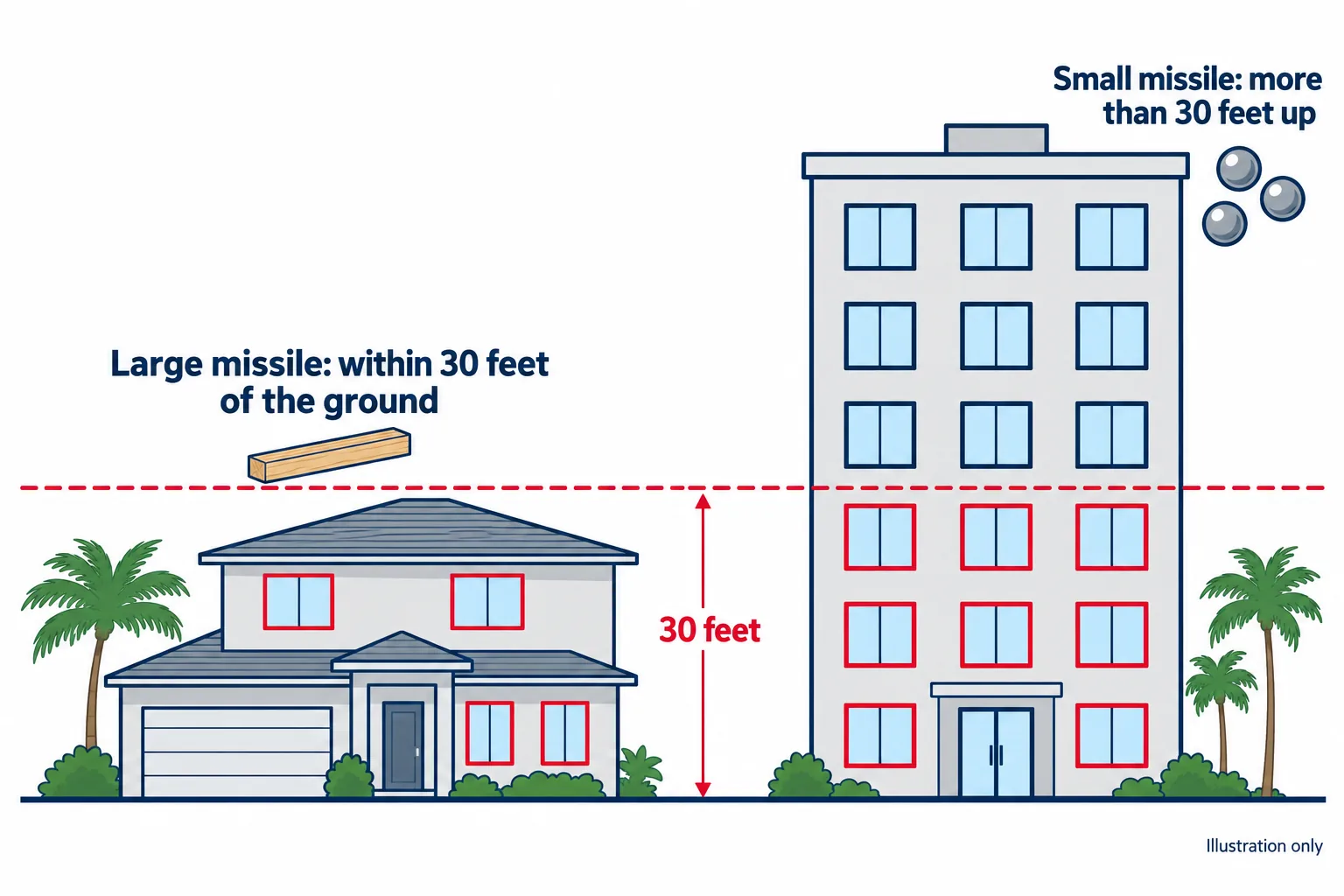
For a one- or two-story house, every window is usually within 30 feet of the ground, so large missile is the rating to look for. In Miami-Dade and Broward, impact products are tested to Florida’s TAS 201, 202 and 203 protocols, and the NOA states which missile level the product passed.
Impact Glass Options to Compare Between Brands
Every impact window uses laminated glass: two layers of glass bonded to a tough plastic interlayer. If the glass cracks, the interlayer holds the pieces in the frame and keeps the opening closed.
Beyond that, brands and product lines differ in the glass package they offer. Compare these on each quote:
- Interlayer type: ask which interlayer the product was approved with, since some large openings need a stiffer one
- Low-E coating: cuts heat from the sun without darkening the room much, which matters for Florida energy code limits
- Insulated laminated glass: a sealed air space plus the laminated layer, for better heat and noise control
- Tint and clarity: gray, bronze or clear; ask for a sample before you choose
Make sure the glass on your quote is the same glass listed on the product’s approval. A window approved with one glass build is not automatically approved with another.
Warranty and Installer: Why They Matter as Much as the Brand
A well-made window installed badly can leak, stick or fail inspection. That is why the warranty and the installer deserve as much attention as the brand name on the frame.
A good warranty answers these points in writing:
- How long the frame, the glass seal, the hardware and the paint finish are each covered
- Whether labor is covered, or only replacement parts
- Who you call: the manufacturer or the installer
- Whether the warranty transfers if you sell the house
The manufacturer’s warranty usually covers the product. The installer’s workmanship warranty covers how the window was set, anchored and sealed, so ask for both.
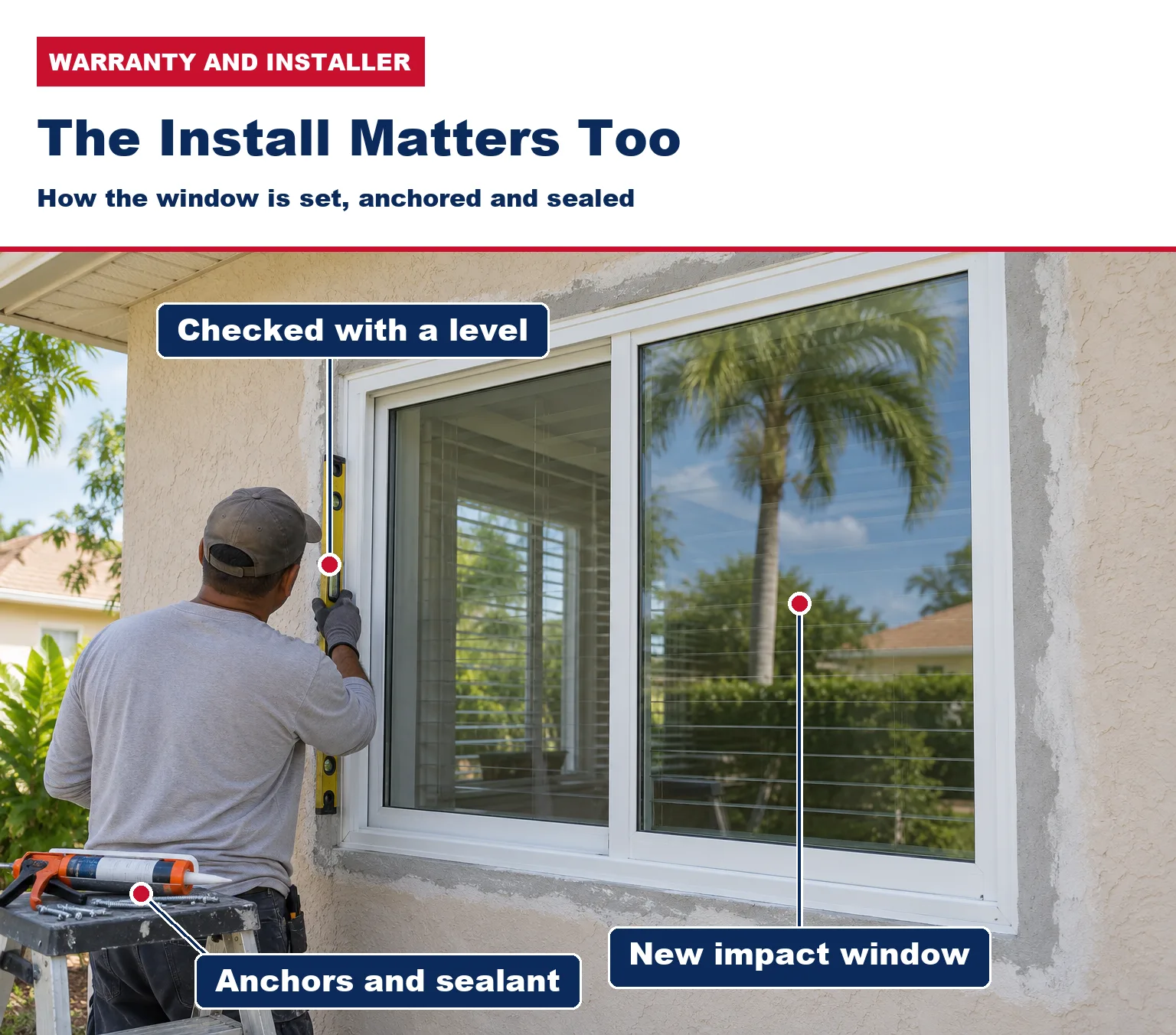
The installer also pulls the permit, installs to the approval’s anchoring details and passes inspection. That paperwork is what an insurer’s wind mitigation inspector looks for, and it can help with home upgrades that can lower your insurance rates.
For more on vetting the company itself, see how to find the best impact window company in South Florida.
How to Compare Impact Window Quotes Side by Side
Put your quotes next to each other and check the same items on each one. If a quote does not show an item, ask for it in writing before you compare prices.
| What to check | Where to find it | Red flag |
|---|---|---|
| Approval | NOA or FL number for each product | “Hurricane rated” with no number |
| DP rating | Listed per opening | One DP for the whole house |
| Missile rating | On the NOA or approval | Not stated |
| Glass | Glass build, Low-E, tint | Glass not on the approval |
| Frame | Aluminum or vinyl, finish, color | Line or series not named |
| Warranty | Product and labor terms | Verbal promises only |
| Install | Permit, removal, stucco, cleanup | Permit left to you |
Price only makes sense after these rows match. Brand is one factor in cost; the number and size of openings, the window types, the DP needed and the glass package usually move the total more.
If the total is the hurdle, look at our financing options for impact windows before you scale the project down.
Questions to Ask Before You Sign
These questions get you the facts a brochure leaves out. A good contractor answers them without hesitation.
- What is the NOA or FL number for each window on this quote?
- What DP does each opening need, and what DP is each window rated for?
- Is every window large missile rated?
- Which glass build is quoted, and is it the one on the approval?
- What does the warranty cover, for how long, and who handles claims?
- Who pulls the permit, and who is my contact during the job?
- Is your contractor license active, and can I see it?
You can check any Florida contractor license on the Florida DBPR license search.
So Which Brand Passes All of This?
Several brands can pass every check above. At USA Home Improvement, we exclusively sell ES Windows, and we want to be clear that this is our choice, so you can weigh it fairly.
ES Windows was founded in 1983 and has made aluminum and glass windows since 1988. It introduced hurricane-resistant windows and doors designed for Miami-Dade County requirements in 2002, and it is part of Tecnoglass Inc., which also makes its own glass and aluminum profiles, according to the ES Windows company history.
ES impact windows and doors go through lab testing to meet Florida’s statewide hurricane protocols. A few things about how the glass and frames are built:
- Impact products use laminated glass, which also helps reduce outside noise and UV
- Heat-strengthened glass is offered where extra strength against wind pressure is needed
- Low-E glass options are available to cut heat from the sun
- Most residential lines use aluminum frames, and ES also makes an Elite uPVC (vinyl) line with large missile impact ratings
You can browse the impact windows and doors we offer, or see styles such as single hung impact windows and casement impact windows. Each is available through USA Home Improvement for homes in Miami-Dade, Broward, Palm Beach and Southwest Florida.
Whatever brand you choose, ask to see the approval for the exact product on your quote. We show it for every ES window we quote, and you can get the Florida Product Approval number for each window on request.
Quick Answers
Is aluminum always better than vinyl in Florida?
No. Aluminum with a coastal finish is the common choice near salt water and for large openings. Vinyl does not corrode and costs less, so with a current approval and the right DP rating it is a legitimate option, especially inland.
What DP rating does my home need?
It depends on floor level, opening size, and exact location. Your contractor calculates it per opening.
Ground-floor windows on single-story South Florida homes often fall around DP 40 to 50. Upper floors, corners and larger openings go higher.
Can I verify an NOA number myself?
Yes. Go to the Miami-Dade product control search page, enter the NOA number, and confirm it is current and covers the specific product being installed. For an FL number, use the Florida Building Commission’s product approval search.
Is a more expensive brand always better?
No. A higher price can reflect larger glass, a higher DP, special finishes or a premium line.
Compare the approval, DP, missile rating, glass and warranty first. If those match, the difference is mostly looks, features and installer service.
Not Sure Where to Start?
USA Home Improvement installs ES Windows across Miami-Dade, Broward, Palm Beach and Southwest Florida. Every job is permitted, inspected, and managed by a dedicated project manager, and most jobs carry a 15-year warranty and a 1-year labor warranty, plus a transferable warranty.
Start by looking at the impact windows we install across South Florida, then ask us for a quote that lists the approval, DP and warranty for every opening.
USA Home Improvement is licensed (CGC1526707) and insured and has served Florida homeowners for more than 15 years.