 Skip to content

Your windows and doors are hurricane rated if they carry a Miami-Dade NOA or Florida Product Approval number you can look up, and that approval shows they passed impact testing. The proof is in three places: the label on the frame, the etching on the glass and the permit record for your address.
This guide shows where to look on windows, entry doors, sliding glass doors and garage doors. It also explains what each code means, how to confirm a number online and what a wind mitigation inspector needs to see in Miami-Dade, Broward, Palm Beach and Southwest Florida.
Why Miami-Dade and Broward Have a Higher Bar Than the Rest of Florida
Not all Florida counties are equal when it comes to window requirements.
Miami-Dade and Broward are the only two counties the Florida Building Code designates as a High Velocity Hurricane Zone, or HVHZ. Products used there are approved through Miami-Dade Product Control or a state listing approved for HVHZ use.
That means windows installed here must pass stricter tests than anywhere else in Florida. A product must be approved specifically for HVHZ use. A standard statewide approval without HVHZ approval is not enough for these two counties.
Palm Beach is not HVHZ but still requires Florida Product Approval. Palm Beach County permit offices commonly accept either a Florida Product Approval or a Miami-Dade NOA.
Southwest Florida, including Naples, Fort Myers and Cape Coral, follows the same statewide rules as Palm Beach. Most of the region sits in the wind-borne debris region, where glass openings must be impact rated or covered by approved shutters. Your building department can confirm your zone.
Anywhere in Florida, windows without impact testing, and without approved shutters, do not earn the opening protection credit on a wind mitigation form. In Miami-Dade and Broward, they also fall short of the HVHZ product rules.
How to Check Your Windows Right Now
Walk to any window in your home and check for these 4 things. Then repeat it on every window, because many homes had windows replaced in stages.
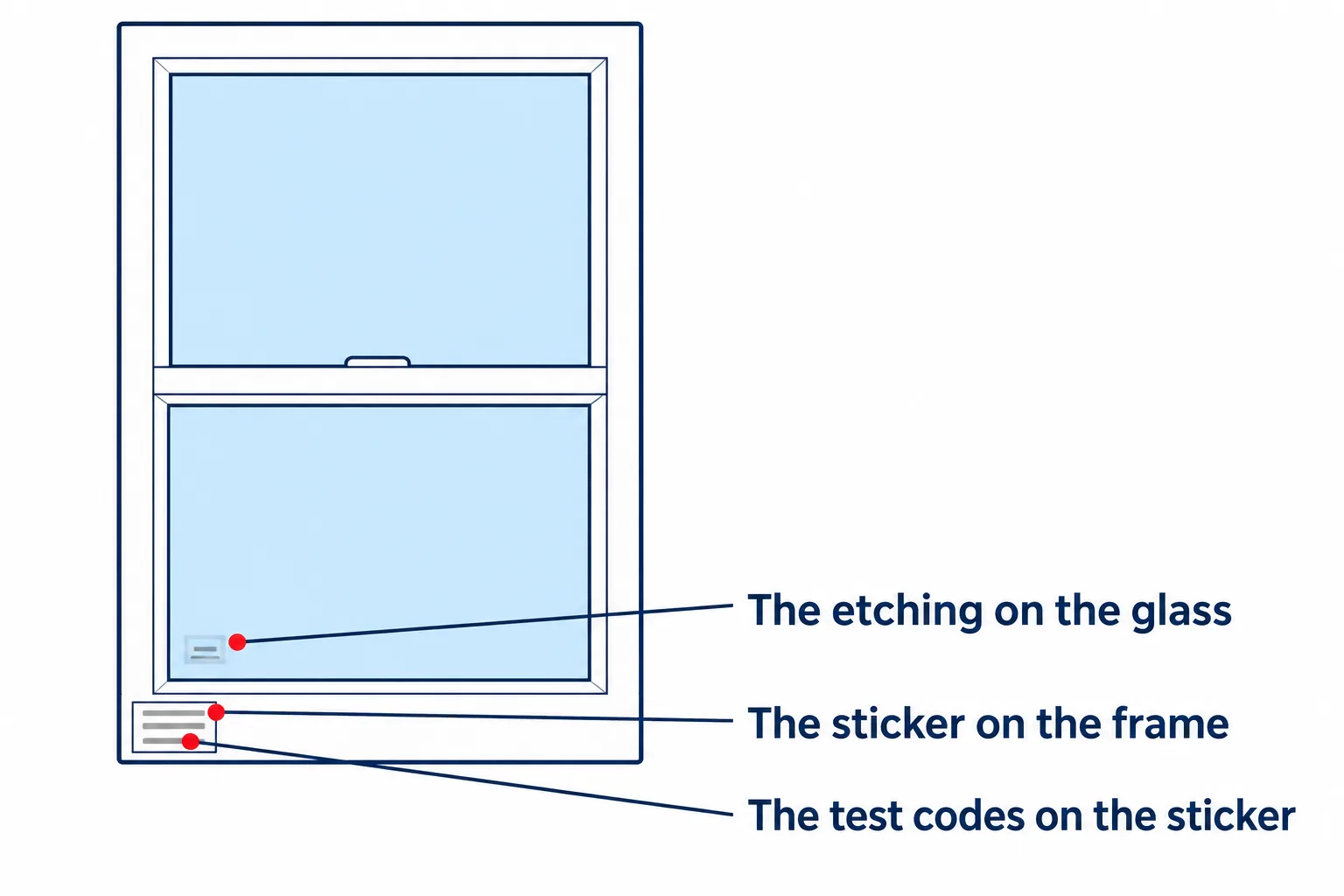
1. The sticker on the frame
Look at the inside of the window frame, usually in a corner, on the sill or along a side track. It should show either a Miami-Dade NOA number or a Florida Product Approval (FL#) number, along with the manufacturer and series.
Miami-Dade approved windows also carry a permanent label with the manufacturer’s name and the words “Miami-Dade County Product Control Approved”, as their NOA documents require.
If you see neither, the window is not verified as hurricane rated. Temporary stickers are often peeled off after the final inspection, so check the glass and the permit record before you decide.
2. The etching on the glass
Impact-rated glass usually has a small permanent etching in one corner, often called the glass bug. It is small but visible when you look closely, and it names the glass maker and often the laminated glass type.
Read the etching instead of just spotting it. Tempered safety glass is etched too, often with ANSI Z97.1 or CPSC 16 CFR 1201, and those are safety glazing marks, not hurricane impact ratings.
No etching means the glass itself is not confirmed impact rated.
3. The test codes on the sticker
Look for TAS 201, TAS 202, and TAS 203 all three together on the sticker or in the product approval.
That combination means the window was tested for impact, pressure, and pressure cycling. It is fully impact rated.
Outside the HVHZ you may see ASTM E1886 and ASTM E1996 instead. Those are the impact test standards used statewide, and the Florida wind mitigation form accepts them too.
If you only see PA-202 or TAS 202 alone, the window was pressure tested only. It is not impact rated. In Miami-Dade and Broward, this means it still needs shutters to be code compliant.
4. A permit on record
Windows installed after 2002 with a pulled permit and a passed inspection are likely to be code compliant. The first statewide Florida Building Code took effect on March 1, 2002.
You can check permit history for your address through Miami-Dade’s online permit search, the Broward County building code office or Palm Beach County Building Division. If you live inside city limits, your city’s building department usually holds the record instead.
Clues that help but do not prove a rating
- A visible interlayer: a thin plastic layer at the edge of laminated glass.
- The reflection test: several close reflections of a pen tip suggest layers, but double-pane glass shows more than one too.
- A tap test: laminated glass sounds duller. Tap lightly, never hit it.
None of these replaces an approval number, an etching you can read or a permit.
What NOA, Florida Product Approval and TAS Mean on a Window Label
An NOA is Miami-Dade County’s approval for one specific product, a Florida Product Approval is the state’s approval, and TAS and ASTM numbers are the tests that product passed.
| Label term | What it means | Where it matters |
|---|---|---|
| NOA (Notice of Acceptance) | Miami-Dade Product Control’s approval for a specific product and series, with approved sizes, pressures and an expiration date | The standard approval in Miami-Dade and Broward; also accepted in many other counties |
| Florida Product Approval (FL#) | The Florida Building Commission’s statewide approval, shown as “FL” plus a number | All of Florida; in Miami-Dade and Broward only if approved for HVHZ use |
| TAS 201 | Missile impact test; the large missile is a 9-pound two-by-four fired at 50 feet per second | Required impact test in the HVHZ |
| TAS 202 | Static air pressure test that sets the design pressure | Pressure only; not an impact rating on its own |
| TAS 203 | Cyclic pressure test that pushes and pulls the unit thousands of times after impact | Required with TAS 201 for an impact rating in the HVHZ |
| ASTM E1886 and E1996 | National impact test method and impact specification | Accepted outside the HVHZ and on the wind mitigation form |
| DP rating (design pressure) | The wind pressure, in pounds per square foot, the unit is rated to hold | Every window; a DP number alone does not mean impact rated |
The missile figures come from the Florida Building Code’s HVHZ impact test, as summarised in Intertek’s TAS 201 test overview. Its TAS 203 test summary describes 4,500 cycles in each direction.
Where to Look Up an NOA or Florida Product Approval Number
Once you have the number from the sticker, you can confirm it online.
- Miami-Dade NOA: search the number in Miami-Dade County’s Product Approval Search. The NOA lists the product, its approved sizes and its expiration date.
- Florida Product Approval (FL#): search it on the Florida Building Commission’s product approval database. The listing shows whether the product is approved for HVHZ use.
When the listing opens, check these 6 points against the window in your wall:
- The product type and series match your window, for example single-hung, casement or horizontal roller.
- The approval lists impact resistance, not only air pressure.
- For Miami-Dade and Broward, the product is approved for HVHZ use.
- The approved sizes and design pressures cover your opening.
- The glass type in the approval matches the etching on your glass.
- The approval was valid when your permit was issued.
An approval number on the sticker only helps if the listing matches your window type and size. If you are choosing new windows, our guide on how to choose an impact window brand and frame covers the buying side.
How to Tell if Your Entry Doors, Sliding Doors and Garage Door Are Hurricane Rated
Doors follow the same rule as windows: a hurricane-rated door has an approval number you can look up, and any glass in it must be impact rated. New windows do not cover an old door.
Entry doors
Look for the label on the hinge edge or top edge of the door, or on the frame jamb. A solid door with no glass can qualify with a wind pressure rating such as ASTM E330 or PA/TAS 202, which the wind mitigation form lists for non-glazed doors.
A door with a glass insert or sidelites counts as a glazed opening and needs an impact rating.
Sliding glass doors
A sliding glass door is usually the largest glass opening in the house. Check the frame label and the etching on every panel, including the fixed one.
If your slider or entry door fails these checks, our impact doors for South Florida homes page shows the French, sliding and pivot styles that carry full approvals.
Garage doors
Look for a label on the inside of the garage door, usually on a panel edge or near the track. The wind mitigation form accepts ANSI/DASMA 115 for impact on garage doors, while ANSI/DASMA 108 shows wind pressure resistance only.
Older garage doors are a common weak spot. If yours has no label, see our impact garage door options.
“Wind Rated” vs “Impact Rated”: Not the Same Thing
This is a common confusion.
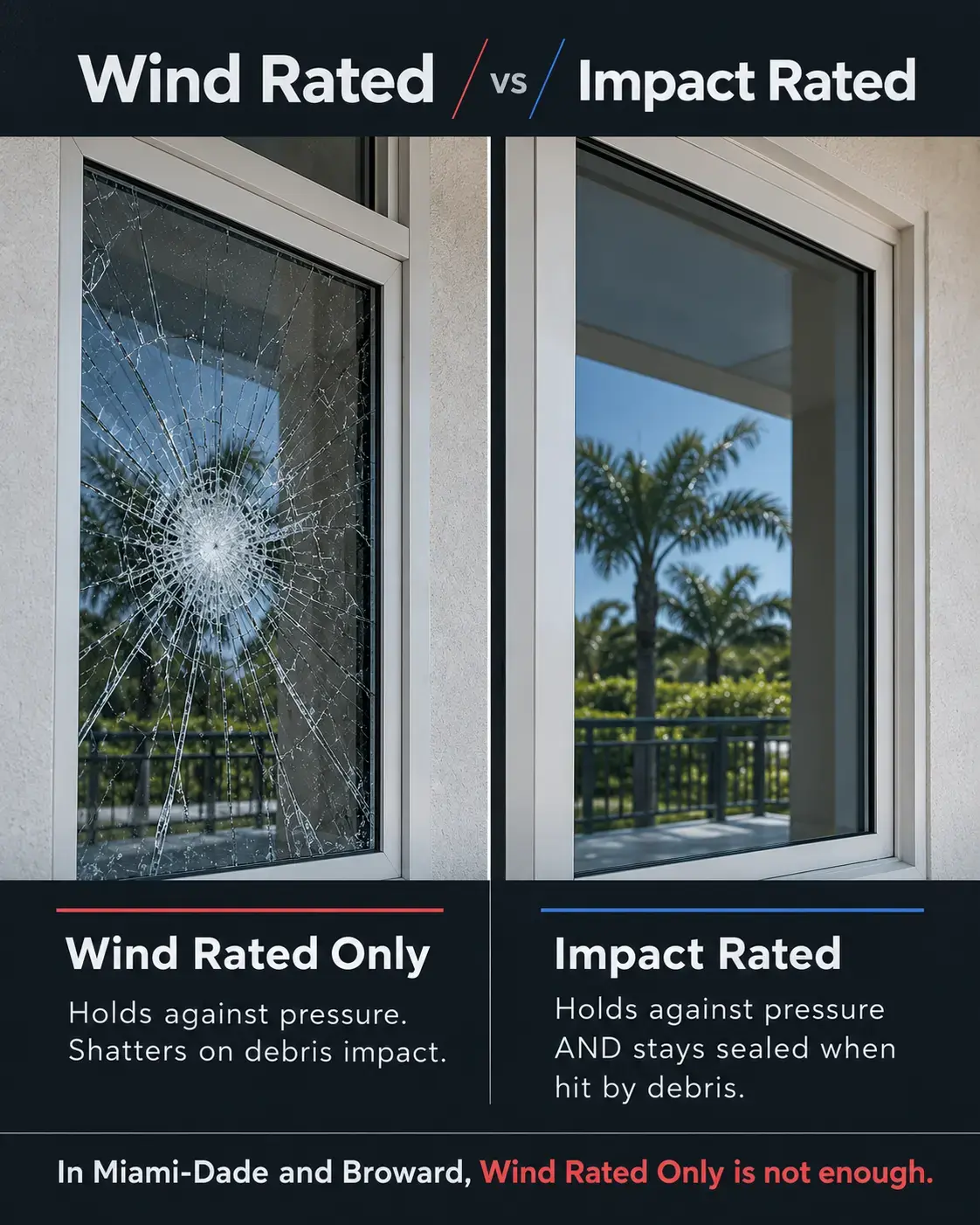
A window can be wind rated, meaning it holds up against air pressure, and still shatter completely when hit by a piece of debris.
In Miami-Dade and Broward, wind rated alone does not meet HVHZ requirements. It does not qualify for the opening protection credit on your wind mitigation form. And it was never tested against the 9-pound two-by-four that impact windows must stop.
Impact rating means the glass was physically struck during testing. It is laminated, so even when it cracks, the interlayer holds the pieces in place. The opening stays sealed.
Double-pane glass is not impact glass either. It helps with heat and noise, but it only counts as impact rated when the unit includes laminated glass and passed the impact tests.
Large missile or small missile?
Most homes need large missile ratings. The Florida Building Code requires large missile protection for glass openings within 30 feet of the ground, so a “small missile” product is for openings higher up, not your first or second floor.
Why One Unrated Window Fails the Whole Home
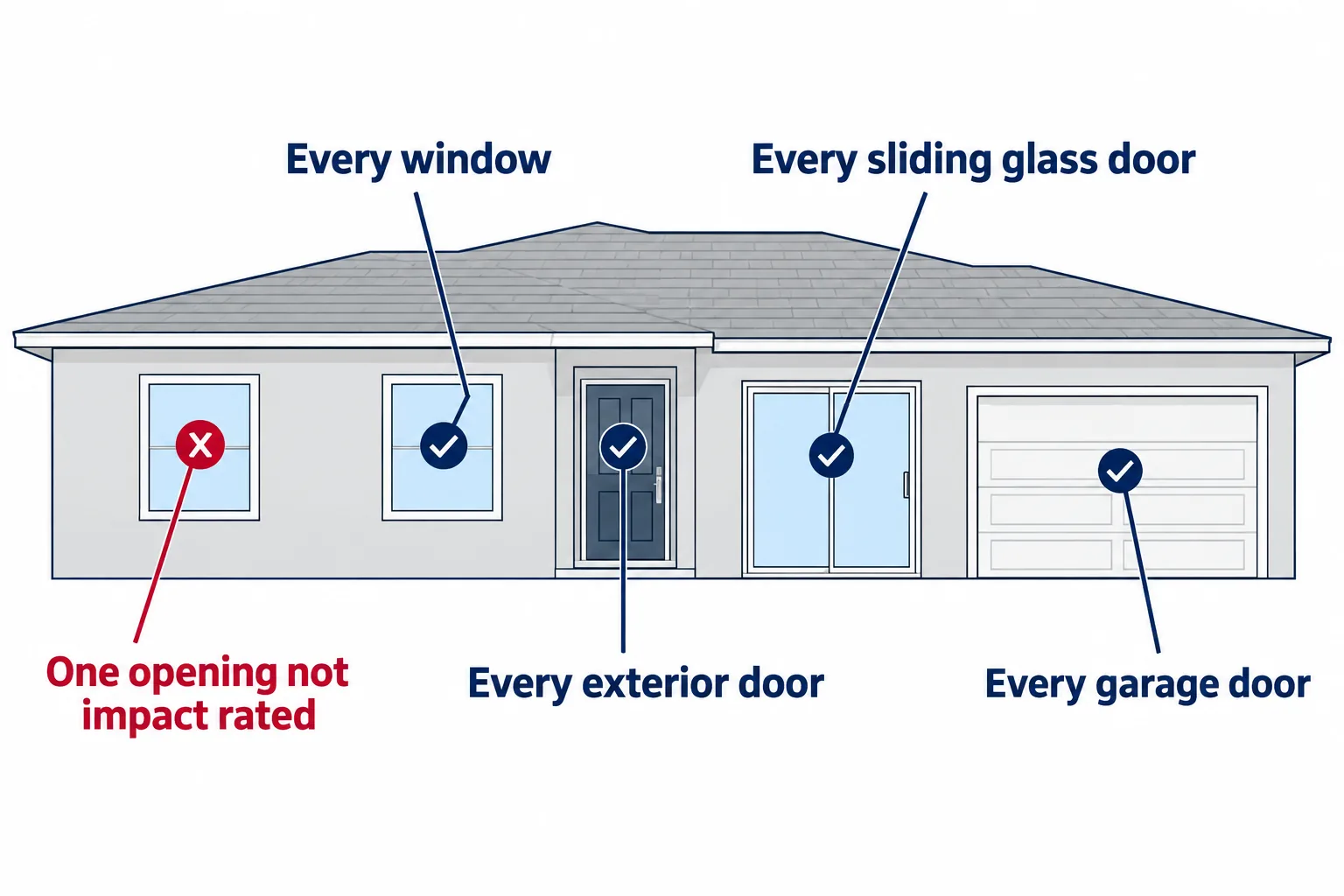
When a licensed inspector fills out your wind mitigation form, they check every single opening. Every window, every exterior door, every sliding glass door, every skylight, every garage door.
The current Uniform Mitigation Verification Inspection Form, OIR-B1-1802 (Rev. 04/26), asks for the weakest form of wind-borne debris protection on the house. Florida’s Office of Insurance Regulation made it the required form for inspections from April 1, 2026, as Citizens explains in its form update.
If even one opening is not impact rated or covered by a code-approved shutter, your home does not qualify for the opening protection discount on that inspection.
Two more details on the form catch homeowners out:
- No paperwork, no top rating: products that look impact rated but cannot be verified are marked “N”, unverified.
- Damaged openings: openings that need repair or replacement are marked “Z”, and the form says those homes do not qualify for wind mitigation rate differentials at all.
Opening protection is one of the main credits on a Florida wind mitigation form, and the amount depends on your insurer. Losing it to one old window or an unrated garage door is avoidable. Our guide to home upgrades that can lower your insurance rates covers the other credits.
This is also why replacing windows in phases can backfire. If you upgrade nine out of ten windows and leave one standard, the form still records the weakest opening, so the credit waits until the last one is done.
A completed form is valid for up to five years, as long as no material changes are made to the house.
What to Do If You Cannot Prove Your Windows and Doors Are Rated
If the labels are gone, start with paperwork before you assume the worst. Many rated windows only lack documents, and the form marks those as unverified.
- Pull the permit record for your address and look for the product approval number.
- Ask for the installer’s paperwork: the invoice, the NOA or FL# and the final inspection card.
- Book a wind mitigation inspection. The state’s My Safe Florida Home program offers free inspections, and grants for eligible homeowners when funding is available, so check its current status first.
- Buying a home? Ask for the seller’s wind mitigation report and window permits, and use these questions home buyers should ask during an inspection.
- Replace the openings that hold you back, so the whole house rates at the same level.
When replacement is the answer, impact windows with Miami-Dade and Florida approvals come with the paperwork an inspector needs. If cost is the obstacle, our home improvement financing options include $0 down and PACE financing for qualified homeowners.
2026 Florida Building Code Update: What It Means for Window and Door Replacement
The 9th Edition (2026) of the Florida Building Code takes effect on December 31, 2026. Until then, the current 8th Edition (2023) still applies.
In Miami-Dade, the County’s Permitting and Inspection Center says all permit applications submitted on or after December 31, 2026 must comply with the new edition. Online applications submitted after 4 PM on December 30, 2026 also fall under the new edition (Miami-Dade code change notice).
The Florida Building Commission is still finishing the rulemaking for the new edition. Until the final text is adopted, treat reported changes as proposed, not required.
What you should do now:
- If you plan to replace windows or doors soon, ask your contractor which code edition your permit will fall under.
- Ask whether your chosen products carry an approval that will still be valid for your permit date.
- In Broward and Palm Beach, check the cutoff process with your local building department.
For the full timeline and what is still pending, read our guide to the 2026 Florida Building Code for South Florida homeowners.
Quick Answers
My home was built in 2005. Are my windows automatically hurricane rated?
Not automatically. The 2002 Florida Building Code required protection for glass openings in wind-borne debris areas, but builders could meet it with impact glass or approved shutters. Verify using the sticker and etching method above.
Do I need impact windows or can I use shutters instead?
Shutters are a compliant alternative if they carry the right Miami-Dade or Florida Product Approval for your county. The trade-off is that shutters require action before every storm. Impact windows vs hurricane shutters compares both, and impact windows work passively year-round.
My windows passed a wind mitigation inspection years ago. Are they still compliant?
The physical rating does not expire, but if your windows have cracked seals, damaged frames, or missing hardware, a current inspector may flag them. Damaged openings are marked “Z” on the current form. It is worth a check before your next renewal.
Do NOAs and impact window ratings expire?
A Miami-Dade product approval is valid for five years and can be renewed, according to Miami-Dade Product Control. The expiration date controls when that product can be permitted for new installs. For windows already installed, the permit record shows which approval was used when they went in.
Do I need a Miami-Dade NOA in Palm Beach or Southwest Florida?
Usually not. Outside Miami-Dade and Broward, a Florida Product Approval with impact testing meets the code, and many permit offices also accept a Miami-Dade NOA. Ask your city or county building department what it accepts for your address.
Not Sure If Your Windows Pass?
USA Home Improvement serves Miami-Dade, Broward, Palm Beach and Southwest Florida. We can assess what you have and tell you exactly what qualifies and what does not.
If an opening needs replacing, we handle the product approvals, permits and final inspection, so your paperwork is ready for the next wind mitigation inspection. You can also get the Florida Product Approval number for each new window and door on request.
USA Home Improvement is licensed (CGC1526707) and insured and has served Florida homeowners for more than 15 years.