Skip to content

Impact windows are not tornado-rated, and no window makes it safe to wait near glass when a tornado is close. In a tornado warning, the National Weather Service (NWS) says to go to an interior room on the lowest floor and avoid windows.
Impact windows are tested for hurricane wind pressure and wind-borne debris under the Florida Building Code. This guide covers South Florida tornadoes, what a watch and a warning mean, where to shelter, and what impact windows can and cannot do.
How Often Tornadoes Hit South Florida, and Where They Come From
The NWS Miami forecast office says South Florida has averaged 11 reported tornadoes a year since 1992.
NWS Miami lists the sources: strong winter and spring cold fronts, waterspouts moving onshore, the outer rain bands of tropical storms and hurricanes, and even ordinary afternoon thunderstorms.
Over 90% are rated EF-0 or EF-1, winds under 110 mph, with typical damage to mobile homes, trees, power lines, roofs and pool screens.
Speed is the real problem. Tornadoes here occur mostly from May to August but have occurred in every month, and most are small and short-lived. NWS Miami says there are often only a few minutes between a warning and touchdown.
Tornadoes in Hurricanes and Waterspouts That Come Ashore
Hurricanes and tropical storms can produce tornadoes. The National Hurricane Center says they most often form in thunderstorms in rain bands well away from the center, though they can also occur near the eyewall.
The NHC says these tornadoes are usually relatively weak and short-lived but still pose a significant threat. The Storm Prediction Center (SPC) tornado FAQ adds that the large majority form outside the hurricane-force wind zone and are harder to detect on radar and to warn for.
Hurricane Milton showed the risk on October 9, 2024. The NWS Miami damage survey documented 15 tornadoes in its South Florida forecast area that day, including two EF-3s, near Lakeport and from Wellington toward Palm Beach Gardens.
The Wellington tornado peaked at an estimated 140 mph. For other storms, see five of the worst hurricanes in Florida’s history.
Waterspouts That Move Onshore
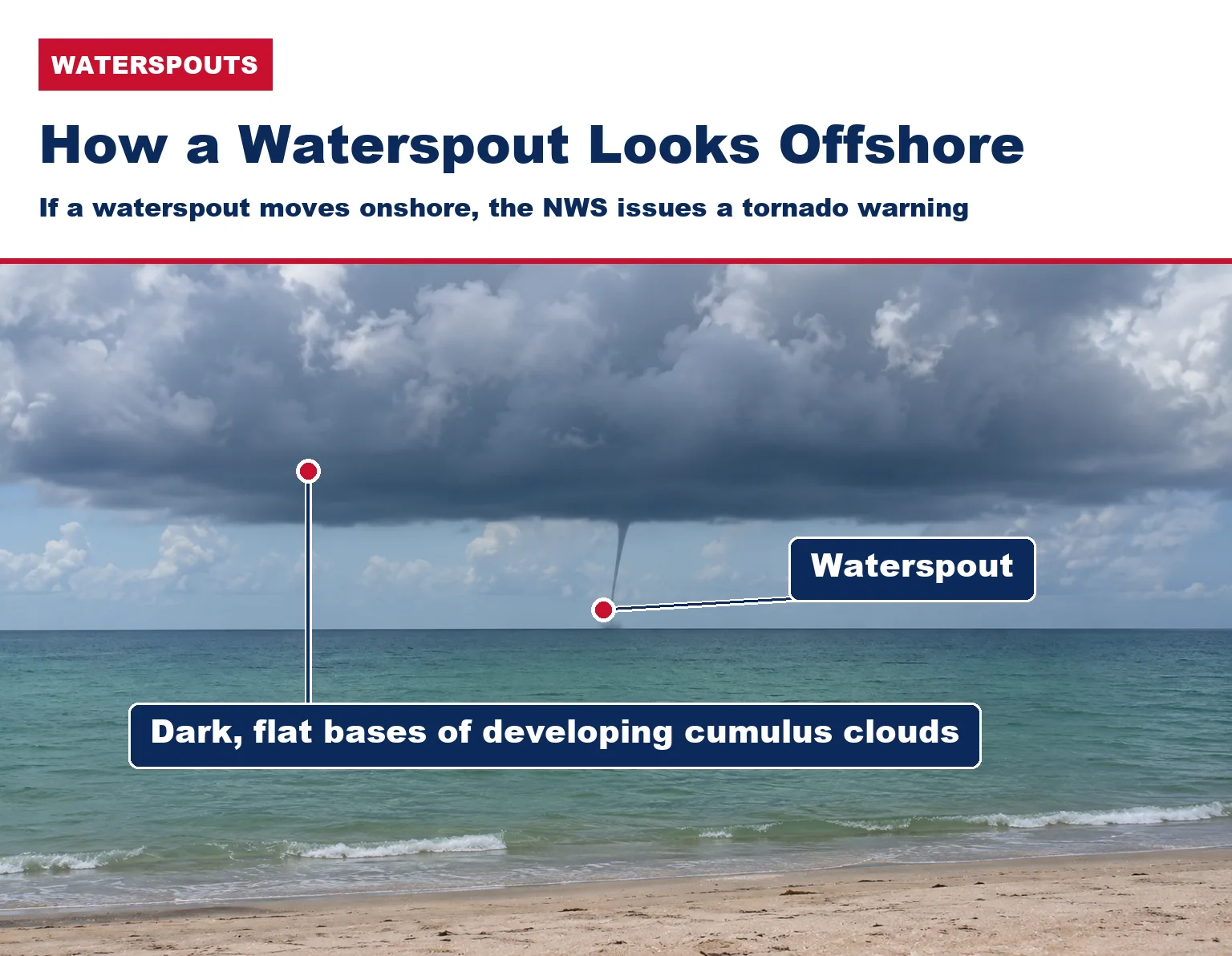
A waterspout is a tornado over water, and the SPC says they are common off southern Florida and the Keys. The NWS Miami waterspout page says tornadic waterspouts have the same characteristics as a land tornado.
Fair weather waterspouts are usually less dangerous. They form along the dark, flat bases of developing cumulus clouds, mostly from late spring to early fall, and usually dissipate rapidly at landfall.
If a waterspout moves onshore, the NWS issues a tornado warning. NWS Miami notes that in 2015 one flipped a bounce house about 30 feet into the air on Fort Lauderdale Beach, injuring four children, and in 2023 another caused minor damage on Hollywood Beach.
Tornado Watch vs Tornado Warning: What Each Alert Means
A tornado watch means tornadoes are possible; a tornado warning means one has been sighted or indicated by radar, so take shelter now. The NWS guide to tornado alerts adds a rarer third level, the tornado emergency.
| Alert | Who issues it | What it means | What to do |
|---|---|---|---|
| Tornado watch | Storm Prediction Center | Tornadoes are possible in and near a large watch area | Review your plan, check supplies and your shelter spot |
| Tornado warning | Your local NWS office (NWS Miami for most of South Florida) | A tornado has been sighted or indicated by weather radar | Move to an interior room on the lowest floor of a sturdy building and avoid windows |
| Tornado emergency | National Weather Service | A violent tornado has touched down, with catastrophic damage confirmed | Seek refuge in the safest location immediately |
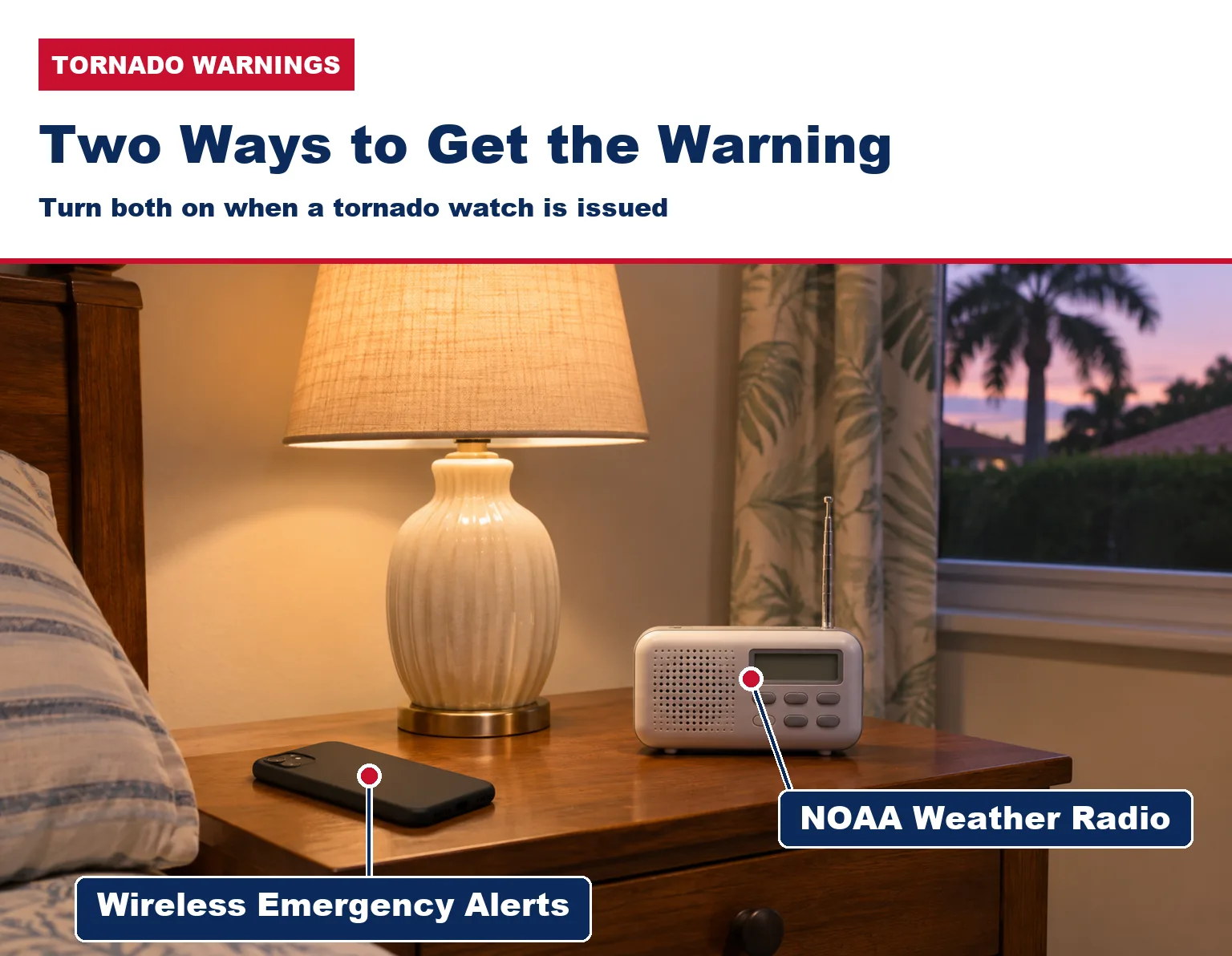
The SPC says a watch covers the next several hours. Turn on a NOAA Weather Radio, take phones with Wireless Emergency Alerts out of Do Not Disturb, and make sure everyone knows where to go.
A tornado watch can come with an ordinary cold front, when shutters and plywood are stored away. Impact windows that stay in place all year keep each opening protected to its tested hurricane rating, but they do not change where you shelter once a warning is issued.
Hurricane alerts run on a longer clock; see what to do with windows and doors in a hurricane watch or warning.
Where to Shelter When a Tornado Warning Is Issued
Go to a small, windowless interior room on the lowest floor as soon as a warning covers your area. Ready.gov names a FEMA safe room or an ICC 500 storm shelter as the best option, then a small, interior, windowless room on the lowest level of a sturdy building.
Most South Florida houses have no basement. For those, the SPC says to go to a small center room such as a bathroom or closet, under a stairwell, or into an interior hallway with no windows, then crouch low and cover your head.
The SPC also says to cover yourself with a mattress or thick blankets in case the roof fails. Ready.gov says to stay away from windows, doors and outside walls.
- Condo or apartment building: NWS Miami says to go to the lowest floor. The SPC says to pick an enclosed, windowless area in the center of the building and stay off the elevators.
- Mobile or manufactured home: the SPC says to get out, even if the home is tied down, and go to a sturdy building.
- In a car: the NWS says a vehicle is not safe; drive to the closest shelter. If you cannot reach one, get down in the car and cover your head, or leave it for a low-lying area such as a ditch.
Impact windows do not change any of this. The NWS, Ready.gov and the SPC all say to stay away from windows, with no exception for impact glass.
For hurricanes, our post on hurricane window myths and where to wait out a storm explains the same rule and why opening windows to “equalize pressure” is a mistake.
Are Impact Windows Tornado-Rated? What Florida’s Tests Cover
Impact windows are tested for hurricanes. In Florida’s wind-borne debris region, Section R301.2.1.2 of the Florida Building Code, Residential requires glazed openings to pass the Large Missile Test of ASTM E1996 and ASTM E1886, TAS 201, 202 and 203, or AAMA 506.
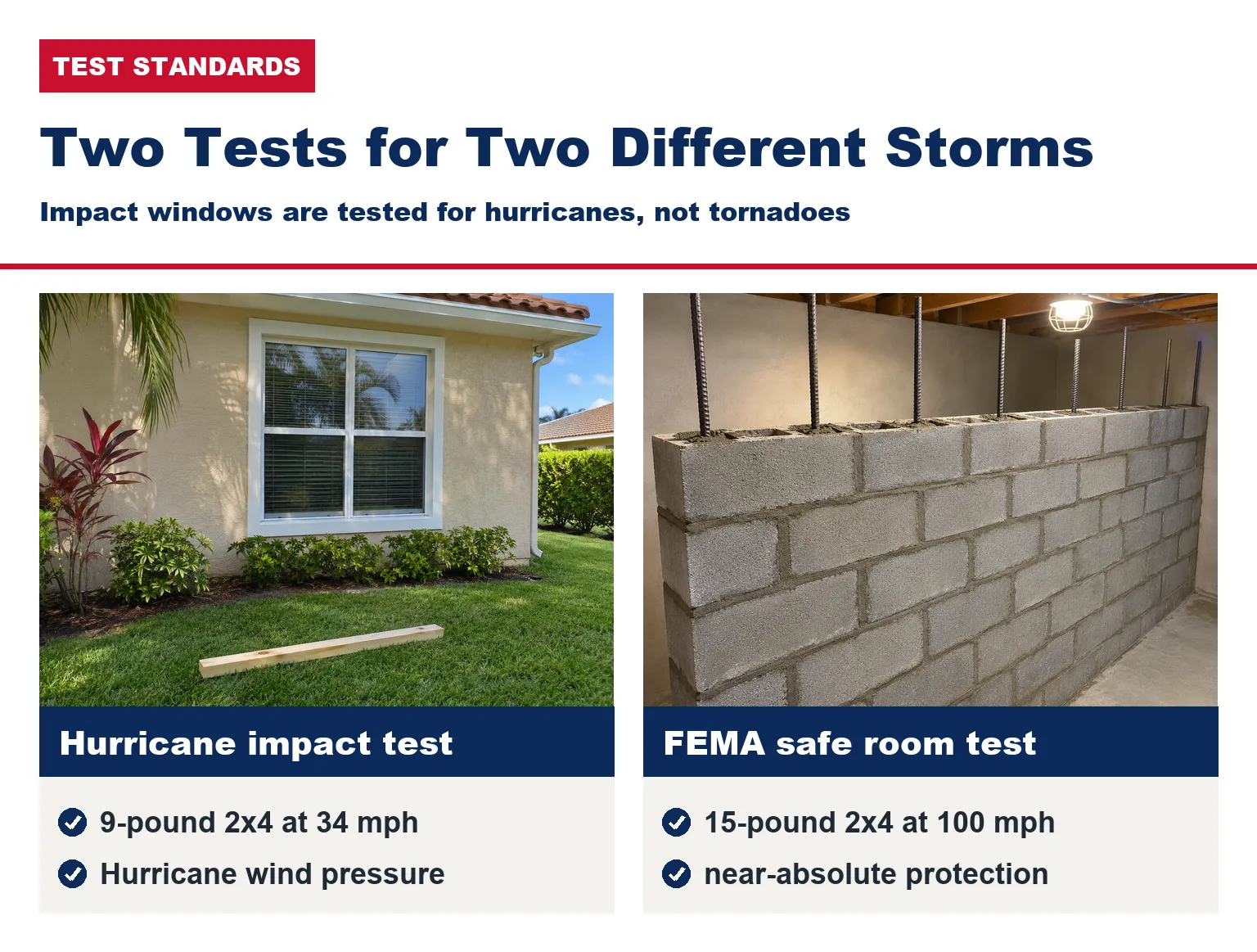
In the High-Velocity Hurricane Zone of Miami-Dade and Broward, the Florida Building Code, Building sets the large missile as a 9-pound 2×4 at 50 feet per second, about 34 mph. See each test a hurricane impact window must pass.
Tornadoes can bring much stronger wind and heavier, faster debris than the code tests assume. FEMA P-320 says tornado winds “can be significantly higher than design wind speeds in modern building codes.” On the SPC’s Enhanced Fujita scale, EF-4 gusts reach 166 to 200 mph and EF-5 over 200 mph.
FEMA adds: “Even homes with enhanced wind-resistant features will not provide reliable life-safety protection from strong tornadoes or hurricanes that generate wind-borne debris capable of penetrating walls, roofs, windows, and doors.”
Home impact windows are not rated for tornadoes. The industry’s voluntary tornado specification for windows, AAMA 512, was withdrawn in 2018 and not replaced, according to the Fenestration and Glazing Industry Alliance.
For the labels on an ordinary window, see how a wind-rated window differs from an impact-rated one.
Why Intact Windows and Doors Still Matter in a Tornado
Intact windows and doors matter in any windstorm. FEMA P-320 explains that wind entering through a broken window or door pushes on the walls and roof from inside, much like air forced into a balloon, and that this effect led to impact protection rules in hurricane-prone regions.
Tornadoes attack the same weak points. The SPC says tornadoes “easily blow open doors (especially garage doors!) and break windows.” In a FEMA photo from the 2011 Joplin, Missouri, tornado, at a house with damage rated EF-2, a failed garage door likely started the roof loss.
That is the honest case for impact windows in a tornado. The SPC says homes “can be fortified against most tornadoes,” and impact windows are built to keep openings closed against wind pressure and debris up to their tested limits.
No test shows which tornado a given window will survive, though. Treat impact windows as protection for the openings, never as a place to shelter.
Garage doors, entry doors and sliding glass doors are part of the same envelope, so plan impact entry doors and sliding glass doors and a wind-rated impact garage door with the windows.
Want every opening protected with nothing to put up? Request a free impact window and door estimate or call (877) 554-6373.
FEMA Safe Rooms: The Protection Built for Tornadoes
The tornado protection for people is a safe room. FEMA P-320 says only safe rooms built to FEMA P-361 criteria offer near-absolute protection in a strong tornado or hurricane. The construction standard behind them is ICC 500, the ICC/NSSA storm shelter standard.
The bar is far higher than a window’s. FEMA’s home safe room designs use a 250 mph design wind speed and resist a 15-pound 2×4 at 100 mph. FEMA contrasts that with the 9-pound 2×4 at 34 mph that Miami-Dade and Broward walls and doors must resist.
Windows are not part of the plans. FEMA notes that closets, interior bathrooms and small storage rooms “typically have only one door and no windows,” which makes them well suited to be safe rooms.
The door must be a tested, listed and labeled assembly, because FEMA says common steel doors cannot pass the ICC 500 tests. Vents and other openings need ICC 500 impact protection too.
Safe rooms must sit outside floodways, and outside Zone V and Coastal A flood zones unless a board of appeals allows it; our guide to storm surge vs wind damage covers the water side.
Tornadoes and Impact Window FAQs
Can a tornado break impact windows?
Yes. FEMA says extreme-wind debris can penetrate windows, doors, walls and roofs, and impact windows are tested for hurricane missiles, not tornadoes. If a storm leaves one cracked, see what to do with a cracked impact window after a storm.
Is a bathtub a safe place in a tornado?
A tub is not a tornado shelter by itself. The SPC says a metal tub may offer partial protection, but plastic or fiberglass tubs are easily penetrated by projectiles. Use one only inside a windowless interior room on the lowest floor, under a mattress.
Can a tornado hit without a warning?
Yes. The SPC says some tornadoes occur without a tornado warning, and South Florida tornadoes often give only minutes of notice. Shelter at once if you see strong, persistent rotation in the cloud base or hear a loud, continuous roar.
How do I get tornado warnings in South Florida?
NWS Miami recommends a NOAA Weather Radio, which it says has saved lives in nighttime tornadoes. Wireless Emergency Alerts on smartphones, the Emergency Alert System on local media and the FEMA app also carry warnings.
Should I still get impact windows if they are not tornado-rated?
For hurricanes, yes. The Florida code requires protected glazed openings in the wind-borne debris region, and impact windows meet that with nothing to put up before a storm. For tornadoes, add a shelter plan.
Plan for Tornadoes With a Shelter, and for Hurricanes With Impact Windows
Pick your tornado shelter spot now: a small windowless interior room on the lowest floor, padding within reach, a weather radio on. Then protect your openings for hurricane season; see our South Florida impact window guide to styles, costs and county rules.
Financing may be available for qualified homeowners through independent third-party providers. Terms, eligibility and availability depend on the program and location. See how impact window financing works.
USA Home Improvement exclusively sells ES Windows impact windows and impact doors. Every project is permitted, and our installation team holds direct certification from the manufacturer.
USA Home Improvement is licensed (CGC1526707) and insured and has served Florida homeowners for more than 15 years.
Get a free estimate or call (877) 554-6373.