Skip to content

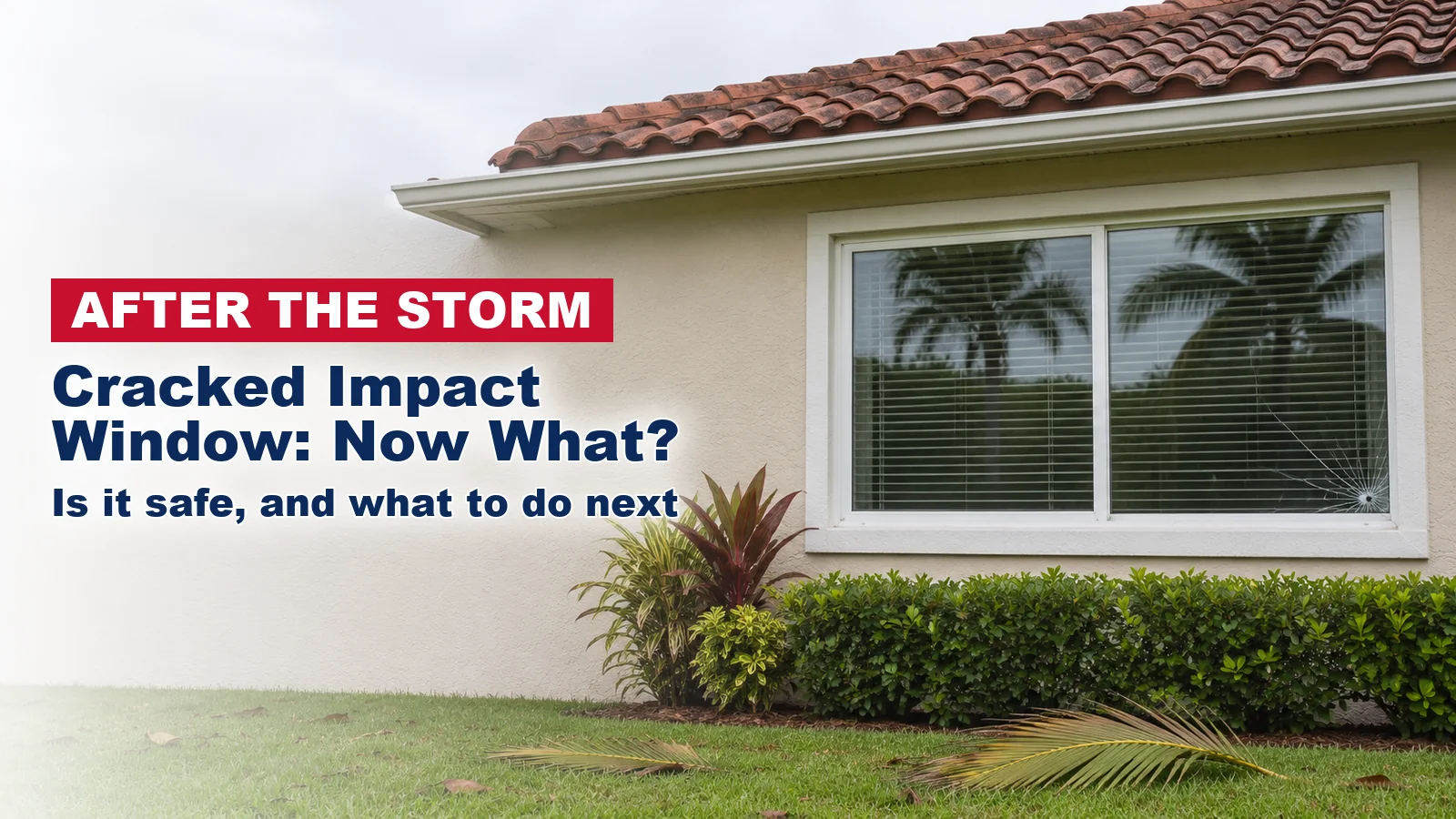
A cracked impact window after a storm is usually still in one piece, because the laminated glass holds its broken fragments together. That does not make it safe to rely on. Treat it as damaged protection: keep people away from it, document it, and plan to replace it before the next storm.
This guide covers how to check impact windows and doors, what to do first, photos for insurance, Florida’s claim deadline, and new glass vs a new unit.
Is a Cracked Impact Window Still Safe?
A cracked impact window is often still holding, but it is no longer the product that passed the test. Impact glass is laminated: layers of glass bonded to a plastic interlayer, usually polyvinyl butyral.
A Florida Department of Community Affairs fact sheet on window systems explains that when laminated glass is cracked or broken, the fragments tend to stick to the interlayer. That is what keeps wind, water and debris from coming straight through.
Some impact units pair an ordinary outer pane with a laminated inner pane. The U.S. Department of Energy’s Building America Solution Center says the outer pane may break on impact while the inner pane cracks into small pieces that stay on the vinyl layer.
Florida’s impact tests do not require the glass to stay unbroken. The missile must not get through, and the unit, cracked or not, must then hold up under cyclic wind pressure, as our explainer on how hurricane impact windows are tested and how strong they are shows.
Each test starts with new units and covers one round of impacts and wind cycles. No approval shows how a unit already hit in a storm will hold up in the next one, so replace a cracked impact window before the next storm.
When you do, compare ES Windows impact windows in aluminum and vinyl frames, or start with our full guide to impact windows in South Florida.
How to Check Impact Windows and Doors After a Storm
Check your impact windows only after it is safe to be outside. If you evacuated, the National Weather Service says to return home only when officials say it is safe.
The Weather Service also says to walk carefully around the outside of your home to check for loose power lines, gas leaks and structural damage. Stay out of the house if you smell gas or floodwater is still around it.
Then look at each window and glass door, inside and outside. Four check points tell you most of what you need to know:
- Glass: crack or hole. Note whether the crack is on the outer pane, the inner pane or goes all the way through.
- Frame: bent or loose. Look at the corners and the edges where the frame meets the wall.
- Sealant: gaps or stains. Water stains on the wall or sill under a window can point to a failed seal.
- Operation: sticks or will not lock. Try each window and sliding door gently, without forcing it.
| What you see | What it can mean | What to do now |
|---|---|---|
| Crack on one pane only (you can see it from one side) | An outer pane may be broken while the laminated layer still holds | Leave it in place, photograph it, keep people back |
| Spider-web crack, no hole | The laminated pane is broken but still in the frame | Leave it in place, plan replacement before the next storm |
| Hole, tear or glass pushed in | The glass no longer closes the opening | Keep people out of the room, cover the opening from outside when safe |
| Bent frame, loose frame or gaps at the wall | The unit or its anchors may have moved | Photograph it, do not force the window, have the unit inspected |
| Window or door sticks or will not lock | The frame or sash may be out of shape | Do not force it, photograph it, have it inspected |
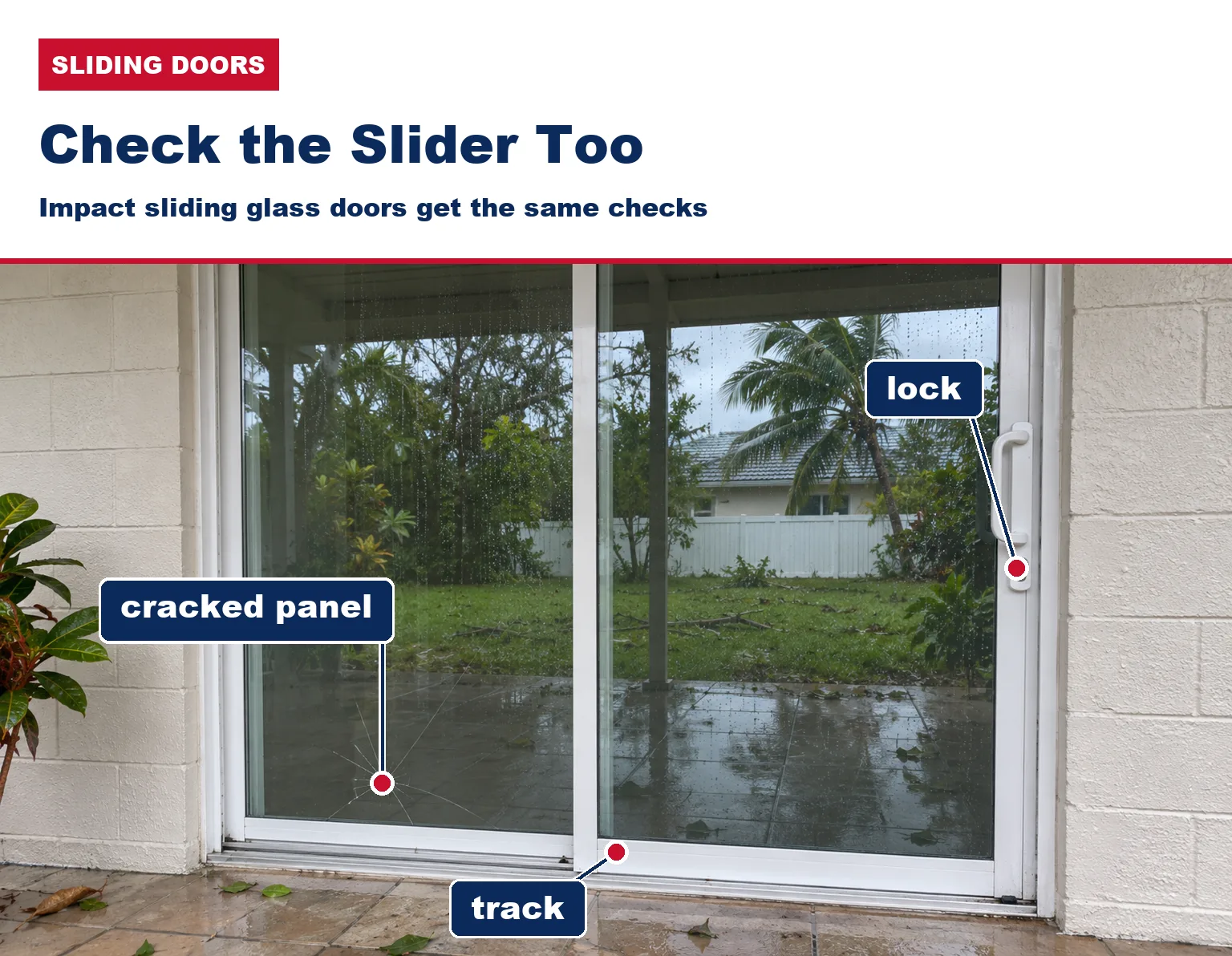
Impact sliding glass doors get the same checks, plus the track and the lock. If a cracked panel is part of a slider, see our page on impact sliding glass doors for South Florida homes.
What to Do Right Away With a Cracked or Broken Impact Window
If the glass is cracked but there is no hole, leave the window closed and in place. Do not push on the glass, tap it or try to pull out loose pieces. Broken glass edges are sharp, so keep children and pets away from that window.
If there is a hole or the glass has been pushed in, keep people out of that room until the opening is covered. When it is safe, cover it from outside with plywood or heavy plastic sheeting to keep rain out. Our step-by-step guide shows how to fasten plywood over a window opening.
The Florida Department of Financial Services tells homeowners to “Make Emergency Repairs to Prevent Further Damage” and to document the damage and repairs with receipts and photos or video. Take your photos before you cover anything.
Be careful who you hire. The state warns that scammers work neighborhoods after storms selling tarps and debris removal for a fee, and some leave after payment without doing the work. The Disaster Contractors Network, set up by the Florida Department of Business and Professional Regulation, lists Florida-licensed contractors by county.
If another storm is forecast before the window is replaced, protect the opening the way you would protect ordinary glass. Our guide on protecting your windows before and during a hurricane covers shutters, panels and plywood.
Document the Damage Before Anything Is Repaired
Photograph and film every damaged window and door before any cleanup or repair. Ready.gov, FEMA’s preparedness site, tells homeowners to document property damage with photographs and contact their insurance company.
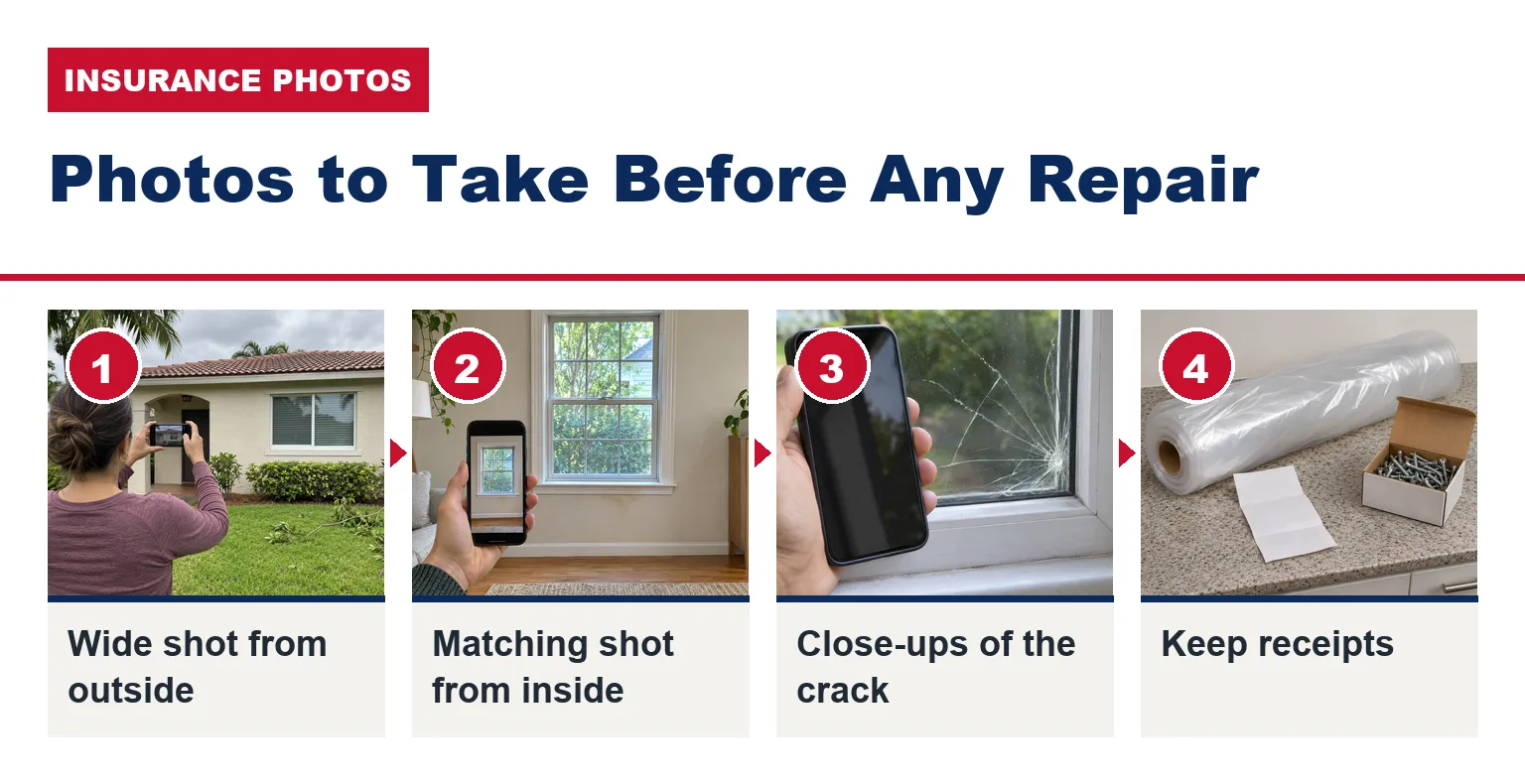
Take a wide shot from outside that shows which window it is, a matching shot from inside, and close-ups of the crack, the frame corners and any water stains. A room-by-room video helps too.
The Department of Financial Services also asks you to keep damaged items, if it is safe, so the adjuster can inspect them. For a cracked impact window that is still holding, that usually means leaving it in place until the adjuster has seen it. Keep receipts for plywood, plastic sheeting and any emergency work.
Write down the date and, if you know it, the time the damage happened. The Department says the adjuster will ask for the exact date of loss.
Florida’s Deadline to Report Storm Damage: Section 627.70132
Florida gives you 1 year from the date of loss to notify your insurer of a property claim. Under Section 627.70132, Florida Statutes, a claim or reopened claim is barred unless notice was given under the policy’s terms within that year.
A supplemental claim, for more damage from the same peril after the first claim was adjusted, must be noticed within 18 months after the date of loss. That matters when a leak around a frame shows up months later.
For hurricanes, the law sets the date of loss as the date the hurricane made landfall. For tornadoes, windstorms, severe rain and other weather events, it is the date the event is verified by the National Oceanic and Atmospheric Administration.
The year is the outer limit, not a target. Your policy’s notice terms still apply, and the Department of Financial Services says to report damage immediately. Its Insurance Consumer Helpline is 1-877-693-5236.
For insurer response times, your hurricane deductible and how to pay the gap, see our guide to insurance timelines and repair financing in Florida.
Glass Replacement or a New Impact Window: What Decides It
Whether you can replace only the glass depends on the frame and on the product’s approval, because impact glass is one piece of a tested, approved product.
Miami-Dade Notices of Acceptance (NOAs) for impact windows point to tables of approved unit sizes, design pressures, reinforcement, glass types and anchors. Replacement glass has to be a glass type that the window’s approval lists, or the window no longer matches its approval.
The frame matters just as much. The Florida fact sheet notes that a strong hit can make the whole frame give way even when the glass holds, and that a window is tested as a unit: glass, frame, hardware and installation.
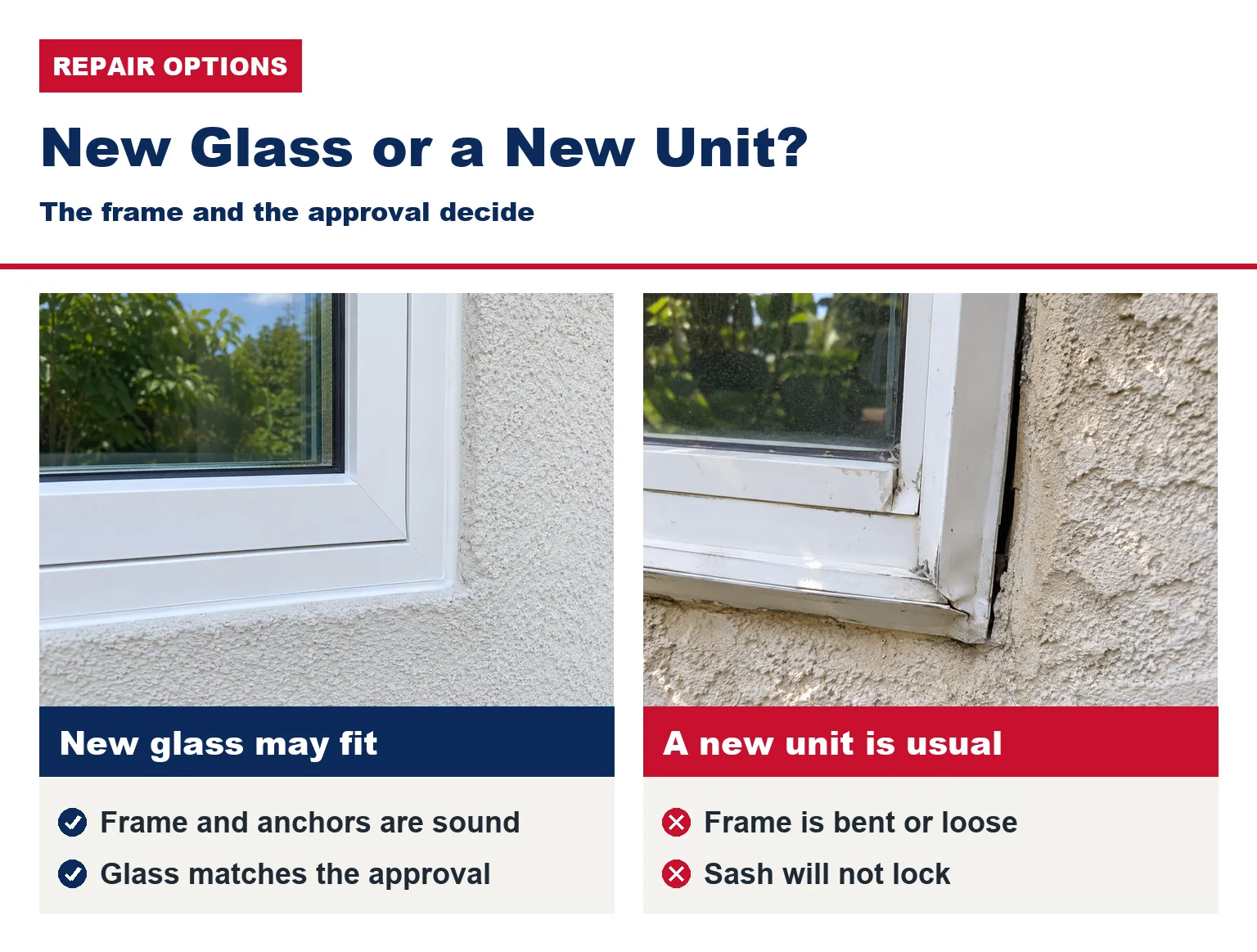
New glass may fit when the frame and anchors are sound and the replacement glass matches the approval. A new unit is the usual answer when the frame is bent or loose, the sash will not lock, or matching approved glass cannot be found.
A new unit should carry the right rating for its opening, usually a large missile rating on a house. Our guide to hurricane windows vs impact windows and their ratings explains what to ask for, and our breakdown of what impact windows cost in Florida helps you budget.
Plan for the wait. For a new USA Home Improvement project, manufacturing takes about 6 to 8 weeks depending on project scope, installation averages 1 to 2 days, and the whole process takes about 3 months start to finish, though it can vary.
If you are ready to price new ES impact windows or doors, request a free, no-obligation estimate and ask for the Florida Product Approval number of each unit.
Do You Need a Permit to Replace a Damaged Impact Window?
Replacing a whole impact window or door needs a building permit in Florida. Section 105.1 of the Florida Building Code, Building requires a permit before anyone alters or repairs a building.
Glass-only work can be different. Section 105.2.2 lets ordinary minor repairs be made with the approval of the building official without a permit, so your local building department decides how it treats a glass swap.
Local rules differ. After Hurricane Ian, the Village of Estero’s emergency permitting notice listed window or door glass replacement (glass only) as not needing a permit, while entire windows or door frames did. Estero also asked that emergency work normally needing a permit be applied for within 24 hours of starting, if possible.
Section 107.1.1 drops the need for sealed drawings when a same-size window or door goes in the same opening of an existing one- or two-family home or townhouse. It must follow the maker’s instructions for the wind zone and meet current design pressures, with those instructions filed with the permit.
Our guide to when Florida requires impact windows on a replacement covers the wider rules.
Every USA Home Improvement project is permitted, and customers can receive the Florida Product Approval number for each window and door on request.
Cracked Impact Window FAQs
Does homeowners insurance pay for a cracked impact window?
It depends on your policy, the cause of the damage and your deductible. If the window was cracked in a hurricane and the repair costs less than your hurricane deductible, the claim may pay nothing for it. Report the damage, share your photos, and ask your insurer what applies.
How do I know if the cracked window is really impact glass?
How the glass broke is a first clue. Laminated glass cracks and stays on its interlayer. Some impact units have an outer pane of ordinary or tempered glass that can break away, so look past it: if a cracked layer behind it is still in place, that layer is likely laminated.
Our guide on finding the impact glass etching and approval number shows what to look for.
Is a cracked impact sliding glass door safe to use?
Do not slide a cracked panel open and closed if you can avoid it, because moving it puts stress on broken glass. Keep the door closed and locked if it still locks, keep people back from the glass, and have the panel and track inspected.
Can I replace impact glass myself?
It is not a safe do-it-yourself job. Broken laminated glass is heavy and sharp, the new glass must match the product’s approval, and your building department may require a permit. Hire a Florida-licensed contractor and ask how the replacement will match the approval.
Replace a Damaged Impact Window Before the Next Storm
If the glass is cracked but holding, photograph it, report it, and schedule the fix before the next storm. If there is a hole, a bent frame or a door that will not lock, cover the opening first and get the unit inspected.
USA Home Improvement installs ES Windows aluminum and vinyl impact windows and impact doors in South Florida, and our installation team holds direct certification from the manufacturer.
Financing may be available for qualified homeowners through independent third-party providers. Terms, eligibility and availability depend on the program and location. See financing options for impact window and door projects.
USA Home Improvement is licensed (CGC1526707) and insured and has served Florida homeowners for more than 15 years.
Get a free estimate or call (877) 554-6373.