 Skip to content

The worst hurricanes in Florida’s history depend on how you measure them. The deadliest was the 1928 Okeechobee hurricane, which killed at least 2,500 people; the strongest at landfall was the 1935 Labor Day hurricane, with winds near 185 mph; and the costliest was Hurricane Ian, with about $109.5 billion in Florida damage in 2022. Below are five storms that shaped the state, the record storms since, and what each one means for protecting your home.
Florida has been hit by more hurricanes than any other state. The National Hurricane Center counts 114 hurricanes striking Florida from 1851 to 2010, against 64 for Texas, the next state on the list, which is why Florida residents need to protect their windows before a hurricane every season.
What Was the Worst Hurricane in Florida History?
There is no single answer, because “worst” can mean the most deaths, the strongest winds at landfall or the highest damage. Each record belongs to a different storm, and the table below gives all three with the source behind each figure.
| Measure | Storm | Record |
|---|---|---|
| Deadliest | Okeechobee hurricane, 1928 | At least 2,500 deaths, possibly as many as 3,000 (National Hurricane Center) |
| Strongest at landfall | Labor Day hurricane, 1935 | Winds near 185 mph and 892 mb pressure, the lowest of any U.S. landfall on record |
| Costliest | Hurricane Ian, 2022 | $109.5 billion in damage in Florida (NOAA) |
| Category 5 landfalls | 1935 Labor Day, Andrew (1992), Michael (2018) | Three of the four Category 5 landfalls in U.S. records |
Dollar figures from different decades are hard to compare. When the National Hurricane Center adjusted past damage to 2010 population and wealth, the 1926 Great Miami hurricane ranked first among all U.S. hurricanes from 1851 to 2010.
Florida’s Worst Hurricanes Compared
This table compares the storms in this article by their strength when they reached Florida, which is often lower than their peak strength over open water. Wind speeds come from the National Hurricane Center’s records, rounded to the nearest 5 mph.
| Year | Hurricane | Florida landfall | Strength at landfall | Deaths |
|---|---|---|---|---|
| 1926 | Great Miami | Near Palmetto Bay, south of Miami | Category 4, about 145 mph | 372 in all areas hit |
| 1928 | Okeechobee | Palm Beach County | Category 4, about 145 mph | At least 2,500 |
| 1935 | Labor Day | Florida Keys (Craig Key) | Category 5, about 185 mph | 408 |
| 1960 | Donna | Middle Keys, then near Marco Island | Category 4, about 145 mph | 50 in the U.S. |
| 1992 | Andrew | Elliott Key, then near Homestead | Category 5, 165 mph | 44 in Florida |
| 2004 | Charley | Cayo Costa, then Punta Gorda | Category 4, about 150 mph | 9 direct and 24 indirect in Florida |
| 2005 | Wilma | Near Cape Romano | Category 3, about 120 mph | 5 direct in Florida |
| 2017 | Irma | Cudjoe Key, then Marco Island | Category 4, about 130 mph | 7 direct in Florida, plus dozens indirect |
| 2018 | Michael | Mexico Beach | Category 5, 160 mph | 50 in Florida |
| 2022 | Ian | Cayo Costa, then near Punta Gorda | Category 4, about 150 mph | 150 in Florida |
| 2024 | Helene | About 10 nautical miles southwest of Perry | Category 4, about 140 mph | 14 surge deaths in Florida; at least 250 in the U.S. |
| 2024 | Milton | Siesta Key | Category 3, about 115 mph | 39 in Florida |
A Closer Look at Some of Florida’s Worst Hurricanes
These five storms set the benchmarks Floridians still talk about. Each section gives the landfall facts from the National Hurricane Center and the damage that made the storm historic.
Hurricane Andrew – 1992
Hurricane Andrew struck South Florida on August 24, 1992, crossing Elliott Key and coming ashore at Fender Point, east of Homestead, as a Category 5 hurricane. In 2002, NOAA upgraded Andrew to peak sustained winds of 165 mph at landfall, with a central pressure of 922 mb.
The National Hurricane Center reports that Andrew destroyed 25,524 homes and damaged 101,241 others. In Homestead, more than 99% of mobile homes, 1,167 of 1,176, were completely destroyed.
The storm tide, surge plus the normal tide, peaked at 16.9 feet at Burger King’s international headquarters and ran 4 to 6 feet in northern Biscayne Bay. Florida damage was estimated at $25 billion in 1992 dollars, and 44 people died in Florida: 15 directly and 29 indirectly.
Andrew also changed how Florida builds. FEMA notes that it broke all records for insured losses and showed that Florida’s building code system was not adequate. The statewide code that followed requires protected openings in the wind-borne debris region, which is where impact-rated windows for South Florida homes come in (more on that below).
Labor Day Hurricane – 1935
The 1935 Labor Day hurricane is the strongest hurricane on record to make landfall in the United States. It crossed the Florida Keys near Craig Key on the evening of September 2 with winds estimated around 185 mph, and its 892 mb central pressure is still the lowest of any U.S. landfall since 1851.
The National Hurricane Center counts 408 deaths in the Keys, mostly World War I veterans working in relief camps in the area.
The storm destroyed the Florida East Coast Railway tracks between the islands. An 11-car train sent to rescue people on Lower Matecumbe Key was washed off the tracks, and only the locomotive stayed upright.
Hurricane Donna – 1960
Hurricane Donna crossed the middle Florida Keys early on September 10, 1960, as a Category 4 hurricane with winds near 145 mph, and Sombrero Key reported 128 mph sustained winds with gusts to 150 mph. Later that day Donna came ashore again just east of Marco Island as a Category 3.
Donna pushed storm surges of up to 13 feet in the Keys and 11 feet along Florida’s southwest coast. It is the only hurricane on record to bring hurricane-force winds to Florida, the Mid-Atlantic states and New England, and it caused 50 deaths and $387 million in damage across the United States.
Okeechobee Hurricane – 1928
The 1928 Okeechobee hurricane is the deadliest hurricane in Florida’s history. It made landfall in Palm Beach County on the evening of September 16 as a Category 4 hurricane, with winds estimated near 145 mph and a central pressure of 929 mb, one of the lowest on record for a U.S. landfall.
Inland, the storm drove a surge of 6 to 9 feet across Lake Okeechobee. When the lake’s levees failed, floodwater swept through Okeechobee City, South Bay and Belle Glade, where one high-water mark stood about 7 feet above the ground.
The National Hurricane Center says at least 2,500 people died and notes the toll could be as high as 3,000. The disaster led to the Herbert Hoover Dike that now surrounds the lake.
Hurricane Irma – 2017
Hurricane Irma made landfall at Cudjoe Key in the lower Florida Keys on September 10, 2017, as a Category 4 hurricane with winds near 130 mph. It hit Marco Island later that day as a Category 3 with winds near 115 mph, then moved up the peninsula.
FEMA estimates cited by the National Hurricane Center put 25% of buildings in the Keys as destroyed and 65% as significantly damaged. About 6 million Floridians evacuated, and on September 11 the U.S. Department of Energy counted about 6.1 million Florida customers without power, 59% of the state.
The National Hurricane Center lists 7 direct deaths in Florida plus dozens of indirect deaths. Fourteen of those indirect deaths happened at a single Broward County nursing home, caused by overheating after the storm.
More Major Hurricanes in Florida’s History
The five storms above are only part of the record. These seven hurricanes also rank among the worst to hit Florida, and four of them hit since 2018.
Great Miami Hurricane – 1926
The Great Miami hurricane came ashore near Palmetto Bay, about 10 miles south of downtown Miami, early on September 18, 1926, as a large Category 4 storm. A surge of nearly 15 feet hit Coconut Grove.
The calm of the eye lasted only about 35 minutes, and the National Weather Service’s account notes that during that lull the streets became crowded with people.
The National Hurricane Center counts 372 deaths, and the storm made a second Florida landfall near Pensacola two days later. Lake Okeechobee flooded Moore Haven, killing over 100 people there.
Hurricane Charley – 2004
Charley hit Cayo Costa, just north of Captiva, on August 13, 2004, as a Category 4 hurricane with winds near 150 mph, and its small eye then passed over Punta Gorda. It was the strongest hurricane to hit the United States since Andrew.
Charley’s worst winds were packed within about 6 nautical miles of the center. Damage was later revised to about $15.1 billion, and the National Hurricane Center lists 9 direct deaths in Florida and 24 indirect deaths.
Hurricane Wilma – 2005
Wilma made landfall near Cape Romano on October 24, 2005, as a Category 3 hurricane with winds near 120 mph. It crossed the peninsula in about four and a half hours and left the coast near Jupiter, sweeping across South Florida on the way.
The National Hurricane Center calls Wilma the largest disruption to electrical service ever experienced in Florida at the time, with media reports of up to 98% of South Florida losing power. U.S. damage was re-estimated at about $21 billion.
Hurricane Michael – 2018
Michael slammed into Mexico Beach and Tyndall Air Force Base on October 10, 2018, as a Category 5 hurricane with 160 mph winds, the strongest landfall on record in the Florida Panhandle. It was also the latest-in-the-year Category 5 landfall in U.S. records.
Storm surge reached about 14 feet in Mexico Beach, where 1,584 of the town’s 1,692 buildings were damaged and 809 were destroyed. Florida damage came to about $18.4 billion, with 7 direct and 43 indirect deaths in the state.
Hurricane Ian – 2022
Ian made landfall on Cayo Costa on September 28, 2022, as a Category 4 hurricane with winds near 150 mph, then made a second landfall near Punta Gorda. Storm surge of 10 to 15 feet above ground swept Fort Myers Beach.
Surge was Ian’s deadliest hazard, causing 41 deaths, 36 of them in Lee County. NOAA puts Florida damage at $109.5 billion, the costliest hurricane ever to affect the state, and the National Hurricane Center lists 66 direct and 84 indirect deaths in Florida.
Hurricane Helene – 2024
Helene made landfall about 10 nautical miles southwest of Perry late on September 26, 2024, as a Category 4 hurricane with winds near 140 mph, the strongest landfall in Florida’s Big Bend since reliable records began around 1900. Storm surge reached 12 to 16 feet above ground from Keaton Beach through Steinhatchee.
Surge also reached Tampa Bay and Sarasota, and all 14 surge deaths happened in Florida, 12 of them in Pinellas County. In the United States, Helene caused at least 250 deaths and about $78.7 billion in damage, the deadliest hurricane in the contiguous U.S. since Katrina.
Hurricane Milton – 2024
Milton came ashore on Siesta Key on the evening of October 9, 2024, as a Category 3 hurricane with winds near 115 mph, after reaching Category 5 strength over the Gulf. Surge of 6 to 9 feet reached the coast from Venice to Boca Grande.
Milton also spawned 45 tornadoes on land, more than one of them rated EF-3, a first for a tropical system in the tornado records kept since 1995. It caused about $34.3 billion in damage, with 12 direct and 27 indirect deaths in Florida.
The Worst Hurricanes to Hit South Florida
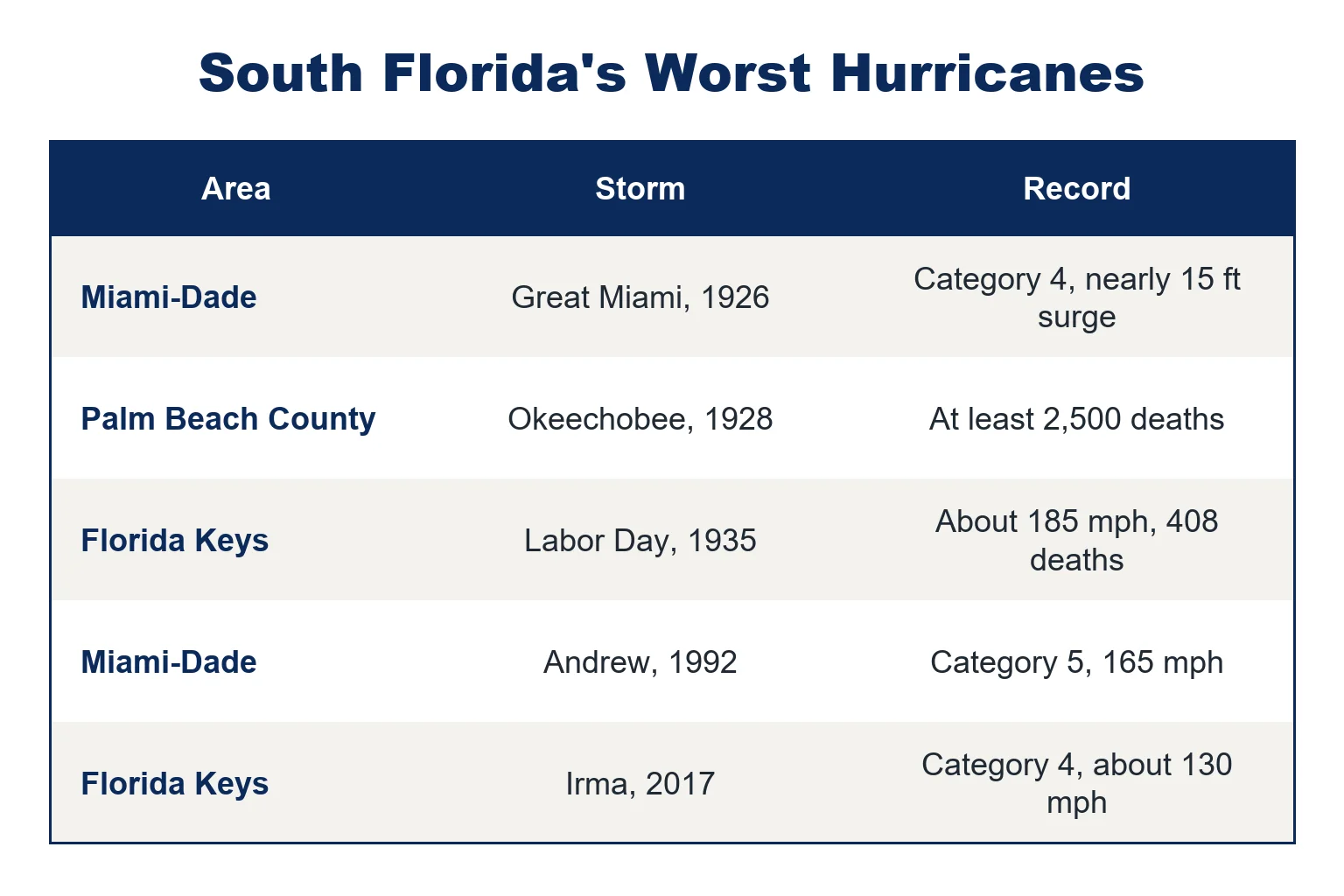
South Florida has taken the hardest hits in the state’s history. Miami-Dade lived through the 1926 Great Miami hurricane and Andrew in 1992, Palm Beach County through the 1928 Okeechobee storm, and the Keys through the 1935 Labor Day hurricane, Donna and Irma.
A Gulf coast landfall can still reach the Atlantic side of the state. Wilma came ashore near Cape Romano and left Florida near Jupiter only about four and a half hours later.
How Florida’s Worst Hurricanes Changed the Way Homes Are Built
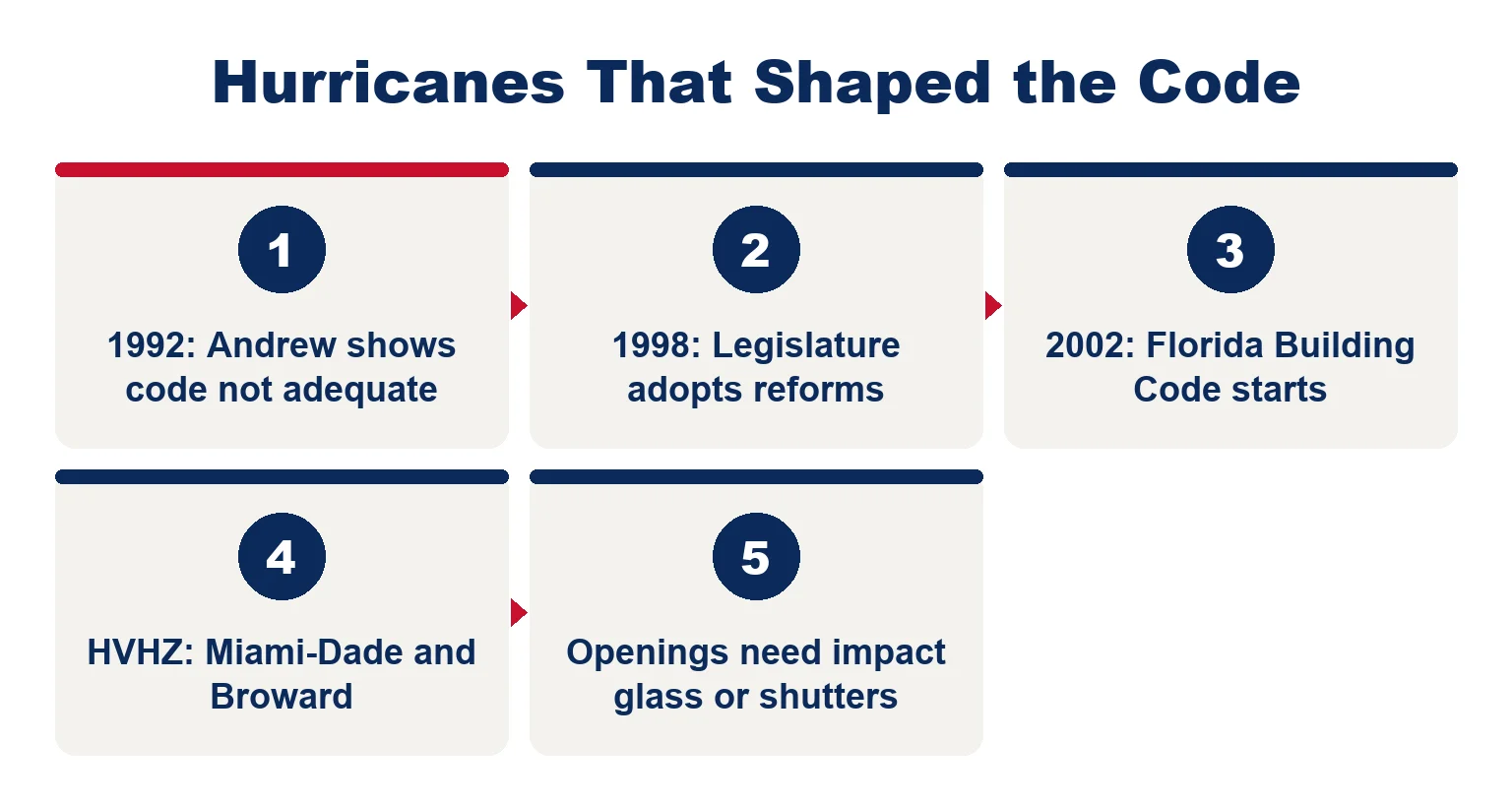
Hurricane Andrew is the storm that rewrote Florida’s building rules. FEMA’s account says Andrew showed the state’s building code system was not adequate, and in 1998 the Legislature adopted the reform commission’s recommendations.
The statewide Florida Building Code took effect on March 1, 2002, replacing the South Florida Building Code in Miami-Dade County. Its High-Velocity Hurricane Zone chapters apply only to Miami-Dade and Broward, where a Miami-Dade Notice of Acceptance (NOA) certifies that a window or door was designed or tested to those standards.
Across the wind-borne debris region, the code requires protection for openings: impact-rated glass or approved shutters. Our complete guide to South Florida impact windows explains the ratings, and you can check whether your windows are hurricane rated before the next season.
What These Storms Mean for Your Home Today
Wind-driven storms like these find the same weak points in a house: windows, doors and garage doors. That is why protecting the openings matters as much as the roof itself.
If you are deciding between options, compare impact windows and hurricane shutters side by side, and see how impact windows hold up in testing. Entry, French and sliding glass doors need the same protection, which is where impact-rated doors for every entry come in.
Openings are one part of the plan. Roof, garage door and other upgrades that make a home hurricane resilient work together, and some of them can also lower your homeowners insurance premiums.
Florida Hurricane FAQs
Has a Category 5 hurricane ever hit Florida?
Yes, three times. The 1935 Labor Day hurricane hit the Keys, Andrew hit South Florida in 1992, and Michael hit the Panhandle in 2018. Only four Category 5 hurricanes have made landfall in the continental United States, and the fourth, Camille in 1969, struck Mississippi.
Was Hurricane Ian a Category 5 when it hit Florida?
No. Ian made landfall on Cayo Costa as a Category 4 hurricane with winds near 150 mph, just below the Category 5 threshold of 157 mph. Many storms are strongest over open water and weaken slightly before landfall, so peak strength and landfall strength often differ.
Why does Florida get hit by so many hurricanes?
Florida reaches far into warm water on both the Atlantic and the Gulf, so storms can arrive from either side. The National Hurricane Center counts about 40% of all U.S. hurricanes from 1851 to 2010 as Florida hurricanes, far more than any other state.
Do impact windows protect against storm surge?
No. Impact windows and doors are tested against wind pressure and flying debris, the hazards that break openings in a hurricane. Storm surge and flooding need separate measures, such as elevation, flood vents and following evacuation orders.
USA Home Improvement is licensed (CGC1526707) and insured and has served Florida homeowners for more than 15 years. If you want your home ready before the next storm, call (877) 554-6373 or Get a free estimate.