Skip to content

A hurricane watch means hurricane conditions, sustained winds of 74 mph or more, are possible in your area. A hurricane warning means they are expected. The National Hurricane Center issues the watch 48 hours and the warning 36 hours before it expects tropical-storm-force winds to begin.
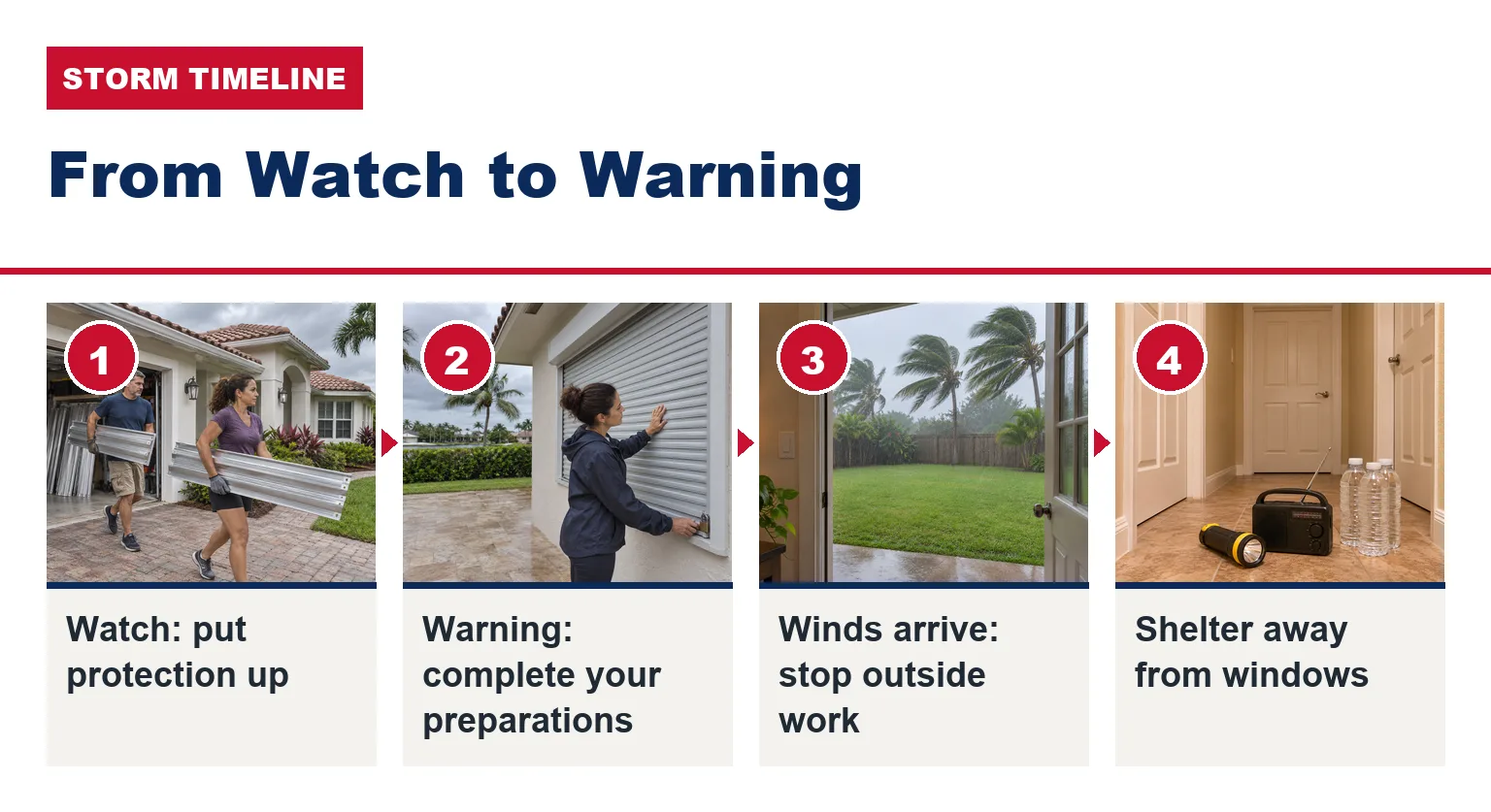
For windows and doors, the watch is when you put protection up and check every opening. The warning comes 36 hours before tropical-storm-force winds to give you time to complete your preparations, so use it to finish before the wind starts.
This guide gives the window and door steps for each stage, the checks for homes that already have impact windows, and when evacuation comes first.
Hurricane Watch vs Warning: What Each Alert Means
The difference between a hurricane watch and a hurricane warning is how sure forecasters are. The National Hurricane Center (NHC) glossary defines a hurricane watch as hurricane-force winds that are “possible” within the area, and a hurricane warning as winds that are “expected” there.
Tropical storm and storm surge alerts follow the same pattern: a watch means the hazard is possible, generally within 48 hours, and a warning means it is expected, generally within 36 hours. This is how the National Weather Service explains each alert.
| Alert | What it means | Timing | NWS guidance |
|---|---|---|---|
| Tropical Storm Watch | Sustained winds of 39 to 73 mph possible | Within 48 hours | Listen to local officials; evacuate if told to |
| Hurricane Watch | Sustained winds of 74 mph or more possible | 48 hours before tropical-storm-force winds are expected | Listen to local officials; evacuate if told to |
| Storm Surge Watch | Life-threatening flooding from rising water possible | Generally within 48 hours | Listen to local officials; evacuate if told to |
| Tropical Storm Warning | Sustained winds of 39 to 73 mph expected | Within 36 hours | Evacuate immediately if told to |
| Hurricane Warning | Sustained winds of 74 mph or more expected | 36 hours before tropical-storm-force winds are expected | All preparations should be complete; evacuate immediately if ordered |
| Storm Surge Warning | Life-threatening flooding from rising water expected | Generally within 36 hours | Check for evacuation orders |
| Extreme Wind Warning | Sustained winds of 115 mph or more | Expected to begin within an hour | Take immediate shelter in the interior of a well-built structure |
A watch is not a reason to wait: the NWS says to evacuate if local officials tell you to, even under a watch.
Why the 48 and 36 Hours Count Down to Tropical-Storm Winds, Not Landfall
The 48-hour and 36-hour lead times count down to the start of tropical-storm-force winds, 39 mph or more, not to landfall or to hurricane-force winds. NHC times its alerts this way because preparations become difficult once those winds begin.
That means the time for ladders, panels and plywood ends hours before the storm’s center arrives. NHC also warns that communities may have less time to prepare if a storm speeds up or grows larger than first forecast.
For each storm, NHC publishes an Arrival Time of Tropical-Storm-Force Winds graphic.
Its Earliest Reasonable Arrival Time map shows the time before which there is no more than a 1-in-10 chance of those winds starting, the period when NHC says preparations should ideally be completed by anyone with a low tolerance for risk.
When coastal watches or warnings are in effect, NHC issues public advisories every 3 hours. Check each one and your local NWS office’s Hurricane Local Statement, and plan window work to finish before the earliest arrival time for your area.
What to Do With Windows and Doors During a Hurricane Watch
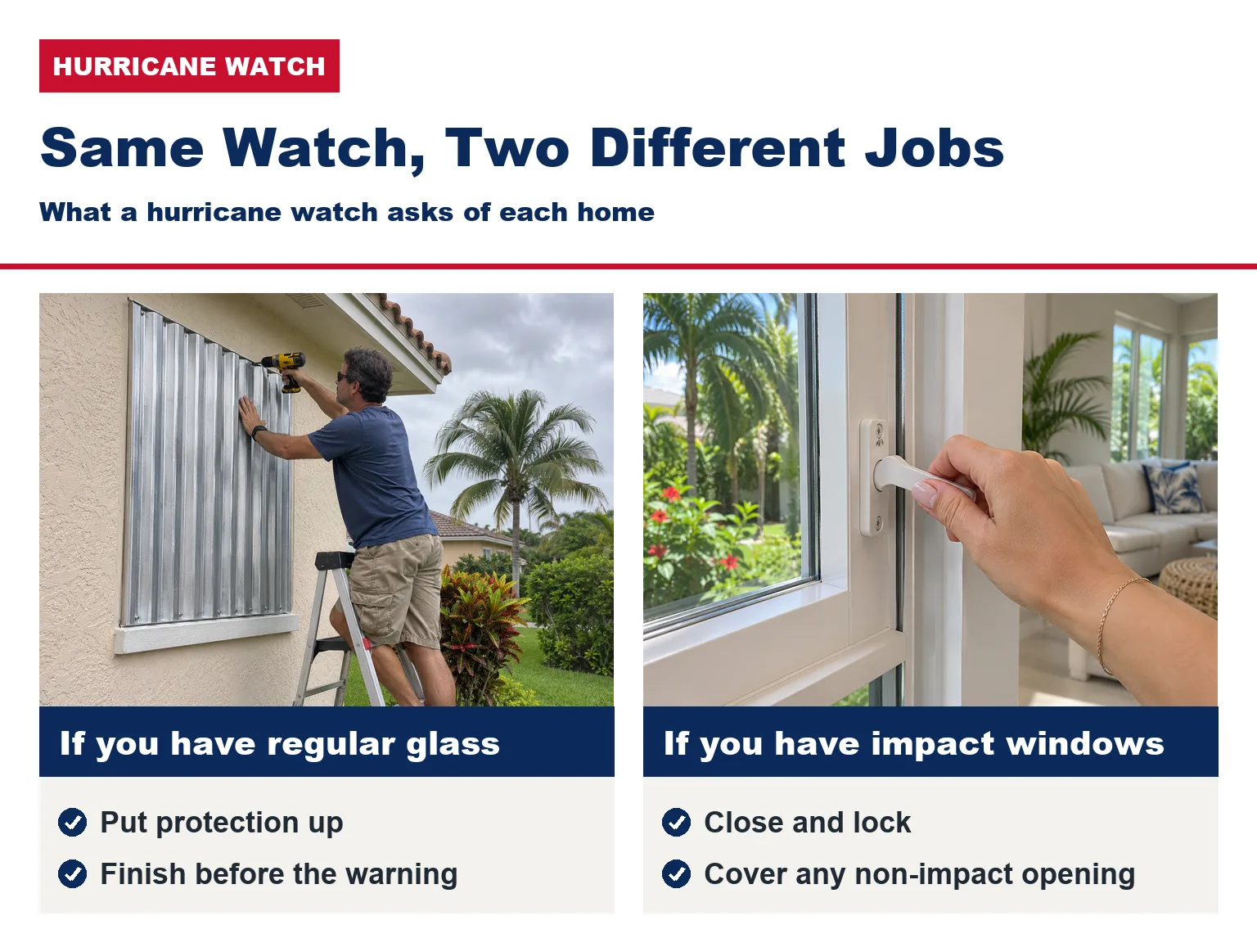
During a hurricane watch, put protection up on every window and glass door that is not impact rated. The NWS advice for a threatened community is to cover all of your home’s windows, and it names permanent storm shutters as the best protection.
Start with the openings that take the longest: large sliding glass doors, upper-floor windows and anything that needs a ladder. Do them in daylight so you can finish before the warning.
Shutters, Storm Panels and Hurricane Fabric
Close and lock accordion or roll-down shutters, and set storm panels or fabric on their tracks or bolts. Fasten each panel with all of its hardware so it is installed the way it was designed.
Do this early in the watch. If a panel is missing or bent, you still have time to replace it or cover that opening another way before the warning.
Plywood as the Backup
If plywood is your plan, the NWS recommends 5/8-inch exterior-grade or marine plywood, built to fit and ready to install. It also advises buying supplies before the season rather than waiting for the pre-storm rush. Boards cut during a watch use hours you may need.
Our step-by-step guide shows how to fasten plywood over windows before a storm. Tape is not a substitute, and our comparison explains why tape and window film do not count as protection.
Sliding Glass Doors and French Doors
FEMA’s Avoiding Hurricane Damage fact sheet lists sliding glass doors, skylights and French doors alongside windows as openings to protect with storm shutters. Sliders need the longest panels, so cover them early in the watch.
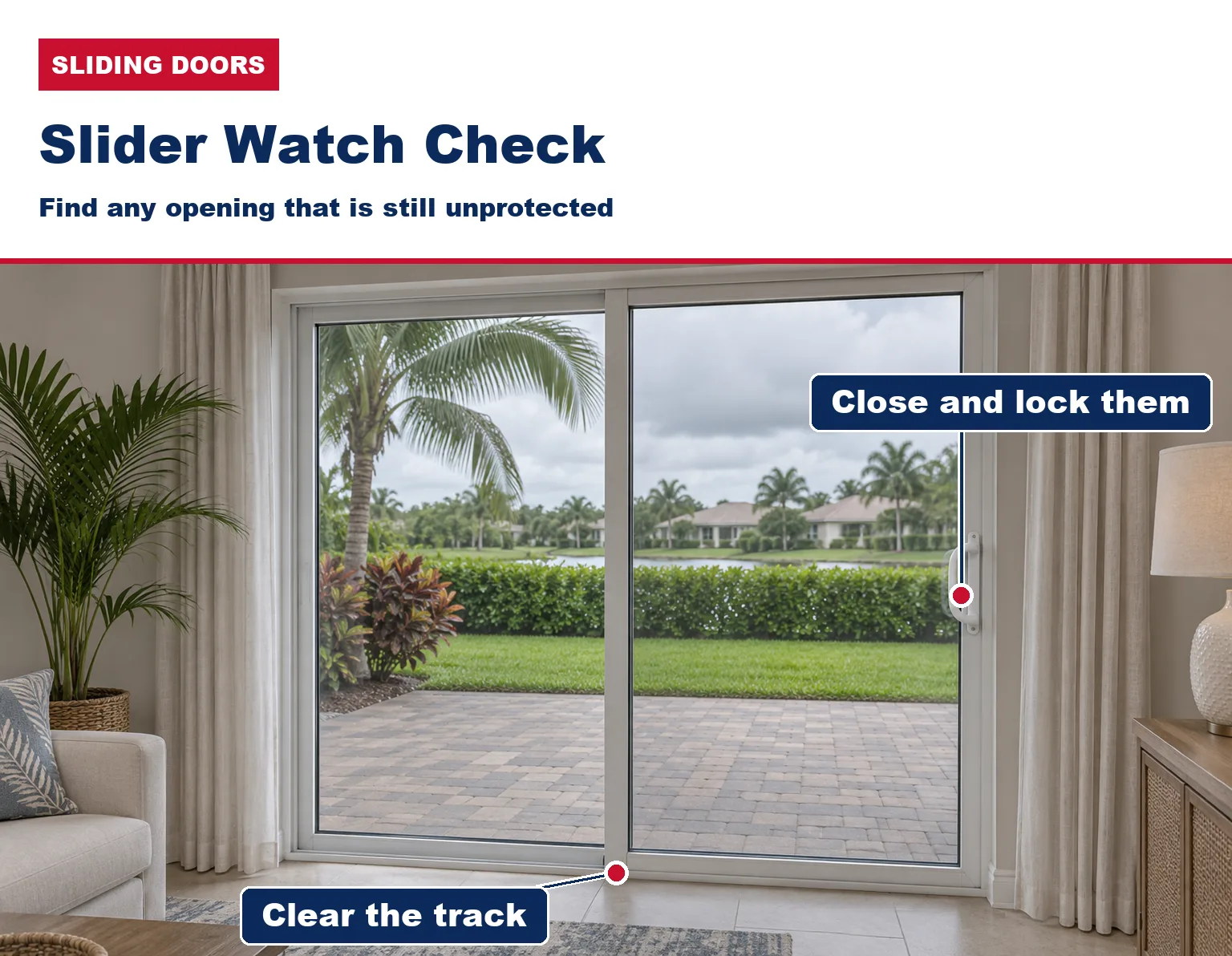
If your sliders are impact rated, close and lock them and clear the track so the panels close fully. If you want to stop covering a slider before every storm, look at impact sliding glass doors for South Florida homes, or see impact windows that stay in place all season.
Checks for Homes That Already Have Impact Windows and Doors
Impact windows and doors are always in place, so a watch becomes a checklist instead of a construction job. The goal is to find any opening that is still unprotected. Walk the house during the watch and work through these checks:
- Close and lock every window and door. Ready.gov’s evacuation advice is to secure your home by closing and locking doors and windows, and the same step applies if you stay.
- Cover any non-impact opening. An older door, a skylight or a window that was never replaced still needs shutters, panels or plywood.
- Garage door: reinforce before the warning. Wind entering a garage can cause dangerous and expensive structural damage, FEMA says, and a trained door systems technician should decide on reinforcing and any counterbalance adjustments. Book that check between storms, not during a warning, or compare impact garage door options for Florida homes.
- Bring in loose items. FEMA warns that wind can pick up yard furniture, grills and trash cans and drive smaller objects through windows and glass doors.
- Test every latch. If a window or door will not close or lock, treat it as unprotected and cover it for this storm.
Impact glass is designed to resist wind-borne debris, not flood water. If your home is in an evacuation zone, the evacuation section below matters more than your windows.
USA Home Improvement installs ES Windows impact windows in aluminum and vinyl frames, plus impact doors. Read our complete guide to impact windows in South Florida.
Want the next watch to be a lock check instead of a panel job? Request a free impact window estimate or call (877) 554-6373, and plan the project between storms.
What to Finish Once a Hurricane Warning Is Issued
The NWS says NHC issues a hurricane warning 36 hours before tropical-storm-force winds “to give you time to complete your preparations,” and that you should evacuate immediately if ordered. Use this period to complete your preparations: cover any opening still uncovered and confirm that the watch work holds.
- Walk around the house and confirm every shutter is locked and every panel and board is fastened.
- Stop outside work when tropical-storm-force winds begin, because NHC says preparations become too dangerous or difficult at that point.
- Keep NOAA Weather Radio, TV, radio or phone alerts on for orders from local officials.
If you stay, shelter away from windows in a small interior room, even if your windows are impact rated, and keep shutters closed until local officials say the storm has passed. An Extreme Wind Warning means to take immediate shelter in the interior of a well-built structure.
For what to do with your windows during and after the storm, see our full guide to protecting your windows during a hurricane.
Evacuation Zones: When Leaving Matters More Than Your Windows
Know your evacuation zone before a watch is issued. The Florida Division of Emergency Management’s Know Your Zone map lets you type in an address and see whether it sits in an evacuation zone, and Zone A is typically the most vulnerable and the most likely to evacuate first.
The state says the greatest threat to life from a hurricane is storm surge flooding. If you are in an evacuation zone ordered to evacuate, or in a flood zone, its guidance is to evacuate no matter what, and impact windows do not change that.
If you are leaving, put protection up and close and lock doors and windows before you go, as Ready.gov’s evacuation guidance advises. Not every zone is ordered out in every storm.
If no evacuation order covers your area and you are not in a mobile home, an unsafe structure or a low-lying, flood-prone area, the state says it may be safer to stay in your home.
If you shelter in place, the state says to know your home’s ability to withstand strong winds and heavy rain.
Away for part of the year? Arrange now who will put up your shutters during a watch. Our tips for managing a Florida home while you are away cover the rest of the house.
Hurricane Watch and Warning FAQs
Which is worse, a hurricane watch or a hurricane warning?
A hurricane warning is more serious. A warning means hurricane conditions are expected in your area, and NHC issues it 36 hours before tropical-storm-force winds are expected. A watch means those conditions are possible, with 48 hours of lead time.
Which comes first, a hurricane watch or a warning?
Usually the watch, because NHC issues it 48 hours ahead and the warning 36 hours ahead of tropical-storm-force winds. Treat whichever alert reaches you first as the signal to start on your windows and doors.
Is a tropical storm watch the same as a hurricane watch?
No. A tropical storm watch means sustained winds of 39 to 73 mph are possible within 48 hours, while a hurricane watch means 74 mph or more. Both can come with flooding and flying debris, so follow local officials either way.
Can a watch be issued before a storm has a name?
Yes. The NWS can issue watches and warnings for a “potential tropical cyclone,” a system it expects to become a tropical cyclone that is not one yet. Do not wait for a name to start preparing.
Can I get impact windows installed once a watch is issued?
No. At USA Home Improvement, manufacturing takes about 6 to 8 weeks depending on project scope, installation averages 1 to 2 days, and the process takes about 3 months start to finish, though it can vary. Every project is permitted, so plan it between storms.
Make the Next Hurricane Watch a Shorter Checklist
If someone can put protection up on every opening well before a warning, shutters or panels can work for your home. If you travel, live alone, have upper-floor glass or cannot work on a ladder, impact windows and doors take that job off the 48-hour list.
Not sure what your current windows are? Learn how to tell if your windows and doors are hurricane rated, then compare what impact windows cost in Florida.
See financing options for impact window projects. Financing may be available for qualified homeowners through independent third-party providers. Terms, eligibility and availability depend on the program and location.
USA Home Improvement is licensed (CGC1526707) and insured and has served Florida homeowners for more than 15 years. We sell ES Windows exclusively, and our installation team holds direct certification from the manufacturer.
Get a free estimate or call (877) 554-6373.