Skip to content

Selling a home with impact windows in Florida goes smoother when you can prove what is installed. Gather four things: the permit with a passed final inspection, the product approval number for each window and door, a current wind mitigation form, and the invoices and warranty papers.
The paperwork, not the look of the glass, is what a buyer’s inspector can verify. This guide shows where to find each document in Miami-Dade, Broward and Palm Beach, how to close an old open permit, and how the state form grades your openings.
Why Proof Matters More Than the Glass When You Sell
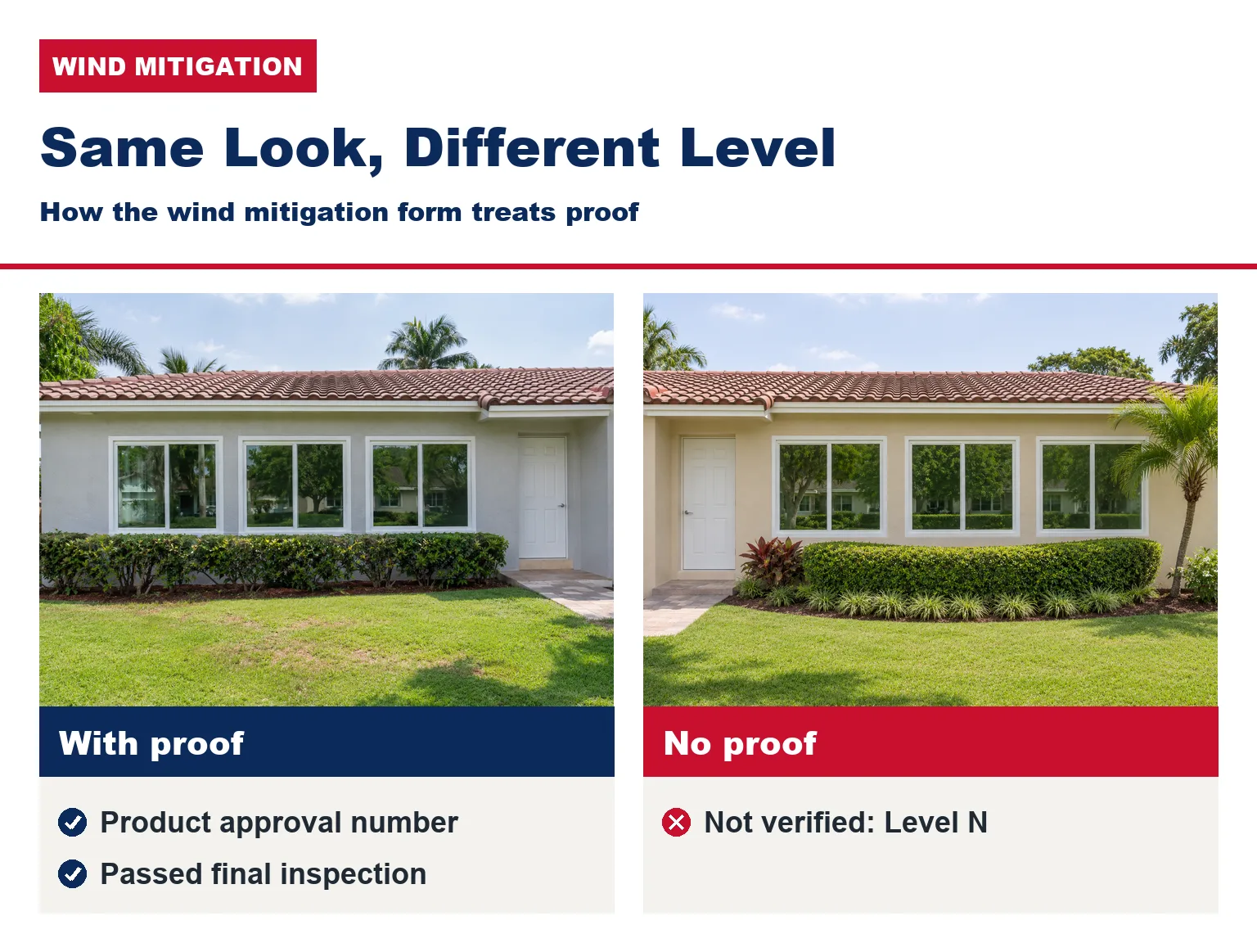
Florida’s wind mitigation form gives its top opening protection levels only to products the inspector can verify. The form, OIR-B1-1802, has a separate row for “Opening Protection products that appear to be A or B but are not verified.” That row is Level N, below both impact levels.
The form also says any documentation used to validate a feature “must accompany this form,” with at least one photograph or document as proof for each feature marked in questions 2 through 9. Opening protection is question 9.
So a house with real impact windows and no papers can land in the same level as unverified shutters. The next owner’s insurer reads that level when it sets wind mitigation credits.
If you are still deciding whether to upgrade before you list, compare home improvements that pay off before selling, and see the aluminum and vinyl ES Windows impact windows we install.
Step 1: Find the Window Permit and Check Its Final Inspection
Start with the building department for your address, because South Florida permit records are split between counties and cities. Look for the window or door permit and a passed final inspection.
Miami-Dade County
Miami-Dade’s building permit public records page says permit and inspection history can be searched free through its Building Permit Selection Menu. You need the permit number, process number or address.
The county keeps permit records for unincorporated areas. Its Microfilm and Plan Library says a folio number starting with “30” means unincorporated Miami-Dade; any other folio means you ask your city.
Broward County
Broward County’s Building Code Division regulates construction in unincorporated Broward and in the cities it contracts with. For an address inside a city with its own building department, search that city’s records.
In Fort Lauderdale, the city’s LauderBuild portal lets anyone run a basic record search without an account. The city’s tip for an address search: enter only the street number and street name.
Palm Beach County
Palm Beach County’s Planning, Zoning and Building Department (PZB) keeps records for unincorporated properties. Its search services page says the public can look up open permits online through ePZB, and PZB also runs certified searches for a fee, using the address and property control number (PCN).
A PCN that begins with anything other than 00 is in a city. The county search covers city addresses only for areas annexed from the county, so check a window permit there with your city’s building department.
Open or Expired Window Permit? How Florida Law Lets You Close It
Any owner can close an old permit, even one a previous owner or contractor pulled. Section 553.79(16), Florida Statutes, says a property owner may close a building permit “regardless of whether the property owner is the one listed on the application.” The law gives four routes:
- Hire a contractor. Keep the original contractor on the permit or hire a different Florida-licensed contractor to do the remaining work and get the inspections. A new contractor is liable only for its own work, not the original contractor’s defects.
- Act as owner-builder. The owner may take that role and becomes responsible for the work. Under Section 489.103(7), the owner-builder exemption does not cover a home improved for sale, except to finish a permit the listed contractor substantially completed, with the building department’s approval. See when a window or door replacement needs a permit.
- Expired but finished. If the work was substantially completed, as the local building department decides, an expired permit can be closed without a new one, and the remaining work can follow the code in force when the application was received.
- After 6 years. The building department may close a permit 6 years after it was issued, even without a final inspection, if it finds no apparent safety hazards.
Before you hire anyone to finish an old job, check the contractor’s Florida license status.
Planning to replace old or unverifiable windows before you list? Every USA Home Improvement project is permitted. Request a free impact window estimate or call (877) 554-6373.
Step 2: Match a Product Approval Number to Every Window and Door
Each impact window and door should trace to a Florida Product Approval number (FL#) or a Miami-Dade Notice of Acceptance (NOA). The form’s Levels A and B both require products listed “in the product approval system of the State of Florida or Miami-Dade County.”
Make a simple list: each opening, the product series and its approval number. Include the doors and the garage door, because the form counts them too. If a number is missing from your papers, ask the building department for the permit file.
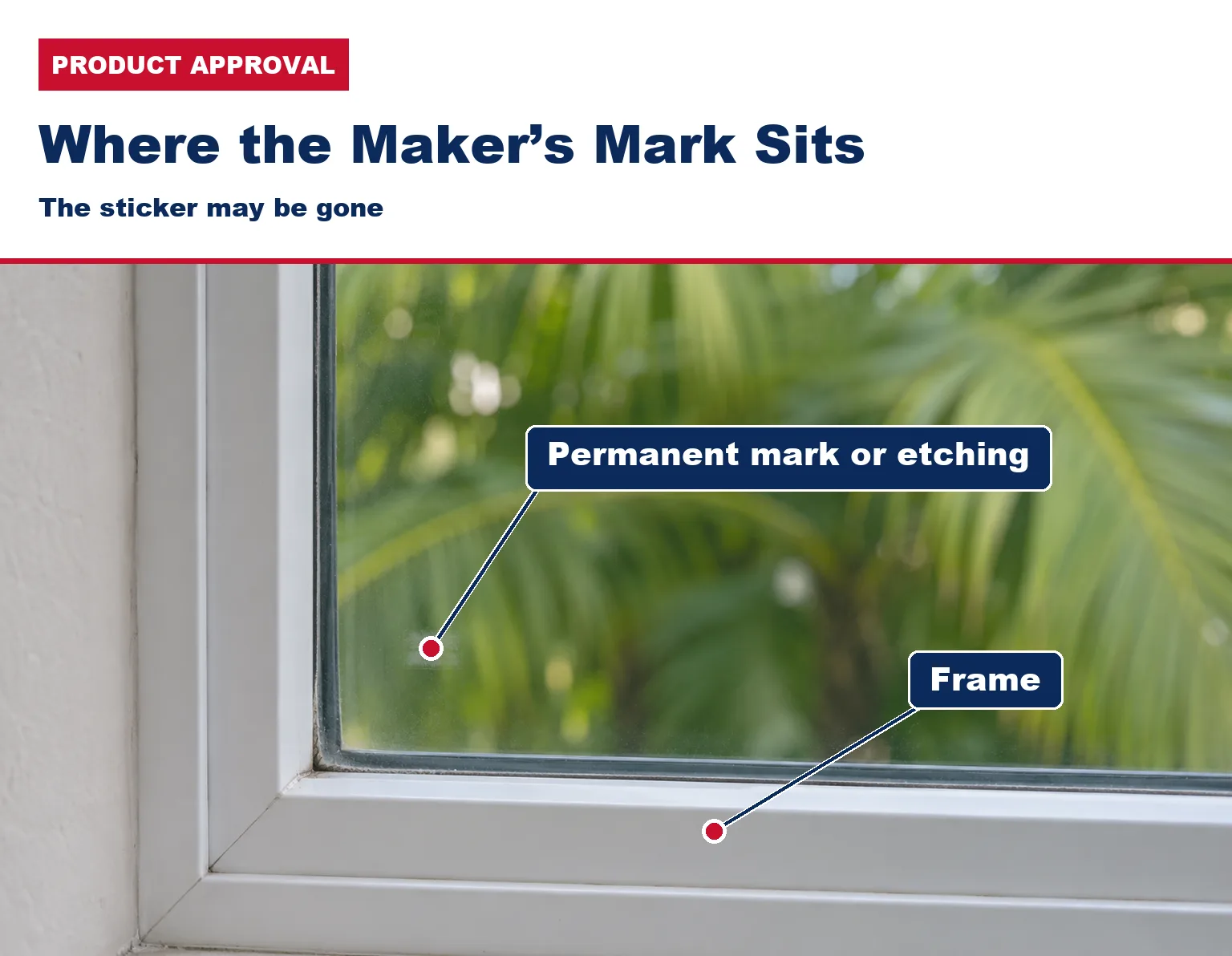
The sticker may be gone. Section R609.3 of the Florida Building Code, Residential lets the ratings and approval number sit on a temporary label that must stay on only until final approval. The permanent mark or etching stays and traces to the maker and product.
Our guide on confirming your openings are hurricane rated shows where to look and how to check a number online. USA Home Improvement customers can receive the Florida Product Approval number for each window and door on request.
Step 3: Read the Opening Protection Section of Your Wind Mitigation Form
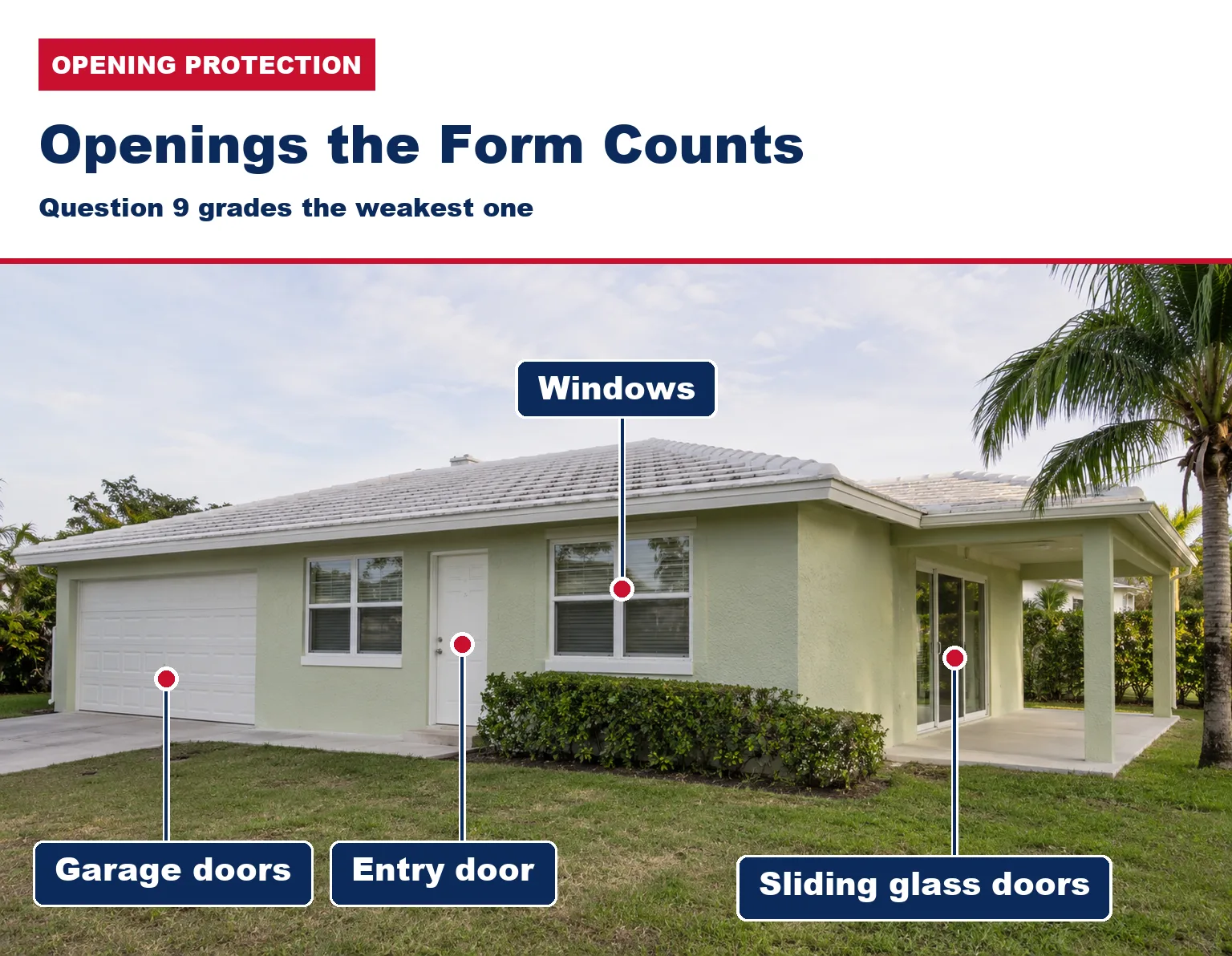
Question 9 of the wind mitigation form asks for the weakest form of wind-borne debris protection on the house. It covers windows, doors, sliding glass doors, skylights and garage doors, and the form says all openings must be in good condition.
| Level | What the form says | What it means for a seller |
|---|---|---|
| A | Verified cyclic pressure and large missile (9 lb. for windows and doors) | Top level; needs approval proof for every glazed opening |
| B | Verified cyclic pressure and large missile (4 to 8 lb.) | Impact level with a lighter test missile |
| C | Verified plywood or OSB meeting Table 1609.1.2 of the FBC 2007 | Panels, not impact products |
| N | Products that appear to be A or B but are not verified, or coverings that cannot be identified as A, B or C | Impact windows without proof can end up here |
| X | No windborne debris protection | One or more glass openings unprotected |
| Z | Damaged openings in need of repair or replacement | Fix or replace before the inspection |
The current edition, OIR-B1-1802 (Rev. 04/26), took effect April 1, 2026, according to the Florida Office of Insurance Regulation’s wind mitigation resources page. The form is valid for up to five years “provided no material changes have been made to the structure or inaccuracies found on the form.”
A report done before your new windows went in does not show them, so a new inspection can record the upgrade.
The form also warns that some items “may not qualify for a discount,” so the buyer’s insurer decides the credit. See which upgrades can lower homeowners insurance.
Step 4: Keep Invoices and Warranty Papers, and Check What Transfers
Invoices and contracts show who installed the products, when, and which series went into which opening. Keep them with the permit record and the wind mitigation form.
Warranty terms vary by company and product. Read yours for the transfer steps before you list. USA Home Improvement offers a 15-year warranty and a 1-year labor warranty on most jobs, plus a transferable warranty.
Lost the Paperwork? How to Rebuild the Proof Before You List
Missing papers can often be rebuilt. Work in this order:
- Search the permit record for your address (Step 1) and ask for the permit file. In unincorporated Miami-Dade, the Microfilm unit handles plan requests.
- Call the installer for the invoice and the approval number of each product.
- Find the maker from the permanent mark or etching on the frame or glass, then match the product to its approval with the manufacturer’s help.
- Book the inspection once the papers are together, because the form needs at least one photo or document per feature.
If an opening still cannot be verified, or one is damaged (see what to do about a cracked impact window), the form records the weakest opening for the house.
Replacing that opening with a permitted impact window or one of our impact sliding glass and entry doors gives the inspector a permit and an approval number to check.
Buying a Home With Impact Windows: What to Ask the Seller For
Buyers should ask for the same four things and check them. Search the permit by address in the county or city system above, confirm a passed final inspection, and match each approval number to the window or door in that opening.
Ask for the date and edition of any wind mitigation report and its opening protection answer. A seller’s word is not proof; the form has a level for products that only appear rated. Our list of questions to ask during a Florida home inspection covers the roof and insurance side.
Selling a Home With Impact Windows: FAQs
Is a wind mitigation report on the older form still good when I sell?
The Florida Office of Insurance Regulation says the form is valid for up to five years when no material changes are made and no inaccuracies are found. The current edition took effect April 1, 2026, so ask the buyer’s insurance agent whether it accepts a report on the earlier edition.
What if the impact windows were already there when I bought the house?
Search the permit by address as in Step 1; you do not need to be the owner who applied. If it is still open, Section 553.79(16) lets you close it even though you are not on the application, and the permit file can hold the approval numbers.
Do the garage door and a solid front door count on the form?
Yes. Doors and garage doors with glass are graded with the windows, and solid doors get their own grade.
In a Level A house, A.1 means every solid door is verified for impact, A.2 means one is verified only for wind pressure (Level D), and A.3 means one rates lower. Compare impact garage door options.
Can a buyer be fined for a previous owner’s open permit?
Not for that reason alone. Section 553.79(17) says a building department may not deny a permit to, cite, fine or charge fees to an arms-length buyer solely because a previous owner’s permit was not closed.
The department keeps its remedies against the owner and contractor listed on the permit, so close it before you sell.
Build the Proof Folder Before the Listing Goes Live
Start with the permit search, because closing an old permit can take the longest. Then match the approval numbers, gather invoices and warranty papers, and book the wind mitigation inspection last.
For a USA Home Improvement project, manufacturing takes about 6 to 8 weeks depending on project scope, installation averages 1 to 2 days, and the whole process takes about 3 months start to finish, though it can vary.
Plan replacements well before your listing date. Our impact window guide for homeowners planning ahead covers styles and glass.
Compare financing options for window and door projects. Financing may be available for qualified homeowners through independent third-party providers. Terms, eligibility and availability depend on the program and location.
USA Home Improvement is licensed (CGC1526707) and insured and has served Florida homeowners for more than 15 years. We sell ES Windows exclusively, and our installation team holds direct certification from the manufacturer.
Get a free estimate or call (877) 554-6373.