Skip to content

To check a contractor license in Florida, search the license number or name on MyFloridaLicense.com, the state Department of Business and Professional Regulation (DBPR) site. Then confirm three things: the status reads “Current, Active”, the business on the license matches your contract, and the license type fits the job.
The search is free and takes a few minutes. This guide walks through each step, explains what the record means, and lists the red flags Florida law names, which matter most after a storm.
How to Check a Contractor License on MyFloridaLicense.com
DBPR’s construction industry instructions say you need one of three things to start: the license number, the contractor’s name or the business name. The license number is the fastest, and Florida law requires it on every bid and contract.
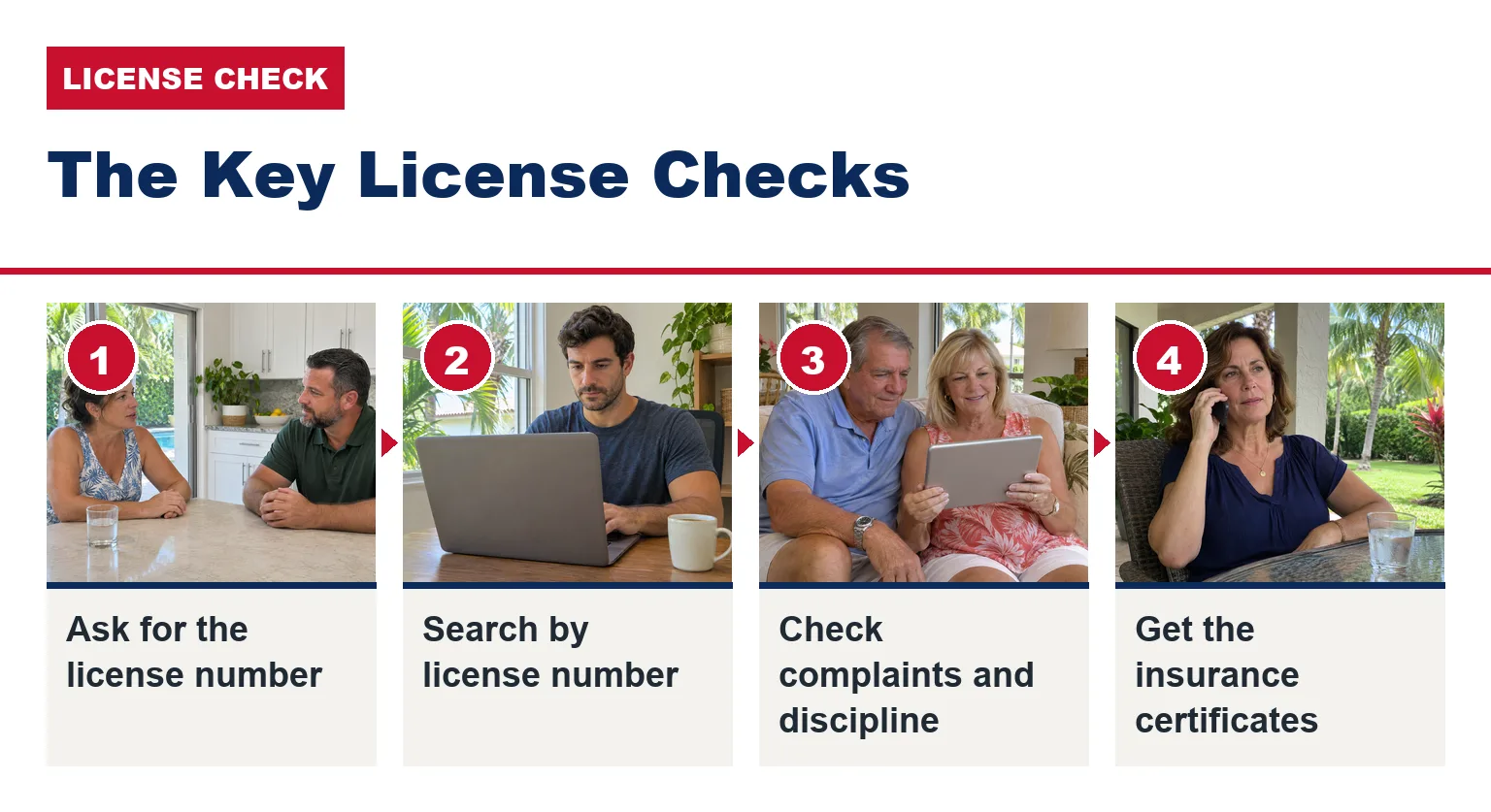
- Ask for the license number. Get it from the estimate, the contract or the company’s ads.
- Open the search. On MyFloridaLicense.com, click “Verify a License”, choose “Search by License Number” and enter the number.
- Open the record. DBPR lists licenses that match or are similar to the number. Click each one to see the licensee’s name and the business name tied to that license.
- Read the status and expiration date. The next section explains each status.
- Search the person too. If you started with the business name, DBPR says to repeat the search with the contractor’s individual name, to confirm that person properly qualifies the business.
- Check complaints and discipline. The search results page says to click the name for more information, including any complaints or discipline.
Step 5 matters because a Florida contractor license is issued to a person. DBPR explains that a company must be qualified by a licensed individual, and the approved business name appears on that individual’s license. A sole contractor without a business name shows “INDIVIDUAL” instead.
Try it with our number. USA Home Improvement, which installs ES Windows aluminum and vinyl impact windows for Florida homes and impact doors, is licensed under CGC1526707. Search it the same way you would search any company that quotes your job.
For the wider buying picture, from products to county rules, see our impact window buying guide.
What “Current, Active” and Other License Statuses Mean
A license you can hire on reads “Current, Active”. DBPR’s status glossary uses two words: a primary status for the license itself and a secondary status for whether the holder may work under it.
| Status on the record | What DBPR says it means |
|---|---|
| Current, Active | Up to date with DBPR requirements and allowed to operate under the license |
| Inactive | Met the requirements but not allowed to work under this license |
| Delinquent, Invol. Inactive or Lic Expired | Did not complete a timely renewal |
| Probation | Placed on probation as part of a disciplinary action or as a condition of licensure |
| Suspended | Work privileges suspended for a set period |
| Revoked or Null & Void | No longer meets requirements, or failed to renew several times and would have to reapply |
Look at the expiration date too. Under section 489.115 of the Florida Statutes, contractors renew every 2 years, so a date that passes before your job ends is worth a question. The licensure date shows when the person was first licensed.
Certified vs Registered Contractors: Where Each Can Work
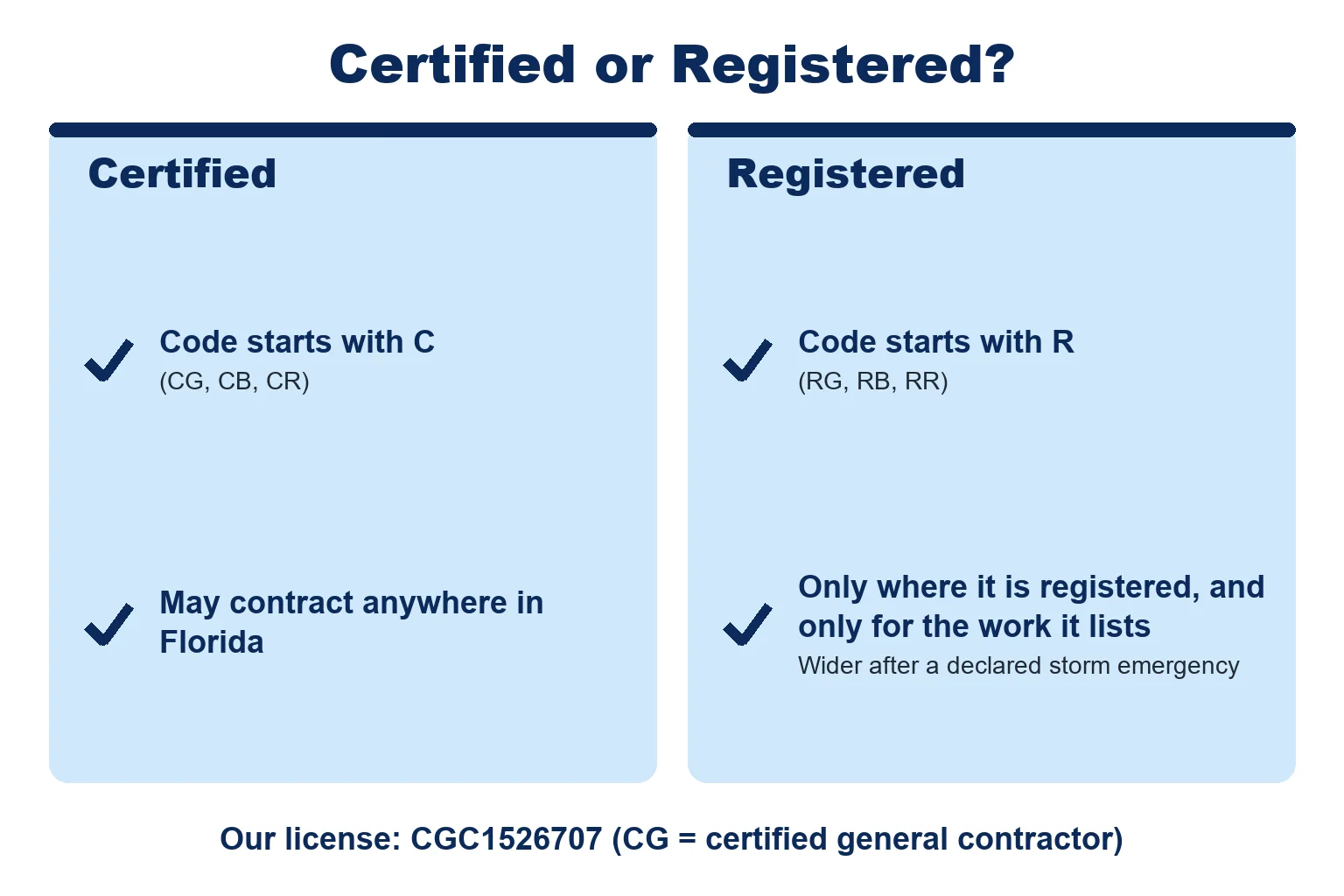
A certified contractor can work anywhere in Florida; a registered contractor can work only where it is registered. Section 489.105 defines a certified contractor as one holding a state certificate of competency who may contract in any jurisdiction in the state.
A registered contractor met a local competency requirement instead, and section 489.105 says registered contractors may contract only in those jurisdictions. Section 489.117 adds that registration covers only the type of work it lists.
You can tell them apart from the license code. DBPR’s construction industry page says certified occupation codes begin with “C” and registered codes begin with “R”. For a registered contractor, check that your city or county is one where it may work.
Storms widen that area. After a natural disaster, section 489.117(5) also lets a registered contractor work in the declared emergency area, only for the type of work its registration covers, until 24 months after the emergency ends.
License Types: General, Building, Residential and Specialty
The letters after the C or R tell you the license type, and each type has a set scope of work. Section 489.105 and DBPR describe the main types this way:
- General contractor (CG or RG): services unlimited as to the type of work, with exceptions the statute lists.
- Building contractor (CB or RB): commercial buildings and homes up to three stories, plus remodeling, repair or improvement of any size building when the work does not affect structural members.
- Residential contractor (CR or RR): one-, two- and three-family homes of no more than two habitable stories above no more than one uninhabitable story.
- Specialty contractor (SCC or RX): limited to one phase of construction in a category set by board rule. These codes do not follow the C/R pattern: SCC is certified, RX is registered.
Our license, CGC1526707, starts with CG, the code DBPR uses for a certified general contractor. Do not judge a license type by its name alone; ask the contractor which license covers your job and confirm the type on the record.
Your building department is the final check. Section 489.119(5)(a) requires the contractor’s number on every building permit application, and the permit office verifies it. Read when a window replacement needs a permit.
How to Find Complaints and Discipline on a License
Open the license record by clicking the contractor’s name in the search results; DBPR shows complaints and discipline there. A record with no cases is a good sign, while a status of Probation, Suspended or Revoked is a reason to open the record and read why before you hire.
Know what DBPR can and cannot do. Its complaint page says discipline is administrative, such as a reprimand, fine, probation, suspension or revocation. DBPR cannot represent you in civil matters to recover fees paid, and some price, contract and workmanship disputes fall outside its authority.
A license check is a minimum, not proof of quality. DBPR’s Hire Smart Florida guide also tells homeowners to get several written estimates, verify references and look beyond price.
Checking companies for an impact window or door project? Book a free estimate with a licensed team or call (877) 554-6373, and look up our license before the visit.
Insurance Certificates and the Local Business Tax Receipt
A current license means the contractor swore to having insurance, but you should still see the certificates. Section 489.115(5)(a) requires an affidavit of workers’ compensation, public liability and property damage insurance before a license is issued or renewed.
Ask the contractor’s insurance agent to send the certificates to you directly, and check the dates against your project. Florida’s workers’ compensation law, section 440.02, covers construction employers with one or more employees.
Our guide on what to verify before hiring a window company lists each policy to ask for.
A local business tax receipt is a different document. Under section 205.022, it is the fee a city or county charges for the privilege of doing business there. It is not a contractor license.
Section 489.119(4) says a certified contractor’s business tax receipt carries the state license number, so a receipt points you to the license; it is not the license itself. Only the DBPR record shows whether that license is current and active.
Red Flags After a Storm: What Florida Law Says
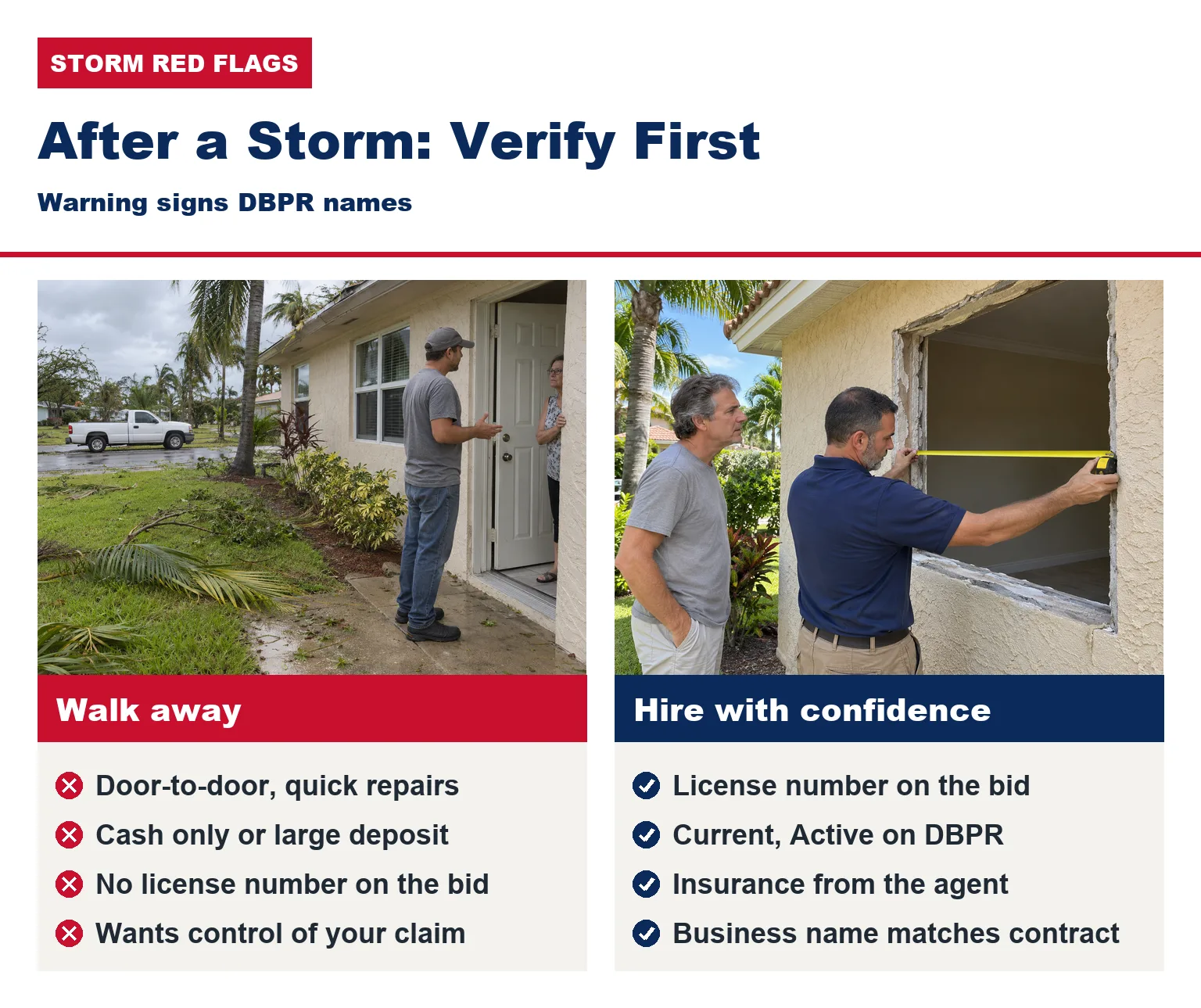
After a storm, verify before anyone touches your home, because Florida punishes unlicensed work harder during an emergency. Under section 489.127(2)(c), unlicensed contracting while a governor’s state of emergency is in effect is a third-degree felony.
The law also gives you easy checks:
- The number must be on the paperwork. Section 489.119(5)(b) requires the license number in each offer of services, proposal, bid, contract and advertisement.
- And on a marked truck. If a vehicle shows the company’s name, section 489.119(5)(c) requires the license number to be displayed legibly with it.
- Contractors do not adjust claims. Section 489.147(2)(d) bars a contractor from interpreting your policy, advising you on coverage or adjusting your claim unless it holds a public adjuster license.
DBPR’s storm recovery page warns about door-to-door crews pushing quick repairs, large upfront deposits and documents that hand over control of your insurance claim. Its Hire Smart list adds cash-only payment, payments in a person’s name instead of a business, and being asked to pull permits yourself.
To find licensed help, DBPR points homeowners to the state’s Disaster Contractors Network. Before you sign, run the quote through these red flags that rule out a window quote.
If a window was damaged, start with the first steps for a cracked impact window, then follow the path from insurance claim to new windows.
Contractor License FAQs
What happens if I hire an unlicensed contractor in Florida?
Florida law limits the contractor, but it also limits your safety net. Section 489.128 makes the contract unenforceable by the unlicensed contractor and gives it no lien rights. But the Florida Homeowners’ Construction Recovery Fund only covers losses caused by a licensed contractor, and DBPR warns of failed inspections and lost deposits.
Why is the license in a person’s name and not the company’s?
Florida licenses individuals. Under section 489.119, a company contracts through a licensed qualifying agent, and DBPR prints the approved business name on that person’s license. Search both the business and the person, and make sure the business on the record matches the one on your contract.
How often do Florida contractor licenses renew?
Every 2 years, under section 489.115(4)(a). Each renewal also requires continuing education and a new insurance affidavit. Check the expiration date on the record, and if it falls during your project, ask the contractor about the renewal.
How do I report an unlicensed contractor?
File a report with DBPR online through its complaint page, which accepts complaints against licensees and against anyone suspected of unlicensed activity. Choose “Construction Industry” from the list. DBPR’s Hire Smart guide says reporting helps protect others in your community.
Does a valid license mean the contractor does good work?
No. A license shows the contractor met state requirements and is allowed to work. Quality still needs checking: compare written estimates, call references, ask who installs the product, and get every warranty and payment term in writing.
Check Us the Same Way You Check Anyone
Before you sign with any company, take five minutes: search the number, read the status, match the business name, open the complaints link and get the insurance certificates. If any check fails, walk away.
USA Home Improvement is licensed (CGC1526707) and insured and has served Florida homeowners for more than 15 years. Every project we install is permitted, and you can receive the Florida Product Approval number for each window and door on request.
We sell ES Windows exclusively, and our installation team holds direct certification from the manufacturer.
Get a free estimate or call (877) 554-6373.