Skip to content

The five questions to ask during a home inspection in Florida are: how old is the roof, are the windows and doors impact rated, will the home pass a 4-point inspection, what will the wind mitigation report show, and which problems need a licensed pro before you close.
Each answer affects your repair budget and your insurance quote. Ask them while your inspector is still on site and the inspection period in your contract is still open. This guide explains what each answer means, which document proves it, and what to do when the answer is bad.
Question 1: How Old Is the Roof, and How Much Life Is Left?
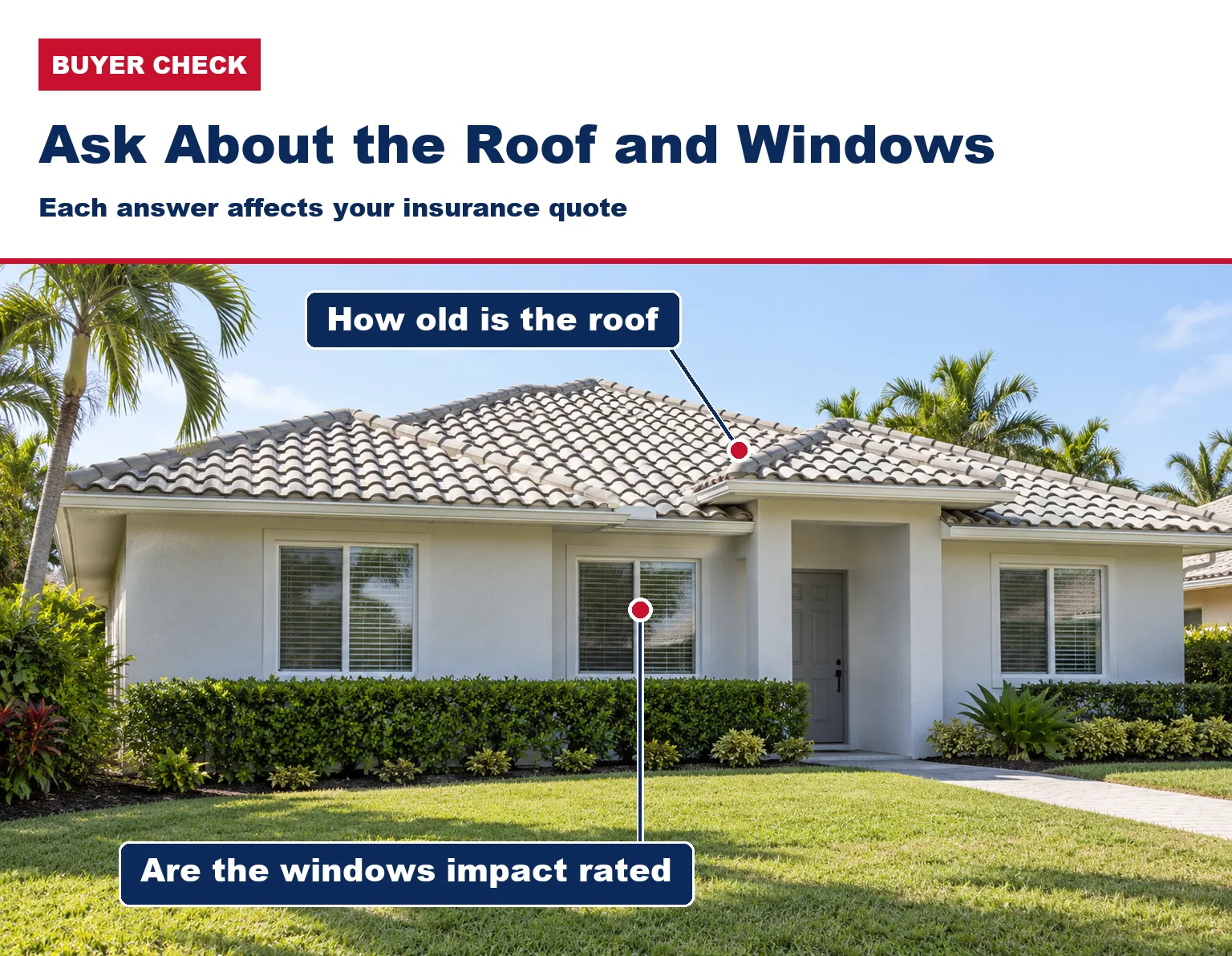
Roof age is the first question because it can decide whether you can insure the home. Ask for the date of the last full roof replacement and the roofing permit, then ask the inspector how many years of useful life the roof has left.
Florida law sets a floor. Under section 627.7011(5), Florida Statutes, an insurer may not refuse to issue or renew a homeowner’s policy solely because of the age of a roof that is less than 15 years old.
For a roof at least 15 years old, the insurer must let the homeowner get a roof inspection, at the homeowner’s expense, by an authorized inspector the insurer approves, before requiring replacement.
If that inspection shows 5 years or more of useful life left, the insurer may not refuse the policy solely because of roof age.
Roof age under that law counts from the last date 100 percent of the roof surface was built or replaced, or from the first date of a partial replacement when later partial jobs together covered the whole roof.
A patch repair does not reset the roof’s age, so ask for the permit and the extent of every past roof job.
Insurers also set their own rules. Citizens Property Insurance, for example, asks for proof of at least five years of remaining useful life on shingle roofs older than 25 years and on tile, metal or other hard roofs older than 50 years.
If the answer is “near the end of its life,” get a roofing estimate before the inspection period ends. Our list of signs a roof needs replacing, not repair helps you read the report, and our roof replacement service for South Florida homes can price the job.
Question 2: Are the Windows and Doors Impact Rated, and Is There Proof?
Ask whether every window and exterior door is impact rated, and ask the seller for the paperwork that proves it. A seller’s “they’re hurricane windows” is not proof, because a window can carry a wind pressure rating with no impact rating at all.
Section R609.3 of the Florida Building Code, Residential says a window label shows the design pressure rating and the “impact-resistance rating if applicable,” plus the Florida Product Approval or Miami-Dade approval number. The ratings may sit on a temporary sticker that is removed after inspection, while a permanent mark or etching names the maker.
So the best proof is on paper: the window permit, the approval numbers, and any invoice that names the product series. Broward and Miami-Dade make up the High-Velocity Hurricane Zone, so there the approval should show the product is approved for HVHZ use.
The answer matters twice. Openings without impact protection need shutters before every storm, and they can lower the wind mitigation result covered in Question 4.
Our guide on how to tell if windows are hurricane rated shows where to look on the glass and frame. If the home has no impact protection, see the ES Windows impact windows we install and our impact entry, French and sliding doors.
Question 3: Will the Home Pass a 4-Point Inspection for Insurance?
Ask your insurance agent whether the insurer needs a 4-point inspection, and ask your inspector whether anything would fail it. A 4-point inspection checks only the roof, electrical, plumbing and HVAC systems, and insurers use it to decide whether a home is insurable.
Citizens requires one for property owner, dwelling and mobile home applications on homes more than 20 years old, according to its inspection requirements. Other insurers set their own age rules, so ask your agent for the exact ones.
Timing matters too. The state’s four-point guide says the report generally must be dated within 30 days before the insurance application, but each insurer sets its own window, so ask your agent before you book it.
The Citizens 4-Point Inspection Form shows what gets flagged. On the electrical side it asks about cloth wiring, active knob and tube, aluminum branch wiring and hazards such as exposed wiring, double taps or scorching.
On plumbing, it records the pipe types, including galvanized and polybutylene, any active or prior leak, and whether the water heater has a temperature pressure relief valve. For HVAC, it asks if the system is in good working order and whether the drain pan or condensate line shows blockage or leakage.

The roof section asks for the covering material, roof age, remaining useful life, the date of the last roofing permit and any signs of leaks in the attic or ceilings. Photos of each side of the house and each roof slope go with the form.
A Florida-licensed inspector must complete, sign and date it. Citizens lists a general, residential or building contractor, a building code inspector or a home inspector, and a trade professional such as an electrician may sign only the section for that trade.
Repairs can come before coverage. The Florida Department of Financial Services’ four-point inspection guide says homeowners may need to complete repairs before an insurer will issue a policy, so price any flagged item before closing.
Question 4: What Will the Wind Mitigation Report Show?
Ask the seller for any existing wind mitigation report, and ask your inspector what a new one would show. The report is the state’s Uniform Mitigation Verification Inspection Form, OIR-B1-1802, and insurers use it to set wind mitigation discounts.
Florida law backs those discounts. Section 627.0629, Florida Statutes, says residential property insurance rate filings must include actuarially reasonable discounts, credits or other rate differentials for homes with features shown to reduce windstorm loss.
The form records the building code in force when the home was permitted, the region by design wind speed, roof slope, roof covering, roof deck attachment, roof-to-wall attachment, roof shape, secondary water resistance and opening protection. Each feature marked from region through opening protection needs at least one photo or document as proof.

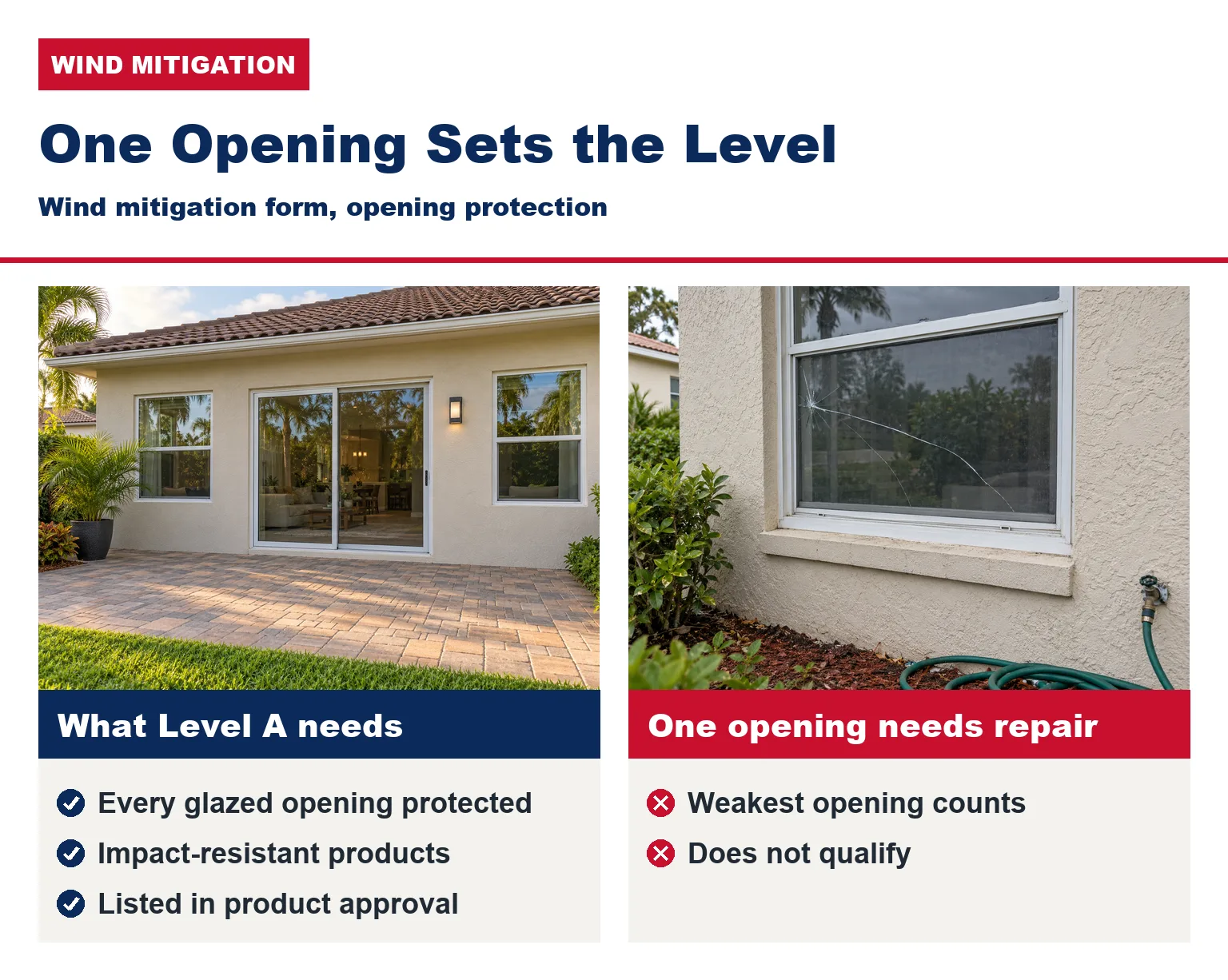
Opening protection is where windows and doors count. The form asks for the weakest form of wind-borne debris protection on the home, across windows, entry doors, sliding glass doors, skylights and garage doors, so one unprotected opening sets the level for the whole house.
The top level, Level A, needs every glazed opening protected with impact-resistant coverings or products listed in the Florida or Miami-Dade product approval system that pass cyclic pressure and 9-pound large missile tests (4.5 pounds for skylights).
The form also states that homes with openings that need replacement do not qualify for wind mitigation rate differentials, the credits insurers give, regardless of other features. A cracked or failing window can cost more than the price of the glass.
A completed form is valid for up to five years if no material changes are made to the structure and no inaccuracies are found. See which upgrades can lower your insurance premium, and our guide to impact windows in South Florida for products and costs.
Question 5: Which Problems Need a Licensed Pro Before You Close?
Ask the inspector to sort every finding into three groups: safety hazards, problems that need a licensed specialist, and simple maintenance. A loose cabinet door and a leaking roof are both “findings,” but only one changes your budget.
For each serious item, ask how far the damage goes, what likely caused it, and which trade should look at it. An inspector reports what is visible, so a stain on a ceiling may need a roofer, a plumber or both to find the source.

Water deserves the most questions in South Florida. Ask where the moisture came from, whether it is still active, and what was repaired, then read our guide on how to stop moisture and mold at home before you decide.
Get written estimates from licensed contractors while you can still negotiate. Check each license on the Florida DBPR license search, and use the estimates to ask the seller for a repair, a credit or a lower price.
Last, ask what must be fixed before you move in. A roof leak, unsafe wiring or a failed water heater can delay your move, while painting and small repairs can wait until you live there.

Home Inspection Questions: Quick Answers
Is a 4-point inspection the same as a home inspection?
No. The Florida Department of Financial Services guide says a 4-point inspection is limited to the roof, electrical, plumbing and HVAC systems. A full home inspection covers much more, so many buyers order the full inspection for the purchase and, when the insurer asks for one, a 4-point for the insurance application.
Can I use the seller’s wind mitigation report?
Ask your insurance agent. The form is valid for up to five years when the structure has no material changes and the form has no inaccuracies, but the insurer decides what it accepts.
If the seller replaced the roof or windows after the report, a new inspection can record them. Our list of upgrades sellers make before listing a home covers common pre-sale projects.
Who can sign a wind mitigation form?
Section 627.711(2), Florida Statutes, lists who may sign. The form names home inspectors with the required hurricane mitigation training, certified building code inspectors, licensed general, building or residential contractors, professional engineers and architects, plus others the insurer recognizes as qualified.
How much does a 4-point inspection cost?
The Florida Department of Financial Services guide says a standalone 4-point inspection may typically range from $100 to $300, and the price may be included when it is done with a home inspection. Compare quotes from several licensed inspectors.
Turn the Inspection Answers Into a Plan
If the roof or openings come back weak, decide before closing whether to negotiate, insure the home as it is, or plan the upgrade right after you move in.
For impact windows and doors from USA Home Improvement, manufacturing takes about 6 to 8 weeks depending on project scope, installation averages 1 to 2 days, and the whole process takes about 3 months start to finish, though it can vary.
USA Home Improvement sells ES Windows exclusively, every project is permitted, and customers can receive the Florida Product Approval number for each window and door on request. Keep those numbers for your next wind mitigation inspection.
Financing options for window and roof projects may be available for qualified homeowners through independent third-party providers. Terms, eligibility and availability depend on the program and location.
USA Home Improvement is licensed (CGC1526707) and insured and has served Florida homeowners for more than 15 years.
Get a free estimate or call (877) 554-6373.