Skip to content

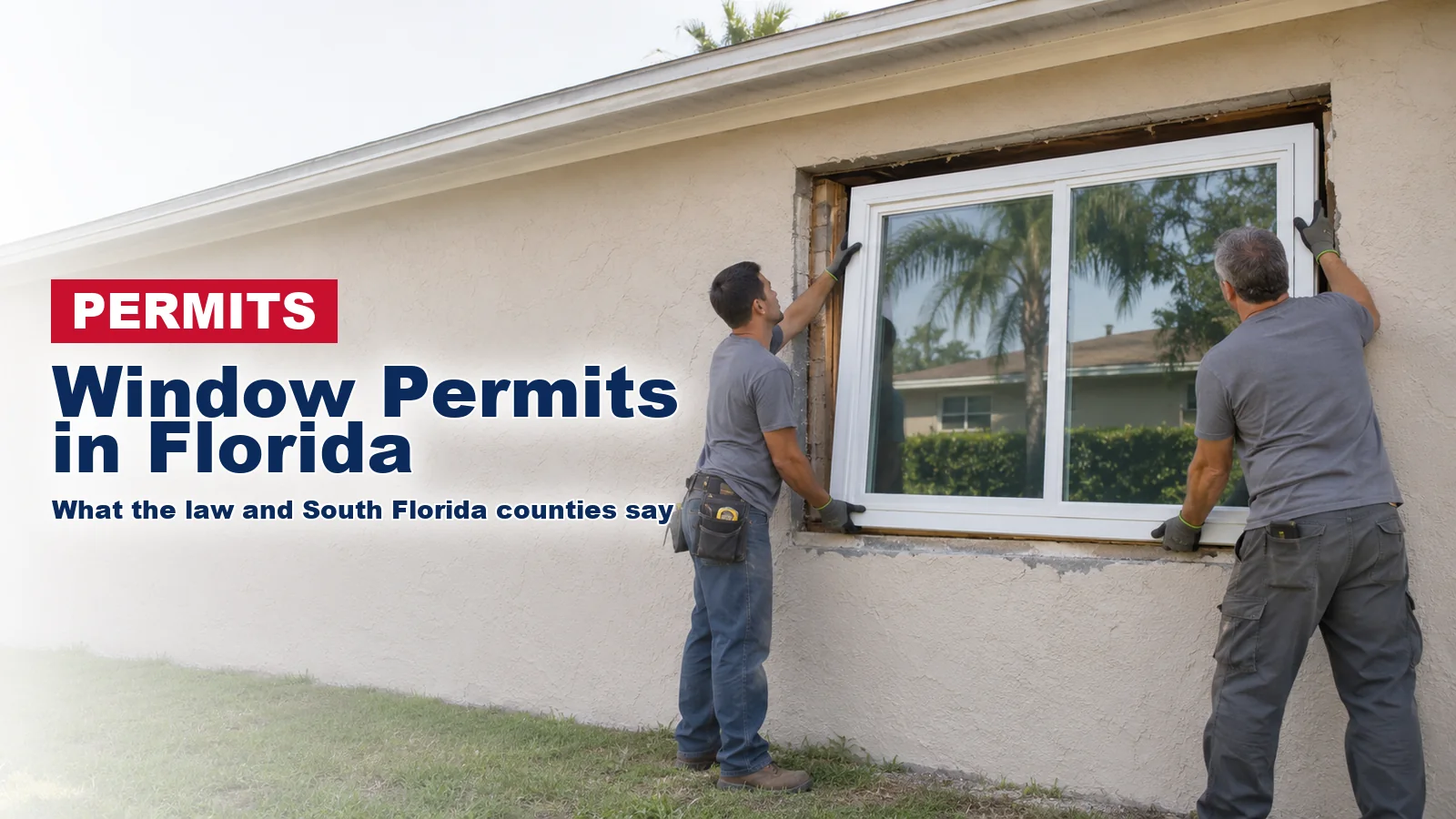
Yes. In South Florida, plan on a building permit for every window or exterior door replacement, meaning the whole unit with its frame, even a same-size swap. Florida law requires a permit to alter or repair a building, and South Florida permit offices treat these replacements as permit work.
A 2026 change to state law created a permit exemption for small jobs under $7,500, but it rarely covers windows or doors. Below: what the law says, what each county asks for, when you can pull your own permit and what skipping it can cost.
What Florida Law and the Building Code Say About Window and Door Permits
Florida’s permit rule starts in Section 553.79 of the Florida Statutes. It says it is unlawful to “construct, erect, alter, modify, repair, or demolish any building” in Florida without first getting a permit from the local enforcing agency, which for a home is your city or county building department.
The Florida Building Code agrees. Section 105.1 of the Building volume requires an owner who intends to “alter, repair” a building, or to install or replace impact-resistant coverings such as shutters, to “first make application to the building official and obtain the required permit.”
The code’s list of work that needs no permit (Section 105.2) names only gas, mechanical and plumbing items, such as a portable heater. Windows and exterior doors are not on it. Ordinary minor repairs can skip a permit only with the building official’s approval, under Section 105.2.2.
Unincorporated Miami-Dade’s permit exemptions page shows where that line falls. Replacing exterior door slabs or window glass panes is a minor repair, but “Window assembly replacement requires a permit,” and so does a door “together with door frame.”
Does the New $7,500 Permit Exemption Cover Window or Door Replacement?
Usually not. Since July 1, 2026, Section 553.79(1)(g), added by HB 803, has required local governments to exempt the owner of a single-family dwelling from a permit for “any work valued at less than $7,500.” The owner or contractor must send a written request with the contract.
The same paragraph lists what the exemption does not cover: any property partly or entirely in a flood hazard area as the Florida Building Code defines it, and any “electrical, plumbing, structural, mechanical, or gas work.” A project also cannot be split up to stay under the limit.
South Florida permit offices apply those limits to windows and doors directly:
- Miami-Dade County: the county’s exemptions page lists “Structural work (including windows, doors, wind-resistant fences, and sheds)” as work that still requires a permit.
- Fort Lauderdale: the city’s HB 803 permitting update lists window replacements as not exempt, because windows are part of the building envelope and their connection to the structure is critical, “so they are considered structural work and require a permit.”
- Palm Beach County: the county Building Division’s HB 803 notice says the exemptions “do NOT apply within Palm Beach County,” because all of the county is designated a flood hazard area under the Florida Building Code.
- Condos and apartments: Miami-Dade applies the exemption to single-family homes, duplexes and townhouses, and says units in multi-family buildings do not qualify.
Miami-Dade County: What a Window or Door Replacement Permit Needs
Miami-Dade County’s how to apply for a permit page says “exterior repair work like the replacement of windows, doors, siding or a new roof needs a permit.” The county issues permits for unincorporated addresses, whose folio numbers start with “30”; each city in the county has its own building official.
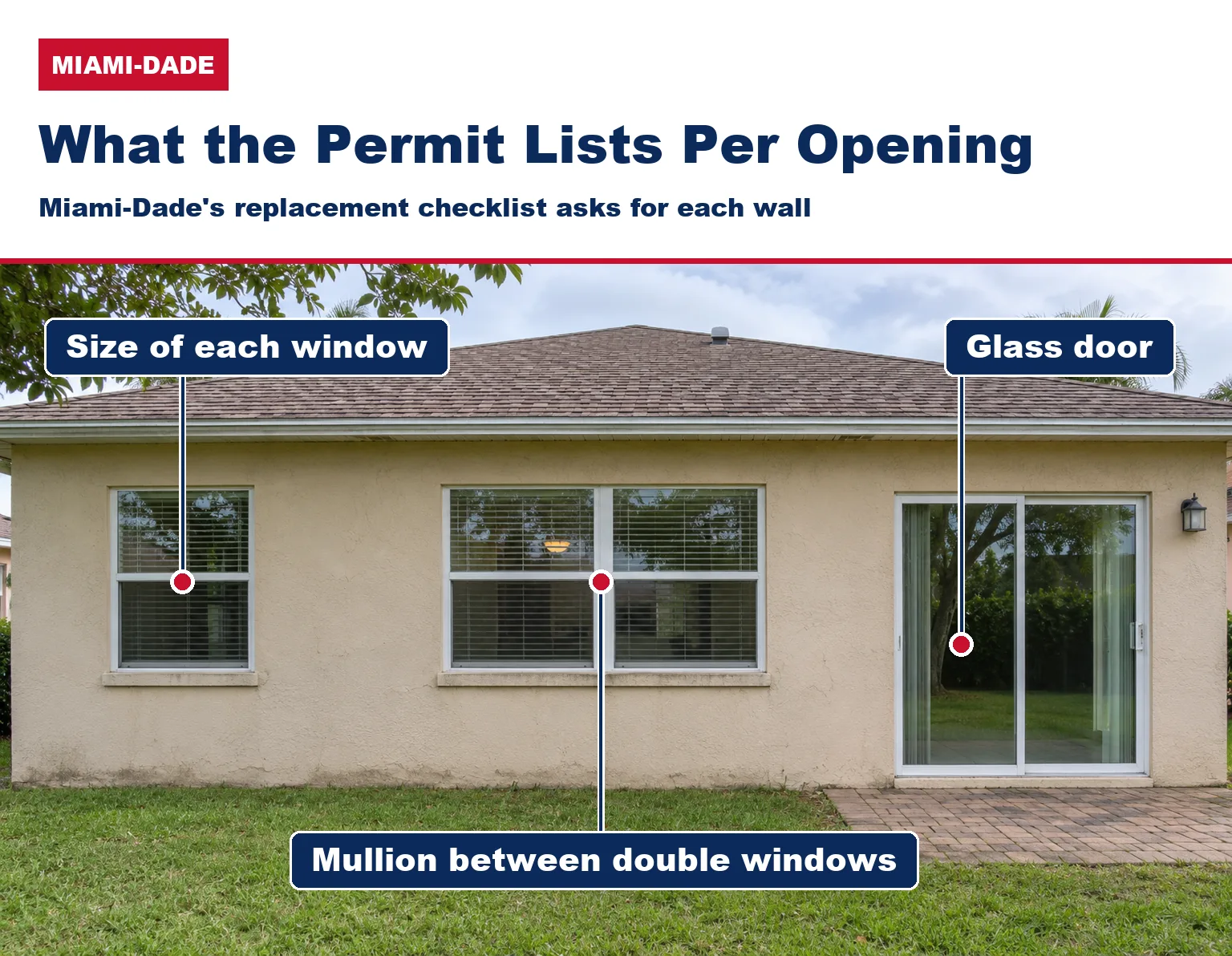
For replacement windows, mullions and glass doors, the county’s windows, shutters and doors checklist asks for three items, and says incomplete or illegible applications will not be accepted:
- A building permit application with the total square footage of windows or glass doors.
- A front view (elevation) of each exterior wall showing the size of each window, the product approval number of each window and the size of any mullion between double windows.
- The current Notice of Acceptance (NOA) for each window, glass door or mullion. The county says Florida Building Commission product approvals are acceptable.
Solid exterior doors and garage doors have their own checklists.
Miami-Dade also offers a fast-track window and door permit for detached one- and two-family homes and townhouses up to a 30-foot mean roof height. Its owner and contractor disclosure statement limits it to the “exact changeout of existing openings,” and says expired, out-of-code-cycle approvals “will not be acceptable.”
The same disclosure notes when replaced openings must meet the impact requirements, a rule our guide on impact window rules for replaced openings explains in full.
USA Home Improvement installs ES Windows aluminum and vinyl replacement impact windows, and customers can receive the Florida Product Approval number for each window and door on request.
Broward Example: Fort Lauderdale’s Window and Door Permit Checklist
In Broward County, permits come from your city’s building department, or the county in unincorporated areas. Fort Lauderdale shows what a city checklist asks for. Its Windows and Doors Permit Checklist calls for a building permit reviewed by the Building and Flood review stops.
- A copy of the Miami-Dade County Notice of Acceptance for each product, with the relevant information circled.
- An original recorded Notice of Commencement if the job cost is over $5,000.
- Design wind pressures from the ASCE 7 chart for buildings under 3 stories; otherwise the designer of record supplies them.
- The Broward County Uniform Retrofit Window & Door Schedule, which the checklist says applies to replacement window and door permits in all Broward jurisdictions as of July 1, 2020.
The checklist adds that windows and doors “must be impact resistant unless shuttered.” That includes glass doors, so plan impact-rated entry, French and sliding doors into the same permit when you replace them with your windows.
Palm Beach County: Permits Unchanged and Product Approval Required
The county Building Division’s July 1, 2026 notice was blunt: “Current permit requirements remain unchanged in Palm Beach County.” Window and door replacements still go through a permit, issued by the county for unincorporated addresses or by your city’s building department.
The county’s product approval page explains that the Florida Product Approval System has applied since October 1, 2003. Its list of covered product categories includes windows and exterior doors, sliding and swinging.
Want to know what your openings need and how the permit fits your timeline? Ask for a free impact window and door estimate or call (877) 554-6373.
From Application to Final Inspection: What the Permit Involves
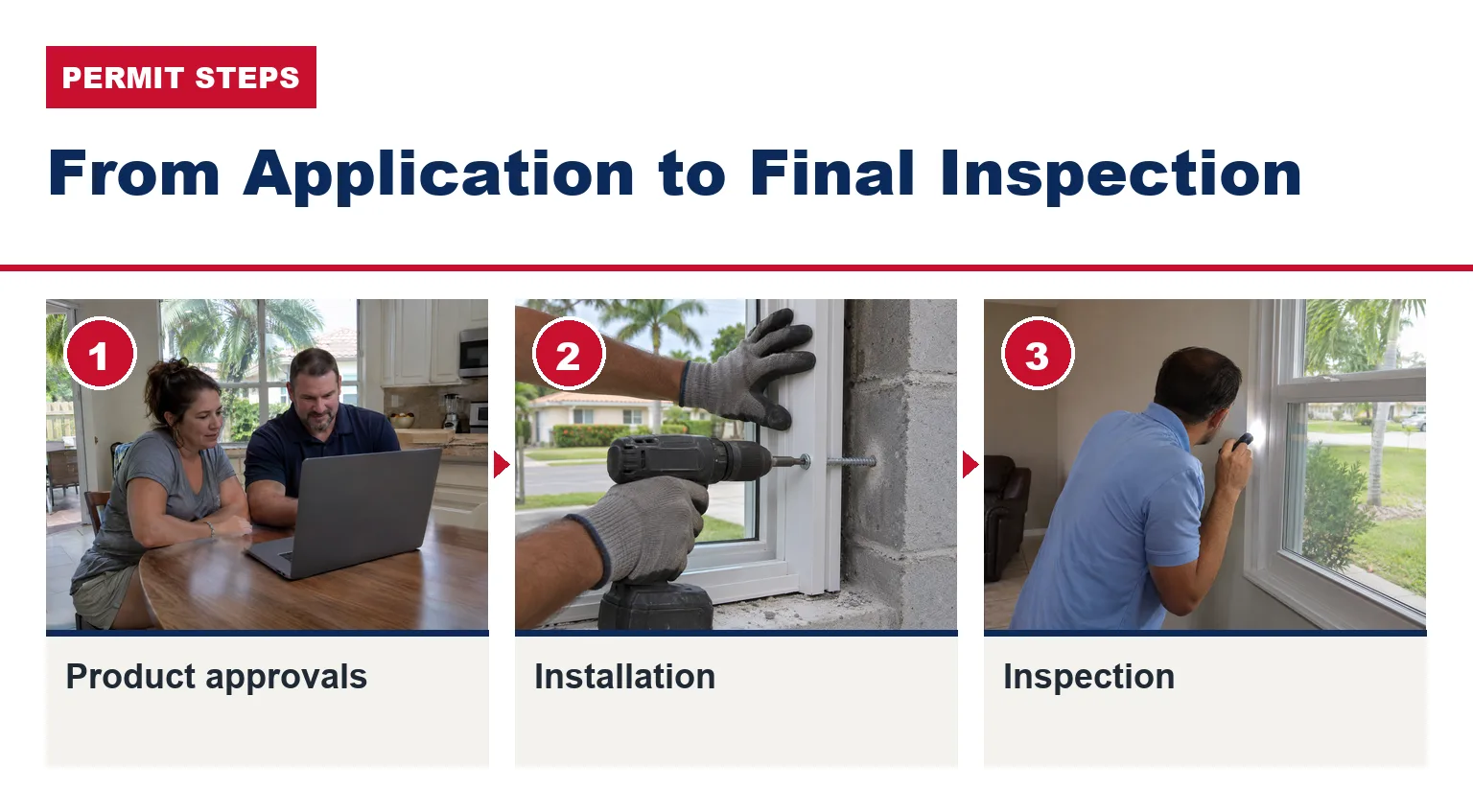
A window or door permit follows the same path in every South Florida county: application with product approvals, a Notice of Commencement when required, installation, then inspection.
If your home is in an HOA, its approval is a separate step; see how HOA approval for impact windows works in Florida.
- Notice of Commencement: Florida’s Construction Lien Law is behind it. Section 105.8 has every permit card warn that failing to record one “may result in your paying twice for improvements to your property.” Miami-Dade and Fort Lauderdale ask for it when the work exceeds $5,000.
- Inspection: under Section 110.3.13, inspections of impact-resistant systems confirm the system on the plans was installed, following the manufacturer’s installation instructions and the product approval.
- Closing: Miami-Dade advises that before your final payment, the contractor should show you proof that all final inspections were approved.
Our impact window FAQ on permits and inspections covers who books inspections and what the inspector looks at, and this walkthrough covers every step from estimate to installed impact windows.
Every USA Home Improvement project is permitted. Manufacturing takes about 6 to 8 weeks depending on project scope, installation averages 1 to 2 days, and the whole process takes about 3 months start to finish, though it can vary.
Can You Pull an Owner-Builder Permit for Windows or Doors?
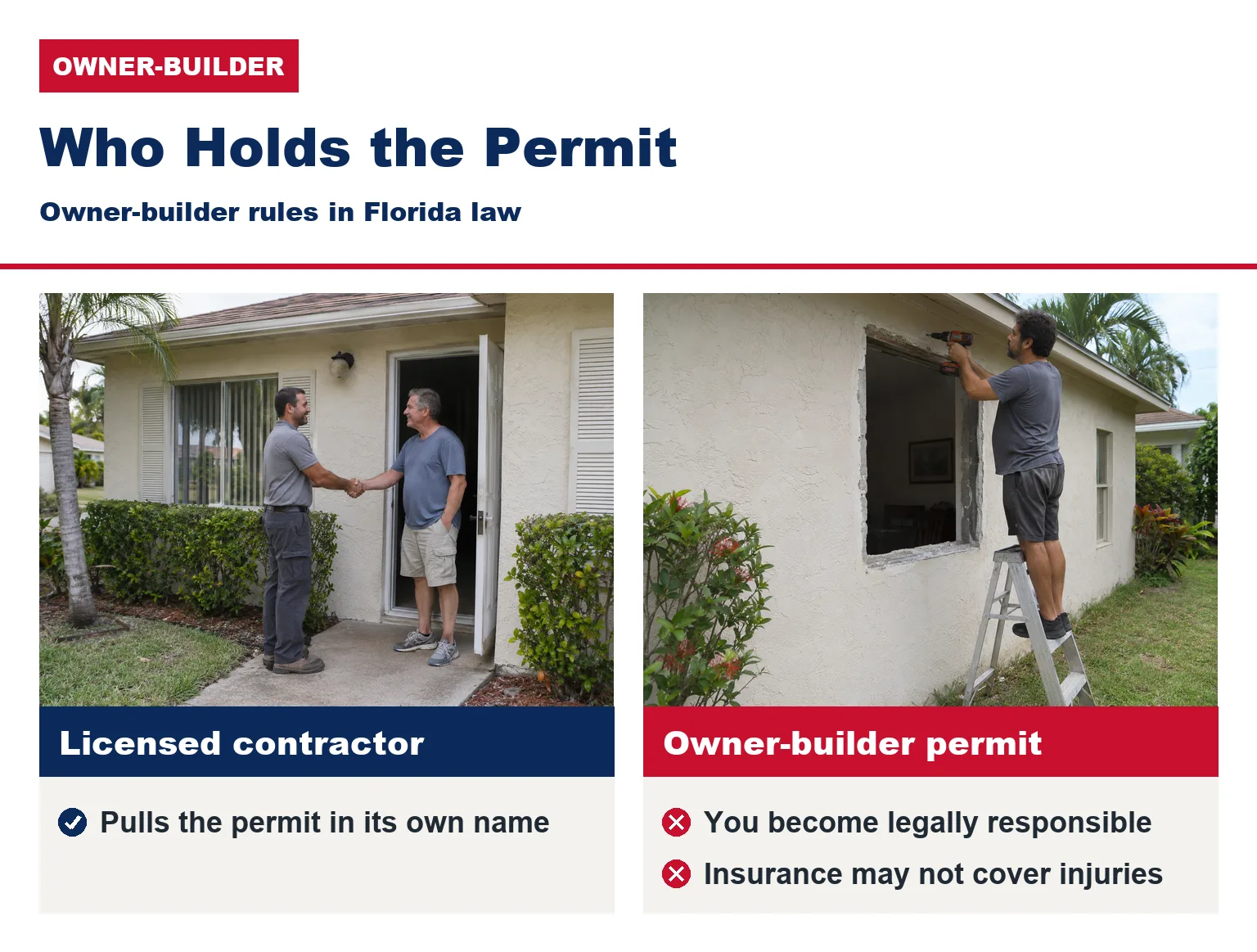
Yes, with limits. Section 489.103(7) of the Florida Statutes lets owners act as their own contractor on a one-family or two-family home for their own use, not offered for sale or lease. The owner must personally appear to sign the permit application and must directly supervise the work on site.
The required disclosure statement spells out the risks.
If you sell or lease the home within 1 year after the work is complete, the law presumes you did it for sale or lease, which violates the exemption. Miami-Dade’s owner-builder page uses a 24-month window counted from permit issuance, so ask your building department.
The disclosure also warns: “My homeowner’s insurance may not provide coverage” for injuries to an unlicensed worker on your property.
Miami-Dade puts the common trap plainly on its owner-builder page: “If a contractor tells you to get an owner-builder permit, you become legally responsible for all the work done.” A licensed contractor should pull the permit in its own name, so check the contractor’s Florida license before you sign.
What an Unpermitted Window or Door Replacement Can Cause
Skipping the permit can cost more. Miami-Dade’s homeowner permit information says working without a required permit “can result in fines and can cause problems when you sell your home.”
- Uncovering the work: Miami-Dade can still permit and inspect finished work, but it “may need to first be uncovered” so inspectors can check it.
- Double fee: if the county has issued a Notice of Violation for unpermitted work, the applicant pays an extra 100 percent of the usual permit fees.
- Extra fees and stop work orders: Section 109.4 of the Building code adds a fee for work started before a permit, and Section 115 lets the building official stop work done contrary to the code.
Paperwork matters for insurance too. A permitted job leaves a product approval, a permit number and a passed final inspection; ask your insurer which documents it accepts for insurance savings from home upgrades.
Window and Door Permit FAQs
Do I need a permit to replace a front door or sliding glass door?
Yes, when the door is replaced with its frame. Miami-Dade has replacement checklists for exterior doors and glass doors, and Fort Lauderdale’s checklist covers windows and doors together. For door-specific questions, see our answers to common impact door questions.
Do hurricane shutters need a permit?
Yes. Section 105.1 of the Florida Building Code names impact-resistant coverings: installing, altering, repairing, removing or replacing them needs a permit.
Can I make a window bigger under a replacement permit?
Not under Miami-Dade’s fast-track permit, which allows only exact changeouts of existing openings. A new or enlarged opening needs its own permit with structural details. Bedroom windows also have escape-size rules; check the bedroom egress requirements before changing one.
Should I pay the contractor before the final inspection?
Miami-Dade advises against it. After the inspections pass, and before you make the final payment, the county says the contractor should show you proof that all final inspections were approved, or a certificate of completion. Write that step into your contract.
Does the 2026 Florida Building Code change my window permit?
It can change which code edition reviews your permit, depending on when the application is submitted. Our guide to the 2026 Florida Building Code for South Florida homeowners covers the dates.
Plan the Permit Into Your Window and Door Project
For a South Florida home, assume you need a permit and make sure your contractor pulls it in its own name. Ask for the product approval for each opening, the Notice of Commencement when required, and proof of the final inspection before the last payment.
Compare financing for a permitted window or door job. Financing may be available for qualified homeowners through independent third-party providers. Terms, eligibility and availability depend on the program and location.
USA Home Improvement is licensed (CGC1526707) and insured and has served Florida homeowners for more than 15 years. We sell ES Windows exclusively, our installation team holds direct certification from the manufacturer, and every project is permitted.
Get a free estimate or call (877) 554-6373.