 Skip to content

You can usually tell if you have impact-resistant windows in a few minutes: look for etching in a glass corner, a permanent label on the frame, extra reflections in the glass, a heavy and solid feel, and paperwork such as a permit or an approval number.
Only the approval number and the permit record actually prove a rating. The other checks are strong or weak hints.
This guide walks through each sign and says plainly what it can and cannot tell you. If you need to prove a rating for a wind mitigation inspection, an insurance discount or code, the paperwork in Sign 5 is what counts.
Why It Matters Whether Your Windows Are Impact Rated
Knowing your window type tells you how much work your home needs before every storm. In Florida’s wind-borne debris region, the building code requires opening protection: impact-rated windows and doors, or approved shutters or panels over standard glass.
If your windows are impact rated, the glass is the protection and stays in place all year. If they are standard glass, someone has to put up shutters or panels before each storm.
The answer also affects your wind mitigation inspection, your insurance credits and, for buyers, the price you should pay for the house. If your windows turn out to be standard glass, the impact window designs we offer show what a replacement could look like.
For the bigger picture on glass types, ratings and county rules, see our guide to how impact windows work and are rated.
Sign 1: Look for a Permanent Mark in One of the Glass Corners
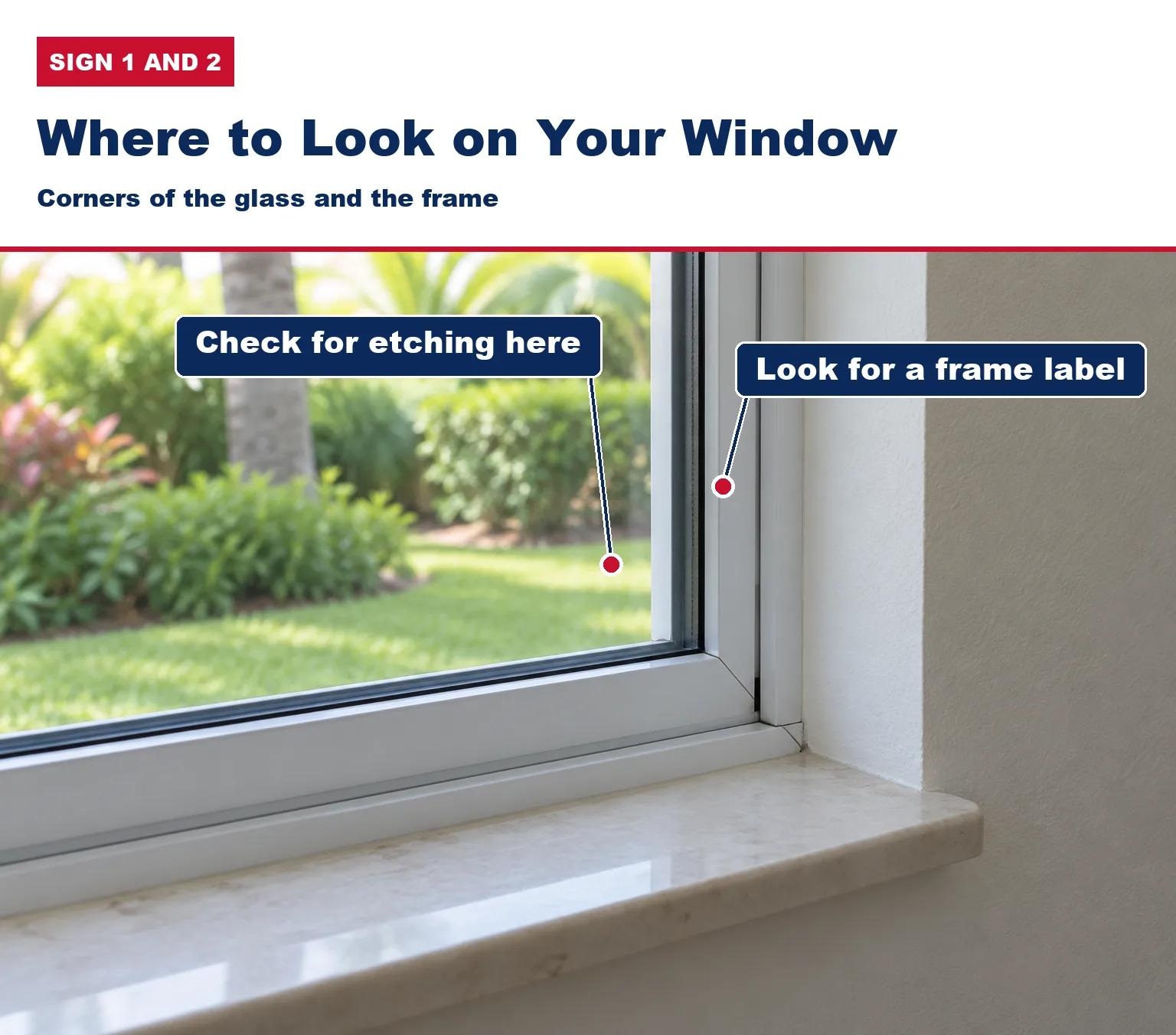
Most impact glass carries a small permanent mark, etched or sandblasted, in one corner of each pane. Look closely at all four corners, from inside and outside, because the mark is small and easy to miss.

The mark usually names the glass maker and often the glass type or product line. Laminated glass, the glass used in impact windows, is two sheets of glass bonded to a tough plastic interlayer that holds the pieces in the frame if the glass cracks.
Read the mark instead of just spotting it. Tempered safety glass is etched too, often with ANSI Z97.1 or CPSC 16 CFR 1201. Those are safety glazing marks, not hurricane impact ratings, and tempered glass on its own is not impact glass.
What it proves: a mark that names laminated glass is a strong clue. What it does not prove: the etching only covers the glass, not the frame, anchors or the whole window assembly. A missing or unreadable mark does not rule out impact glass either.
Sign 2: Check for a Permanent Label on the Window Frame
The frame label is the best on-the-spot clue, because it names the product and its approval. Look on the inside of the frame, usually in a corner, on the sill or along a side track.
A useful label shows the manufacturer, the series and a Miami-Dade Notice of Acceptance (NOA) number or a Florida Product Approval (FL) number. Miami-Dade approved windows also carry a permanent label with the words “Miami-Dade County Product Control Approved.”
You may also see the test codes TAS 201, TAS 202 and TAS 203, or ASTM E1886 and E1996 outside the HVHZ.
Many windows also come with a temporary sticker on the glass that lists the same details. Installers and homeowners often peel it off after the final inspection, so a missing glass sticker means nothing on its own. The permanent frame label and the etching are the parts that stay.
What it proves: a readable NOA or FL number gives you something you can look up. What it does not prove: the number alone does not show the window passed impact testing. Some approvals cover only wind pressure, so you still need to check the listing.
Sign 3: Inspect the Reflection in the Glass
The reflection test can tell you the window has more than one layer of glass, but it cannot tell you the window is impact rated. Try it after dark: hold a small light, such as a lighter flame or a phone flashlight, close to the glass and look at the reflections from an angle.
Each glass surface throws back its own faint reflection, so a window built from several layers shows several reflections. Laminated glass and standard double-pane glass can both do this, which is why inspectors disagree about how to read the result.

Use the reflection test to spot a mismatch. If a frame label says the window is impact rated but the glass looks like one thin sheet, ask questions. If you see several reflections, move on to the label and the paperwork before you draw a conclusion.
Our article on how strong impact windows are in testing explains what the layers actually do.
Sign 4: Knock, Look at the Glass Edge and Feel the Weight
Sound, weight and the look of the glass edge are informal hints only. They can make you suspicious, but no inspector or insurer accepts them as proof.
- Knock lightly: tap the glass gently with a knuckle, never with a tool. Laminated glass often sounds duller than a single sheet of glass, but tempered and laminated glass can sound alike.
- Look at the glass edge: on some windows you can see a thin plastic layer at the edge of the glass, between the sheets. That points to laminated glass.
- Feel the weight: impact windows use thicker glass and stronger frames, so sashes feel heavier and frames look deeper than on older standard windows.
If all three hints point to standard glass, treat the window as unprotected until paperwork says otherwise.
Sign 5: Check the Paperwork: Permits, Seller Disclosure and the NOA or FL Number
Paperwork is the only proof of an impact rating: a permit record with a passed final inspection, or a Miami-Dade NOA or Florida Product Approval (FL) number whose listing shows impact resistance, not only design pressure.
Gather the window permit, the installer’s invoice and, if you are buying, the seller’s written answers, then follow our guide on how to look up a window’s approval number for the search steps. Check every opening, because many homes had windows replaced in stages.
What Each Check Can and Cannot Prove
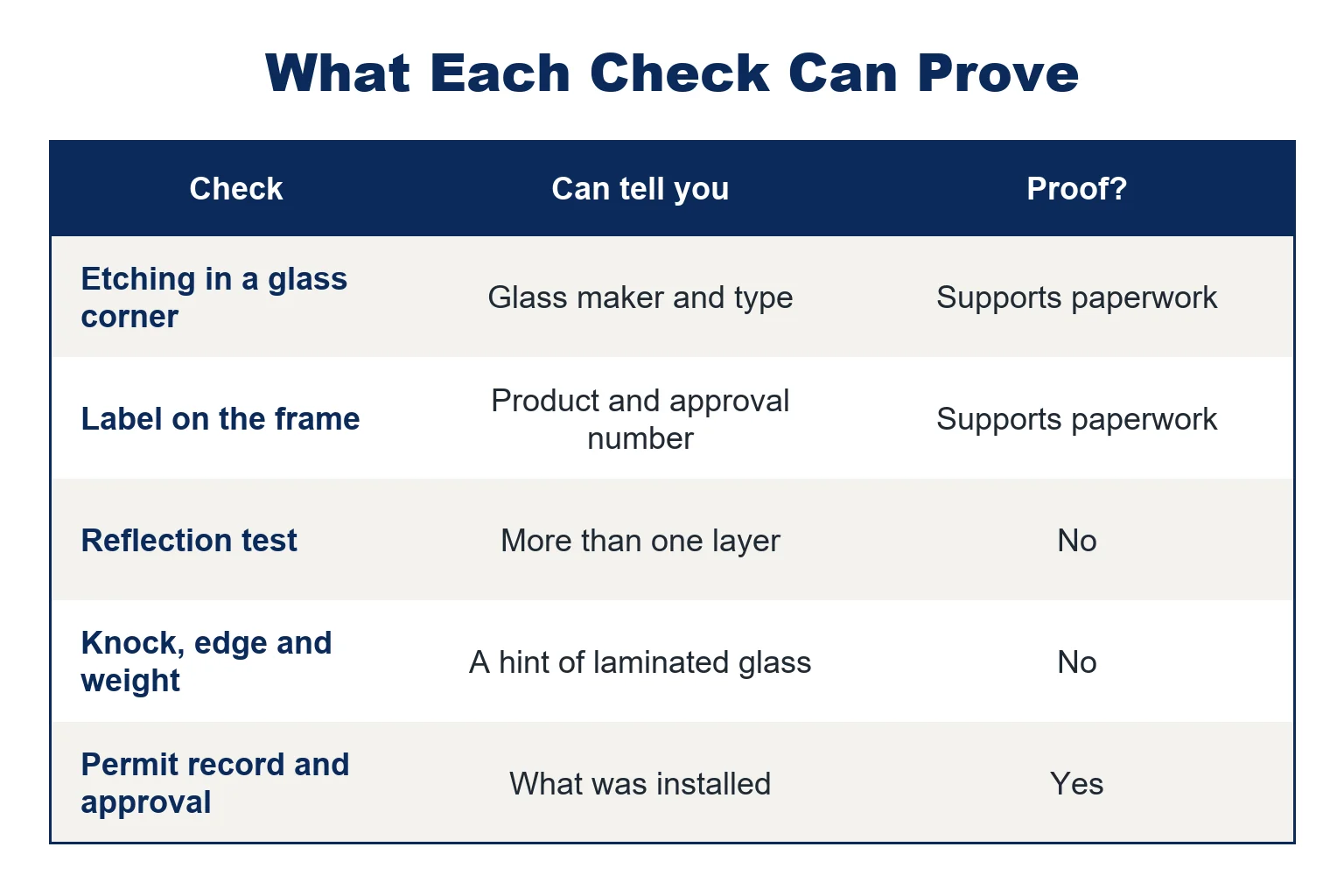
Use the table to decide how much weight to give each sign. Start with the quick checks, then confirm with the paperwork.
| Check | What it can tell you | What it cannot prove | Accepted as proof? |
|---|---|---|---|
| Etching in a glass corner | Who made the glass and often the glass type | That the frame and whole window passed impact testing | Supports the paperwork |
| Permanent label on the frame | The product, series and approval number | Impact rating, until you check the listing | Supports the paperwork |
| Reflection test | More than one layer of glass | Laminated glass versus double pane | No |
| Knock, edge and weight | A hint of laminated glass or a heavier frame | Anything about the rating | No |
| Permit record and approval listing | What was installed, its approval and inspection | The condition of the window today | Yes |
How Home Buyers Can Check for Impact Windows Before Closing
As a buyer, check the windows yourself during a showing, then ask for documents before you close. Impact windows add real value to a South Florida house, so the claim deserves the same checking as the roof.
- Walk every room and check each window for corner etching and a frame label. Take a photo of every label you find.
- Check the sliding glass doors, French doors and garage door too. Each opening needs its own protection, and a new window does not cover an old slider. If the slider fails, look at impact sliding glass door options and factor the cost into your offer.
- Ask the seller for the window permits, the installer’s invoice and the most recent wind mitigation report.
- Ask your home inspector to note the window type on every opening. Our list of what to ask your home inspector before closing helps you prepare.
- Run a permit search for the address yourself. It takes a few minutes and costs nothing.
What to Do If You Cannot Confirm Your Windows Are Impact Rated
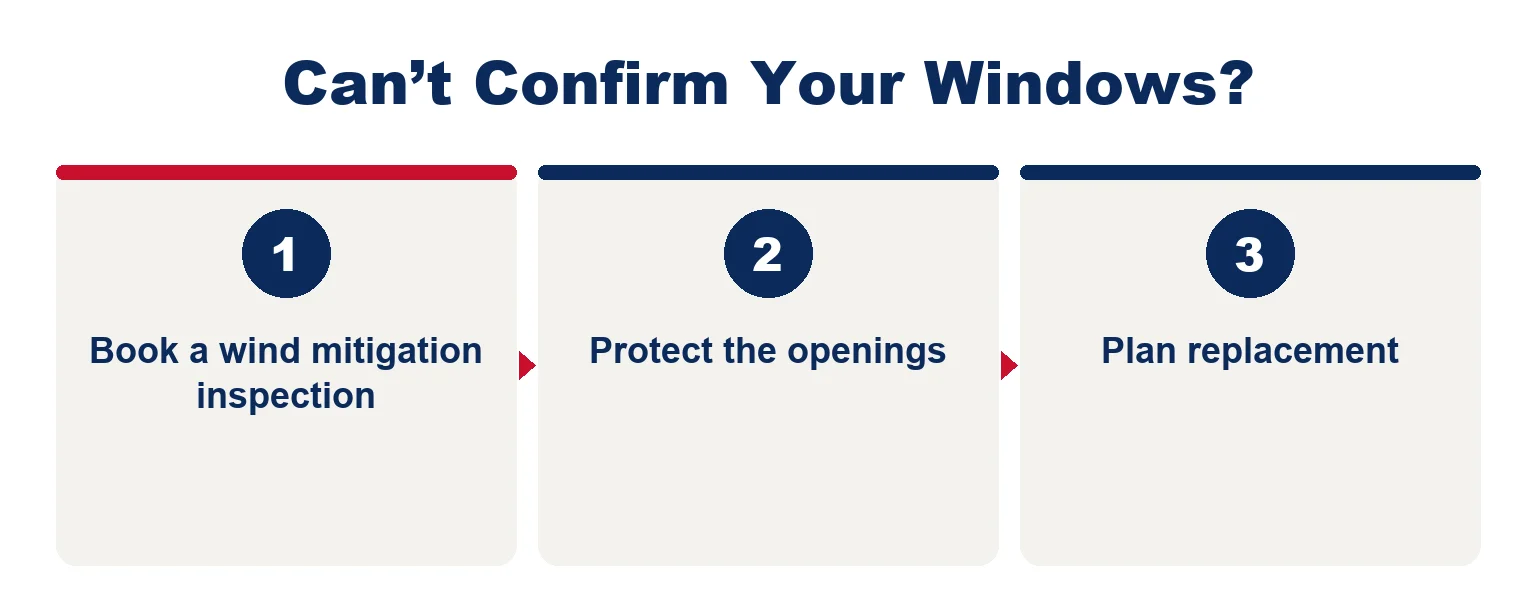
If the labels are gone and the paperwork is missing, treat the windows as unprotected until a professional confirms otherwise. Book a wind mitigation inspection, keep approved shutters or panels ready for every opening you cannot confirm, and plan replacement for any window that fails.
When you replace, read how to vet impact window installers and ask about monthly payment options for impact windows for qualified homeowners.
Quick Answers About Identifying Impact Windows
Are double-pane windows the same as impact windows?
No. Double-pane, or insulated, glass helps with heat and noise, but it only counts as impact glass when the unit includes laminated glass and passed impact testing. That is why the reflection test alone cannot tell the two apart.
Can a window company tell me what windows I have?
Yes. An installer or glazier can often identify the product from the frame, the etching and the glass build, and can tell you what paperwork to look for.
For insurance, the wind mitigation inspector’s findings are what count, and our list of upgrades that can cut your homeowners premium shows which other features can earn credits.
My glass sticker is gone. Does that mean my windows are not impact rated?
No. The temporary sticker on the glass is often removed after the final inspection. Check the permanent label on the frame, the corner etching and the permit record before you decide.
Not sure what is in your walls? USA Home Improvement serves Miami-Dade, Broward, Palm Beach and Southwest Florida. Call us at (877) 554-6373 and we will look at your windows, tell you what we find, and quote approved impact windows for any opening that needs them.
USA Home Improvement is licensed (CGC1526707) and insured and has served Florida homeowners for more than 15 years.