 Skip to content

The best way to protect your windows during a hurricane is to cover every glass opening with a tested, approved product before the storm, or to replace the glass with impact windows. Plywood is the emergency backup, and tape does nothing.
Windows matter more than most people think. Broken glass turns into flying shards, and once an opening breaks, wind and rain get inside the house.
This guide compares every window protection option, explains what does not work, and shows how to check approvals in South Florida. For roofs, garage doors and the rest of the house, see our guide to upgrades that make your home hurricane resilient.
Hurricane Window Protection Options Compared
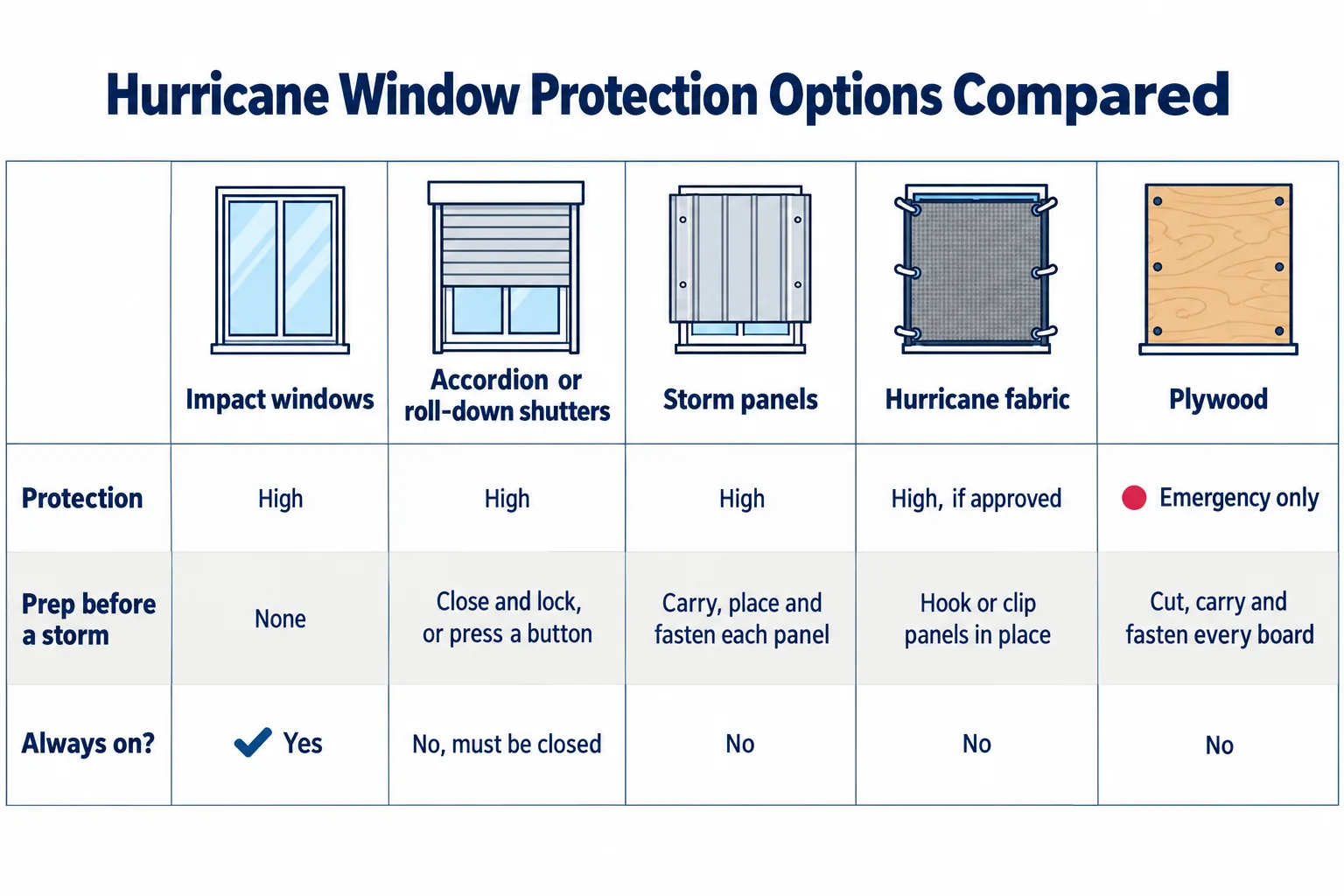
There are five main ways to protect windows from a hurricane: impact windows, permanent shutters, removable storm panels, hurricane fabric and plywood. They differ most in how much work they take before a storm and whether they protect the house when nobody is home.
| Option | Protection | Approved products? | Prep before a storm | Always on? | Relative cost |
|---|---|---|---|---|---|
| Impact windows | High | Yes, tested and approved | None | Yes | Highest |
| Accordion or roll-down shutters | High | Yes, many models | Close and lock, or press a button | No, must be closed | Medium to high |
| Storm panels | High | Yes, many models | Carry, place and fasten each panel | No | Low to medium |
| Hurricane fabric | High, if approved | Some products, check the approval | Hook or clip panels in place | No | Low to medium |
| Plywood | Emergency only | No product approval | Cut, carry and fasten every board | No | Lowest |
Relative cost depends on the number and size of your openings. For typical installed price ranges per window, see our comparison of impact windows vs hurricane shutters.
How Each Window Protection Option Works
Every option has the same job: stop flying debris from breaking the glass. They get there in different ways, and the trade-offs are about effort, light and cost.
Install Hurricane Impact Windows and Doors
Hurricane impact windows replace your old glass with laminated glass: two panes bonded to a tough, clear plastic layer. If debris hits hard enough to crack the glass, the plastic layer is designed to hold it in the frame.
Impact windows are the only option that protects your home every day without anyone lifting a finger. That matters if you travel, live alone, or cannot climb a ladder before a storm.
They also cut outside noise, block much of the UV that fades floors, and make break-ins harder. Styles range from single-hung impact windows to horizontal roller windows, so you can keep the look of your home.
The trade-offs are the higher upfront cost and the lead time. Impact windows need measuring, a permit and professional installation, so they are a project for the off-season, not the week a storm is forecast.
Use Hurricane Shutters
Hurricane shutters are covers that close over the glass so debris never reaches it. The main types are:
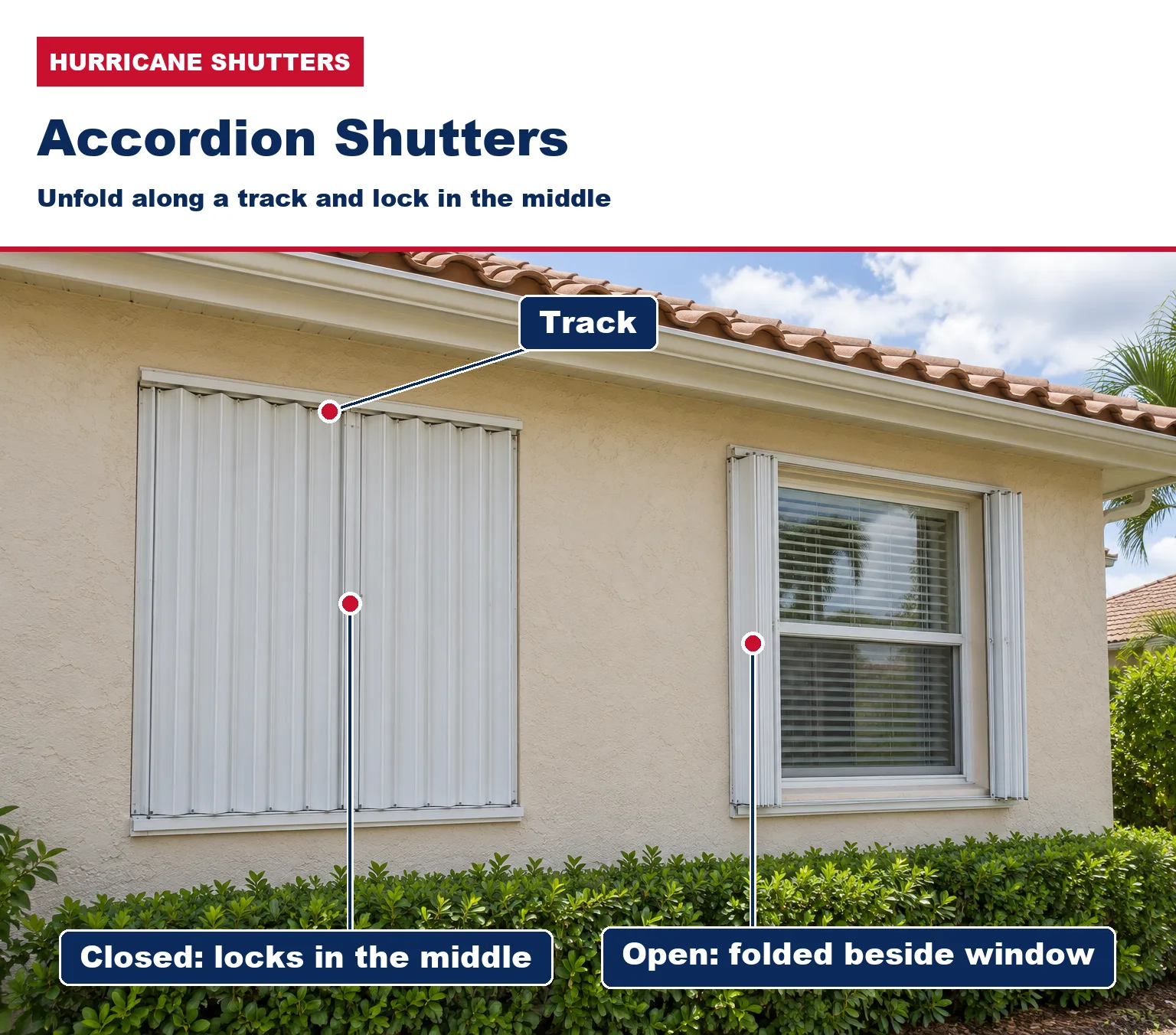
- Accordion shutters: fixed beside the window, they unfold along a track and lock in the middle. One person can usually close them.
- Roll-down shutters: roll down from a box above the window, by hand crank or motor. Ask whether a motorized model has a manual override for power outages.
- Storm panels: aluminum or steel sheets you place in tracks or on bolts before each storm. They cost the least of the shutter types but take the most work and need storage.
- Bahama and colonial shutters: hinged shutters that stay on the house. Bahama shutters prop open like an awning and give shade; colonial shutters close from the sides.
Shutters only protect the window when they are closed. Someone has to close them before every storm, and rooms go dark while they are shut.
Use Hurricane Fabric
Hurricane fabric is a strong woven screen that clips or hooks over the window. When debris hits, the fabric stretches and absorbs the blow, like a trampoline.
Fabric is light, easy to store, and lets some daylight through, so rooms are not pitch dark. The mounting hardware is installed once by a professional, and then the panels go up quickly.
Not every fabric system is approved for use in Miami-Dade and Broward. Because fabric flexes, the approval drawings also set how it must be mounted, including its distance from the glass, so follow them exactly and ask for the product’s approval number before you buy.
Board Up Your Windows With Plywood
Plywood is the last-minute option when nothing else is in place. The Federal Alliance for Safe Homes (FLASH) calls it a temporary, emergency measure and recommends tested and approved shutters for the highest level of protection.
If you use plywood, follow the FLASH emergency board-up guide: exterior-grade plywood at least 5/8 inch thick, cut to overlap the opening by about 4 inches on every side, and fastened to the wall, not to the window frame.
Cut and label each board before the season starts, so you know exactly which board goes with which window. Our step-by-step guide shows how to install plywood over windows for a hurricane.
What Does Not Protect Your Windows
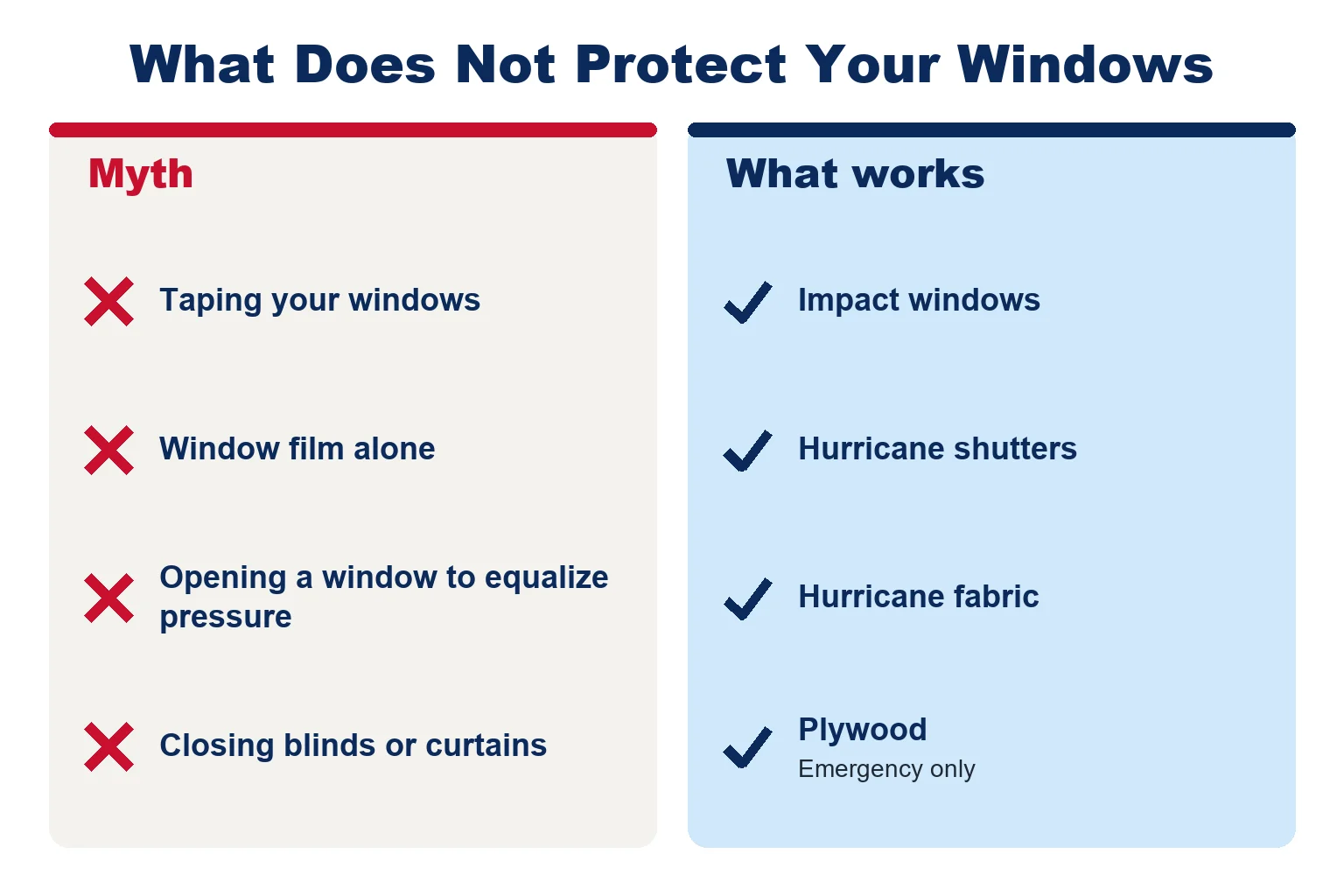
Taping your windows does not protect them. FLASH calls window taping a myth, and the National Hurricane Center dropped it from its advice decades ago.
Tape does not stop glass from breaking. It can make the broken pieces larger, and it wastes time you could spend putting up real protection.
Other common mistakes:
- Window film alone: security film on its own is not tested hurricane protection. FLASH warns that some films do not do what they claim.
- Opening a window to “equalize pressure”: keep every window and door closed. An open window lets wind push into the house and up against the roof.
- Closing blinds or curtains: they may catch small glass pieces, but they do nothing to stop debris.
- Waiting for the forecast: stores sell out of plywood and installers get booked when a storm is coming.
How to Check Approval in Miami-Dade and Broward
In Miami-Dade and Broward, window protection must meet the High-Velocity Hurricane Zone (HVHZ) rules of the Florida Building Code, the strictest wind rules in the state. Products used there need an approval that covers the HVHZ.
There are two approval systems to know:
- Miami-Dade Notice of Acceptance (NOA): issued by the county’s product approval office after lab testing. An NOA has an expiration date, so check that it is current.
- Florida Product Approval (FL number): the statewide system, searchable on floridabuilding.org. Check whether the approval says it is valid in the HVHZ.
Three quick checks before you buy windows, shutters or fabric:
- Ask for the NOA or FL number for the exact product, not just the brand.
- Confirm the approval covers the size of your openings and your county.
- Make sure the installer follows the approval drawings and pulls a permit.
Palm Beach County and Southwest Florida sit outside the HVHZ, but Florida Building Code wind rules and product approval still apply. Not sure what you already have? Here is how to tell if your windows and doors are hurricane rated.
Protect Sliding Glass Doors and Other Large Openings
Sliding glass doors need the same protection as windows, and often more planning. They are usually the largest glass opening in the house, and a broken slider lets a lot of wind and rain inside.
Your options for a slider are the same as for windows: storm panels, accordion or roll-down shutters, fabric rated for that size, or an impact door. Large openings need longer, heavier panels and stronger anchors, so check the approval covers the full width.
Plywood is hard to use on a slider because one sheet rarely covers it, and joined sheets need bracing along the seam. If your slider is old, impact sliding glass doors remove the job completely. French doors and skylights need protection too.
Start Your Hurricane Preparations Early
Start window protection well before the season. The Atlantic hurricane season runs from June 1 to November 30, and the National Hurricane Center lists September 10 as the peak, with most activity from mid-August to mid-October.
- Impact windows or doors: plan during the off-season, from December to spring, to allow time for measuring, permits and installation.
- Shutters and fabric: have them installed before June, then do a test run so you know how long it takes and that every part fits.
- Plywood: buy, cut, label and pre-drill boards before the season, and keep the fasteners with them.
During the season, follow the National Hurricane Center and your county emergency office. Put protection up once a watch is issued for your area, not when the wind starts.
Storing Shutters, Panels and Plywood Between Storms
Removable protection only works if you can find all of it when a storm is coming. Store panels, fabric and boards together in a dry place, such as a garage wall rack.
- Number each panel or board and write the matching number inside the window frame.
- Keep nuts, wing nuts, clips and anchors in a labeled bag or bin with the panels.
- Rinse salt and dirt off metal panels and fabric, and let them dry before storing.
- Clean and lubricate accordion and roll-down tracks once a year.
- Replace warped plywood and bent or rusted panels before the next season.
Insurance Credits and Grants for Window Protection
Florida law requires home insurers to offer premium credits for opening protection. Section 627.0629 of the Florida Statutes lists opening protection and window, door and skylight strength among the features that earn discounts.
The credit is based on a wind mitigation inspection, and inspectors look at every opening, including doors and garage doors. Approved impact windows and approved shutters can both qualify; the amount depends on your insurer and your home.
The state’s My Safe Florida Home program has offered free inspections and grants toward opening protection. Funding changes year to year, so check the program site for current status. For other upgrades that can cut premiums, see home upgrades that can lower your homeowners insurance rates.
What to Do With Your Windows During and After the Storm
During the storm, stay away from windows and glass doors, even protected ones. Wait it out in an interior room with no windows, and keep every window and door closed.
After the storm passes and officials say it is safe:
- Walk around the house and photograph any damage before you clean up, for your insurance claim.
- Check impact glass for cracks. A cracked impact window may still be holding, but it needs to be replaced.
- Look for water stains around frames, which can point to failed seals.
- Open shutters and remove plywood once the storm has passed, so you have daylight and a way out.
- Rinse, dry and store panels and fabric, and note anything to repair before the next storm.
Which Window Protection Is Right for Your Home?
The right choice depends on who will be home before a storm, your budget, and how long you plan to stay in the house.
- Choose impact windows if you travel, are away part of the year, cannot put up shutters yourself, or are replacing old windows anyway.
- Choose shutters if your current windows are in good shape and someone can close them before every storm.
- Choose fabric if you want a lighter, lower-cost cover and the product is approved for your county.
- Keep plywood only as an emergency backup while you plan permanent protection.
If cost is what holds you back, financing options for impact windows and doors can spread the cost over time for qualified homeowners. USA Home Improvement installs impact windows and doors across Miami-Dade, Broward, Palm Beach and Southwest Florida.
Hurricane Window Protection FAQs
Do I still need shutters if I have impact windows?
No, approved impact windows are designed to protect the opening on their own. Some homeowners still add shutters for very strong storms as a second layer. We cover that choice in detail in our comparison of impact windows and hurricane shutters.
Can I put up plywood myself?
Yes, many homeowners do, but plan ahead. Cut, label and pre-drill the boards before the season, use exterior-grade plywood (FLASH recommends 5/8 inch or thicker; the code minimum is 7/16 inch), and fasten it to the wall, not the window frame. Upper-floor windows are hard and risky to board from a ladder.
Can I leave my shutters closed all season?
You can close permanent shutters when you leave for a long trip, but keep at least one way out of every bedroom when someone is home. Closed shutters block light and can block an escape route in a fire.
Does hurricane fabric work as well as metal shutters?
Approved hurricane fabric is tested to stop debris, like approved shutters. The difference is that fabric flexes, so it must be mounted exactly as its approval drawings require. Always check the product is approved for your county.
Ready to stop boarding up every season? Call USA Home Improvement at (877) 554-6373 or request a free consultation, and we will walk you through impact window options for your home.
USA Home Improvement is licensed (CGC1526707) and insured and has served Florida homeowners for more than 15 years.