Skip to content

In Florida, a condo window’s required impact rating depends on how high it sits.
In wind-borne debris regions, the Florida Building Code requires each glazed opening within 30 feet of grade, or the shutter that covers it, to pass the large missile test, and openings more than 30 feet above grade to pass the small missile test.
This guide shows where that line falls on a condo tower, how the rule differs in Miami-Dade and Broward, when upper floors may go unprotected, and what to check before you order windows and pull a permit.
The 30-Foot Rule: Large Missile Below, Small Missile Above
The rule is in Section 1609.1.2 of the Florida Building Code, Building, Chapter 16.
It says glazed openings “located within 30 feet (9144 mm) of grade shall meet the requirements of the large missile test of ASTM E1996,” and those more than 30 feet above grade must meet the small missile test.
A glazed opening is any window or door with glass. Grade is the ground level next to the building. So the rule follows each opening’s height, not the building’s total height or the number on your unit door.
The rule applies in wind-borne debris regions. The code defines them as areas within 1 mile of the coastal mean high water line where the ultimate design wind speed is 130 mph or more, or anywhere it is 140 mph or more.
Our guide on which Florida homes must have impact windows explains how that applies to an address.
The two tests are far apart. In the code’s own HVHZ protocol, the large missile is a 9-pound 2×4 timber fired at 50 feet per second, and the small missile test uses 2-gram steel balls at 130 feet per second.
See how the large and small missile tests work, and which missile rating a house or condo window needs.
Where the 30-Foot Line Falls on a Condo Tower
On a high-rise condo, the 30-foot line splits the building. Glass in the lobby and the lower units falls under the large missile rule, and glass higher up falls under the small missile rule. The code counts feet above grade, not floors.
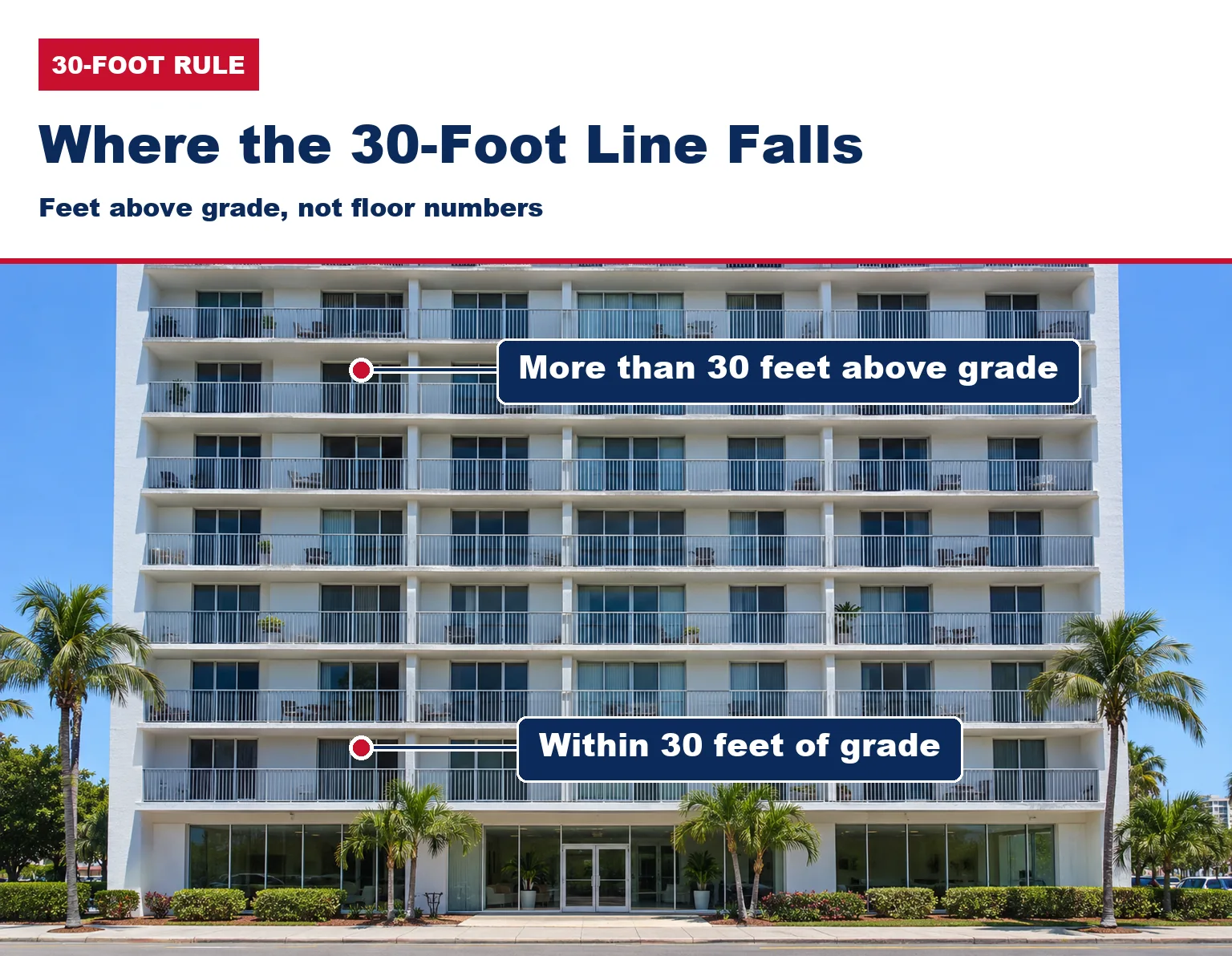
Story heights differ from building to building, so do not guess from your floor number. Find each opening’s height above grade by asking the building’s engineer or the Florida licensed design professional who prepares the permit drawings.
If a tall window wall or sliding door starts below the line and ends above it, ask the building department how that opening is classified before you order. A wrong guess means the wrong product on the permit.
Height also matters for wind load, which is a separate rating from the missile level. Each opening needs a design pressure that meets what the code requires for it; our guide to what design pressure means for each window explains the numbers.
USA Home Improvement sells the ES Windows aluminum and vinyl impact window product line and impact doors. For styles, costs and county rules, start with our South Florida impact windows guide.
Planning impact windows or doors? Ask for a free estimate for your windows and doors or call (877) 554-6373.
Miami-Dade and Broward: No Height Exception for Windows
In Miami-Dade and Broward, height never excuses a window. Every window on every floor must meet an impact test or be covered by a protection device that does, apart from narrow exceptions such as screen-enclosed balconies (below).
The code calls these two counties the High-Velocity Hurricane Zone (HVHZ), and they follow Section 1626 for impact testing.
Section 1626.1 says all parts of the building envelope, including outside doors, glazing and glass block, “shall meet impact test criteria or be protected with an external protection device that meets the impact test criteria.”
The height split is the same as elsewhere.
Section 1626.2.1 applies the large missile test to products used “up to and including 30 feet (9.1 m) in height in any and all structures.” Section 1626.3.1 applies the small missile test above 30 feet. Both use test protocols TAS 201 and TAS 203.
The HVHZ exceptions in Section 1626.1 cover items such as soffit vents, roof hatches and screened balconies. None of them excuses windows because they are high up, so a penthouse window in Miami-Dade or Broward still needs small missile protection or a protection device that meets the test.
Outside the HVHZ: The 60-Foot Exception
Outside Miami-Dade and Broward, glass very high on a tower may be allowed without impact protection.
Exception 3 of Section 1609.1.2 says glazing in Risk Category II, III or IV buildings “located over 60 feet (18 288 mm) above the ground” and over 30 feet above aggregate surface roofs within 1,500 feet of the building “shall be permitted to be unprotected.”
In plain words, aggregate surface roofs are roofs topped with loose gravel or stone that wind can pick up. Glass more than 60 feet up qualifies only if it is also more than 30 feet above every such roof within 1,500 feet.
Which risk category your building is in, and whether a nearby roof counts, is for the building’s engineer and the building department to confirm. “Permitted to be unprotected” is a code minimum. Your association’s specifications and your insurer may expect more, so check with both.
| Where the glass is (window or covering) | Miami-Dade and Broward (HVHZ) | Other wind-borne debris regions |
|---|---|---|
| Within 30 feet of grade | Large missile test, TAS 201 and 203 (1626.2.1) | Large missile test of ASTM E1996 (1609.1.2) |
| More than 30 feet above grade | Small missile test, TAS 201 and 203 (1626.3.1) | Small missile test of ASTM E1996 (1609.1.2) |
| Over 60 feet up and over 30 feet above gravel roofs within 1,500 feet | No height exception; small missile test still applies | May be unprotected in Risk Category II, III or IV buildings (Exception 3) |
Balconies and Enclosed Balconies
A balcony enclosure has its own rule, and it can move the requirement to the wall behind it.
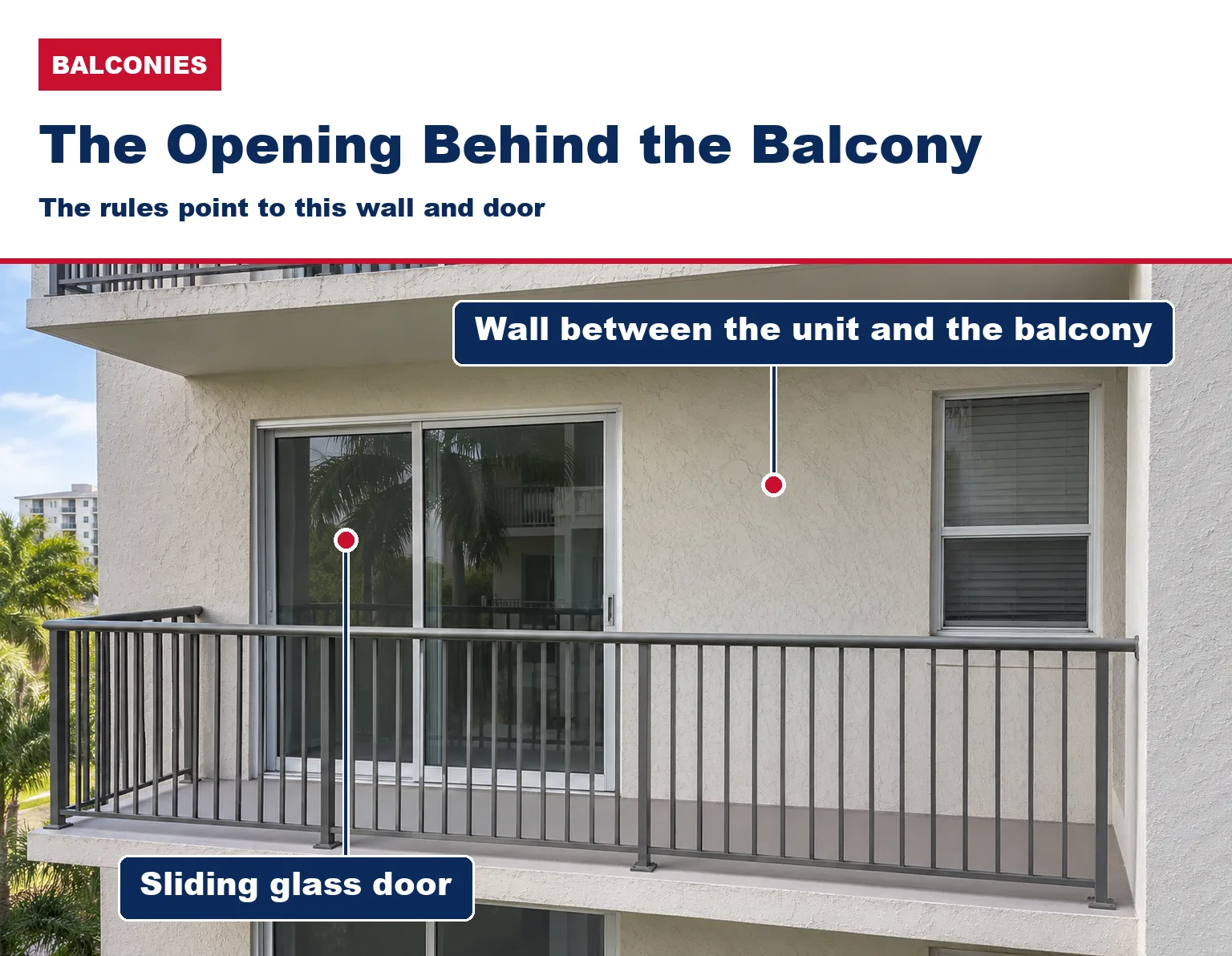
Outside the HVHZ, Section 1609.1.2 says openings in sunrooms, balconies or enclosed porches built under existing roofs or decks do not need protection, provided a wall separates the space from the interior and every opening in that wall is protected.
In the HVHZ, the screened-balcony exception to Section 1626.1 covers balconies under existing roofs or decks enclosed with screen or removable vinyl and acrylic panels that meet the code’s screen enclosure rules (Section 1622).
Then neither the enclosure nor the openings in the wall between the unit and the balcony need protection “unless required by other provisions of this code.”
For most condo owners, the opening that matters is the sliding glass door to the balcony. Compare impact sliding glass doors for balcony openings, and clear any enclosure with the association and the building department first.
What the Missile Tests Say About Glass and Frames
Both missile tests rate the whole window, not just the glass. Sections 1626.2.2 and 1626.3.2 say each test specimen is “the entire assembled unit, including frame and anchorage as supplied by the manufacturer,” fastened with the same size and spacing used in the field.
The impact sections do not name a glass type or thickness for either level. What was tested shows up in the product approval, so check the product approval for each opening rather than the brochure.
The label helps too. Section 1709.5.1 of the Florida Building Code, Building, Chapter 17 requires windows and doors to show the design pressure rating, “impact-resistant rating if applicable,” and the Florida or Miami-Dade product approval number. Learn to check whether your current windows are impact rated.
USA Home Improvement customers can receive the Florida Product Approval number for each window and door on request.
Who Decides Which Windows Go Into Your Unit
Your declaration of condominium decides whether you or the association replaces the windows and sliding doors, and the board’s hurricane protection specifications set the look and other requirements. Read the association’s specifications before you choose a product, and see how condo window responsibility is split for the details.
Permits for Condo Window and Door Replacement
Replacing windows or glass doors in a condo unit takes a building permit, and some South Florida building departments want the association’s sign-off first. Two examples show what to expect:
- Miami Beach: the city’s Building Department requires an authorization letter from the condominium association for any work in the building’s units.
- Town of Palm Beach: its condo plan review checklist requires an approval letter from the condominium or building manager for all window and door replacements. It also asks for the product approval and the existing opening’s site-specific design pressure, signed by a Florida licensed professional.
So get the association’s letter early, and ask your own building department for its condo checklist. Every USA Home Improvement project is permitted. For what the permit itself involves, see how window and door permits work in Florida.
High-Rise Condo Impact Window FAQs
Do sliding glass doors follow the same missile rule as windows?
Yes. The code’s rule covers glazed openings, and a sliding glass door has glass. In the HVHZ test, Sections 1626.2.5.2.1 and 1626.3.5.2.1 say doors with glass are hit on the glass and on the thinnest section that is not glass.
Do hurricane shutters on upper floors follow the same height rule?
Yes. In the HVHZ, Section 1626.2.6.1 says protection devices must resist the large missile impacts, and Section 1626.3.6.1 the small missile impacts, without bending into the glass they protect. Compare shutters, panels and impact windows for storm protection.
Does the 2026 Florida Building Code change the 30-foot rule?
No. The 2026 edition of Section 1609.1.2 keeps the large missile rule within 30 feet of grade and the small missile rule above it. It drops a Florida section on applying ASTM E1996; read our breakdown of the 2026 window and door changes.
Does the 30-foot rule apply to my townhouse?
Usually not. The Florida Building Code, Residential covers detached one- and two-family homes and townhouses up to three stories with their own exit, and its Section R301.2.1.2 names only the Large Missile Test, at any height.
A low-rise condo building with stacked units falls under the Building code. In Miami-Dade and Broward, ask the building department which rules apply.
Is a small missile window weaker than a large missile window?
It passed a different test, built for the smaller debris the code expects higher up. The code accepts a small missile product only for glass more than 30 feet above grade, so a small-missile-only window never belongs on a lower floor or in a house.
Find Your Opening’s Height Before You Order
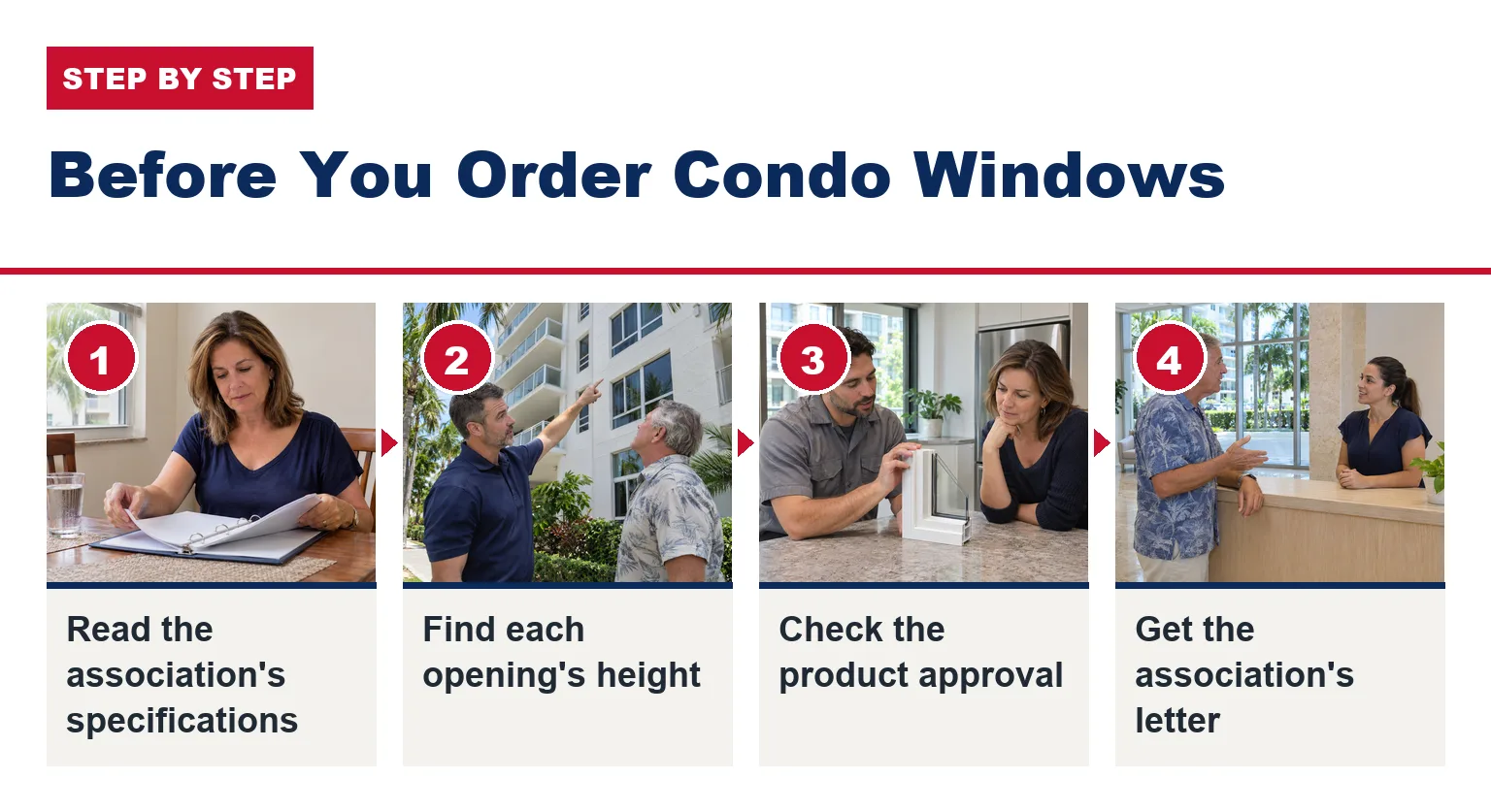
Start with three facts for every opening: its height above grade, whether your building is in the HVHZ, and what the association’s specifications require. Then match each opening to a product approval with the right missile level and design pressure, and get the association’s letter before the permit.
Compare ways to finance an impact window project. Financing may be available for qualified homeowners through independent third-party providers. Terms, eligibility and availability depend on the program and location.
USA Home Improvement is licensed under CGC1526707 and insured, and has served Florida homeowners for more than 15 years. We sell ES Windows exclusively, and our installation team holds direct certification from the manufacturer.
Get a free estimate or call (877) 554-6373.