Skip to content

In a Florida condo, your declaration of condominium decides who maintains and replaces the windows and sliding glass doors: you or the association. Florida law fills in the rest, from the board’s hurricane specifications to what the association’s insurance must cover.
This guide shows who does what under the Florida Condominium Act, who pays for impact windows and shutters, what needs approval, how the insurance splits, and what to arrange before a storm, including when you are away for the season.
Who Is Responsible for Condo Windows and Sliding Doors in Florida?
Florida law makes the association maintain the common elements and lets the declaration assign the rest. Under section 718.113 of the Florida Statutes, maintaining the common elements is the association’s job, except for limited common elements the declaration assigns to the unit owner.
Florida law leaves the unit’s boundaries to each declaration: a unit is the part of the property owned exclusively, “as specified in the declaration” (section 718.103).
So windows and sliders can be part of your unit, a common element, or a limited common element reserved for your unit, and two buildings on the same street can have opposite answers.
| Question | Who, under Florida law | Section |
|---|---|---|
| Routine upkeep and replacement of windows and sliders | Whoever the declaration names | 718.113(1) |
| Hurricane protection specifications | The board must adopt them | 718.113(5) |
| Removing protection for association work | Not the owner’s cost, unless the declaration says so | 718.113(5)(d) |
| Storm damage to property the association must insure | The association, as a common expense, unless the owners voted to opt out | 718.111(11)(j), (k) |
| Blinds, curtains and interior finishes | The unit owner | 718.111(11)(f) |
| Damage from an owner’s negligence or rule breach | That owner, for costs insurance does not pay | 718.111(11)(j) |
If the windows turn out to be your job, our South Florida impact window guide explains ratings and approvals, and you can see the ES Windows impact window styles we sell in aluminum and vinyl.
Your Declaration Decides Most of It
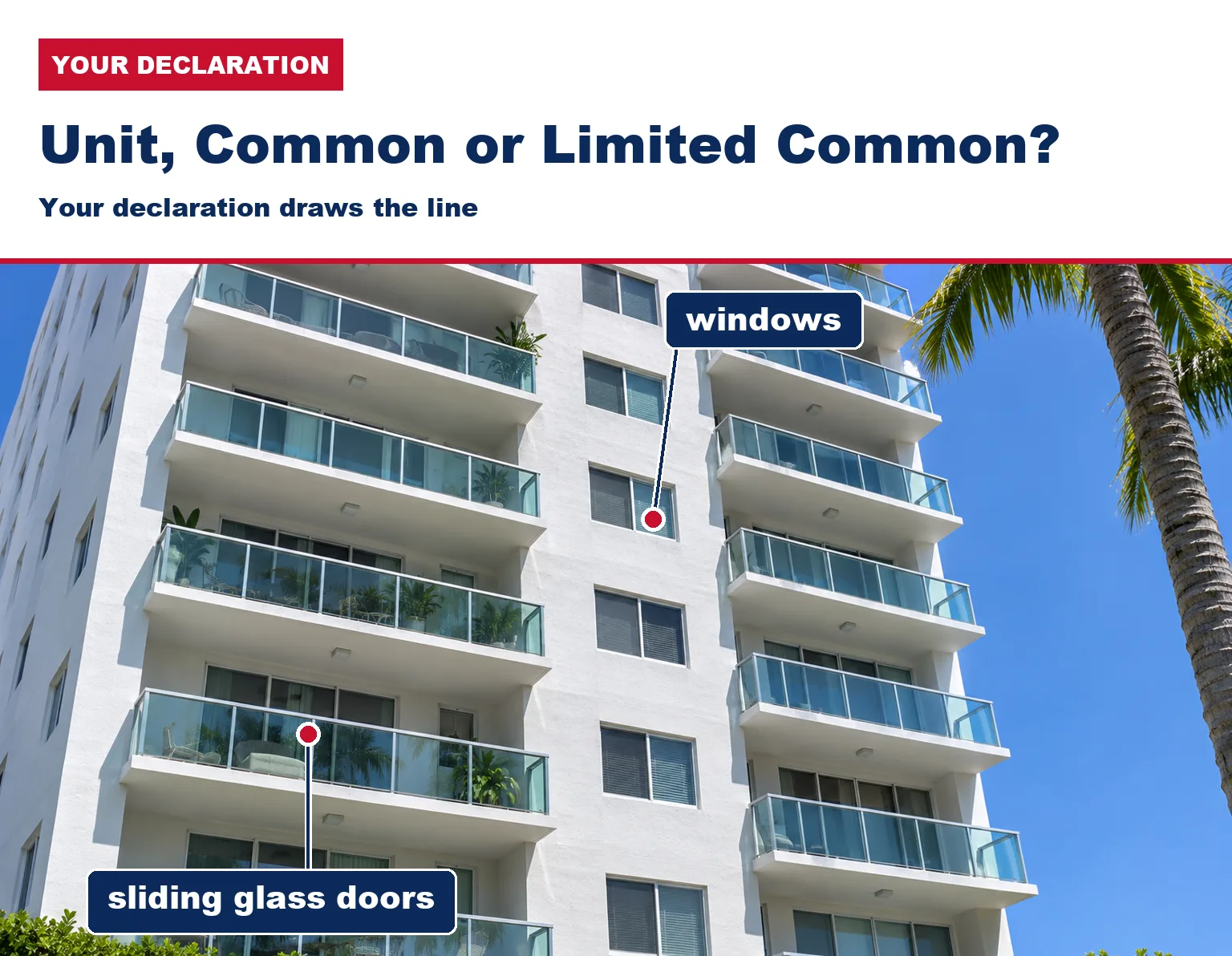
The declaration of condominium is the recorded document that creates your condo, and it answers most window questions. Look first at the article that defines the unit boundaries. Many declarations say whether windows, glass doors and their frames sit inside or outside the unit.
Next, read the maintenance article. It may make owners responsible for the windows and sliding glass doors serving their unit, even when the declaration calls them limited common elements.
The declaration may instead have the association maintain limited common elements and bill the cost only to the owners who use them, under section 718.113(1). Ask how your building charges for window work.
The association must keep the recorded declaration, its amendments, the bylaws and the current rules in its official records under section 718.111(12). Ask the manager for them, and ask in writing who is responsible for your windows and sliders.
Who Pays for Impact Windows, Sliding Doors and Shutters
Who pays usually follows who is responsible. Under section 718.115(1)(e), if the declaration or an owner vote makes installing hurricane protection the owners’ job and the association installs it anyway, the cost is charged to each owner for the protection on that unit, not shared as a common expense.
Protection on common elements is a common expense every owner shares. If your unit already has protection that meets the current building code, you are excused from the assessment, or credited, when the association uses its budget or reserves to install the same type on all the units that lack it.
Removal has its own rule. Unless the declaration says otherwise, section 718.113(5)(d) says you do not pay to remove or reinstall hurricane protection, including exterior windows and doors, when the association needs it out of the way to work on property it maintains.
If you do that removal yourself, the association must reimburse you or credit your future assessments.
Under section 718.112, buildings three habitable stories or higher must have a structural integrity reserve study that includes windows and exterior doors. Ask the manager what the study plans to fund. For prices, see what impact windows cost in Florida and what changes the price.
Association Specifications and Approval Before You Replace Anything
Before you replace anything, ask the board for its hurricane protection specifications. Section 718.113(5) requires every residential condo board to adopt them for each building, covering color, style and other factors the board finds relevant, and they must follow the building code.
If your documents require approval, the board cannot turn down an installation that meets the specifications, though it can hold you to the building’s existing look.
A board can also require owners to install protection after a majority vote, which our guide on when Florida law requires impact windows or shutters explains.
Before you sign a contract, get the specifications and the application form in writing. Section 718.113(3) bars an owner from doing anything that would harm the safety or soundness of the common elements, so the board may ask how the frames will be fastened to the building.
A balcony slider goes through the same approval steps. Our impact sliding glass doors page shows the ES Windows door styles we sell. Every USA Home Improvement project is permitted, and customers can receive the Florida Product Approval number for each window and door on request.
Planning impact windows or doors for your home? Ask us for a free estimate or call (877) 554-6373.
Before a Storm: Shutters, Balcony and Sliding Doors
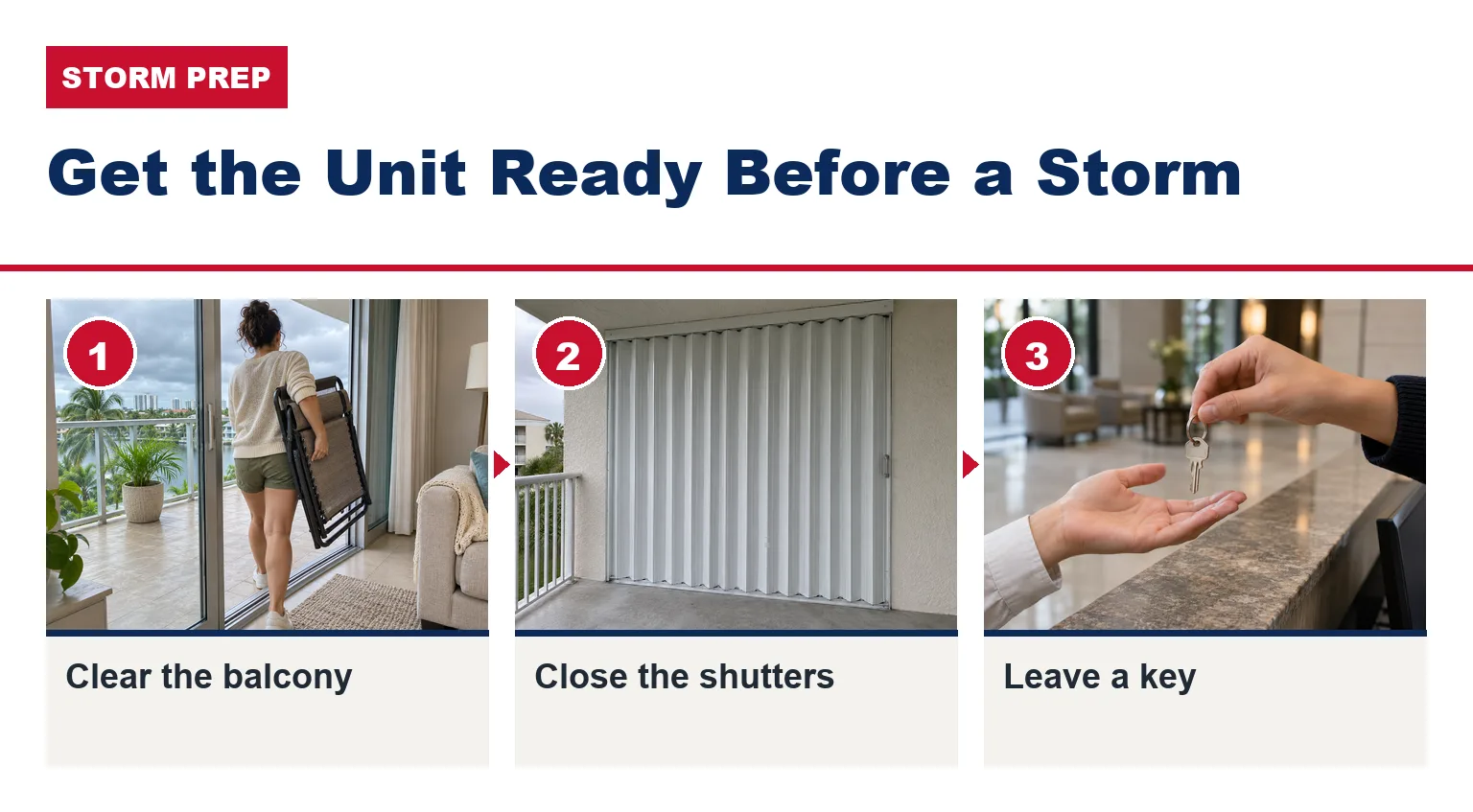
Whoever owns the glass, you prepare the unit before a storm. The City of Miami Beach evacuation checklist tells condo residents to bring in furniture, plants, umbrellas and other loose items from all balconies, to not tape windows and to not leave windows or doors ajar.
Clearing the balcony protects your own glass and your neighbors’. Miami Beach adds that unsecured windows and doors in neighboring units can damage your unit too.
Close shutters if your unit has them, following your building’s rules. FEMA’s Avoiding Hurricane Damage fact sheet names sliding glass doors among the openings storm shutters should protect. Close and lock every window and slider.
Do this early. The National Weather Service says to follow instructions from local officials and leave immediately if ordered to evacuate.
Impact-rated windows and sliders need nothing put up, but the balcony still needs clearing. Our guide on ways to protect your windows during a hurricane compares shutters, panels and plywood, and our explainer on what separates hurricane windows from impact windows shows how to read a rating.
Give the Association a Way Into Your Unit
Section 718.111(5) gives the association an irrevocable right of access during reasonable hours to maintain, repair or replace common elements or parts of a unit it maintains, or to prevent damage to the common elements or to a unit.
The board may also operate hurricane protection without your permission, but section 718.113(5)(b) allows that only when it is necessary to preserve and protect the condo property. Neither rule makes the staff responsible for your shutters, so do not count on them.
Before the season, give the manager a key or the name of someone who has one, plus a phone number that works while you travel. Ask what the building does when a hurricane watch is issued, and whether staff ever close owners’ shutters.
Condo Insurance Basics: Master Policy vs Your HO-6
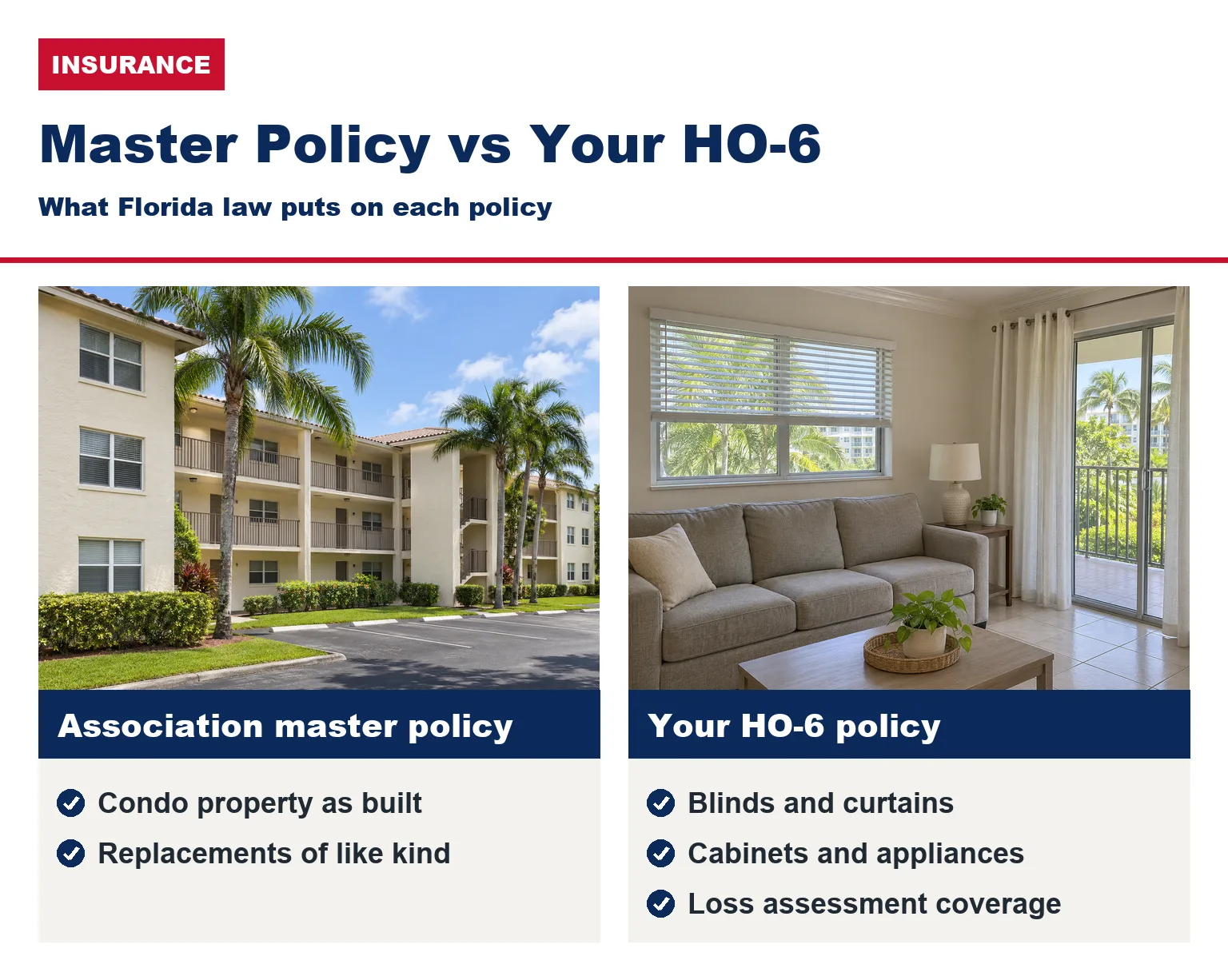
The association’s master policy covers the building, and your HO-6 unit owner policy covers what the statute leaves to you. Section 718.111(11)(f) says the association’s property policy must give primary coverage for all of the condo property as originally installed, or replacements of like kind and quality.
The master policy must exclude personal property in the unit, floor, wall and ceiling coverings, built-in cabinets, appliances and window treatments such as curtains, drapes and blinds that serve only one unit. Those are yours to insure. Window glass and frames are not on that list.
After a storm, the association repairs the property it must insure as a common expense, and its deductibles are common expenses too. The exception is a building whose owners voted by majority to opt out of this rule, with a recorded notice, under section 718.111(11)(k) and (m).
Section 718.111(11)(n) adds another: the association does not have to pay to repair an upgrade an owner installed that benefits only that unit and was not part of the developer’s standard build. If you replaced your own windows or slider, ask who would pay for storm repairs.
A shared deductible can come back to you as a special assessment. Under section 627.714, an HO-6 policy must include at least $2,000 of loss assessment coverage, with a deductible of no more than $250.
Ask your agent whether that limit fits your building’s hurricane deductible, and read our guide on upgrades that can lower Florida home insurance premiums.
Snowbird Condo Owners: What to Arrange Before You Leave
If you leave Florida for part of the year, arrange storm prep before you go, because you may not be able to get back. Clear the balcony, close the shutters or arrange who will close them, and leave a key and contact details with the manager or a caretaker.
Tell the association in writing that you will be away. Under section 718.111(5)(b), a unit can be presumed abandoned when no one appears to have lived in it for 2 consecutive months without prior written notice and the association cannot reach the owner.
The board may then enter, after mailing or hand-delivering notice 2 days ahead except in an emergency, and charge you for what it does there.
Report storm damage as soon as you learn of it. Under section 718.111(11)(j), the association does not have to pay for repairs if the owner knew or should have known of the damage and reported it only after the association’s claim was settled or denied as late.
For closing up the rest of the home and local limits on how long shutters may stay closed, see our checklist for Florida snowbird homeowners.
Condo Window Responsibility FAQs
Does the condo association have to replace my sliding glass door after a hurricane?
Often, yes, when the master policy must insure the door and the storm caused the damage. The association repairs it as a common expense, even if routine upkeep is yours, unless the owners opted out of that rule or you installed the door as an upgrade. Without a covered loss, the declaration decides.
Can I install impact windows in my condo without board approval?
Not if your documents require approval. Apply in writing with products that meet the board’s hurricane protection specifications; the board may not refuse a conforming installation, though it can require the building’s unified look. The work still needs a building permit.
Do I need HO-6 insurance if the association has a master policy?
The master policy leaves out your belongings, interior finishes, cabinets, appliances and window treatments, which an HO-6 policy covers. It also carries loss assessment coverage for your share of a storm assessment, when the loss is a type your policy covers. Your declaration or lender may require one.
Who pays if a neighbor’s unprotected window lets a storm damage my unit?
Storm damage to property the association insures is usually repaired by the association. If an owner’s negligence or failure to follow the declaration or rules caused the damage, section 718.111(11)(j) makes that owner responsible for repair costs insurance does not pay, including damage to other owners’ property.
Read the Declaration, Then Plan the Upgrade
Start with your declaration and the board’s hurricane specifications, and get the answer on windows and sliders in writing. If they are your responsibility, impact windows and doors mean nothing to put up before the next storm and nothing for anyone to close while you are away.
Financing may be available for qualified homeowners through independent third-party providers. Terms, eligibility and availability depend on the program and location. See financing for window and door projects.
USA Home Improvement is licensed (CGC1526707) and insured and has served Florida homeowners for more than 15 years.
Get a free estimate or call (877) 554-6373.