Skip to content

Impact windows and doors make a break-in slower and harder, but they do not stop every burglar. Their laminated glass is built to stay in the frame when it breaks, and in Miami-Dade and Broward, windows and doors that open must also pass a forced entry test.
What impact glass does not have is a security rating. It is not bulletproof, and the forced entry test pushes on the frame and lock, not the glass. Below: what each test proves, where the limits are, and which layers to add.
How Impact Glass Holds Up When Someone Tries to Break It
Impact glass is laminated: two layers of glass bonded to a plastic interlayer between them. When the glass breaks, the interlayer holds the pieces together, so the broken glass tends to stay in the frame instead of falling out.
The National Glass Association (NGA) is careful about what that means for burglary. Its technical paper on security glazing says hurricane resistant laminated glass “may offer some level of burglary or forced entry resistance.” It does not call it burglar-proof.
The same paper lists what even basic two-layer laminated glass offers: “glass containment upon breakage” and “reduced ability for reach and release.” In plain words, it is harder to break a small hole and reach in to open the lock.
The hurricane test is also not a burglary test. In the large missile test, TAS 201, a 9-pound 2×4 is shot from an air cannon at the glass, as Intertek’s TAS 201 summary describes. That copies flying storm debris, not a person who keeps striking or prying.
So the honest goal for any window is the one ASTM’s forced entry test methods name: to “restrain, delay, or frustrate” forced entry. Laminated impact glass helps with the delay. Our explainer on how hurricane impact windows are tested for strength covers the storm side.
USA Home Improvement sells ES Windows exclusively and installs ES Windows impact windows with laminated glass in aluminum and vinyl frames. ES Windows’ product presentation says its impact-rated windows help prevent forced entry. Our impact windows guide for South Florida houses covers styles, costs and county rules.

The Forced Entry Test in Miami-Dade and Broward Approvals
In Miami-Dade and Broward, the High-Velocity Hurricane Zone (HVHZ), windows and doors that open must pass a forced entry test. Section 2411.3.2.1 of the Florida Building Code, Building says operative window and door assemblies “shall be tested” under TAS 202.
The same section adds “the forced entry resistance requirements” of AAMA/WDMA/CSA 101/I.S.2/A440, the North American Fenestration Standard. “Operative” simply means the window or door opens.
TAS 202 is the HVHZ pressure test. Intertek’s TAS 202 page lists the air, water and wind load steps, then says: “Finally, forced entry resistance is performed.” Our guide to how hurricane impact doors are tested and rated walks through the pressure steps.
You can see it in the paperwork. One ES Windows Miami-Dade Notice of Acceptance (NOA), the county’s product approval, for an aluminum horizontal sliding impact window lists a forced entry test “per ASTM F 588 and per FBC 2411 3.2.1, TAS 202-94” among its test reports.
Outside the HVHZ, Section R609.3 of the Florida Building Code, Residential has windows and sliding doors tested to the North American standard or TAS 202. Wherever you live, ask for the approval of each window and door in your quote and read its test list.
USA Home Improvement customers can receive the Florida Product Approval number for each window and door on request. If labels are missing on your current windows, here is how to find a hurricane rating without labels.
Want to see the approvals for the windows and doors in your own quote? Request a free impact window estimate or call (877) 554-6373.
What a Forced Entry Test Checks and What It Leaves Out
A forced entry test attacks the frame, sash and lock, not the glass. ASTM F588, the window method named in the ES Windows approval above, says it “does not evaluate glazing materials for breakage,” and that other standards must be used for entry by breaking the glass.
The method also names its target: “unskilled or opportunistic burglars.” For skilled attacks, ASTM says it takes alarms, communication or apprehension systems, or special security glazing. In plain words, a passed test means a window resists an opportunistic attempt with tools, not a determined, equipped intruder.
| Test | What it covers | Includes breaking the glass? |
|---|---|---|
| ASTM F588 | Windows: sashes, frames and locks | No |
| ASTM F842 | Sliding glass doors | No |
| ASTM F476 | Swinging doors: hinge, lock, door, strike and jamb | No |
| ASTM E2395 | Whole window or door, including attacks on the glass | Yes |
| UL 972 | Burglary-resisting glass on its own | Yes, glass alone (no frame) |
The table follows the NGA paper and ASTM’s own scope pages. ASTM E2395 is a voluntary security specification aimed at “unskilled and semi-skilled intruders,” and it is the one that adds assault on the glass.
ASTM F588 also leaves the passing level to local officials: acceptance criteria “are a matter for authorities having specific jurisdiction to establish.” That is why the approval, not a sales sheet, is the place to check what was tested.
Impact Glass Is Not Security Glass or Bulletproof Glass
Impact glass is rated for hurricanes, not for attacks. The NGA paper sorts protective laminated glass by the threat it is tested for, and each kind has its own standards:
- Hurricane resistant: tested in window and door systems to ASTM E1886 and E1996 for wind-borne debris. NGA says it “may offer some level of burglary or forced entry resistance.”
- Burglary resistant: tested to UL 972. NGA says it “can be a deterrent to smash-and-grab crimes.”
- Forced entry resistant: tested to ASTM F1233 or F1915 and used where the risk of attack is high, such as detention facilities. NGA says it may resist hammers, crowbars, bats and bricks.
- Bullet resistant: tested to UL 752 or NIJ 0108.01 for set ammunition levels.
Glass that stays in one piece has a trade-off. NGA notes that security laminates are designed to remain intact after breakage, which can add time for firefighters working through them.
Impact glass also holds together when it breaks, so the way out of a bedroom is to open the window, not break it. That is why bedroom windows should open easily from inside, and why any bars must release from inside.
Locks and Hardware: Where a Forced Entry Test Pushes
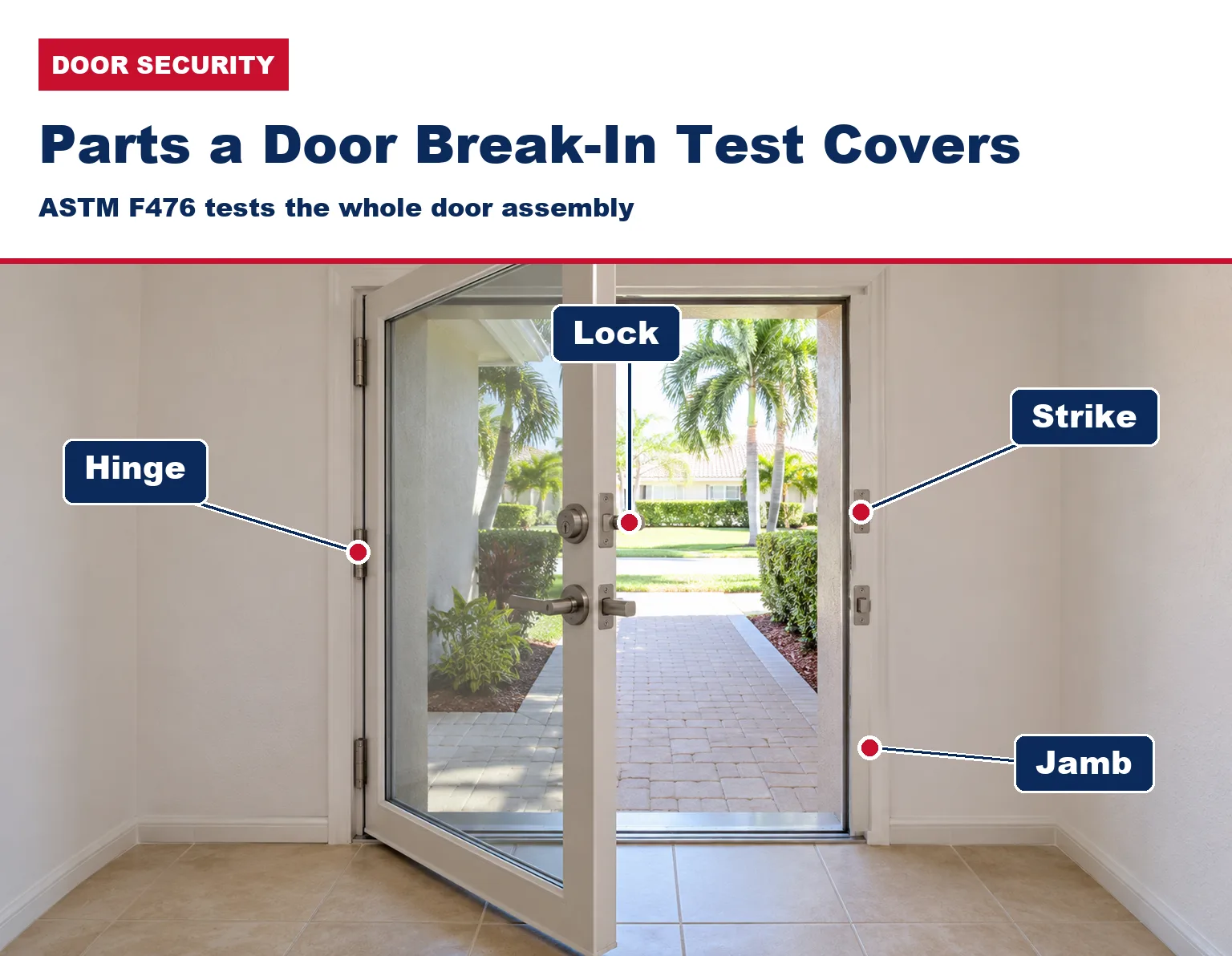
The lock is where a forced entry test does much of its work. ASTM F476, the test for swinging doors, covers the door assembly and its parts, “such as the hinge, lock, door, strike, and jamb.”
Many impact doors use a multi-point lock, which drives several bolts or hooks into the frame when you lift the handle. If yours stops halfway, read why an impact door sticks or will not lock. On windows, our casement and awning styles close with multi-point locking.
USA Home Improvement installs ES Windows impact entry, French and sliding doors. Every project is permitted, and our installation team holds direct certification from the manufacturer.
Leave the hardware as approved. An impact door is approved with the hardware it was tested with, so ask the installer which locks and handles the approval allows before you fit a smart lock or a heavier deadbolt.
A lock only works when it is engaged, so make locking every opening a habit, including the bathroom and laundry windows.
Security Layers That Work With Impact Windows
Impact windows work best as one layer of several. ASTM’s own forced entry method says skilled attacks call for alarms, communication or apprehension systems, so plan the rest of the house around the glass.
- Lock every opening, including the sliding door and the door from the garage into the house.
- Add an alarm and cameras that cover the back and sides of the house, where no one on the street can see.
- Light and clear the yard: motion lights and trimmed shrubs. Our list of eight ways to theft-proof your home, inside and out covers these steps in detail.
Security bars are the layer to think twice about. Section R310.4 of the Florida Building Code, Residential allows bars and grilles over a bedroom escape window only if the window keeps its required clear opening and the bars release from inside without a key, tool, special knowledge or extra force.
Impact windows add no bars at all, so the bedroom window still opens normally. Before you add any grille, check the bedroom escape window rules in Florida.

Impact Windows and Break-Ins: FAQs
Are impact windows bulletproof?
No. The NGA says hurricane resistant laminated glass is “typically” not bullet resistant without a stated ballistic threat level. Bullet-resistant glass is a different product, built from multiple layers of glass and plastic and tested to standards such as UL 752 for a stated ammunition level.
Will a cracked impact window still keep someone out?
Often the cracked glass stays in the frame, held by the interlayer, but treat it as damaged. A crack means the glass has already taken a hit, so plan to replace it. Here is what to do with a cracked impact window.
Do fixed impact windows need a forced entry test?
Not under the HVHZ rule. Section 2411.3.2.1 requires the forced entry test for operative windows and doors, the ones that open. A fixed window has no sash or lock to pry, so its laminated glass is what slows a break-in.
ASTM F588 does include fixed panes as a window type, so a maker can still test one; the approval’s test list shows it.
Is an impact sliding glass door harder to break into?
The laminated glass helps, and sliders have their own forced entry method, ASTM F842. It tests sliding panels that lock to the jamb or to each other, and it does not test breaking or removing the glass. Compare our impact sliding glass doors for patios.
Buy Impact Windows for Storms, Then Add Security Layers
Choose impact windows and doors because they protect the openings in a hurricane and slow a break-in, not because they make the house burglar-proof. Ask for each product’s approval and test list, keep the hardware as approved, and add locks, an alarm and lighting.
USA Home Improvement is licensed (CGC1526707) and insured and has served Florida homeowners for more than 15 years. Every project is permitted, and we offer a 15-year warranty and a 1-year labor warranty on most jobs, plus a transferable warranty.
Get a free estimate or call (877) 554-6373.