Skip to content

The best way to theft-proof your home is to stack layers: locked doors, windows and cars, stronger glass at ground level, outdoor light, clear sightlines and a house that looks lived in. No single fix stops every break-in, but each layer makes one slower, louder or easier to see.
The eight steps below follow a South Florida home from the front door to the backyard shed. Each one draws on police advice or Justice Department research, so you can start with the fixes that matter most for your house.
Lock Every Door, Window and Car, Even When You Are Home
Locking up is the cheapest layer, and it closes the most common way in. A U.S. Bureau of Justice Statistics study of household burglary covering 2003 to 2007 found that when burglars entered an empty home without force, 40% got in through an unlocked door or window.
Being home does not make the house safe either. The same study found a household member was present in about 28% of burglaries, so lock the front door while you are out back mowing the lawn.
Hardware matters as much as the habit. Baltimore Police advise a deadbolt on every exterior door, because a key-in-the-knob lock alone is not enough, and a strike plate anchored to the house framing with 3-inch screws.
The Hialeah Police Department adds that all windows should have window locks. Both departments say never to hide a spare key outside; leave one with a trusted neighbor instead.
Your car is part of the house. Lock it in the driveway, keep keys and valuables out of sight, and never leave the garage door remote inside. A thief who takes the remote and the registration card has your address and a way in.
Upgrade Ground-Floor Windows With Laminated Impact Glass
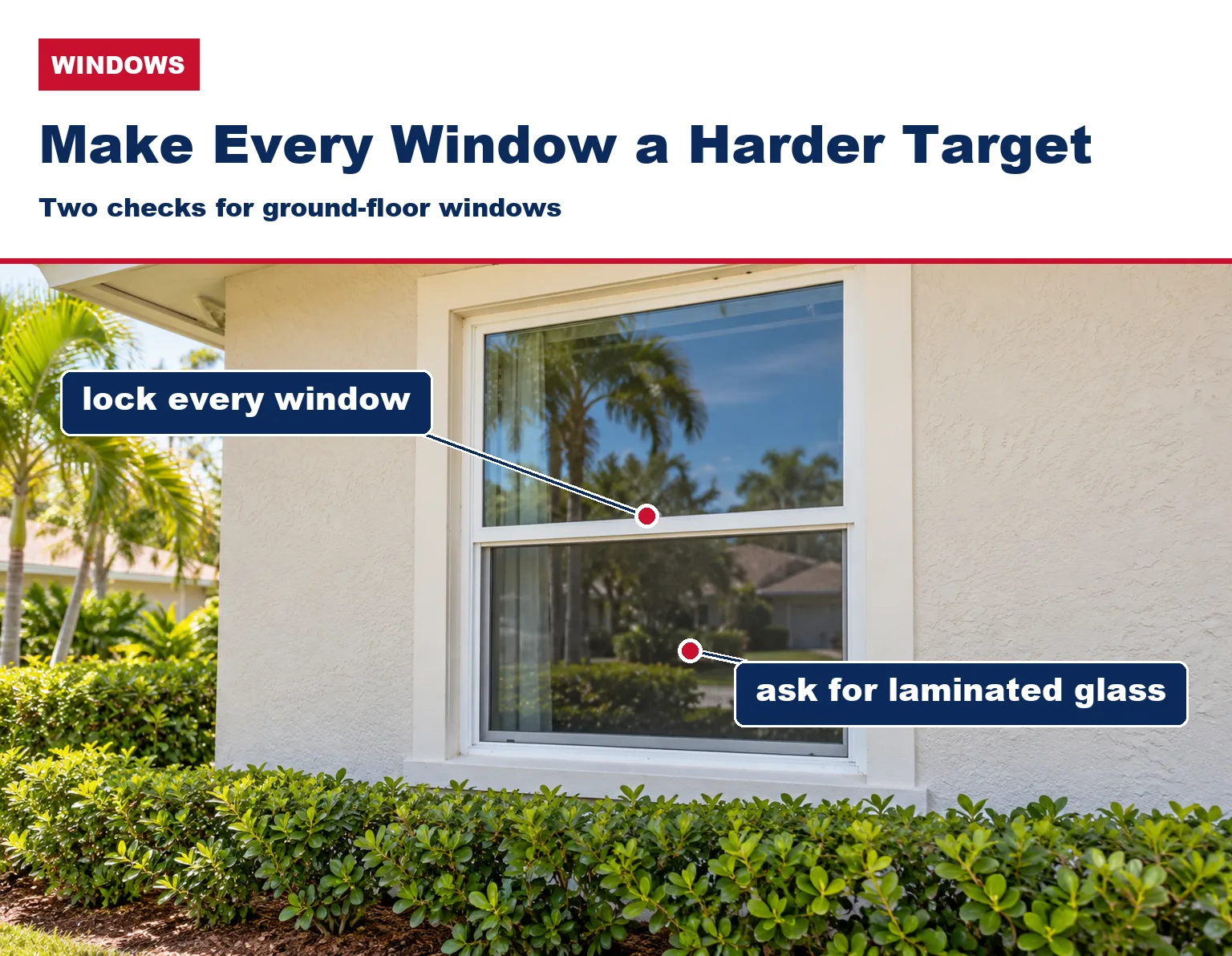
Stronger glass is the layer that still works when someone tries to break in instead of walking in. Impact windows use laminated glass, which is two layers of glass with a vinyl layer between them.
How Laminated Glass Slows a Break-In
A crime prevention officer with the Sandy Springs Police Department in Georgia wrote in a safety column that a burglar would have to strike laminated glass repeatedly to make even a small opening. That takes time and makes noise.
Police departments recommend it for the same reason. After a rise in attempted break-ins at local businesses through shattered glass doors and windows, the Prince William County Police Department in Virginia advised laminated glass for new doors and laminated glass sheets for existing doors and windows.
Laminated glass resists entry better than plain glass, but it does not replace locks. Cracked glass can still be attacked with enough time, and an unlocked window opens like any other window, so ask for laminated glass and lock every window.
In Broward and Miami-Dade, the High-Velocity Hurricane Zone, the Florida Building Code requires windows to pass the TAS 202 pressure test. Intertek’s TAS 202 test summary says that sequence ends with forced entry resistance testing.
USA Home Improvement installs ES Windows exclusively, and ES Windows says its impact-rated windows help prevent forced entry. You can compare ES Windows impact windows for South Florida homes in aluminum and vinyl frames, starting with the ground-floor openings a stranger can reach.
The Same Glass Protects the Home During Hurricanes
Impact glass also matters after a storm. A window broken by flying debris leaves the house open to rain and to anyone walking by until it is boarded up. Impact windows are tested to keep a large debris strike out even when the glass cracks; see how hurricane impact windows are tested.
In Florida’s wind-borne debris region, Section R301.2.1.2 of the Florida Building Code, Residential requires glass openings to be protected, either by impact windows or by approved shutters. Shutters help only when they are closed, so compare impact windows and hurricane shutters side by side if you travel often.
Opening protection is also one of the features on Florida’s wind mitigation inspection form, OIR-B1-1802, which insurers use for windstorm credits. Read about home upgrades that can lower insurance rates before you price the project.
Financing may be available for qualified homeowners through independent third-party providers. Terms, eligibility and availability depend on the program and location, so review the financing options for qualified homeowners before your estimate.
Light the Outside and Add Motion Alarms and Cameras
Motion-detecting lights take away the dark corners a burglar needs. Baltimore Police recommend more exterior lighting with motion lights or timers, and leaving a light on whenever you are not home. Start with a light over the front door, then cover the side yard and the back.
Inside, motion detectors linked to an alarm sound off if someone moves through the house while the system is armed. Baltimore Police also suggest “Alarm” or “Beware of Dog” decals as a visible warning at the door.
Web-connected cameras let you check the house from your phone and save video you can share with police. Do not count on Wi-Fi alone: a Fort Lauderdale homeowner told NBC 6 South Florida that his indoor Wi-Fi cameras shut off and recorded nothing for a stretch when his home was broken into.
Ask your alarm company whether the system keeps reporting if the home Wi-Fi goes down. Put at least one camera where it can see the back of the house, since that report described burglars getting in at the rear.
Use Fencing and Landscaping to Remove Hiding Spots
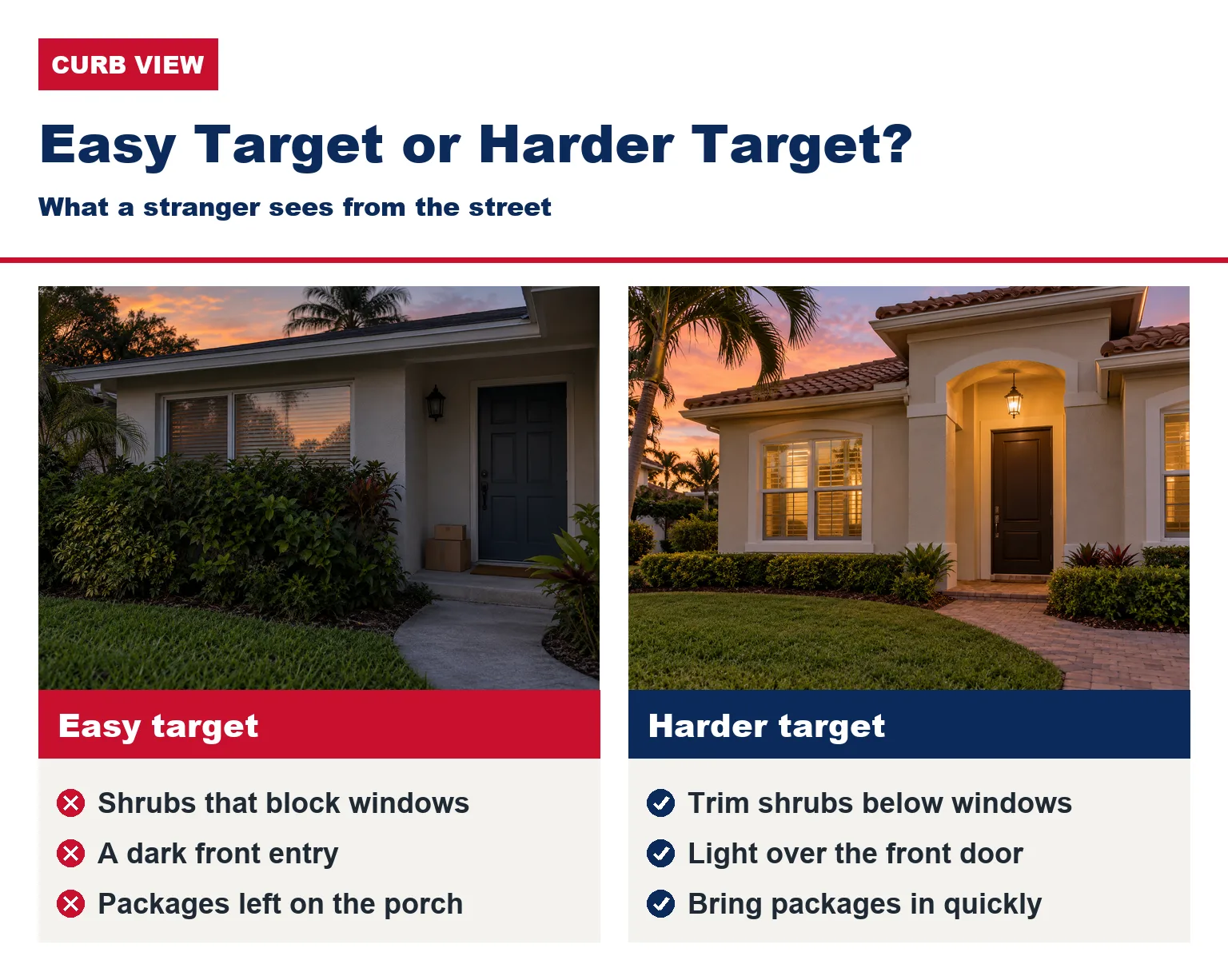
A burglar wants to work where no one can see. Hialeah Police advise keeping shrubbery trimmed away from entrances and walkways, and Baltimore Police say trees and bushes should never block windows and doors.
Trim shrubs below windows so anyone trying to climb in can be seen from the street. Thorny plants such as bougainvillea, common in South Florida yards, make the ground under a window an uncomfortable place to stand.
A fence adds one more step and keeps bikes, tools and pool gear out of easy reach. Fences with pointed tops are harder to climb, and USA Home Improvement offers fence installation for South Florida yards if yours has gaps.
Stand at the street and look back at your house, the way a stranger would. Shrubs that block windows, a dark front entry and packages left on the porch all signal an easy target.
Keep Travel Plans Off Social Media Until You Are Back
Save the vacation photos for when you are home. A public post that says you are away for a week tells strangers exactly when the house will be empty.
If you do post, limit the audience to people you know and turn off location tags. Tell a trusted neighbor instead, and ask them to keep an eye on the driveway and the front door.
Most burglaries happen when no one is home, and for empty homes daytime is more common than night. In the Bureau of Justice Statistics study, burglaries of homes with no one inside were more likely to happen between 6 a.m. and 6 p.m. (43%) than between 6 p.m. and 6 a.m. (26%).
Use Timers and Smart Lights So the House Looks Lived In
A home that looks occupied is a harder target. Hialeah Police suggest making your home appear occupied with lights or a television on a timer while you are out.
Set the timers to follow your normal evening: living room lamps on at dusk, then off as a bedroom lamp switches on. Smart plugs and smart bulbs do the same job from a phone app, so you can change the schedule from anywhere.
Ask a neighbor to pick up mail, flyers and packages so nothing piles up at the door. Snowbirds who close up for the whole summer need a longer plan, from mail holds to hurricane prep, and our guide on how snowbirds can manage a Florida home covers it.
Lock Up Mail and Packages and Bolt a Safe to the Floor
Thieves do not have to enter the house to steal from you. Mail can carry bank statements, card offers and account details that help someone open credit in your name. A locking mailbox keeps mail secure until you open it with a key.
Packages are the same problem. Bring packages in quickly, send deliveries to a pickup locker or a neighbor who is home, or ask for a signature on valuable orders.
Inside, a safe bolted to the floor with an electronic code lock protects jewelry, documents and spare cash. Baltimore Police advise using safes for valuables and always keeping a record of serial numbers.
Hialeah Police note that marked personal property is difficult for a burglar to sell. Engrave an identification number on electronics and tools, and keep the list somewhere safe outside the house.
Secure the Shed, Garage and Sliding Glass Door
Sheds, garages and sliders are the soft spots many homeowners forget. Secure shed doors and hinges with Allen head or hex screws to slow a thief carrying only a standard Phillips screwdriver, and lock up ladders and tools so no one can use them on your windows.
Keep the garage door closed at all times, as Hialeah Police advise, even while you are home. Give the door from the garage into the house the same deadbolt as the front door. If the garage door itself is old and dented, see impact-rated garage doors for Florida homes.
For a sliding glass door, Baltimore Police say a broomstick or dowel placed in the inside track is sufficient to block it. Cut it to fit snugly, so the panel cannot slide open even if the latch is forced.
A slider whose latch no longer catches is worth replacing. Our impact sliding glass doors for patios replace an old slider with laminated impact glass.
Walk Around Your Home at Night Like a Stranger Would
The fastest way to find weak spots is a walk around the house after dark, outside first and then inside. Look at each opening the way a stranger on the sidewalk would.
- Every exterior door has a deadbolt, and the strike plate screws reach the framing.
- Every window locks, including bathroom, laundry and garage windows.
- Ground-floor glass is laminated, or on your list to upgrade. You can check whether your windows are impact resistant in a few minutes.
- No shrub hides a window or door, and no corner of the yard stays dark.
- Ladders and tools are locked away, and the shed uses tamper-resistant screws.
- The slider has a dowel in its track, and the garage remote is not in the car.

Home Security Questions South Florida Homeowners Ask
Can a burglar break through impact windows?
Impact windows are much harder to get through than plain glass, but a determined person with time and tools can still damage them. Their laminated glass slows entry and makes noise.
That happened in Fort Lauderdale: a homeowner told NBC 6 that burglars got in through hurricane windows at the back of his house, and said it takes a long time and makes a lot of noise. That is why glass works best with an alarm and a camera on the rear.
Keep them locked and the yard well lit. Our complete guide to impact windows in South Florida covers styles and costs.
How do most burglars get into a house?
When force is used, most often through a door. In the Bureau of Justice Statistics study, damaging or removing a door was the most common method in forced and attempted forced entries.
When no force was used, burglars most often came in through an open or unlocked door or window, so door hardware and locking habits come first.
What should I fix first on a tight budget?
Start with what costs little: lock every door and window, move the garage remote out of the car, take the hidden key inside and trim shrubs below windows. Next add motion lights and a dowel for the slider. Then plan glass upgrades for the ground-floor windows and doors a stranger can reach.
Start With the Free Fixes, Then Upgrade the Weakest Opening
Start tonight with the free layers: lock up, move the remote and trim the shrubs. Then list the ground-floor windows and sliders that still have plain glass or worn latches, because those openings are worth upgrading first.
USA Home Improvement is licensed (CGC1526707) and insured and has served Florida homeowners for more than 15 years. Every project is permitted, our installation team holds direct certification from the manufacturer, and customers can receive the Florida Product Approval number for each window and door on request.
Request a free, no-obligation estimate or call (877) 554-6373.