Skip to content

An impact door that is hard to lock is usually out of alignment: its lock points no longer meet the strikes in the frame. Common causes are a door that has dropped on its hinges, dirt in a track or bolt hole, low rollers on a slider, or heat.
Below: how to tell a door problem from a lock problem, what you can check safely, what to leave to your installer, and why forcing or swapping parts is a bad idea on an approved impact door.
Why Impact Doors Get Hard to Lock: Multi-Point Locks and Alignment
Many impact entry and French doors use a multi-point lock. Lifting the handle drives several locking points into the frame at once, usually hooks or bolts above and below the handle, and then the key or thumbturn locks them.
Each locking point has its own strike, a metal plate or pocket in the frame. When the door shifts even slightly, one point hits the edge of its strike instead of sliding in, and the handle stops halfway.
Those extra points add strength. The Federal Alliance for Safe Homes (FLASH) says three- and five-point latching creates a stronger door-to-frame connection than a single latch, which it calls a common weak point in high winds.
So a door that will not lock fully is more than an annoyance in South Florida. USA Home Improvement installs ES Windows impact doors in entry, French and sliding styles, and our full guide to choosing and caring for impact doors covers types, testing and county rules.
The Open-Door Test: Is It the Door or the Lock?
The quickest way to find the cause is to work the lock with the door open, as one multi-point lock supplier’s troubleshooting guide advises. Open the door fully, lift the handle, turn the key or thumbturn, then lower everything again.
If the hooks and bolts move smoothly with the door open, the lock itself is working.
Now close the door and try again. If the handle binds only when the door is closed, the locking points are missing their strikes, which points to alignment: a sagging door, a strike that has moved, or debris in a bolt hole.
If the handle is stiff or stops even with the door open, the problem is more likely in the lock hardware itself. That is a job for your installer or the door maker’s service network, not for more force.
Quick Guide: Symptom, Likely Cause and Who Should Fix It
Match what you see to the likely cause; each row is explained below.
| Symptom | Likely cause | Who should fix it |
|---|---|---|
| Handle lifts with the door open, binds when closed | Door out of alignment with the strikes | Check hinge screws; installer adjusts |
| Handle stiff even with the door open | Problem inside the lock | Installer or door maker |
| Door rubs at the top corner or drags at the threshold | Door dropped on its hinges | Installer |
| French door active side will not lock | Second door’s bolts not fully engaged | You first; installer if bolts miss |
| Slider is hard to push and the lock misses | Dirty track or worn, low rollers | You clean; installer adjusts rollers |
| Sticks only in afternoon sun | Heat movement | Watch it; installer if it persists |
| Stops closing over time, with new foundation cracks | The house may be moving | A professional inspection |
Entry Doors That Sag or Drag: Hinges and the Strike
A hinged entry door that has dropped on its hinges is a common reason the latch side stops lining up. FLASH calls the hinge side another potential weak point, because the hinges must stay firmly attached to the door and frame.
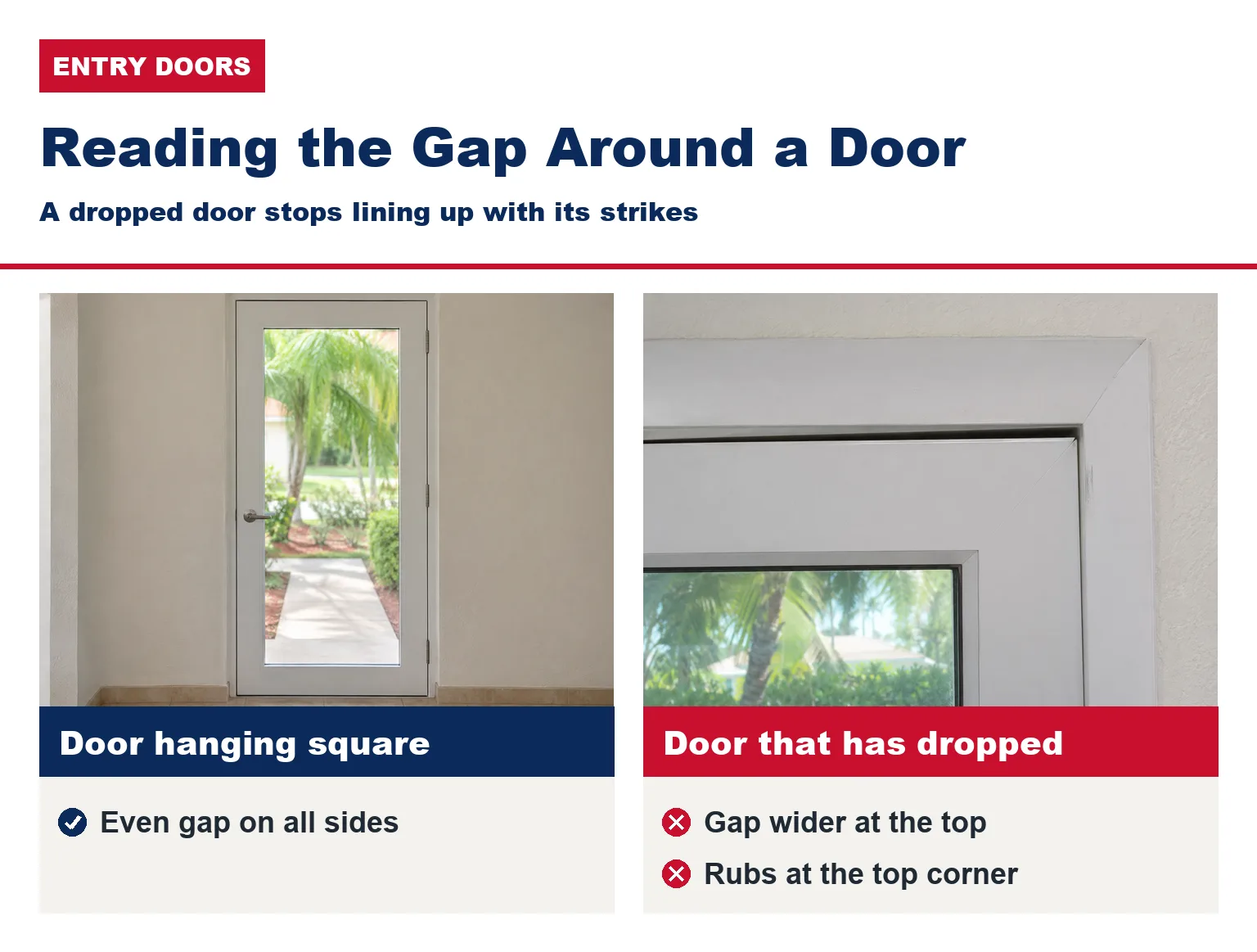
Look at the gap around the closed door. On a door hanging square, the gap is even on all sides. On a dropped door, the gap along the top grows wider toward the latch side, and the door may rub the frame at the top corner or drag at the bottom.
Check the hinge screws first; a door maker’s troubleshooting guide lists hinge screws that are not flush among the causes of a door that does not sit square. If a screw tightens by hand, snug it. If it spins, the hole is stripped and needs your installer.
Then look for fresh scrape marks beside a strike, which show where a hook is landing. Moving a strike or shimming a hinge on an impact door is an installer’s job, for reasons explained below.
French Doors: Lock the Second Door First
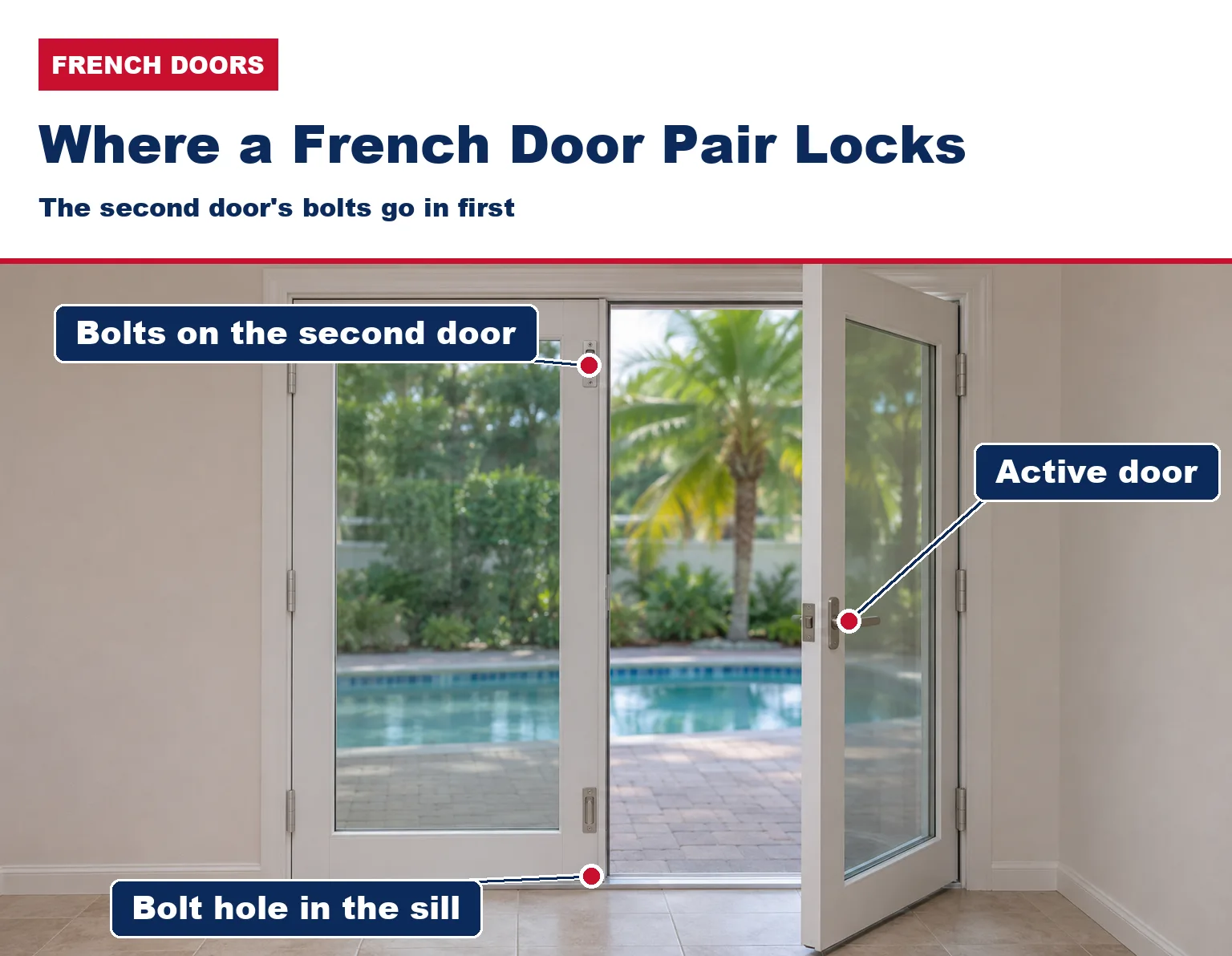
On impact French doors, the active door’s lock depends on the second door being fully secured first. The second door, often called the inactive or fixed leaf, usually stays closed and is held by bolts that shoot up into the frame and down into the sill.
If either of those bolts is only partly thrown, the second door can move slightly, and the active door’s hooks no longer meet their strikes. A door maker’s guide lists a shoot bolt that will not fully engage because its strike is blocked by debris, and says to clear it.
So check that both bolts on the second door are fully engaged, the bolt hole in the sill is free of sand, and the active door is fully closed before you lift the handle. Follow the locking order in your door’s instructions.
FLASH recommends bolts at the top and bottom of the inactive door against wind, so if a bolt still misses its hole after cleaning, have it reset. See our impact French door options for patios and entries for how the two doors work together.
Sliding Impact Doors: Track, Rollers and the Lock Hook
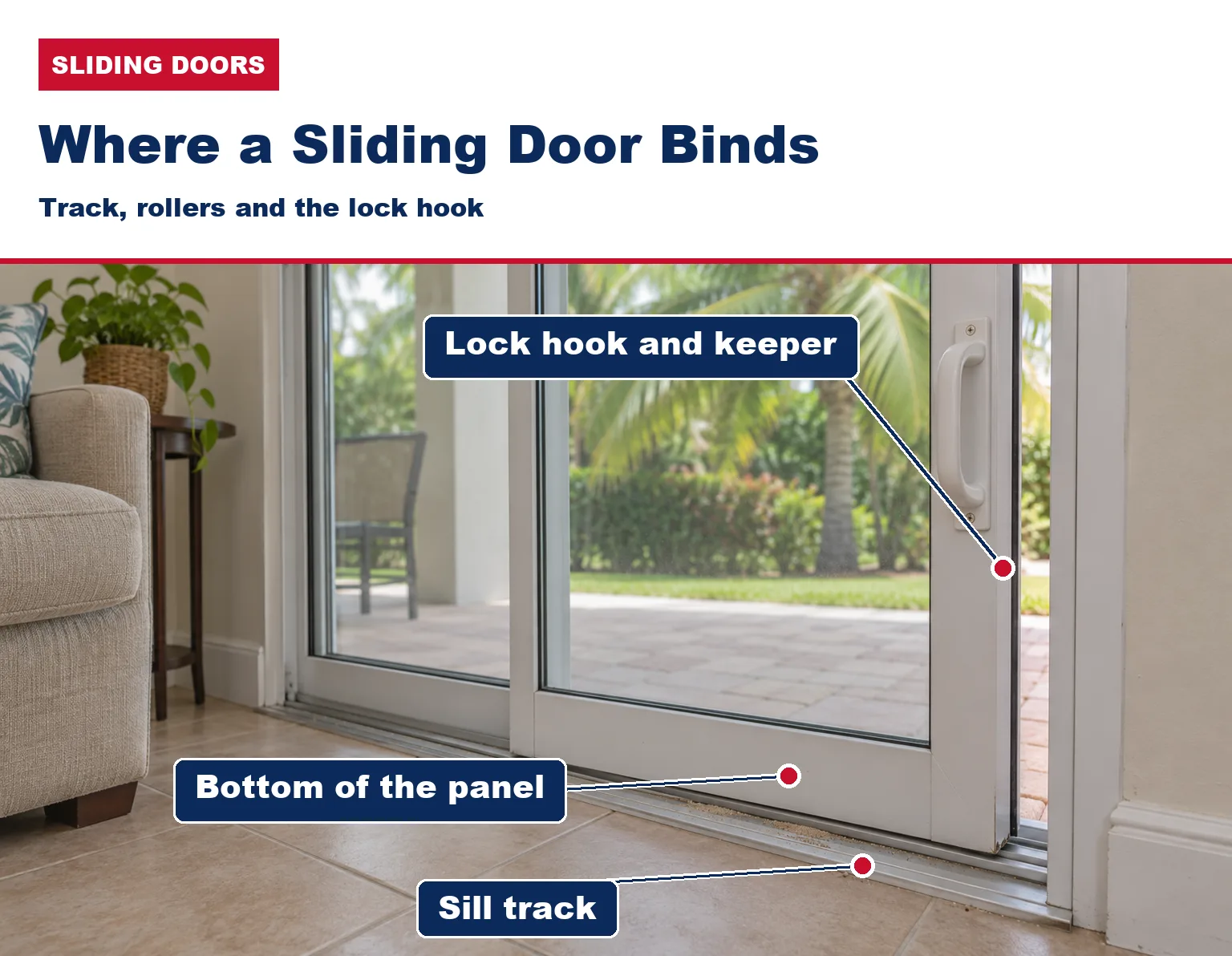
An impact sliding door that is hard to push and hard to lock usually has a dirty track or rollers that have worn or dropped. When the panel sits too low, it drags on the track and its lock hook no longer lines up with the keeper on the frame.
Start with the track. Vacuum sand and grit along its full length, wipe it, and slide the panel again before you suspect the rollers. FGIA, the window and door industry group, advises cleaning tracks with a dry paint brush or vacuum brush attachment.
Roller height is set with adjustment screws near the bottom of the panel, and getting it right matters both ways. One door maker’s service guide warns that rollers set too low make the panel drag, while a panel set too high may allow water and air leakage.
So leave roller adjustment and any panel removal to your installer; the same guide warns that removing a panel can cause injury or damage. For water at the track, read why impact sliding doors leak and how weep holes drain, or compare impact sliding door configurations.
Heat, Weatherstripping and a House That Moves
A door that sticks only on hot afternoons may be moving with heat. The Door & Access Systems Manufacturers Association (DASMA) describes this for insulated garage door panels: when one face is much warmer than the other, the warm side grows and the door bows toward it.
DASMA’s technical data sheet on thermal bowing adds that darker doors facing the sun bow more. A door in direct sun with air-conditioning behind it may move in a similar way, so note when it happens and tell your installer.
Weatherstripping that has pulled out of its groove or bunched at a corner can also push back on a closing door. FGIA says damaged weatherstripping should be replaced.
Rarely, the house is the cause. The St. Johns River Water Management District lists doors and windows that fail to close properly, and foundation cracks, among warning signs of a sinkhole.
The district adds that ground settlement has many other causes. Either way, new foundation cracks plus a door that stops closing properly call for a professional inspection.
What You Can Check Safely and What Needs a Pro
You can do the looking, cleaning and testing; anything that changes how the door hangs or how the lock is set belongs to the installer. FGIA’s homeowner care guide points you to the owner’s manual for moving parts.
Safe for you to do:
- Run the open-door test and note where the handle stops.
- Check the gap around the door and look for scrape marks at the strikes.
- Vacuum the sliding track and clear sand from bolt holes in the sill.
- Snug a loose hinge screw by hand, stopping if it spins.
- Lubricate only with what the maker’s instructions name; FGIA warns oil-based lubricants can damage weep holes.
- Take photos or a short video of the problem.
Leave to the installer: shimming or moving hinges, moving or replacing strikes, adjusting or replacing rollers, lifting a sliding panel out, and opening or replacing the lock itself.
Our salt air care routine for impact windows and doors covers cleaning and lubrication, and our post-season window and door checks include a lock test.
If your door is old, keeps slipping out of line, or is not impact rated at all, a new door may be the better fix. Ask for a free impact door estimate or call (877) 554-6373.
Why Not to Force, Trim or Swap Parts on an Impact Door
Forcing a stuck handle can damage the lock. Trimming the door, drilling new holes or fitting a different lock or hinge also changes the approved product, and the approval is for the door as tested.
A Miami-Dade Notice of Acceptance for an aluminum outswing impact French door gives design pressure charts by glass, threshold type, lock type and hinge type, and says the lower design pressure applies to the entire assembly.
On that door, the lock and hinges are part of the rating. Our explainer on how impact doors are tested as complete units walks through the tests, and you can find the approval label on your door before you call anyone.
Warranty is the other reason. FGIA’s care guide tells owners to follow the manufacturer’s maintenance instructions and to consult the manufacturer’s warranty for details, so check your warranty before anyone changes parts. Call the company that installed the door first, with photos, the permit and the Florida Product Approval number.
Impact Door Sticking and Locking FAQs
Should I lock my impact door during a hurricane?
Yes. NOAA’s storm preparation advice is to secure all exterior doors, and an impact door should be closed with every locking point engaged. If the handle will not lift all the way, have the alignment fixed before hurricane season.
Can I put a smart lock on an impact door?
Ask before you buy. Lock type can be part of an impact door’s approval, as the Miami-Dade example above shows. Your installer or the door maker can tell you whether a smart lock works with your multi-point lock and which hardware your approval allows.
Is a door that sticks covered by the warranty?
It depends on the cause and on the written terms of your warranty. A track full of sand is a cleaning job, while a lock that fails with the door open is a question for the installer or maker.
Who should I call if my impact door will not lock?
Call the company that installed the door first, or the door maker’s service network. Have photos or a short video, your permit and the Florida Product Approval number ready, plus the results of the open-door test.
When a New Impact Door Makes More Sense
If the door only needs cleaning or a small adjustment, keep it. If the lock is failing, the frame is corroded, or the door is not impact rated, a new door built to the measured opening is the cleaner path.
If you choose a new door, every USA Home Improvement project is permitted, our installation team holds direct certification from the manufacturer, and customers can receive the Florida Product Approval number for each window and door on request.
Compare financing for a replacement impact door. Financing may be available for qualified homeowners through independent third-party providers. Terms, eligibility and availability depend on the program and location.
USA Home Improvement is licensed (CGC1526707) and insured and has served Florida homeowners for more than 15 years. We sell ES Windows exclusively.
Get a free estimate or call (877) 554-6373.