 Skip to content

Hurricane impact doors in South Florida are tested as complete units: a 9-pound 2×4 is fired at them, then thousands of pressure cycles push and pull on the damaged door, and separate tests rate it for wind pressure and wind-driven rain.
Only a door that passes is approved, and only for the sizes and setup it was tested in.
This article explains each test, what design pressure and water ratings mean for doors, how to read the label, and what a rating does not cover. For door types, county rules and cost in one place, see our all-in-one guide to hurricane impact doors.
Why South Florida Doors Must Pass Hurricane Tests
South Florida doors must pass hurricane tests because the Florida Building Code requires every glass opening in the wind-borne debris region to be protected, either by impact-rated products or by approved shutters. Doors count as openings, and sliding glass doors are often the largest openings in the house.
Storms come often enough to make this matter. Based on the 1991 to 2020 record, an average Atlantic season brings 14 named storms, 7 hurricanes and 3 major hurricanes, according to NOAA’s updated season averages. The season runs from June 1 to November 30.
Miami-Dade and Broward sit in the High-Velocity Hurricane Zone (HVHZ), which has the strictest wind rules in the state. Palm Beach County and the rest of the region still fall under Florida Building Code wind rules and product approval.
Every door we fit, from entry doors to sliders, carries this testing in its approval; you can see the range of entry, French and sliding impact doors we offer.
The Tests Every Impact Door Must Pass
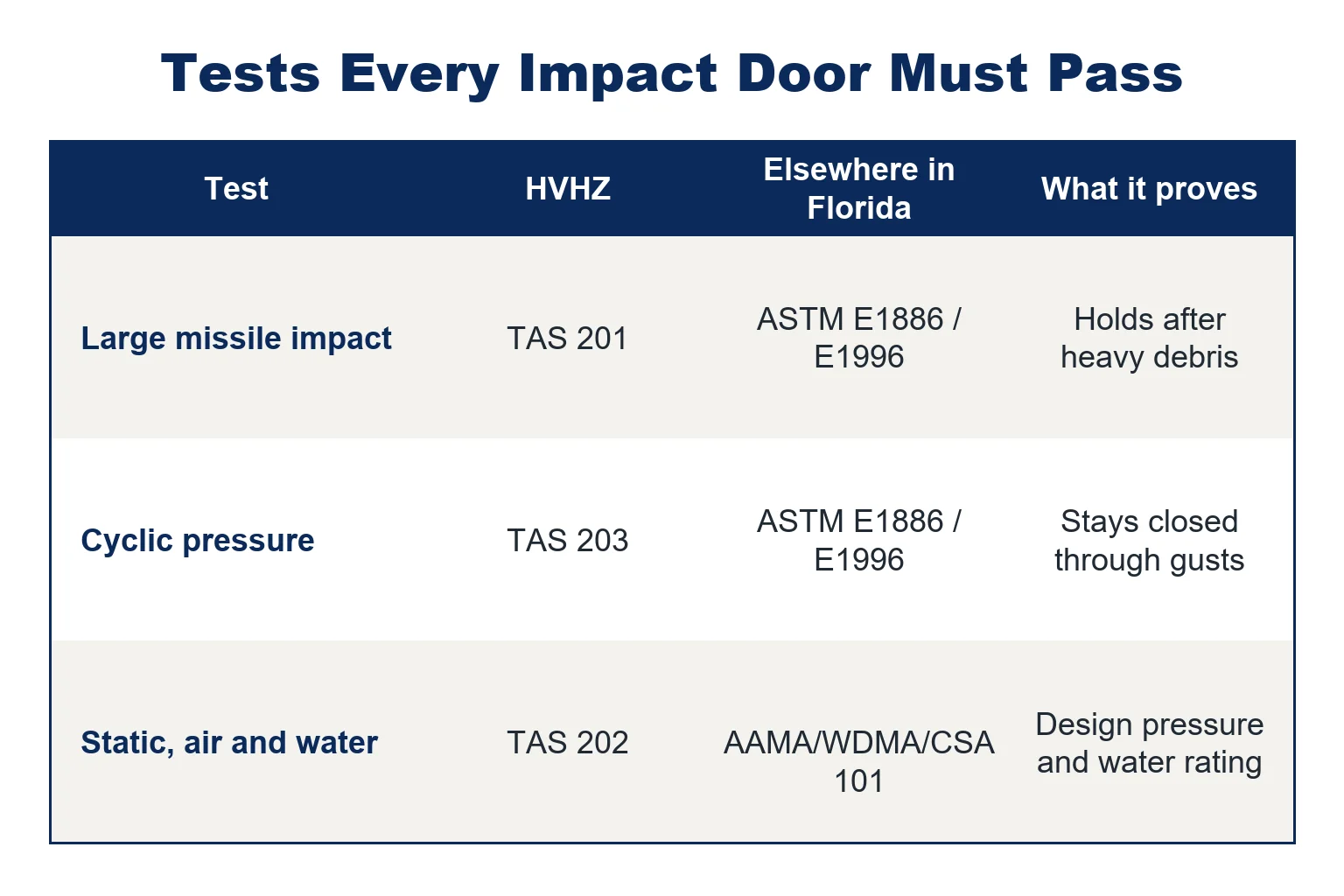
An impact door must pass a missile impact test, a cyclic pressure test on the same damaged door, and a static pressure test that also checks air and water leakage. The HVHZ uses Florida’s Testing Application Standards (TAS); the rest of Florida also accepts the matching national ASTM and window and door standards.
| Test | HVHZ standard | Elsewhere in Florida | What it proves |
|---|---|---|---|
| Large missile impact | TAS 201 | ASTM E1886 and E1996 | The door holds after a hit from heavy debris |
| Cyclic pressure | TAS 203 | ASTM E1886 and E1996 | The damaged door stays closed through gusts |
| Static pressure, air and water | TAS 202 | AAMA/WDMA/CSA 101/I.S.2/A440 | The design pressure and water rating |
ASTM E1886 is the test method and ASTM E1996 sets the missile levels and pass rules. The window and door standard on the last row is often called NAFS, the North American Fenestration Standard.
Large Missile Impact: Why Doors Near the Ground Need It
The large missile test fires a 9-pound piece of 2×4 lumber at the door at 50 feet per second, about 34 miles per hour. Intertek’s TAS 201 test overview describes the missile and the impact locations set by the code. In ASTM E1996 the same shot is called Missile D.
Under the Florida Building Code (Section 1609.1.2), glass openings within 30 feet of the ground in the wind-borne debris region need large missile protection. Doors sit at ground level, so every door on a South Florida house falls inside that zone.
A small missile rating, meant for glass high up on tall buildings, is not enough for a door.
Cyclic Pressure After the Hit
The cyclic pressure test checks whether a damaged door can survive the hours of gusting wind that follow the debris.
Under TAS 203, the same door that was just hit is pushed by 4,500 cycles of positive pressure and pulled by 4,500 cycles of negative pressure, in stages set from its design pressure, according to Intertek’s TAS 203 test summary.
To pass, the cracked glass must stay in the panel, the panel must stay in the frame, and the locks and hinges must keep the door shut. A door that survives the missile but tears open during the cycles is not impact rated.
Static Pressure, Water and Forced Entry Under TAS 202
TAS 202 is the test that sets a door’s design pressure and water rating.
Intertek’s TAS 202 test summary lists the order: air leakage, steady positive and negative wind loads, water leakage at a minimum of 15% of the positive design load, overloads of 1.5 to 3 times the design load depending on the product, and a forced entry test last.
The overload step is a safety margin. The door has to hold well past its rated pressure without failing, then still pass the forced entry check.
TAS in Miami-Dade and Broward, ASTM Elsewhere
In Miami-Dade and Broward, doors are tested to the TAS protocols and approved for use in the HVHZ, most often through a Miami-Dade Notice of Acceptance (NOA). In Palm Beach County and the rest of Florida, a Florida Product Approval based on the ASTM and NAFS tests is the usual route.
A product approved only outside the HVHZ cannot be used on a home in Miami-Dade or Broward. For permits and inspections in the county, read our guide to Miami-Dade impact door permits and rules.
Design Pressure for Doors: Positive and Negative
Design pressure (DP) is the wind load a door is rated to resist, in pounds per square foot (psf), written as two numbers. Positive pressure pushes in on the door; negative pressure, or suction, pulls it out. A rating written as +50/-60, for example, means 50 psf inward and 60 psf outward.
Doors need both numbers because wind loads them from both sides. On a swinging door, positive pressure pushes the panel against its stops on one side, and suction pulls it against the locks and hinges on the other.
That is why in-swing and out-swing doors are tested and approved as separate setups, and why one swing can carry a different rating than the other.
Design pressure is set per opening, not per house. An engineer works it out from your area’s wind speed, the height and exposure of the home, and where the door sits on the wall, using the ASCE 7 method the code follows. Doors near the corners of a house see higher suction.
Size changes the rating. A wide panel bends more under load, so the same door model can carry a lower DP at a larger size. This is where wide impact sliding glass door panels are most often limited.
DP is also not a hurricane category: a door is rated for a load, and that load must meet or beat what your opening requires. Windows follow the same logic, explained in our article on how strong hurricane impact windows are.
Water Resistance: The Rating That Matters Most on Sliders
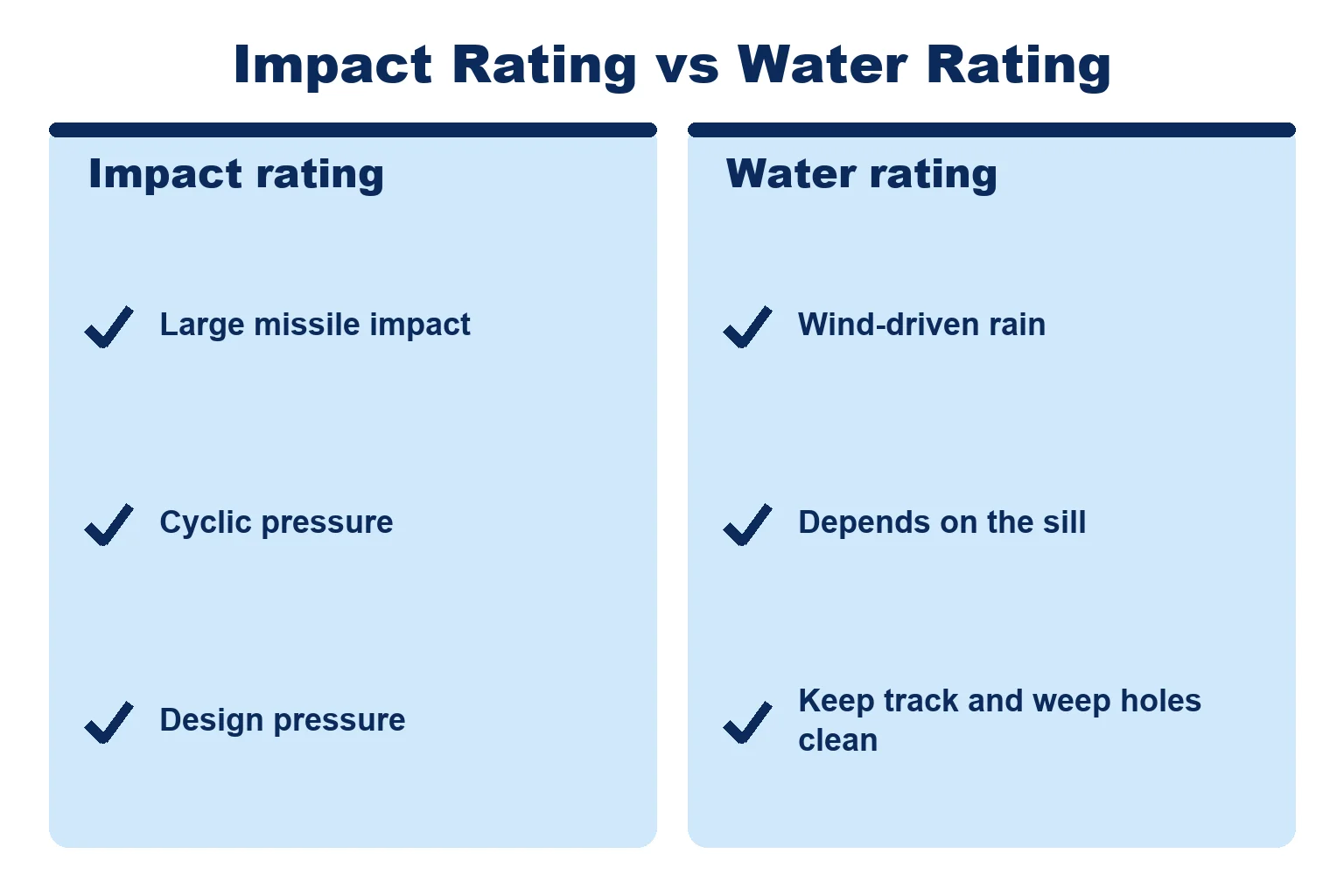
The water resistance rating shows how much wind-driven rain a door keeps out before water gets past it, and it is separate from the impact rating. A sliding door can pass every impact and pressure test and still let water in during a long storm.
Water is tested at only a fraction of the design pressure, so the water rating is always much lower than the DP. On sliders, the water rating depends a great deal on the sill.
Florida product approvals for sliding doors often list several water ratings for the same door, one for each sill riser height, with taller sills keeping out more water.
Water through slider tracks is a known problem in Florida. Under a state law (HB 1021), the Florida Building Commission studied standards for stopping wind-driven rain through sliding glass door tracks, and its interim report called sliders especially vulnerable.
What this means for you:
- Ask for the water rating, not just the DP, for any slider that faces open water or takes the full force of the wind.
- Check which sill height the approval used, and make sure the door you buy has that sill.
- Keep the track and weep holes clean, so water that gets into the track can drain out.
Why an Impact Door Is Approved as One Assembly
An impact door is tested and approved as one assembly: the frame, panels, glass, hinges, locks, threshold and anchors all go through the tests together. The approval covers that exact combination and nothing else.
The approval drawings list the sizes, panel setups, swing directions, glass, hardware and anchor spacing that passed. A two-panel slider approval does not automatically cover a three-panel door. A pair of impact French doors with matching hardware is approved as a pair, with its own locking rules for the inactive panel.
Small changes can take a door outside its approval:
- Swapping the lock, handle or hinges for parts that were not tested.
- Fastening the frame with different anchors or wider spacing than the drawings show.
- Cutting down or building out the opening without matching the approved size.
- Adding a sidelite or transom that is not part of the approval.
Garage doors follow the same rule. Outside the HVHZ, impact garage doors are commonly tested to ANSI/DASMA 115; in Miami-Dade and Broward they are tested to the TAS protocols. A garage door with only a wind pressure rating is not impact rated.
See our impact-rated garage doors for South Florida homes.
Because the installation is part of the approval, the installer matters as much as the product. Our checklist for choosing an impact door installer you can trust covers what to ask.
How Impact Doors Are Built to Pass the Tests
Impact doors pass the tests because every part is built for load: laminated glass, a reinforced frame, multi-point locks and a threshold shaped to hold the panel and drain water. Any glass insert, sidelite or transom in a door is a glazed opening and must be impact rated too.
What Happens When an Impact Door Is Hit
When an impact door is hit hard enough, the glass cracks but stays in one piece, held by the interlayer, and the panel stays locked in the frame so wind cannot get inside.
The cracked glass is weakened, so plan to replace it before the next storm; our article on how impact doors protect a South Florida home explains why a sealed opening matters.
How to Read an Impact Door Label and Find the NOA or FL Number
To check an impact door’s rating, find the label or etching on the door or frame, note the approval number, and look it up. Doors usually carry a permanent mark that traces them to the manufacturer and product, and often a temporary sticker with the ratings that is peeled off after installation.
- Find the mark: look on the edge of the panel, the hinge side of the frame, the top of the frame or a corner of the glass.
- Note the numbers: the manufacturer, the product or series, and the approval number. A Miami-Dade NOA number is often printed with the words Miami-Dade County Product Control; a Florida Product Approval starts with FL.
- Look it up: search NOAs on Miami-Dade Product Control and FL numbers on floridabuilding.org.
- Check the details: the approval should match your door type, swing, size and panel count, show the DP and water rating, and say whether it is valid in the HVHZ.
- Check the date: NOAs expire, so make sure the approval was current when your door was permitted.
Keep the approval, the permit and the final inspection record together. Insurers ask for proof of rated openings on a wind mitigation inspection, as our guide to cutting premiums with storm-hardening upgrades explains. If the label is gone, our step-by-step guide on how to tell if doors are hurricane rated covers other ways to check.
What an Impact Door Rating Does Not Cover
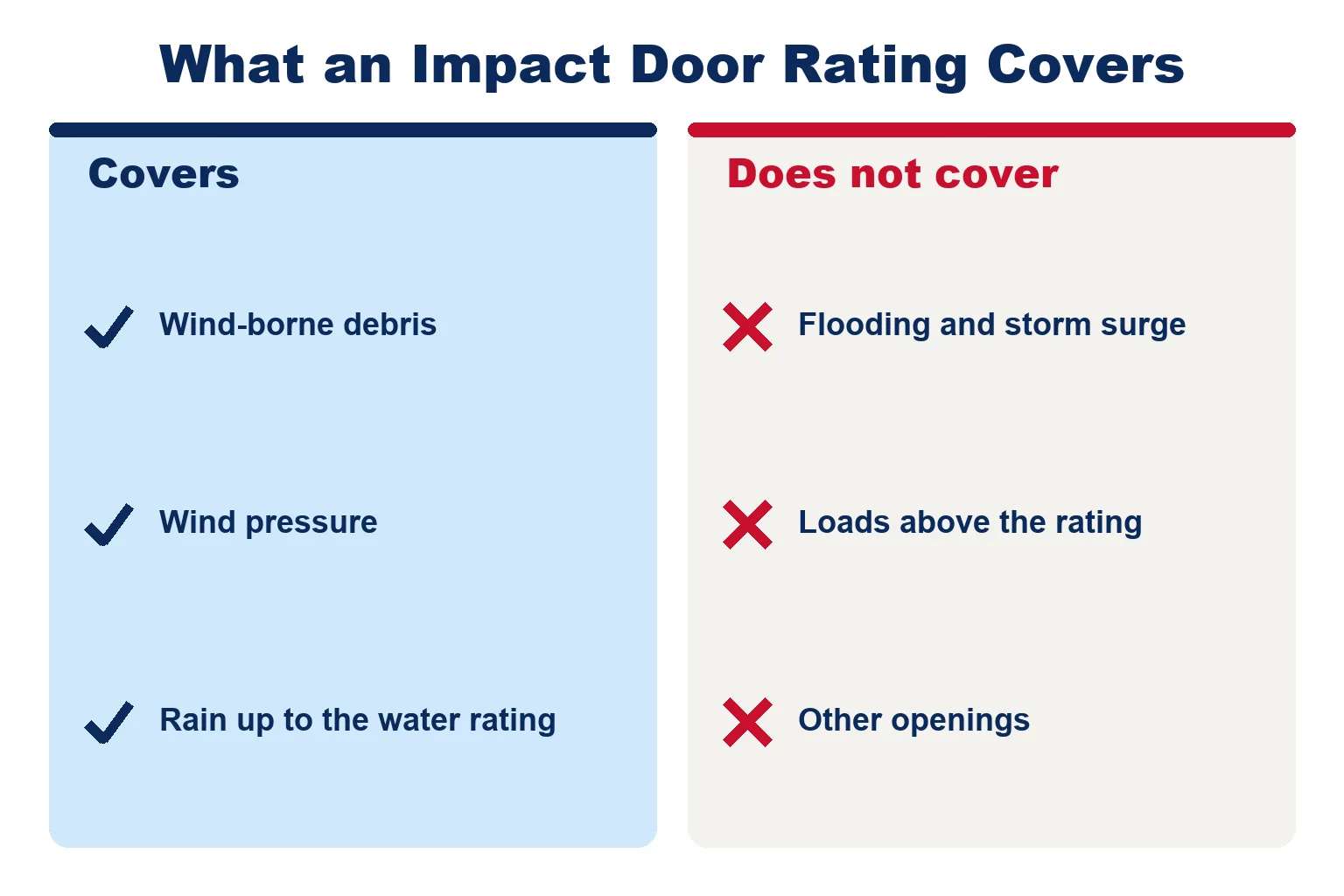
An impact door rating covers wind-borne debris, wind pressure, and wind-driven rain up to the water rating. It does not cover flooding or storm surge, and it does not protect the rest of the house.
- Flooding and storm surge: rising water pushes on a door with a force no impact test measures, and it also comes in through floors, walls and drains. The National Hurricane Center’s storm surge overview explains why surge is so dangerous. Follow evacuation orders whatever doors you have.
- Rain above the water rating: long storms with strong wind can push water past a sill, especially on sliders.
- Loads above the rating: a door is proven for its design pressure and the test missile, not for more.
- Doors that left their approval: swapped hardware or the wrong anchors can mean the door no longer performs as tested.
- Other openings: one unprotected window or garage door can still let wind into the house.
Impact Door Testing FAQs
Are impact doors rated for a Category 5 hurricane?
No door is rated by hurricane category. Impact doors are tested against a debris missile and rated for a design pressure, which must meet the load your opening needs under the Florida Building Code. In South Florida, that code load is based on design wind speeds set for very strong hurricanes.
Is a hurricane-rated door the same as an impact door?
Not always. Some doors are rated only for wind pressure and have not passed a missile test. In the wind-borne debris region, a glass door needs an impact rating or approved shutters.
Check that the approval lists large missile impact, not only a DP.
Can I change the handle or lock on my impact door?
Only with parts the approval allows. The door was tested with specific hardware, and a lock or handle that was not tested can take it outside its approval. Ask the manufacturer or installer which replacement parts are approved before you swap anything.
Does a solid front door need an impact rating?
A solid door with no glass is rated for wind pressure, not missile impact, because there is no glass to break. If the door has a glass insert, sidelites or a transom, those glazed parts must be impact rated, or the opening needs approved shutters.
Ask for These Four Ratings on Every Door Quote
The door that protects your home is one that matches its opening: a large missile rating, a design pressure that meets what the opening needs, a water rating that suits its exposure, and an installation that follows the approval. Ask for all four in writing on any quote.
To see what that costs for your openings, read our breakdown of Florida impact door prices by type, and if budget is the hurdle, financing for impact door projects can help qualified homeowners spread the cost.
USA Home Improvement is licensed (CGC1526707) and insured and has served Florida homeowners for more than 15 years. Call (877) 554-6373 or Get a free estimate.