Skip to content

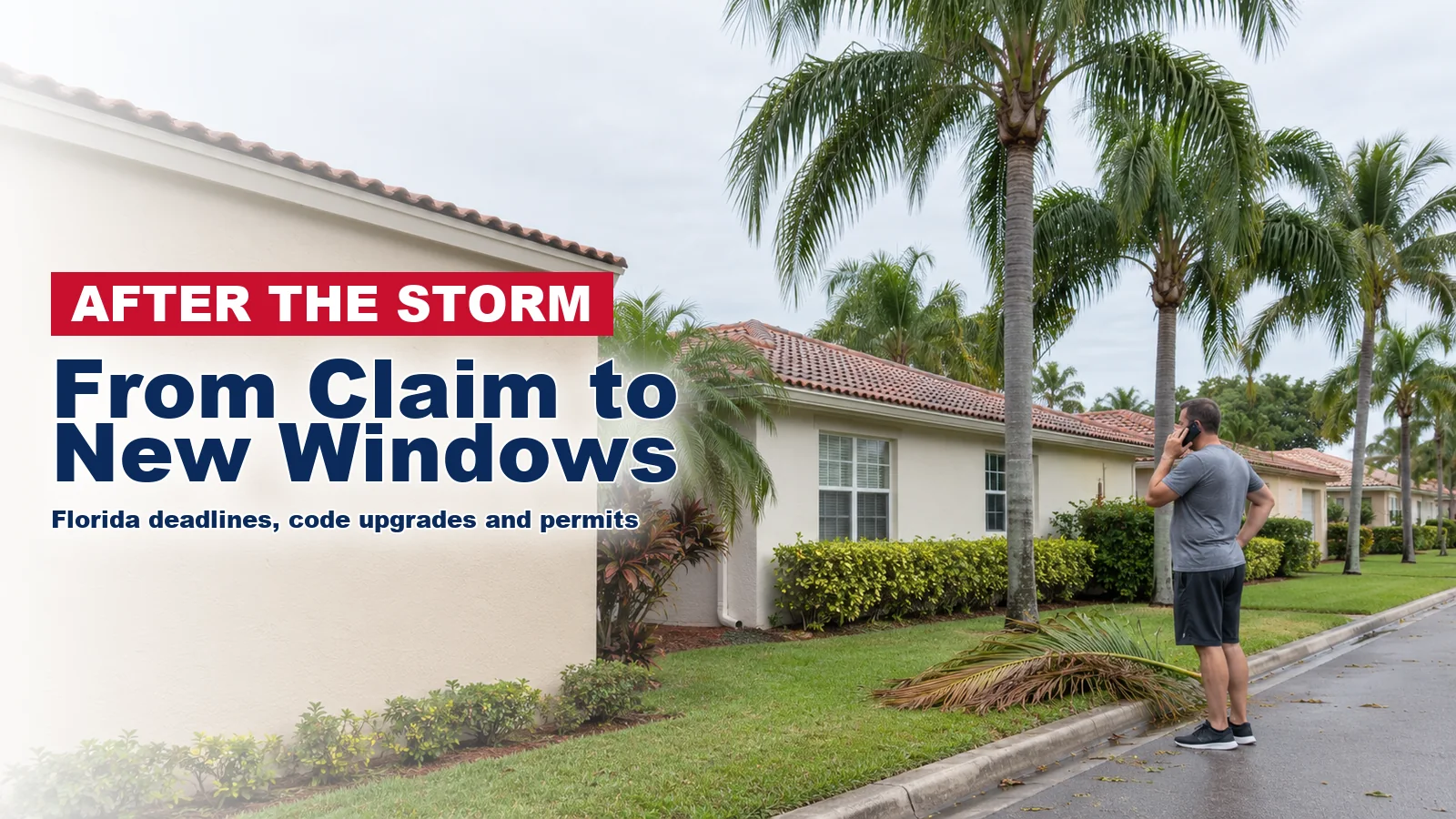
After a storm damages your windows or doors, report the claim right away, protect the opening and document everything. Florida law gives you 1 year from the date of loss to notify your insurer.
Then the adjuster inspects, you get estimates from licensed contractors, and the new windows are permitted, built and installed. The replacement must meet today’s building code, which can mean impact protection, and your policy’s law and ordinance coverage decides how much of that upgrade insurance pays.
This guide follows a storm damage insurance claim in Florida from the first call to installed impact windows and doors.
The Claim-to-Installation Timeline at a Glance
The Florida Department of Financial Services (DFS) lays out the claim side in its guide What to Expect After Filing a Homeowners Claim, and Florida statutes set the legal limits.
| Step | When | Source |
|---|---|---|
| Report the claim and make emergency repairs | Immediately | DFS guide |
| Legal deadline to notify your insurer | Within 1 year after the date of loss | s. 627.70132 |
| Insurer acknowledges your claim | Within 7 days | s. 627.70131, DFS guide |
| Adjuster inspects; experts if needed | Weeks 2 to 6 (DFS estimate) | DFS guide |
| Copy of the adjuster’s estimate | Within 7 days after it is generated | s. 627.7142, DFS guide |
| Payment or denial | Within 60 days after notice | s. 627.70131 |
| Permit, manufacturing and installation | About 3 months start to finish with USA Home Improvement, though it can vary | USA Home Improvement |
DFS notes that all timeframes in its guide are estimates. The statutes allow exceptions when delays are beyond the insurer’s control.
Step 1: Report the Damage and Know Your Claim Deadline
Report storm damage to your insurance agent or company immediately, DFS says on its hurricane recovery page.
Under Section 627.70132, Florida Statutes, a property claim is barred unless notice was given to the insurer, under the policy’s terms, within 1 year after the date of loss.
For a hurricane, the date of loss is the date the hurricane made landfall. For a tornado, windstorm or severe rain, it is the date the National Oceanic and Atmospheric Administration (NOAA) verifies the event.
DFS adds three practical tips. Be ready to give the adjuster the exact date the damage happened, keep your contact details current with the insurer, and tell it your temporary address if you have to leave home.
Step 2: Protect the Opening and Document Everything
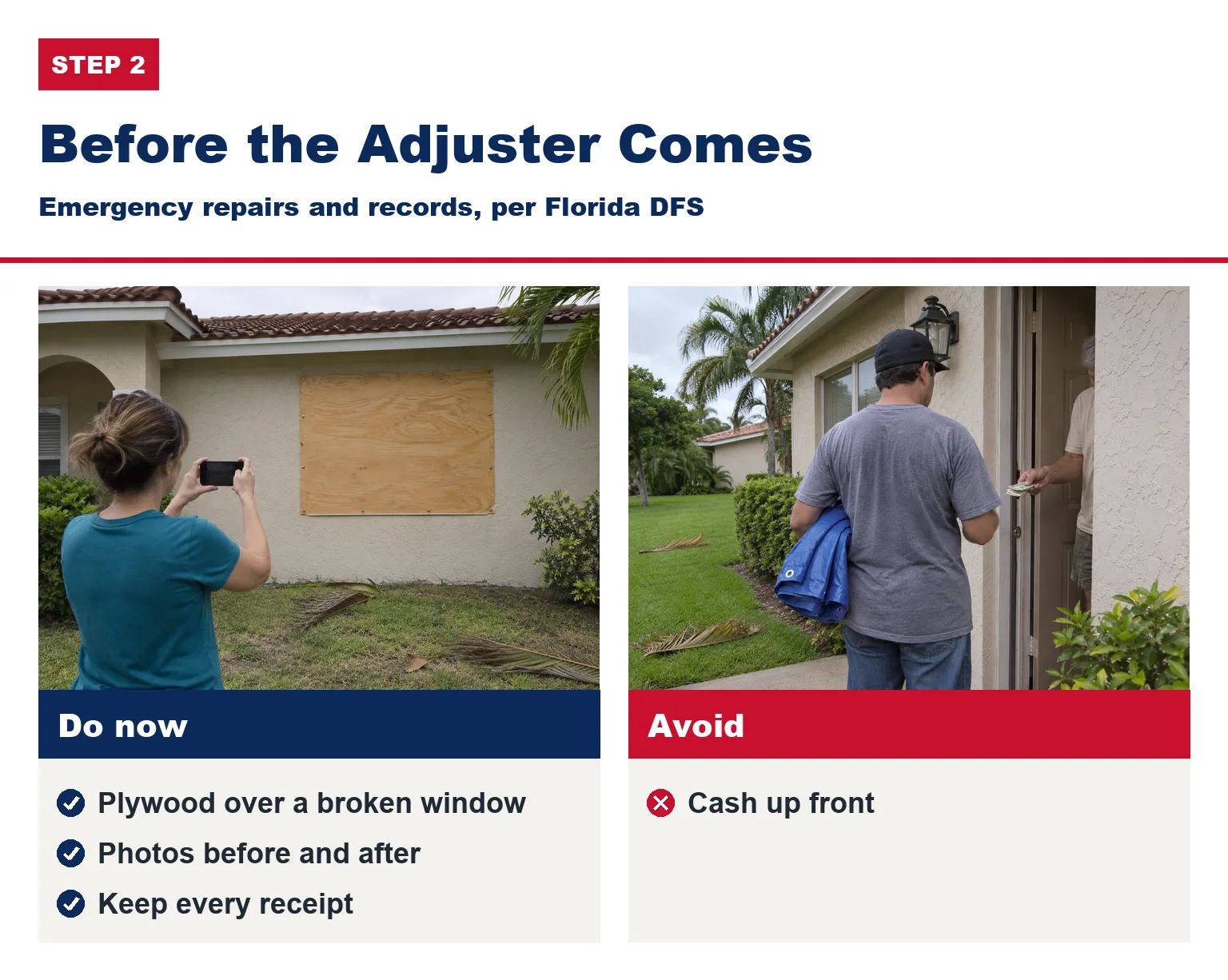
Make emergency repairs that stop further damage, such as plywood over a broken window, DFS says. Take photos before and after the repairs, and keep every receipt.
- Photograph first. Take photos or video of every damaged window, door and frame before cleanup. Our guide to handling a cracked impact window explains what to check and when a crack is urgent.
- Keep damaged parts. If it is safe, keep damaged items so the adjuster can inspect them, DFS advises. If something is unsafe to keep, photograph it before you throw it out.
- Watch for scams. DFS warns that scammers often visit neighborhoods after storms offering tarps or debris removal for a fee, then leave without doing the work. Be careful with anyone who demands cash up front.
Plywood is a stopgap. When a window or door has to be replaced, the new unit must meet the Florida Building Code.
We install ES Windows aluminum and vinyl impact windows for storm-damaged openings. For styles, glass and county rules, see our overview of impact windows for Florida homes.
Step 3: The Adjuster Visit and the Insurer’s Estimate
After you report the claim, your insurer assigns an adjuster to inspect the damage. DFS says to follow up with the insurer if the adjuster has not contacted you within one week. The insurer may send a field adjuster or use drones for more inspections.
The insurer must acknowledge your claim within 7 days. Section 627.7142 also requires it to send you a Homeowner Claims Bill of Rights within 14 days after your first contact about the claim.
If needed, engineers or other experts may be hired to find the cause of loss or the cost to repair, and DFS says their reports can take up to 30 days.
The adjuster then writes an itemized repair estimate, and the insurer must give you a copy within 7 days after it is generated.
Under Section 627.70131, the insurer must pay or deny the claim, or a portion of it, within 60 days after receiving notice. The first check may be smaller than the repair because of the deductible and how replacement cost is paid. Our guide to hurricane deductibles and paying for storm repairs explains both.
Step 4: Replacement Estimates and Choosing Your Contractor
Call your insurer before you sign any repair contract. The Homeowner Claims Bill of Rights advises policyholders to confirm any managed repair provisions or optional preferred vendors in the policy first.
Some insurers sell a preferred contractor endorsement. DFS explains that it trades a discount for using a contractor from the insurer’s approved list, and that it comes with conditions. If your policy has one, ask the insurer how it affects the window replacement.
Before you hire anyone, DFS advises you to:
- Confirm the contractor is licensed in Florida and check for complaints with the Department of Business and Professional Regulation. Our guide shows how to look up a Florida contractor license.
- Get proof of liability and workers’ compensation insurance before signing the contract.
- Read carefully any contract that charges a fee based on a percentage of your insurance proceeds.
Ask each company for a written estimate that lists every opening, and weigh the quotes opening by opening before you choose.
Ready to price the replacement? Request a free impact window and door estimate or call (877) 554-6373.
Code Upgrades: When the New Window Must Meet Today’s Code, and Who Pays
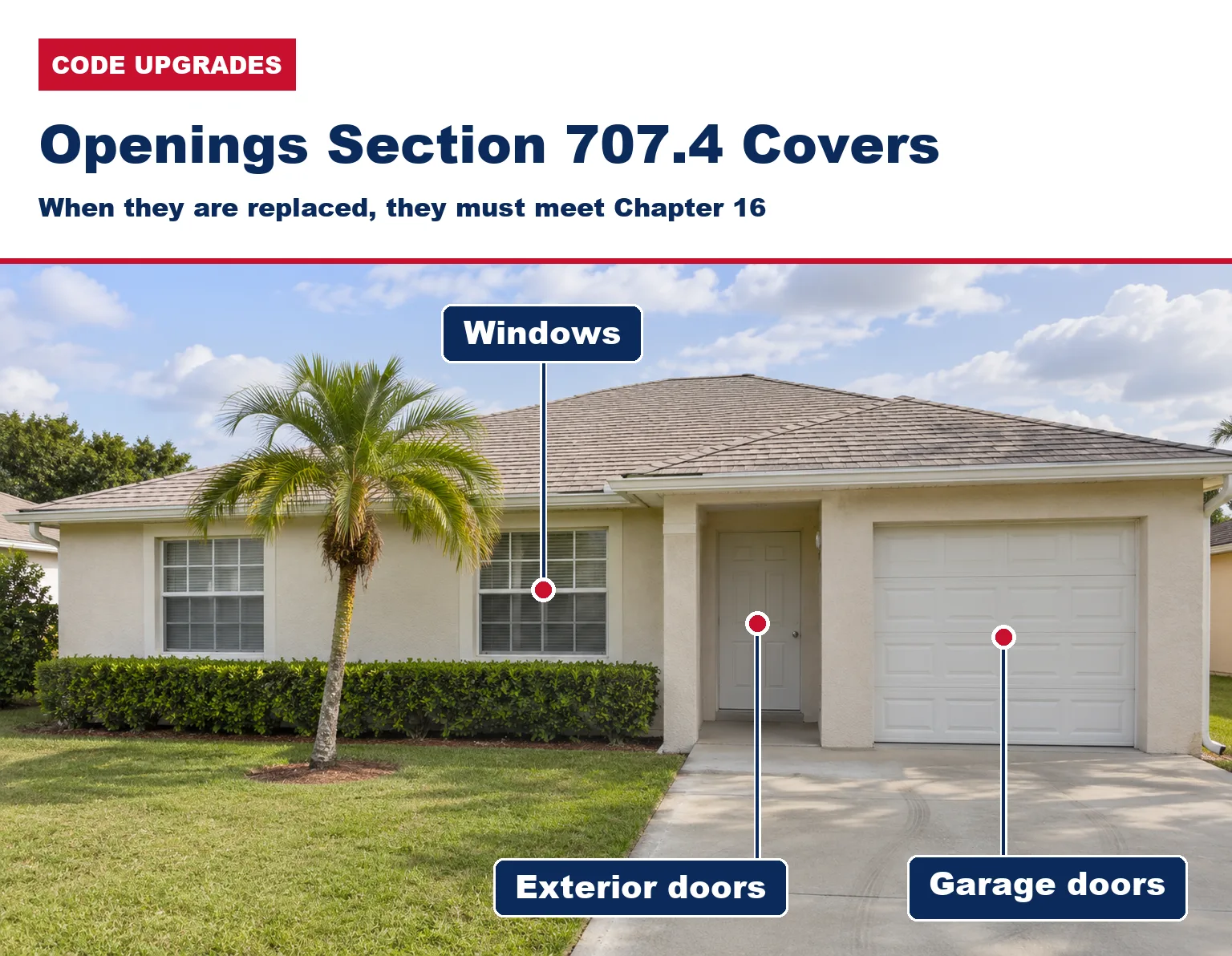
A replacement window or door must meet the current Florida Building Code, even in an older home. Section 707.4 of the Florida Building Code, Existing Building says replaced garage doors, exterior doors, skylights and windows must comply with Chapter 16 of the Building code, the chapter with the wind and debris rules.
In South Florida that can mean impact-rated units or approved shutters on every replaced opening. Older homes have an exception: if the glass replaced within 12 months is 25 percent or less of the home’s glazed openings, those openings may not need impact protection.
So a claim for one or two broken windows may cover only like-for-like units. Ask your building department and your adjuster which rule applies; upgrading anyway is your choice, as our guide on where impact windows are required by code explains.
When the code does require the upgrade, law and ordinance coverage matters. Subject to your policy’s terms, it pays the extra cost of meeting building laws when you repair or replace a damaged part of the home.
A policy without it can pay to replace what you had, but Section 627.7011 says such a policy does not include costs needed to meet laws and ordinances.
Here is what Section 627.7011 says about this coverage:
- It must be offered. Before issuing a homeowners policy, the insurer must offer law and ordinance coverage, which may be limited to 25 percent or 50 percent of the dwelling limit, as the policyholder selects.
- It is included unless you refused it. Unless the insurer has your written refusal, the policy is deemed to include law and ordinance coverage limited to 25 percent of the dwelling limit.
- It covers the damaged portion. The coverage applies only to repairs of the damaged portion of the structure, unless total damage exceeds 50 percent of the structure’s replacement cost.
Florida requires insurers to print this warning with the policy at issue and renewal: “Law and ordinance coverage is an important coverage that you may wish to purchase.”
Check your declarations page, and ask your adjuster whether the code-required part of the new windows and impact replacement doors falls under it. Section 627.7011 does not apply to mobile home policies.
Permit, Inspection and Installation After the Claim
Replacing a window or door generally needs a building permit. Section 105.1 of the Florida Building Code requires a permit before anyone alters or repairs a building or replaces impact-resistant coverings, and Section 110.1 makes permitted work subject to inspection by the building official.
Every USA Home Improvement project is permitted. Customers can receive the Florida Product Approval number for each window and door on request.
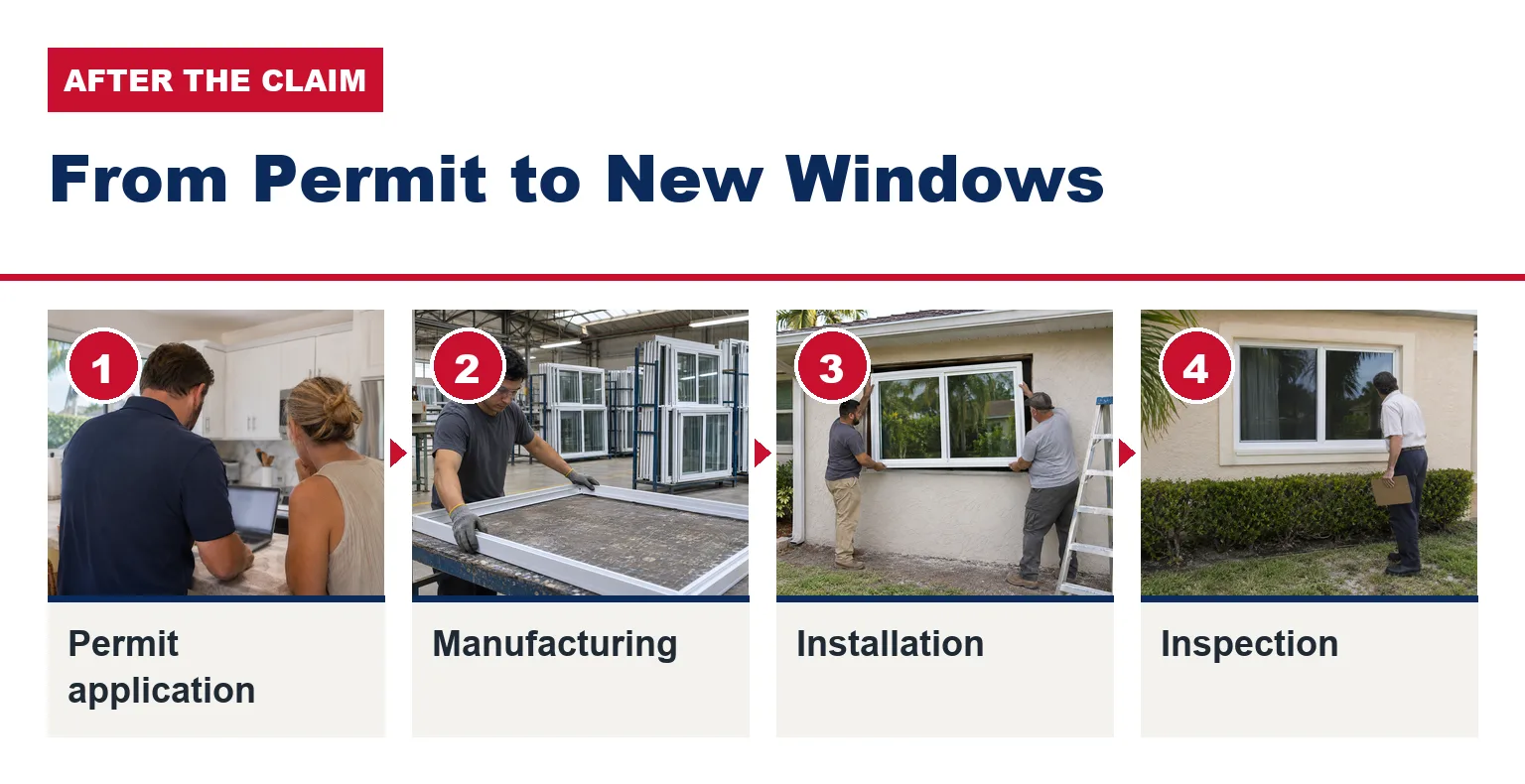
The sequence after you sign is the permit application, manufacturing, installation and inspection. Manufacturing takes about 6 to 8 weeks depending on project scope, installation averages 1 to 2 days, and the whole process takes about 3 months start to finish, though it can vary.
Keep the temporary protection in place until the new units are in. For local permit steps and documents, read our guide on permit rules for window and door replacement.
Paying for What the Claim Does Not Cover
Even a paid claim can leave a gap: the hurricane deductible, any upgrade beyond your law and ordinance limit, an impact upgrade the code does not require, and openings you choose to upgrade that were not damaged.
For that gap, compare financing for impact window and door projects. Financing may be available for qualified homeowners through independent third-party providers. Terms, eligibility and availability depend on the program and location.
Two more things can lower the long-term cost. Qualifying impact windows and doors may be eligible for Florida’s sales tax refund on impact windows, and you can ask your agent about home upgrades that may reduce premiums.
Storm Damage Claim FAQs
Can I replace my windows before the adjuster comes?
Make the emergency repairs needed to stop more damage, like plywood over a broken window, and photograph everything first. For the permanent replacement, the Homeowner Claims Bill of Rights advises contacting your insurer before signing any repair contract. Keep damaged parts for the adjuster if it is safe.
Does my homeowners claim cover flood damage to windows and doors?
Usually not. Florida requires a homeowners policy without flood coverage to state that it does not cover flood damage, even if hurricane winds and rain caused the flood. Unless your policy includes flood coverage, flood damage needs a separate flood policy, so ask your agent how to report it.
What if I find more window damage after my claim was paid?
You can still report it. Under Section 627.70132, if the claim was closed and you need more for damage you already reported, ask to reopen it within 1 year after the date of loss. For new damage from the same storm, a supplemental claim is due within 18 months after the date of loss.
What if I disagree with the insurer’s estimate?
DFS suggests getting estimates from contractors of your choice and sending them to the insurer for reconsideration. If the dispute continues, DFS offers free mediation of disputed claims in most circumstances, and appraisal may be available if your policy includes it.
Can I sign my insurance benefits over to the window company?
Not under a newer policy. Section 627.7152 says post-loss benefits under a residential property policy issued on or after January 1, 2023 cannot be assigned, and any attempt is void. The Homeowner Claims Bill of Rights advises filing all claims directly with your insurance company.
Turn the Claim Into Windows That Are Ready for the Next Storm
Report the damage now, protect the opening, and keep your photos and receipts. Then read your declarations page for law and ordinance coverage before you compare replacement estimates, because it decides how much of a code-required upgrade the claim can pay.
USA Home Improvement is licensed (CGC1526707) and insured and has served Florida homeowners for more than 15 years. We sell ES Windows exclusively, our installation team holds direct certification from the manufacturer, and every project is permitted.
Get a free estimate or call (877) 554-6373.