Skip to content

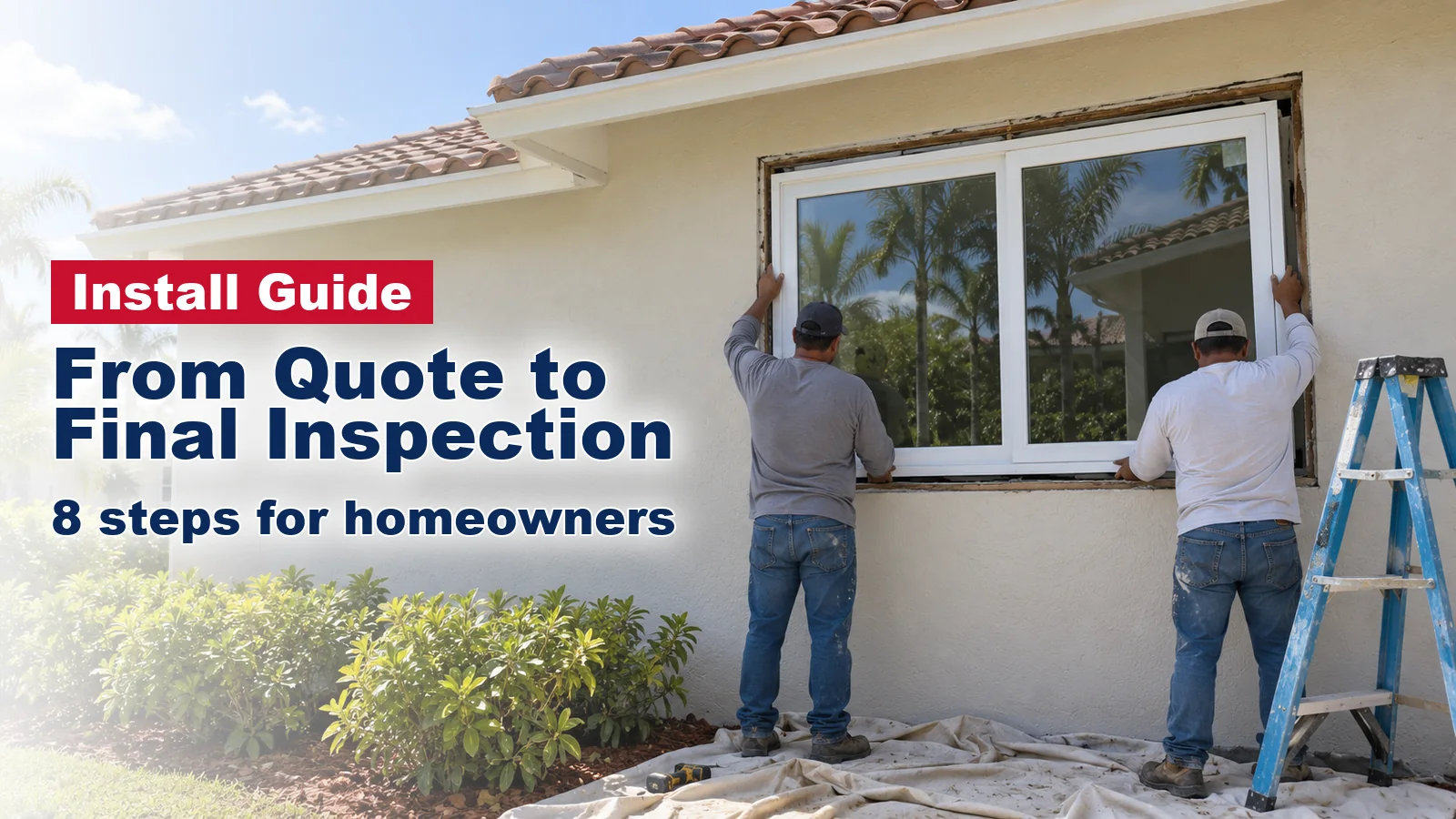
You install impact windows in your home by hiring a licensed contractor who measures every opening, pulls the permit, orders custom windows, installs them to the product approval and passes the building inspection. Your part is choosing the products, signing the permit papers, preparing the house and keeping the paperwork.
This guide walks through all eight steps, from the first quote to the final inspection, so you know who does what and what to expect at each stage. For product types, ratings and costs, start with our all-in-one impact window guide.
The Impact Window Installation Process at a Glance
An impact window project has eight steps. Most of the work sits with your contractor, but a few steps need your signature, your decisions or your help at home.
| Step | Who does it | What you do |
|---|---|---|
| 1. Estimate and measurements | Contractor | Point out problem windows, choose styles |
| 2. Quote and contract | Contractor and you | Compare quotes, check the license, sign |
| 3. Permit and HOA approval | Contractor | Sign the owner forms, send the HOA request if needed |
| 4. Ordering and fabrication | Contractor and manufacturer | Plan storm protection while you wait |
| 5. Home preparation | You | Clear windows inside and out |
| 6. Installation day | Installation crew | Give access, keep pets and kids away |
| 7. Inspections | Contractor and building inspector | Give the inspector access if needed |
| 8. Paperwork | Contractor | Collect and file every document |
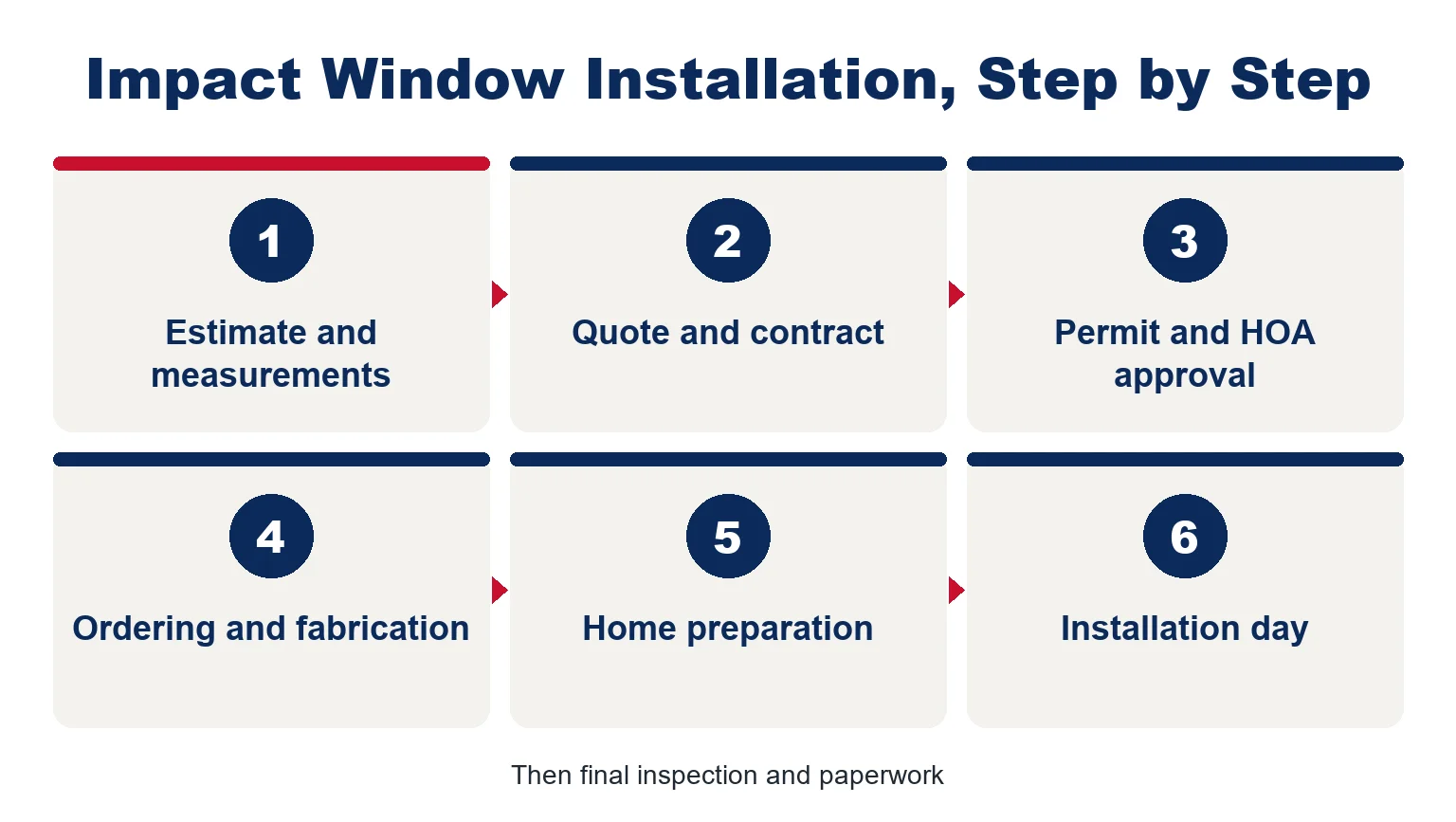
Step 1: Free Estimate, Home Assessment and Measurements
The impact window process starts with a home visit. A consultant looks at every window and door, asks what you want to fix (storm protection, noise, heat, insurance, looks), and measures each opening.
Measurements matter more for impact windows than for standard windows. Each window is made to order for its opening, and the product chosen must be rated for the wind pressure at that spot on your house.
The consultant also checks the wall around the opening, because the condition of the frame and stucco decides how the old window comes out and how the new one is anchored.
This visit is also when you choose styles. You can browse our full range of impact window styles, from single-hung to casement and fixed picture windows, before the visit so you know what you like.
One rule to know early: bedroom windows must still work as emergency escape openings under the Florida Building Code, as Miami-Dade County’s window permit disclosure reminds owners. That means you cannot swap a bedroom’s only opening window for a fixed one.
Step 2: Review the Quote and Sign the Contract
A good impact window quote lists every opening with its size, the product and its approval number, the glass, the permit, and who patches stucco and drywall. If a quote only gives a total price, ask for the line items before you sign.
Getting more than one quote is normal. Our checklist shows how to read and compare impact window estimates, so you compare the same windows and the same scope.
Before you sign, check that the contractor holds an active Florida license on the DBPR license lookup, and read the payment schedule and warranty terms. Our guide on picking a trustworthy window contractor covers the other checks, from insurance to reviews.
If the total is more than you planned, ask about financing options for qualified homeowners before you cut windows from the scope; if available, independent third-party providers may offer no down payment and 0% interest plans with fast approval. Leaving some openings unprotected can affect both your permit and your insurance credit.
Step 3: Permits, Building Codes and Licensing
Replacing windows in South Florida is permitted work. The building department checks that each new window has a valid product approval, is rated for the wind pressure at your home and will be installed the way the approval requires.
Who Applies for the Permit
Your licensed contractor normally applies for the window permit and schedules every inspection. You still sign as the owner. In unincorporated Miami-Dade County, for example, the fast-track window and door permit disclosure is signed by both the property owner and the contractor in front of a notary.
Florida does let owners pull their own permit as an owner-builder, but then you take on the contractor’s legal responsibility for the work. For impact windows, that is rarely worth it.
What the Permit Application Includes
Each city has its own checklist, but the documents look similar across South Florida. The City of Pembroke Pines window and door permit checklist in Broward County asks for:
- The Broward County Uniform Permit Application
- A retrofit window and door schedule with a row for every unit
- Design wind pressures for the openings
- The product approvals
- A floor plan showing each opening
- An HOA Affidavit of Awareness, even if you do not belong to an association
In the High-Velocity Hurricane Zone (Miami-Dade and Broward), the product approval is a Miami-Dade Notice of Acceptance (NOA) or a Florida Product Approval valid for that zone.
Miami-Dade’s disclosure adds that approvals must be for the current building code, and that when more than 25% of the glazed openings are replaced, every replaced opening must be impact rated or protected by an approved shutter.

How Long the Permit Takes
Permit time varies by city and by how busy the building department is, so there is no single South Florida answer. Some departments offer faster processes for simple jobs.
Miami-Dade County’s fast-track window and door permit, for example, covers single-family homes and townhouses up to 30 feet mean roof height, and only exact changeouts of existing openings.
Making an opening larger, adding one or closing one off takes you out of that fast track and into a regular review. Ask your contractor which process your job falls under and when they expect approval.
HOA and Condo Approval
If you live in an HOA community, you usually need architectural approval before work starts. Under Section 720.3035 of the Florida Statutes, HOA boards must adopt hurricane protection specifications and may not deny an application for impact windows that meet them. The association can still set rules on color and style.
Condo owners follow a separate law and their association’s rules, and some building elements belong to the association. Send the HOA or condo request as soon as you choose your windows, since the board’s schedule can hold up the permit.
Notice of Commencement
For larger jobs, Florida’s construction lien law requires a Notice of Commencement. The owner signs it, it is recorded with the county clerk, and it is posted at the job site before the first inspection, as set out in Section 713.13 of the Florida Statutes.
Pembroke Pines, for example, requires it before the first inspection for jobs over $5,000. Your contractor will usually prepare the form for you to sign.
Step 4: Ordering and Fabrication of Your Windows
Impact windows are built to order, so the manufacturer only starts once the measurements and products are final. Lead time depends on the manufacturer, the window type and how many orders are in line, so ask your contractor for an expected delivery window in writing.
On USA Home Improvement projects, manufacturing takes about 6 to 8 weeks, depending on the project scope.
Custom colors, large or unusual shapes and architectural windows can take longer than standard sizes. Changing a size or style after the order is placed usually restarts part of the process.
Hurricane season does not wait for the delivery truck. If your installation will land during the season, keep your current plan in place until the new windows are in, and review these hurricane window protection tips.
Step 5: How to Prepare Your Home for Installation Day
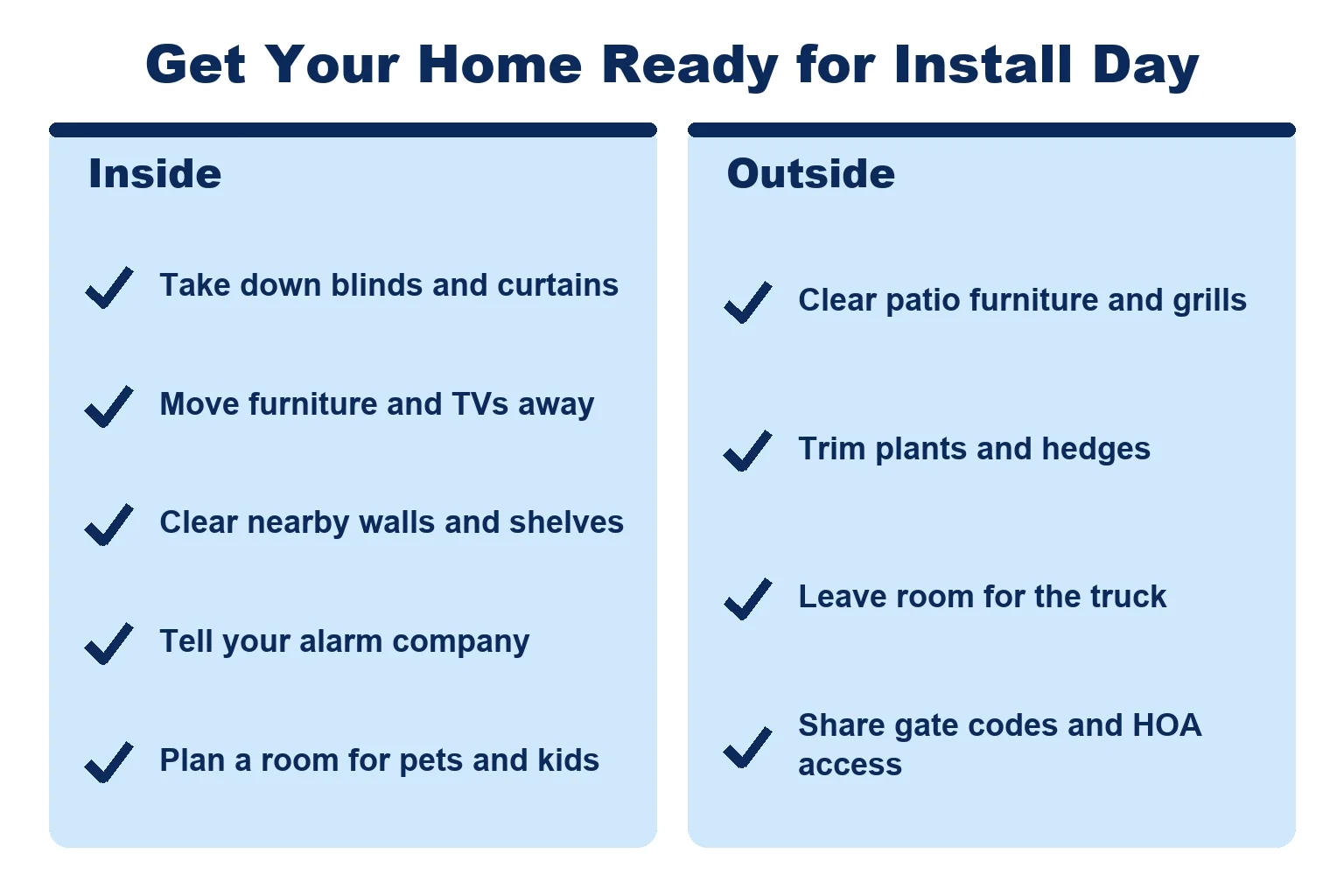
Preparing your home means giving the crew a clear path to every window, inside and out. Do it the day before, so the crew can start on time.
Inside the house:
- Take down blinds, curtains, rods and shutters on the windows being replaced.
- Move furniture, beds and TVs away from the windows.
- Take wall art, mirrors and shelf items off nearby walls.
- Tell your alarm company if window sensors will be removed.
- Plan a room for pets and children away from the work.
Outside the house:
- Clear patio furniture, grills and pots from under each window.
- Trim plants and hedges that block the openings.
- Leave space in the driveway for the truck and any dumpster.
- Give the crew gate codes and HOA access if needed.
Ask your project manager whether the crew covers floors and moves heavy furniture, and whether someone must be home to let the crew in and out.
Step 6: What Happens on Installation Day
On installation day, the crew works opening by opening: protect the area, remove the old window, prepare the opening, set the new impact window, fasten it as the product approval specifies, seal it, and finish the trim.
Each opening is closed up before the crew moves to the next one, so the house is not left open.

How long the job takes depends on the number and size of openings and the condition of the walls; on USA Home Improvement projects, installation averages 1 to 2 days.
Your contractor should give you a schedule before the start date. Expect noise, dust and people moving in and out of rooms while the crew works.
Removing old windows from concrete block walls can crack stucco and drywall around the opening. Your contract should say who patches and paints those areas and when. On USA Home Improvement projects, stucco patching and finishing, permitting, HOA coordination where the property has an HOA, and worksite cleanup are part of the scope of work.

The fastening and sealing are what make an impact window perform in a storm. We explain the details, and what goes wrong when they are rushed, in why careful impact window installation is crucial.
If you are replacing doors at the same time, new impact sliders for patio openings are often installed in the same project.
Step 7: Permit Inspections and Final Sign-Off
The building inspector checks the installed windows against the approved permit, and the job is not finished until that inspection passes. Your contractor requests the inspection.
The timing of the inspection matters. In Miami-Dade’s fast-track window permit, the “102-Buck and Fastener” inspection is requested once all windows are installed, but before the interior frame perimeter is caulked or sealed, so the inspector can see the shims and fasteners.
For that permit, it is the final inspection that closes the permit, and the county may do it virtually or on site.
Other cities use their own inspection steps, so do not let anyone finish the interior trim early just to tidy up. If the inspector asks for corrections, the contractor fixes them and books a reinspection.
Ask your contractor to tell you when the permit is closed, and keep a copy of the final inspection result. An open permit can cause problems when you sell or refinance the house.
Step 8: Paperwork to Keep for Your Wind Mitigation Inspection
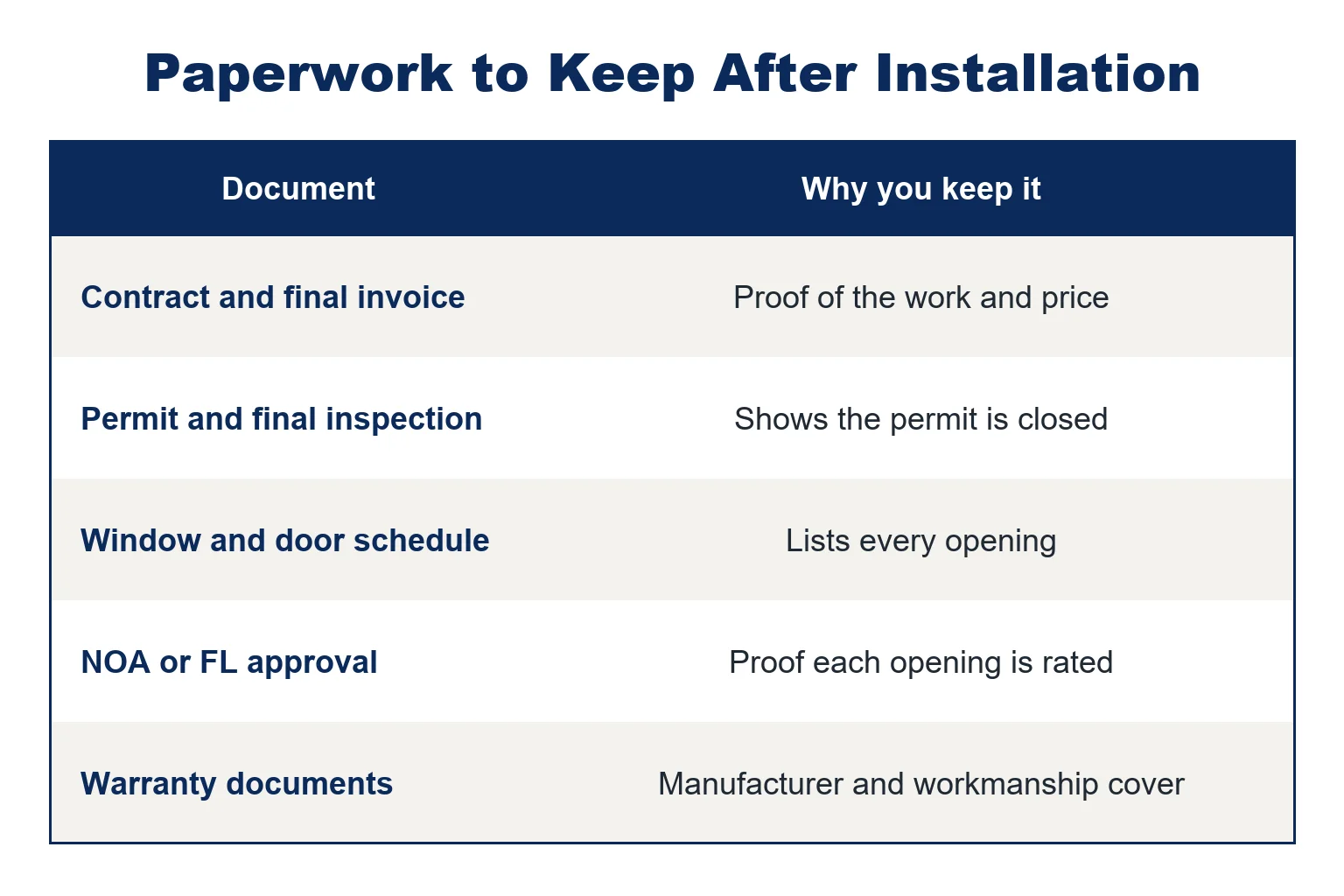
Keep every document from the project in one folder, because a wind mitigation inspector will ask for proof that each opening is protected. Insurers use the inspector’s report on form OIR-B1-1802, the Uniform Mitigation Verification Inspection Form, to set wind credits.
Ask your contractor for:
- The signed contract and final invoice
- The permit number and the passed final inspection
- The window and door schedule listing every opening
- The Miami-Dade NOA or Florida Product Approval for each product
- Manufacturer and workmanship warranty documents
The inspector looks at every opening, including doors and the garage door, so one unprotected opening can lower the result. Read how to identify hurricane-rated windows and doors if you also have older units, and see which home upgrades can lower your insurance rates once the report is done.
Why Impact Window Installation Is a Job for a Licensed Professional
Impact windows only perform as tested when they are installed exactly as their product approval describes, with the right anchors, spacing and sealing for your wall type. That is why South Florida building departments review the approval and inspect the installation.
A licensed contractor carries the permit responsibility, has the crew and equipment to handle heavy laminated glass, and fixes any inspection issue. You also get a workmanship warranty on top of the manufacturer’s warranty. For a homeowner, the real work is choosing the right contractor and products, and the steps above show where to focus.
Impact Window Installation FAQs
Can I install impact windows myself?
Installing impact windows yourself is not a good idea. The windows are heavy, they must be fastened exactly as the product approval requires, and the work needs a permit and inspection. An owner-builder permit makes you legally responsible for the work, and mistakes can affect both storm performance and your insurance credit.
Do I need a permit to replace windows in South Florida?
Yes, plan on a building permit for window replacement in South Florida. City and county building departments publish window and door permit checklists, and the permit is how they confirm the product approval and inspect the installation. Your contractor should include the permit in the quote and pull it for you.
Can I stay in my house during installation?
Yes, most homeowners stay home during an impact window installation. Crews usually finish each opening before moving on, so rooms are not left open. Expect noise and dust, keep pets in a closed room, and ask your project manager about the daily schedule.
Can impact windows be installed during hurricane season?
Yes, installers work all year, and many homeowners schedule during the season. The risk is the wait: until the new windows are in, your current protection is all you have. Keep shutters or panels ready, and ask your contractor what happens if a storm is forecast during the job.
The best next step is a home visit, so you get exact measurements, a written scope and a realistic schedule for your city.
USA Home Improvement handles the permits for impact windows and doors across Miami-Dade, Broward, Palm Beach and Southwest Florida, and coordinates HOA approval where your property has an HOA. Call (877) 554-6373 or request your consultation online.
USA Home Improvement is licensed (CGC1526707) and insured and has served Florida homeowners for more than 15 years.