Skip to content


Foggy or cloudy impact window glass means one of a few things, and where the fog sits tells you which. Moisture you can wipe off either side is condensation from humid air, not a broken window. Fog trapped between two panes means the insulating glass seal has failed.
Milky edges or bubbles inside a laminated pane point to the interlayer letting go of the glass. Here is how to tell them apart, what each means for strength and approval, and when replacement is the answer.
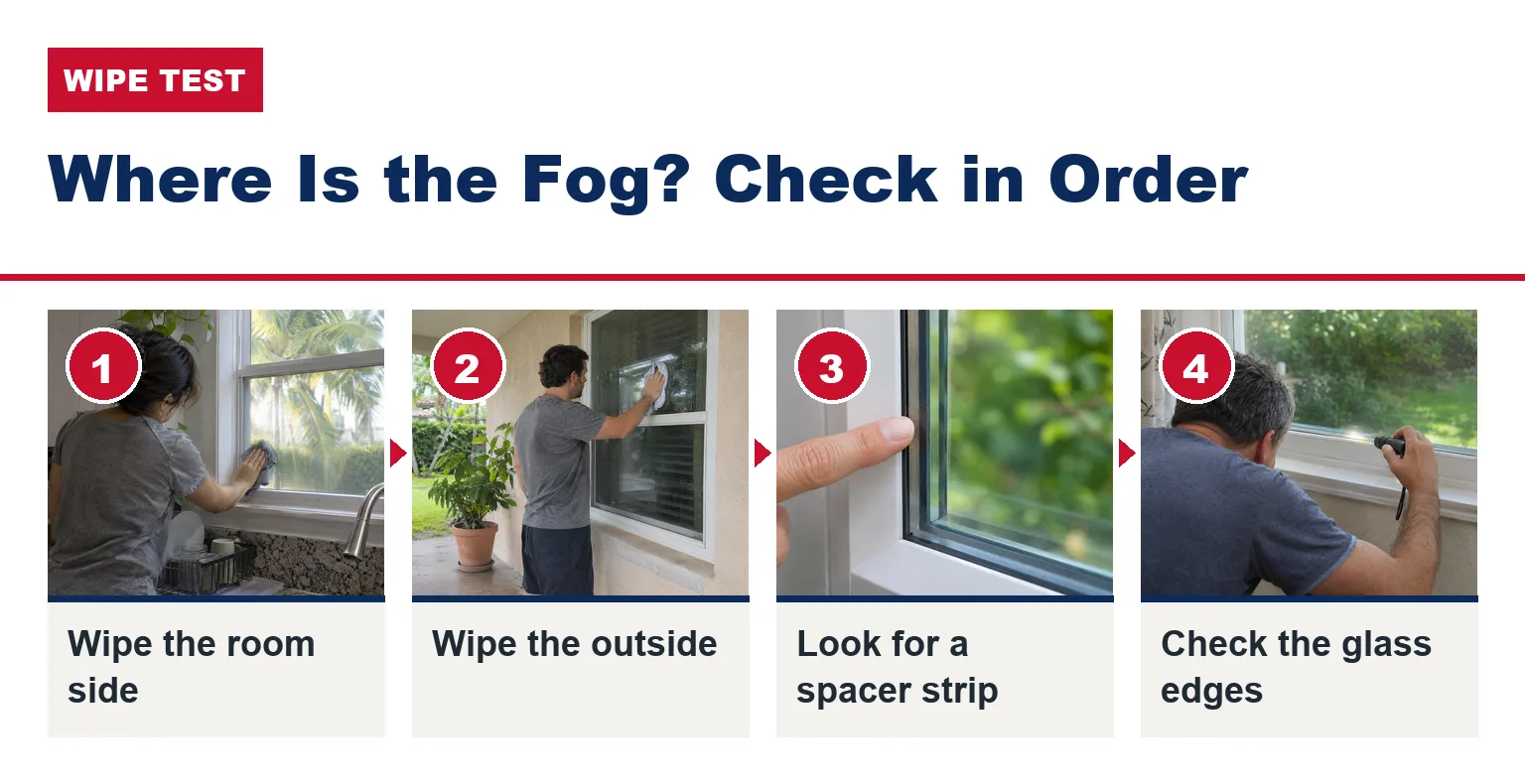
Where Is the Fog? A Two-Minute Wipe Test
Fog that wipes away with a dry cloth is on a surface; fog that stays after you wipe both sides is inside the glass.
- Wipe the room side. If the glass clears, the moisture came from the air inside your home.
- Wipe the outside. If the outside clears, humid outdoor air condensed on cooler glass.
- Look for a spacer strip. A strip running around the edge between two separate panes means the glass is an insulated unit with a sealed air space.
- Check the glass edges. Bubbles, a milky band or discoloration near the edge of a laminated pane point to the interlayer, not an air space.
Some impact glass is a single laminated pane with no air gap, so haze inside it sits in the interlayer. Other units pair an outer pane with a laminated inner pane.
Outside haze that a dry cloth will not lift may be salt or water spots; see washing impact glass and frames in salt air.
Condensation on the Outside of Impact Glass in South Florida
Condensation on the outside of the glass is usually normal in a humid, air-conditioned home. The Fenestration and Glazing Industry Alliance (FGIA) explains that water forms on any surface that is cooler than the dew point of the air around it.
In South Florida, the cool side is often indoors. When the AC keeps the glass cool and the outdoor air is warm and humid, the outer surface can fall below the outdoor dew point, and water beads on the outside.
Natural Resources Canada notes that low-E coatings reduce heat loss through the glass, and that after a cool, calm, humid night, condensation may form on the outside surface around sunrise.
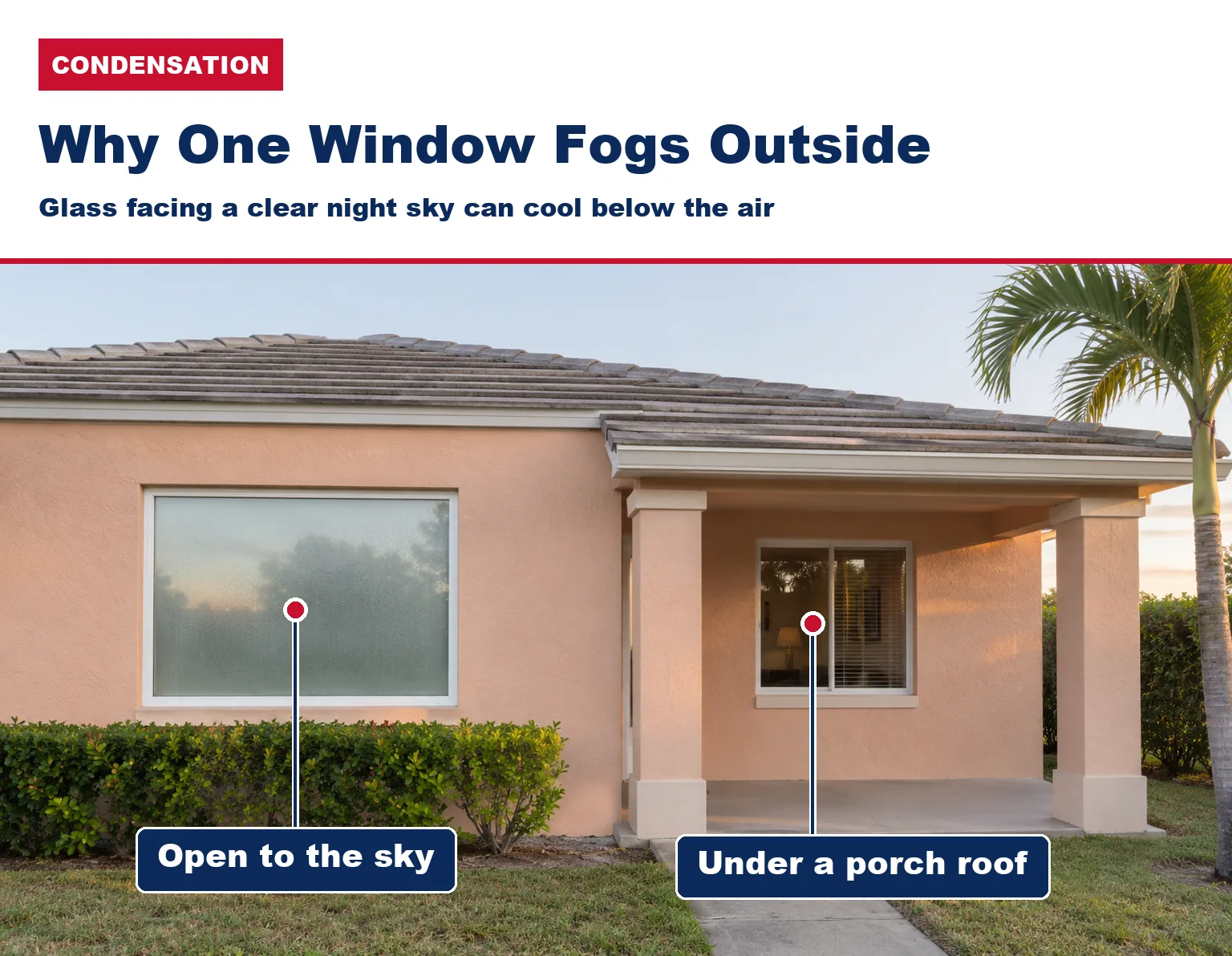
Glass maker Pilkington’s bulletin on outside condensation says glass with a clear view of a cloudless night sky can cool below the air temperature, and that this dew “soon dissipates as the day progresses.”
The bulletin describes the same effect on single-pane glass in air-conditioned office lobbies in very hot, humid weather, and advises pointing AC vents away from the glass. Outside condensation is not a sign the window is failing.
Condensation on the Room Side Means the Air Indoors Is Too Humid
Water on the room side of the glass comes from moisture inside your home. FGIA’s homeowner guide to indoor condensation lists three causes: glass cooler than the dew point of the room air, high indoor humidity and cold outdoor temperatures.
Showers, cooking and even breathing raise indoor humidity, FGIA says, and kitchens and bathrooms are the likeliest spots. The fix is to lower the humidity, not to replace the glass:
- Run bathroom and kitchen exhaust fans, and ceiling fans to keep air moving, as FGIA suggests.
- Open curtains and blinds during the day. FGIA says keeping them closed makes condensation more likely.
- Keep indoor humidity below 60 percent, ideally 30 to 50 percent, as the EPA’s mold and moisture guide advises, and use a dehumidifier if needed.
Dry the glass and sill quickly, as the EPA advises. Our guide to preventing mold in a humid South Florida home covers humidity, ventilation and leaks.
Fog Between the Panes: A Failed Insulating Glass Seal
Fog you cannot wipe off from either side, in glass with a spacer strip, means moisture got into the sealed air space. An engineer at Simpson Gumpertz & Heger, writing in The Construction Specifier, calls this the accepted meaning of insulating glass “failure.”
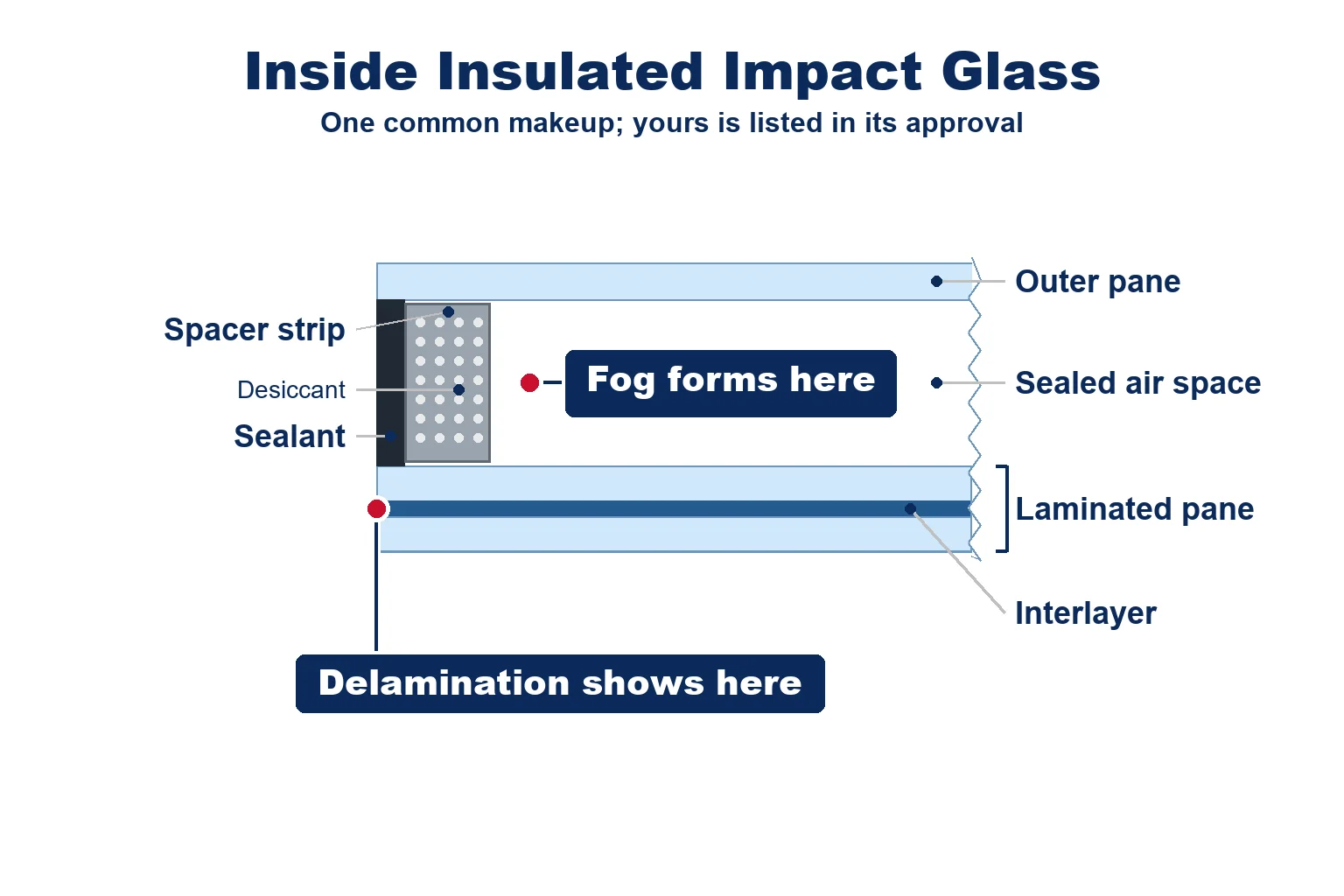
An insulated glass unit is two or more panes held apart by a spacer around the edge. Sealant closes the air space, and a moisture-absorbing desiccant inside the spacer keeps the trapped air dry.
When the seal is breached, damp outside air gets in. The desiccant fills up, and water condenses on the inner glass surfaces. How the fog behaves gives you a clue:
- Fog that never clears means the unit has failed. The engineer says a breached seal fogs within days and stays fogged, and slow moisture creep through the seal also ends in permanent fog.
- Fog that comes and goes can mean moisture is slowly working through the edge seal over years, a sign that full failure is coming.
- Hard water stains between the panes mean the unit has been fogged for months, often years.
The Insulating Glass Manufacturers Alliance (IGMA) defines a failed unit as one with a “permanent material obstruction of vision” from dust, moisture or film inside. Even before that point, the article says, a unit taking on moisture insulates less well than one with an intact seal.
Water sitting against the unit’s edge wears down the perimeter sealant, the engineer adds. When you compare new windows, ask whether the insulating units are certified; the Insulating Glass Certification Council (IGCC) keeps a public directory.
If several older windows have fogged, new windows may make more sense than chasing each unit. USA Home Improvement installs ES Windows impact windows to replace fogged older units, in aluminum and vinyl, and ES lists insulated glass options on some lines.
Want a price to compare? Request a free impact window estimate or call (877) 554-6373. Every USA Home Improvement project is permitted.
Cloudy, Milky or Bubbling Laminated Glass: When the Interlayer Lets Go
Cloudiness or bubbles inside a laminated pane, usually at the edge, point to a problem with the interlayer. Laminated glass is two or more panes bonded to a clear plastic interlayer, usually polyvinyl butyral (PVB), according to a Florida fact sheet on window systems.
A paper by interlayer maker Kuraray, presented at Glass Performance Days 2017, calls this edge stability: the edges’ ability to resist “discoloration, bubbling, delamination, or other blemishes over time.” Most laminated glass never shows them, it adds.
That paper and a Cardinal LG technical bulletin name these causes:
- Weak bonding at the factory. Dirty glass, a damp interlayer or glass that is not flat at the edge can lower adhesion and lead to edge bubbles.
- Standing water. The paper says laminated glass should not sit in water, and glass held in a frame needs weep holes or another way to drain.
- Sealants that react with the interlayer. Cardinal says solvents, oils and plasticizers in some caulks, setting blocks and sealants can cause edge bubbles, discoloration and delamination.
- Salt spray. In the paper’s accelerated lab test on laminates with exposed edges, as on beachfront railings, standard PVB edges began to cloud at about 1,000 hours. The maker’s high-adhesion PVB and an ionoplast interlayer showed no visible edge defects after 3,000 hours.
Cardinal puts the window or door manufacturer in charge of matching glazing materials to the laminated glass, so take a delaminating pane to the manufacturer through your installer. Interlayer types are compared in our checklist for choosing impact windows.
What Fog or Delamination Means for Strength and Product Approval
Delamination affects the layer that holds the glass together. The Florida fact sheet says that when laminated glass cracks, the fragments “tend to adhere to the plastic interlayer,” which keeps wind, water and debris out. Where the interlayer has let go, it is no longer bonded in that spot.
Fog between the panes is a seal problem. IGMA defines a failed unit by lost clear vision, and the engineer adds lost insulating value; neither speaks to debris. Either way, ask the manufacturer whether the unit still performs as tested before the next storm.
Approval is the other half: a window is tested and approved as a unit, so any replacement glass must be a type its approval lists. Our guide to deciding between new glass and a new impact window explains when each fits.
You can ask USA Home Improvement for the Florida Product Approval number of each window and door we install.
Not sure the window is impact-rated at all? Learn how to check whether your windows are hurricane rated.
When Replacement Is the Answer
Replacement is the answer only when the fog or haze is inside the glass:
| What you see | Likely cause | What to do |
|---|---|---|
| Water that wipes off the outside | Humid outdoor air on cool glass | Nothing; it clears as the glass warms |
| Water that wipes off the room side | High indoor humidity | Lower humidity, run fans, dry the sill |
| Fog between panes that comes and goes | Moisture slowly entering the seal | Note it; ask about the warranty |
| Fog or stains between panes that never clear | Failed insulating glass seal | Replace the glass unit or the window, matched to the approval |
| Bubbles, milky band or discoloration in a laminated pane | Interlayer delamination | Manufacturer assessment before the next storm |
A new window makes more sense than new glass when several units have failed, when the frame or hardware is worn, when glass that matches the approval cannot be found, or when the windows are not impact-rated at all.
Start with the warranty on the windows you have. Ask your installer or the manufacturer what it says about seal failure and delamination, and photograph where the fog or bubbles sit.
If you replace, our guide to choosing Low-E, tinted or clear impact glass helps you pick the new glass.
Foggy Impact Window FAQs
Can I clear the fog between the panes myself?
No. Cleaning reaches only the two outer surfaces, and this fog is in the sealed air space, where the engineer’s article says breach fog is permanent. Do not drill or open the unit yourself: the glass makeup is part of the window’s product approval.
Did the last hurricane make my windows fog?
Probably not, unless the storm visibly damaged the unit, such as a cracked pane. The engineer writes that insulated units “do not catastrophically fail from a single weather event,” and stains between the panes show months or years of fog. For storm damage, check with your insurer.
Why does only one window fog on the outside?
Each pane cools differently. Pilkington explains that glass facing a clear night sky radiates heat away and can drop below the air temperature, while trees or awnings shield it. A window under a porch roof may stay dry while the next one, open to the sky, fogs by morning.
Will new impact windows stop condensation?
Not always: FGIA says condensation can form on any window under the right conditions. To compare products, use one rating system: FGIA’s Condensation Resistance Factor (CRF) or the NFRC Condensation Rating (CR), where higher numbers are better. FGIA notes the ratings do not predict results in a home.
Find the Fog, Then Decide
Wipe both sides first; surface water calls for lower humidity and a little patience. Fog or stains between the panes, or bubbles in a laminated pane, mean the glass itself has changed. On older windows, that is a good moment to plan new impact windows before the next storm.
USA Home Improvement offers a 15-year warranty and a 1-year labor warranty on most jobs, plus a transferable warranty. Plan ahead: the whole process takes about 3 months start to finish, though it can vary.
Compare financing for replacing foggy impact windows. Financing may be available for qualified homeowners through independent third-party providers. Terms, eligibility and availability depend on the program and location.
USA Home Improvement is licensed under CGC1526707, insured and has served Florida homeowners for more than 15 years. We sell ES Windows exclusively, and our installation team holds direct certification from the manufacturer. Our impact windows explained for South Florida homes covers styles, costs and county rules.
Get a free estimate or call (877) 554-6373.