 Skip to content

The best glass for an impact window in South Florida starts with the laminated makeup your window’s product approval lists. Then you add a coating or tint: Low-E glass such as Solarban 70 cuts heat with a clear view, while gray glass darkens it.
Near a nesting beach, your city may also limit how much light the glass lets through. This guide covers each choice, the NFRC label and what changes the price.
Start With the Laminated Glass Your Window Is Approved For
Impact window glass is laminated: layers of glass bonded to a plastic interlayer. The glass you choose has to be one of the makeups listed in the window’s Florida Product Approval or Miami-Dade NOA, so your options start there.
ES Windows, the brand USA Home Improvement installs, lists different standard glass on each line. Its Elite line has heat-strengthened glass as a standard feature. Multimax, which ES developed for multi-family projects, uses laminated glass by Tecnoglass, with heat-strengthened and annealed glass in clear and gray as standard.
On the Prestige line, ES lists color or ultra-clear interlayers, and it offers insulating glass on Prestige and insulated glass options on Elite. Ask whether a makeup is approved for the size of your opening before you plan around it.
Interlayer types are covered in four things to check before buying impact windows. For what laminated glass does when debris hits it, read how impact windows hold up to hurricane debris.
Low-E Glass and Solarban 70: Less Sun Heat With a Clear View
Low-E (low-emissivity) glass carries a thin coating that controls how much heat passes through. ES Windows describes it as a way to add “even more thermal control” to its windows.
Solarban 70 is a Low-E glass made by Vitro, the company formerly known as PPG Glass. Vitro describes Solarban 70 as a triple-silver-coated low-e glass and lists its look as neutral, with low reflectivity.
Solarban 70 is not standard on every ES line. On Multimax, ES lists Solarban 70 Low-E as an energy-efficiency feature, while clear and gray glass are the standard. Elite lists Low-E glass options by Tecnoglass.
Our impact window styles from single-hung to picture windows list Low-E and Solarban 70 glass options. Check which coating each window in your quote has, and whether different rooms can get different glass.
Vitro’s published Solarban 70 numbers are for insulating glass units, not a laminated impact window, so compare the rating of the finished window instead.
How to Read the NFRC Label: SHGC, U-Factor and Visible Light
The National Fenestration Rating Council (NFRC) rates the energy performance of windows, so its label lets you compare two glass choices on the same terms. These are the ratings to look for on the label or product sheet:
- Solar Heat Gain Coefficient (SHGC): how much solar heat the window lets in. NFRC puts it simply: low numbers resist solar heat. ENERGY STAR’s Southern-zone limits below include an SHGC cap.
- U-factor: how easily heat passes through the window. The lower the number, the better the window insulates.
- Visible transmittance: how much daylight comes through. A higher number means more natural light; tinted glass lowers it.
For a yardstick, ENERGY STAR’s window criteria place South Florida in the Southern zone. There, a certified window needs a U-factor of 0.32 or less and an SHGC of 0.23 or less.
ENERGY STAR is a voluntary label, so treat those numbers as a comparison point, not a code rule. Your quote should give the NFRC rating of each window.
Tinted and Gray Impact Glass for Glare and Daytime Comfort
Tinted glass, such as gray or bronze, lets less visible light through, which softens glare in bright rooms. The trade-off is a darker room, and it shows up as a lower visible transmittance on the label.
To see how much heat a tint blocks, compare the SHGC of the tinted and clear versions of the same window. The ES Windows turtle flyer also lists Solarban 70 paired with gray; check whether your window’s series and approval include it.
If your property has an HOA, check its rules on glass color before you order. Historic districts can be stricter: Delray Beach’s historic preservation form asks for clear, non-tinted, non-reflective glass on contributing and individually designated buildings, so ask the city’s historic staff before choosing tint.
Impact Window Glass Options Compared
This table compares common impact window glass options. The last column shows laminated glass values from a turtle code flyer for ES Windows, hosted by its glass supplier Tecnoglass. The codes quoted below set 45 percent or less as the light limit, along with other conditions such as a warranty.
| Glass option | What it does | Trade-off | Turtle flyer value |
|---|---|---|---|
| Clear laminated | Most daylight, true-color view | No help with glare | 86 to 88%: above 45% |
| Gray or bronze laminated | Less glare, darker view | Less daylight | Gray + gray 22 to 40%; bronze + bronze 31 to 37% |
| Solarban 70 Low-E with clear | Heat control with a neutral look | A listed feature, not standard on Multimax | 60%: above 45% |
| Solarban 70 Low-E with gray | Heat control plus a darker tone | Darker rooms | 30 to 41% |
| Privacy glass | Blocks the view into the room | Not see-through | Not listed |
The flyer is a sales sheet, so treat its values as a starting point.
Sea Turtle Glass Near Nesting Beaches: State and City Rules
Hollywood, Boca Raton and Palm Beach County limit indoor light that reaches nesting beaches, and their codes name tinted glass as one way to do it. Each one writes its own trigger and paperwork, so check the rule where your home is before you choose a makeup.
Seaward of the state’s Coastal Construction Control Line, work that needs a Florida DEP coastal construction permit must use tinted glass or similar light control on windows and doors visible from the nesting beach. Florida Rule 62B-33.005 sets that tint at 45 percent or less inside-to-outside light transmittance.
Hollywood’s code defines nesting season as March 1 through October 31, and Boca Raton uses the same dates for its beach lighting limits.
Hollywood
Hollywood’s window and door permit checklist asks for a turtle glass certification letter from the manufacturer when the property is on the Coastal Construction Control Line and the openings face east, north or south near the beach.
The city code, Chapter 108, defines tinted glass as an inside-to-outside light transmittance of 45 percent or less. It calls for that glass on the east-facing and shore-perpendicular sides of new development.
How the code applies to a window-only replacement is decided at permit review, so ask the Building Division before you order.
Boca Raton
Boca Raton’s beach lighting code covers buildings within 300 feet of the toe of the dune. For new construction and changes to existing buildings, it calls for tinted or filmed glass in all windows visible from the beach, including windows in doors, and lets shade screens stand in.
Existing buildings must also use window treatments, such as blinds, in those windows.
Replacement windows on an existing building need a Sea Turtle Lighting Plan, reviewed with the building permit. The code defines tinted or filmed glass as tint or film with 45 percent or less visible light transmittance and a 5-year written warranty.
Check with the city whether a factory-tinted impact glass meets that definition.
Palm Beach County and Delray Beach
Palm Beach County’s code defines tinted glass as glass with a visible light transmittance of 45 percent or less, a warranty of at least five years and tested performance claims. A county lighting plan applies to new building construction and new lighting within 600 feet of the mean high-water line.
For existing buildings visible from the beach, where the county rules apply, the county requires window treatments and prefers blackout drapes or shade screens, with tint as an option.
Delray Beach adopts the county’s sea turtle chapter by reference (Ordinance 11-14, 2014), and the city’s Code Enforcement staff inspect beachfront lighting.
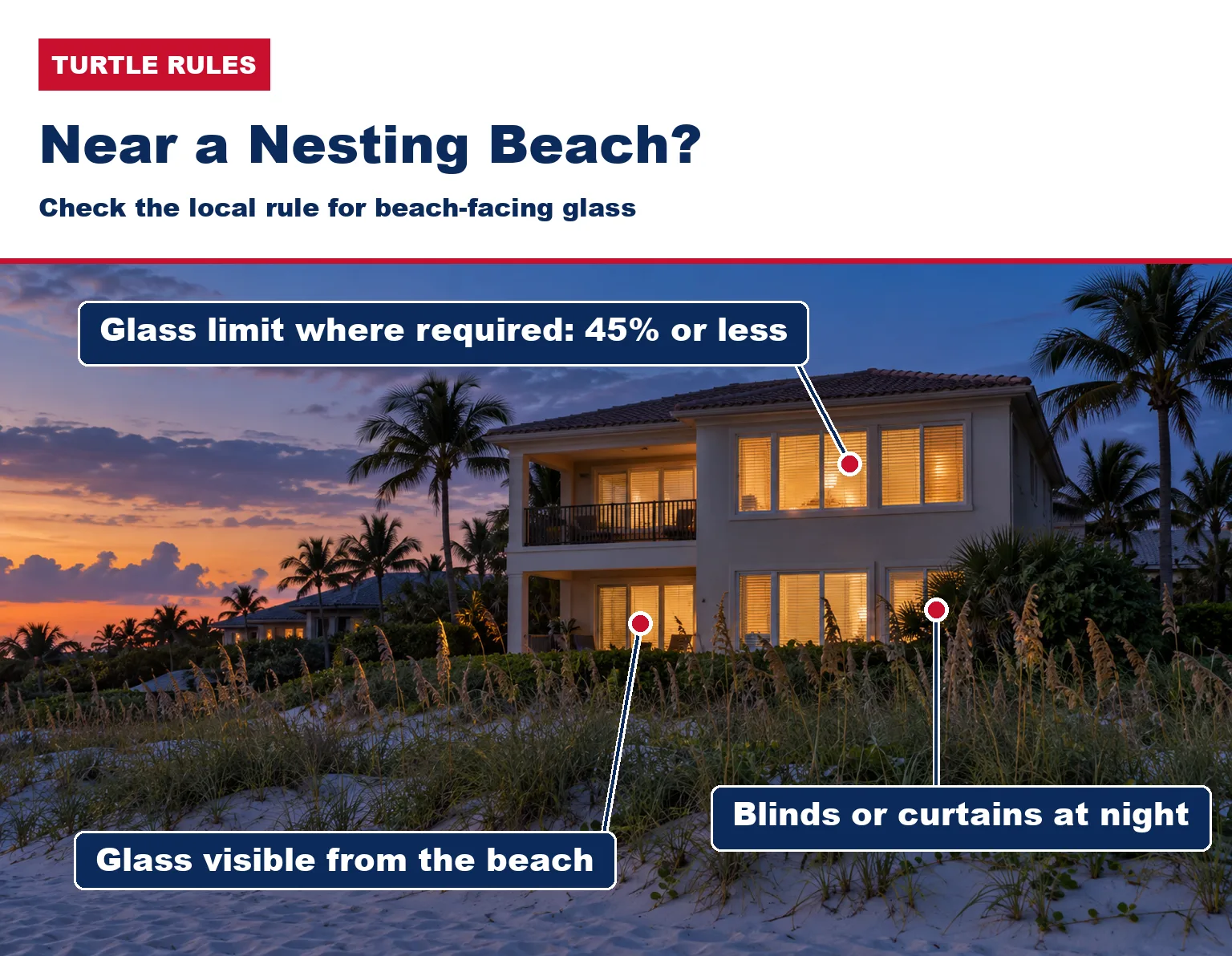
In Delray Beach or any other beach city, ask the building department before you order glass, because a rule from one city does not carry over to the next.
Why a Clear Low-E Coating May Not Meet a 45 Percent Rule
Low-E glass alone may not pass a turtle rule. The ES Windows turtle code flyer, hosted by Tecnoglass, lists clear laminated glass at 86 to 88 percent and Solarban 70 on clear at 60 percent, both above the limit.
Gray-plus-gray makeups and Solarban 70 paired with gray are listed at 45 percent or less. Before you order, get the manufacturer’s turtle letter for the exact glass makeup and confirm that makeup is listed in your window’s approval.
In the same flyer, ES Windows says it offers products with a visible light transmittance of 45 or less.
Live near the beach? Check your city’s turtle rule first, then call (877) 554-6373 for an estimate on approved glass makeups that fit it.
Privacy Glass for Bathrooms and Street-Facing Rooms
Privacy glass blocks the view into a room while still letting light in, which suits bathrooms and street-facing rooms. Our page lists privacy glass options for impact sliding doors; for windows, ask which privacy glass the series offers and whether the approval lists it.
Tint gives daytime privacy only, because a lit room shows through tinted glass at night.
What Changes the Price of Impact Window Glass
Your price depends on how many openings you replace, their sizes, and the product series and glass you choose. Each series and glass package is priced on its own, so ask to compare two glass options for the same window at your estimate.
- Coating: a Low-E coating such as Solarban 70 can be priced as its own line, so ask to see it listed separately.
- Color: ES lists clear and gray as standard on its multi-family Multimax line; standard colors on the series in your quote may differ.
- Opening size: the size and design pressure of each opening decide which glass makeups the approval allows.
- Turtle paperwork: near the beach, a manufacturer’s letter or a lighting plan may be part of the permit.
When quotes differ, compare impact window quotes line by line so each one names the same makeup. Financing may be available for qualified homeowners through independent third-party providers; see our financing options for qualified homeowners.
Impact Window Glass FAQ
Is Low-E glass the same as tinted glass?
No. Low-E is a coating that controls heat, and Vitro lists Solarban 70’s look as neutral, while tint colors the glass gray or bronze and lets less visible light through. The two can be combined, so compare the SHGC and visible transmittance of each option on the NFRC label.
Do I need turtle glass if my house is not on the beach?
It depends on your city’s trigger: Boca Raton’s rule covers buildings within 300 feet of the toe of the dune, and Hollywood ties its letter to the Coastal Construction Control Line. Seaward of the state Coastal Construction Control Line, a state coastal permit can also require tinted glass.
Will gray impact glass make my rooms dark?
Gray glass lets less daylight through than clear glass, so rooms look darker and the label shows a lower visible transmittance. For sun control without the darker look, compare a clear Low-E glass, or ask about gray only on the sunniest sides if your HOA allows it.
Do impact windows block UV rays?
ES Windows lists reducing exposure to harmful UV rays among the benefits of its impact-rated windows. How much UV a specific window blocks depends on its glass makeup, so ask for the product data on the exact glass in your quote.
Does the glass choice also affect outside noise?
Laminated glass and a tightly sealed window assembly can help create a quieter home, whichever coating or tint you end up picking. If street or airport noise is your main concern, read how impact windows cut outside noise before you choose.
How to Choose Your Glass Before the Estimate
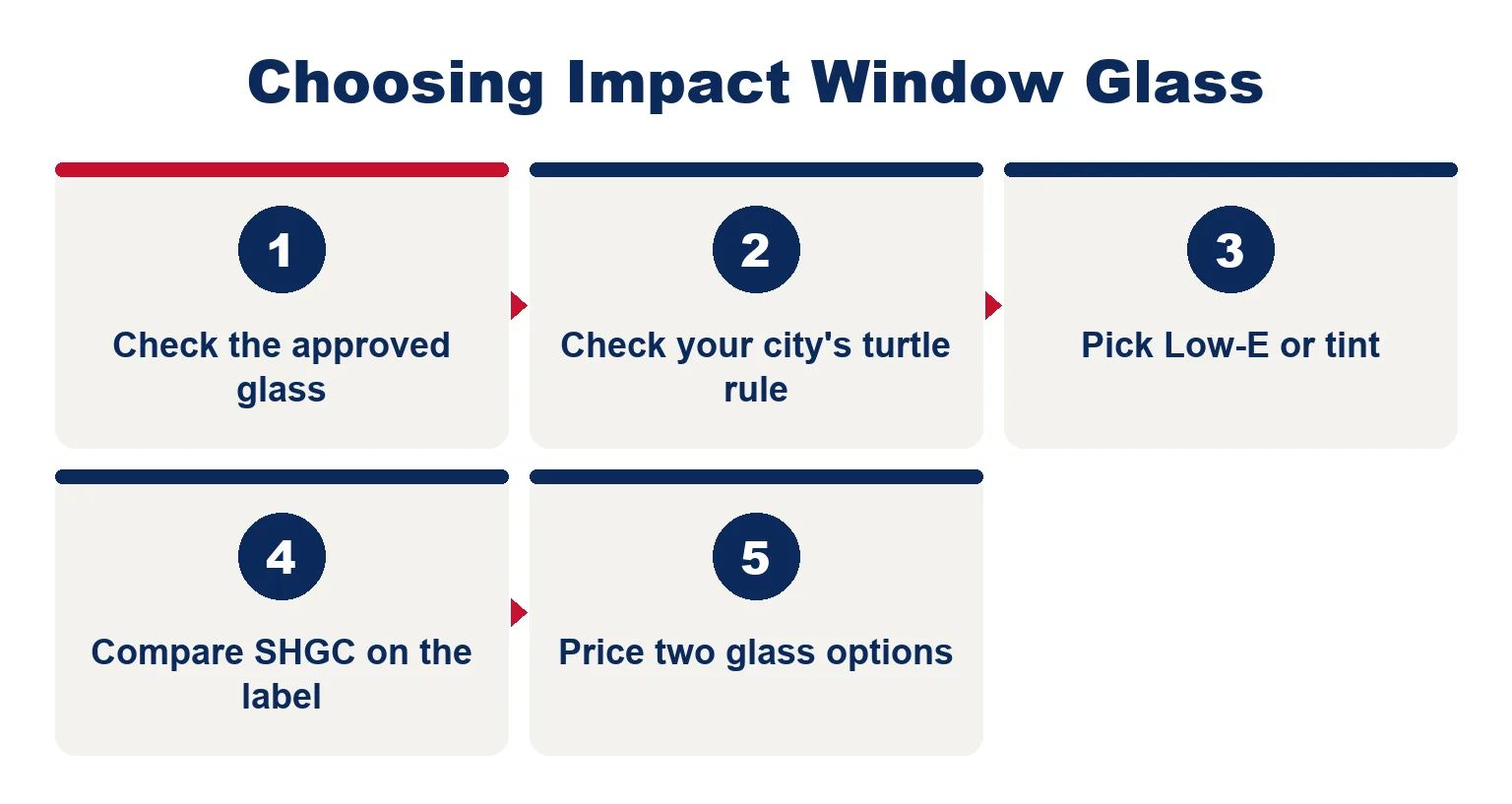
Make the glass decision in five steps: check the approved glass, then check your city’s turtle rule if you live near the beach. Next, pick Low-E or tint by how much sun each room gets, compare SHGC on the label, and price two glass options side by side.
For ratings, county rules and costs beyond the glass, see our complete South Florida impact windows guide.
USA Home Improvement is licensed (CGC1526707) and insured and has served Florida homeowners for more than 15 years. We sell and install ES Windows, and customers can receive the Florida Product Approval number for each window and door on request.
Call (877) 554-6373 or Get a free estimate.