Skip to content

Florida homeowners can pay for home improvements with cash, a home equity loan or HELOC, a personal loan, a government-insured loan or a PACE assessment on the property tax bill.
State programs such as the home hardening sales tax refund, My Safe Florida Home and insurance discounts can then lower what the project really costs you.
This guide compares how each option is repaid, what it puts at risk and when it fits, so you can pick one before you sign a contract. Each section links to a deeper guide if you need the details.
Comparing Home Improvement Financing Options in Florida
Home improvement financing options differ most in two ways: how you repay and what backs the money. The table sums up each one using the descriptions from the Consumer Financial Protection Bureau, HUD and Florida law cited below.
| Option | How you repay | What backs it | Fits best when |
|---|---|---|---|
| Cash or savings | Nothing to repay | Nothing | You can pay and still keep an emergency fund |
| Home equity loan | Regular payments on a lump sum | Your home | One large project with a known price |
| HELOC | Draw as needed, then repay; rate usually adjustable | Your home | A project done in phases |
| Personal loan | Fixed periodic payments | Usually nothing; some are secured | A smaller project, or little equity |
| FHA 203(k) | Part of your mortgage payment | The mortgage on the home | Buying or refinancing a home that needs work |
| HUD Title I | Payments to the lender | Lender loan insured by HUD | Improvements without a full refinance |
| PACE | Assessment on your property tax bill | A lien equal to county taxes | Qualifying improvements where a local program is authorized |
USA Home Improvement does not lend money. Financing may be available for qualified homeowners through independent third-party providers. Terms, eligibility and availability depend on the program and location, so see financing options for qualified homeowners before you choose.
Paying for Home Improvements With Cash or Savings
Paying with cash or savings is the cheapest way to fund a home improvement, because there is no interest, no lien and no application. The trade-off is that the money is gone if a storm, a job loss or a medical bill comes next.
Cash works best when you can cover the full price and still keep an emergency fund. Many homeowners mix the two: savings for the deposit and part of the work, and a loan for the rest.
Ask how the contract schedules payments before you decide how much cash to use. A written schedule tied to milestones, such as permit, delivery and final inspection, tells you when each amount is due.
Home Equity Loans and HELOCs: Borrowing Against Your Home
A home equity loan and a HELOC both let you borrow against the equity in your home, so your house is the collateral.
The Consumer Financial Protection Bureau explains that a home equity loan is a specific amount paid out in one lump sum, while a HELOC is a line of credit you can draw from several times up to a limit.
HELOC rates are usually adjustable, so your payment can change from month to month. A home equity loan can carry a fixed or an adjustable rate, which suits a single project with a known price, such as a full roof or a whole-house window replacement.
If you already have a mortgage, either one is a second mortgage you pay on top of the first. The CFPB warns that you should only take a HELOC if you are confident you can keep up with the payments, because falling behind could cost you your home.
Home equity borrowing and PACE are often weighed against each other for the same project. Our guide on how a PACE assessment compares with home equity lines them up side by side.
Personal Loans for Smaller Home Improvement Projects
A personal loan is a fixed amount you repay in regular, fixed installments, and many are unsecured, so your home is not the collateral. That makes it a common choice for smaller projects or for homeowners who have little equity yet.
Because an unsecured loan carries more risk for the lender, the CFPB notes it may come with a higher interest rate than a secured loan. Personal installment loans can also include fees such as origination and late fees, which add to the cost.
Compare personal loan offers by the annual percentage rate (APR) and the total of all payments, not by the monthly payment alone. A longer term lowers each payment but usually raises what you pay overall.
Government-Insured Loans: FHA 203(k) and Title I
Two HUD programs insure lenders who finance home repairs, which can open a path for homeowners who do not fit a standard loan. You still apply through a private lender that takes part in the program.
- FHA 203(k): the 203(k) rehabilitation mortgage program rolls the cost of repairs into a mortgage when you buy or refinance a one- to four-family home. It fits an older Florida home that needs a roof, windows or doors at purchase.
- Title I property improvement loans: HUD’s Title I program insures loans for improvements to a home you already own, without refinancing the mortgage. Loan limits and terms are set by HUD, so ask the lender for the current figures.
Both programs follow lender and HUD rules on the property, the contractor and the paperwork. Ask a participating lender early, because approval steps can add time before work starts.
PACE Financing in Florida
PACE lets a Florida homeowner finance qualifying improvements through a non-ad valorem assessment collected with the property taxes. Under section 163.081, Florida Statutes, the recorded assessment is a lien of equal dignity to county taxes.
A PACE program can operate only where the county or city has authorized it by ordinance or resolution. Qualifying improvements for homes are listed in section 163.08, and they include repairing, replacing or improving a roof.
They also include replacing windows or doors, garage doors included, with impact-resistant or hurricane windows or doors. See which home projects qualify for Florida PACE for the full list.
Florida law also protects homeowners before a PACE agreement is signed. Among other checks, the total assessment generally cannot exceed 20 percent of the home’s just value, the yearly payment cannot exceed 10 percent of household income, and you have 3 business days to cancel.
Our guide on how PACE financing works in Florida walks through every check and step.
The required disclosures include the interest, the estimated APR and a warning that a lender may require full payoff when you sell or refinance. For the cost side, read what sets PACE interest rates and fees. For a future sale, read about refinancing or selling a home with PACE.
Tax treatment and availability outside Florida are separate questions. Ask a tax professional and see whether PACE payments are tax deductible, or check which states offer PACE financing if you own property elsewhere.
Programs That Lower the Net Cost of Impact Windows and Doors
Three Florida programs can lower what impact windows and doors cost you after the work is done, whatever way you pay. They are separate from financing and from each other, with their own rules and paperwork.
Florida Home Hardening Sales Tax Refund
Florida homeowners can get back up to $500 in total of the sales tax paid on impact-resistant windows, doors and garage doors bought from July 1, 2026 through June 30, 2029.
To qualify, the home must be site-built and homesteaded, with a just value no higher than $700,000 on the property appraiser’s record, according to the Florida Department of Revenue’s Tax Information Publication 26A01-09.
You pay the full tax first and claim the refund afterward with Forms DR-26S and DR-26HH, by September 30, 2029. Keep receipts showing Florida sales tax paid.
Each owner can claim for one property only, and if your contractor buys the products, ask it for the receipt showing the Florida sales tax it paid. Read how the Florida sales tax refund works for the forms and steps.
My Safe Florida Home Grants
My Safe Florida Home, run by the Florida Department of Financial Services, offers free wind mitigation inspections and two kinds of grants for approved hardening upgrades: matching grants, and low-income grants that need no matching contribution. Eligible upgrades include impact-resistant windows, doors and garage doors.
Its program FAQ says grants are subject to legislative appropriation and are paid after the work is complete.
The home needs a homestead exemption and must meet the program’s limits on home age and insured value. You can choose a contractor and get an estimate, but do not start any work before the official grant approval notice.
Insurance Discounts After a Wind Mitigation Inspection
Florida law (section 627.0629) requires insurers to offer discounts for features that reduce wind damage. An inspector records those features on the Uniform Mitigation Verification Inspection Form (OIR-B1-1802).
Discounts differ from one insurer and one home to the next. After the new windows and doors pass final inspection, have a new form completed, then see home upgrades that can lower insurance rates for the items on the form.
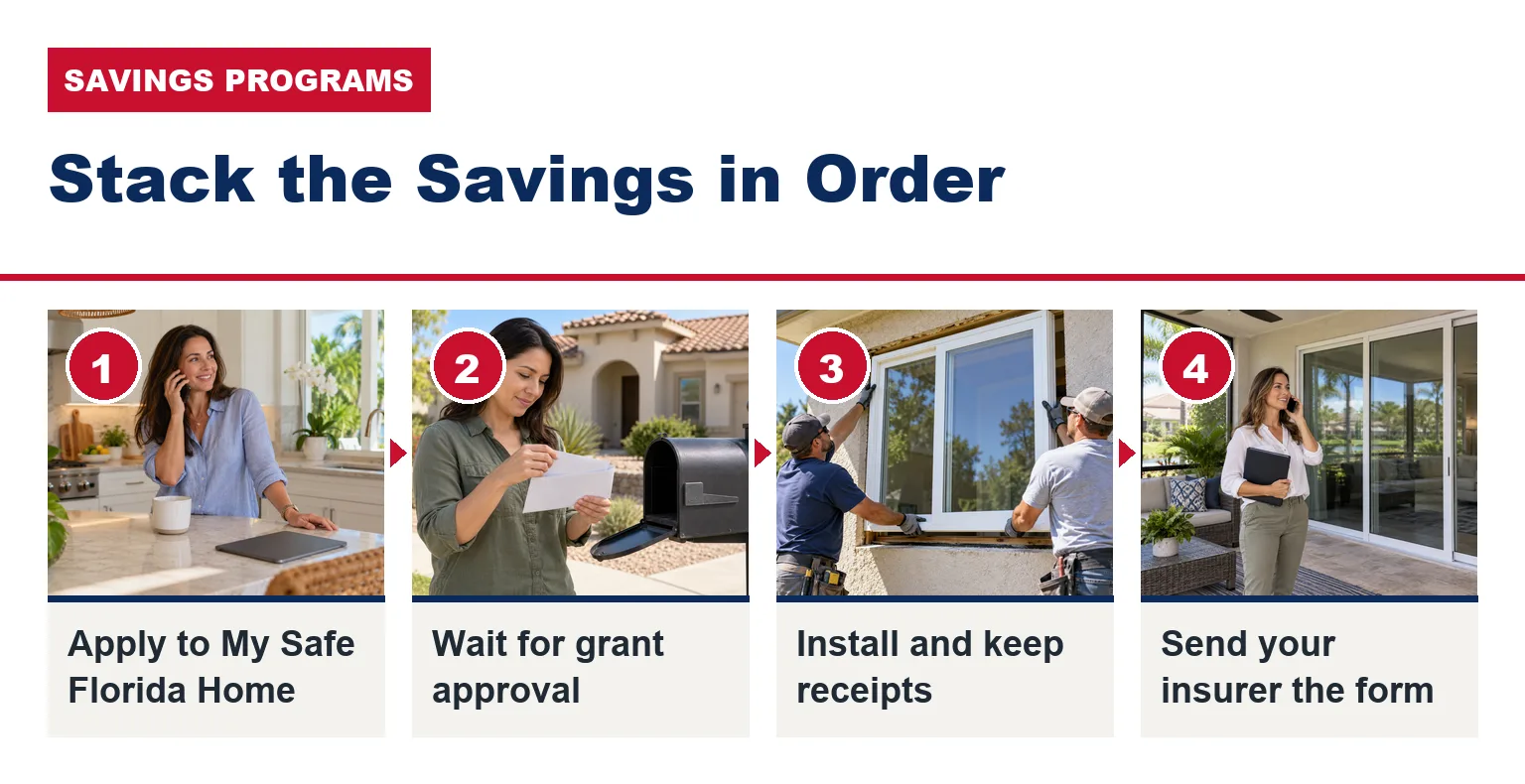
Order matters when you stack these programs. If you want a grant, apply to My Safe Florida Home first, because the program assigns its own inspector. Wait for grant approval before any work starts.
Then install and keep receipts for the sales tax refund. After final inspection, have a new wind mitigation form completed and send your insurer the form.
Compare ES Windows impact windows for South Florida homes when you plan which openings to replace.
Making the Right Choice on Home Improvement Financing
The right way to pay depends on the size of the project, the equity in your home and how long you plan to stay. Use these as a starting point, then compare written offers.
- Choose cash or savings when you can pay in full and still keep an emergency fund.
- Choose a home equity loan for one large project with a fixed price, if you have equity and steady income.
- Choose a HELOC for work done in phases, such as windows this year and doors next year, if you can handle a changing payment.
- Choose a personal loan for a smaller project, or when you have little equity and want to keep your home out of the loan.
- Consider an FHA 203(k) when you are buying or refinancing a home that needs work.
- Consider PACE for qualifying improvements where a local program is authorized, after you read every disclosure and check how a sale or refinance would work.
Urgent work follows different rules, because a leaking roof or a broken window after a storm cannot wait for a grant or a long approval. For that case, read our guide to financing options for urgent home repairs, and see our roof repair and replacement services.
Whatever you choose, get the project price in writing first. A financing offer only makes sense once you know the full cost of the openings, products and installation you need.
Home Improvement Financing FAQs
Does USA Home Improvement provide financing?
No. USA Home Improvement does not directly provide financing. Financing may be available for qualified homeowners through independent third-party providers. Terms, eligibility and availability depend on the program and location, so ask about current options at your estimate.
Is there a federal tax credit for impact windows?
No. The federal energy efficient home improvement credit (section 25C) ended for property placed in service after 2025, according to the IRS guidance on the 2025 tax law. Florida’s sales tax refund is a separate state program.
Can I combine a My Safe Florida Home grant and the sales tax refund?
Yes. My Safe Florida Home states that receiving both a grant and the sales tax refund is not a conflict, and that it does not administer the refund. They are separate programs with separate applications, so follow each program’s rules and keep every receipt.
Do I need to pay the full project price before a grant pays out?
For a My Safe Florida Home matching grant, yes. The program FAQ says matching grants are paid on a reimbursement basis after the work is complete, with a paid-in-full invoice. Plan how you will cover the full price first, whether with savings or financing.
Your Next Step: Price the Project, Then Compare Ways to Pay
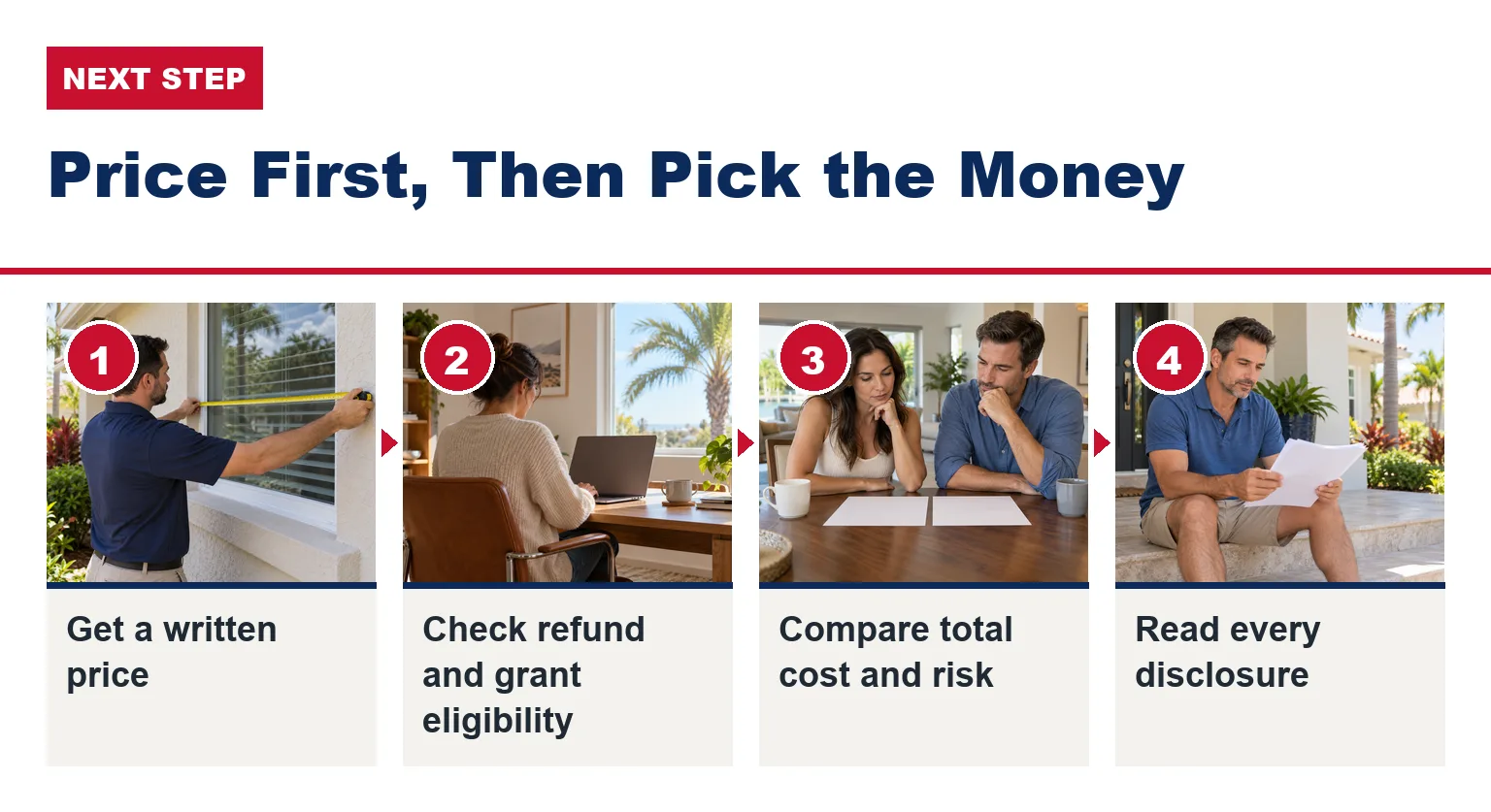
Start by getting a written price for the work, then check refund and grant eligibility before you choose. Compare total cost and risk across two or three ways to pay. Read every disclosure before you sign anything tied to your home.
USA Home Improvement is licensed (CGC1526707) and insured and has served Florida homeowners for more than 15 years. Every project is permitted, and our installation team holds direct certification from the manufacturer.
Call (877) 554-6373 or request your free, no-obligation estimate for impact windows, impact doors or roofing.