Skip to content

Residential PACE financing is offered in only three states, California, Florida and Missouri, according to PACENation, the national PACE trade group. Many more states have PACE laws, but most of those programs serve commercial property, not single-family homes.
This guide shows where the state counts come from, which states run residential and commercial programs, and how a Florida homeowner can check whether a program covers a specific address.
What Is PACE Financing?
PACE stands for Property Assessed Clean Energy. It pays for qualifying improvements to a property, and the owner repays it as an assessment collected with the property taxes, so the obligation is tied to the property rather than to a personal loan.
For how it works in Florida, see Florida PACE rules, checks and timeline. If you may sell soon, read about selling or refinancing a home with PACE. Our guide to home improvement financing options compares PACE with loans.
How Many States Have PACE Laws, and Why the Counts Differ
A state needs a law that allows PACE, and then a program has to launch and operate. Those are two different counts, and published sources do not always agree on either one.
| Source | States with PACE-enabling laws | States with active programs | Residential PACE |
|---|---|---|---|
| PACENation program map page | 40 states plus D.C. | 36 states plus D.C. (all PACE types) | California, Florida and Missouri |
| Poyner Spruill C-PACE summary | 39 states plus D.C. | 33 states plus D.C. (commercial PACE only) | Not covered |
The gap comes from what each source counts. The law firm counted commercial programs only, while PACENation counts any active PACE program. PACENation’s page does not show a date, and both counts change whenever a state passes a new law.
For homeowners, the residential list matters more than the total. A state can have a PACE law and active commercial programs and still offer nothing for a single-family home.
States with Active Residential PACE (R-PACE) Programs
PACENation lists three states where residential PACE is offered. Even inside those states, a program has to be authorized locally, so availability can change from one county or city to the next.
Florida
Florida law allows residential and commercial PACE, but a residential program can operate only where the county or city has authorized it. Because Florida is where we work, the two sections below explain the law and how to check your address.
California
California has residential and commercial programs. One example is the CSCDA Open PACE program, which says it serves residential and commercial property owners for energy efficiency, renewable energy, water conservation and seismic improvements.
Missouri
Missouri’s residential PACE is authorized only in cities and counties that have passed ordinances allowing it, Canary Media reported. Some local programs have since ended, so a Missouri owner should ask the city or county first.
Missouri lawmakers also added oversight. According to ProPublica’s report on the reforms, the state Division of Finance must review residential programs at least every two years, and loans must be based on local government appraisals.
States with Commercial PACE (C-PACE) Programs
Most PACE states offer commercial PACE only. These programs serve businesses, industrial buildings, nonprofits and larger apartment buildings, and they do not open PACE to a typical single-family home.
- Hawaii: HI C-PACER, run by the Hawaii Green Infrastructure Authority, covers non-residential property, including multifamily housing with five or more dwelling units.
- Texas: TX-PACE funds commercial, multifamily, agricultural, industrial and nonprofit property upgrades, and owners can ask for a program where none exists yet.
- North Carolina: Senate Bill 802 created a commercial PACE program, and local governments that want to take part must adopt a resolution, per the Poyner Spruill summary.
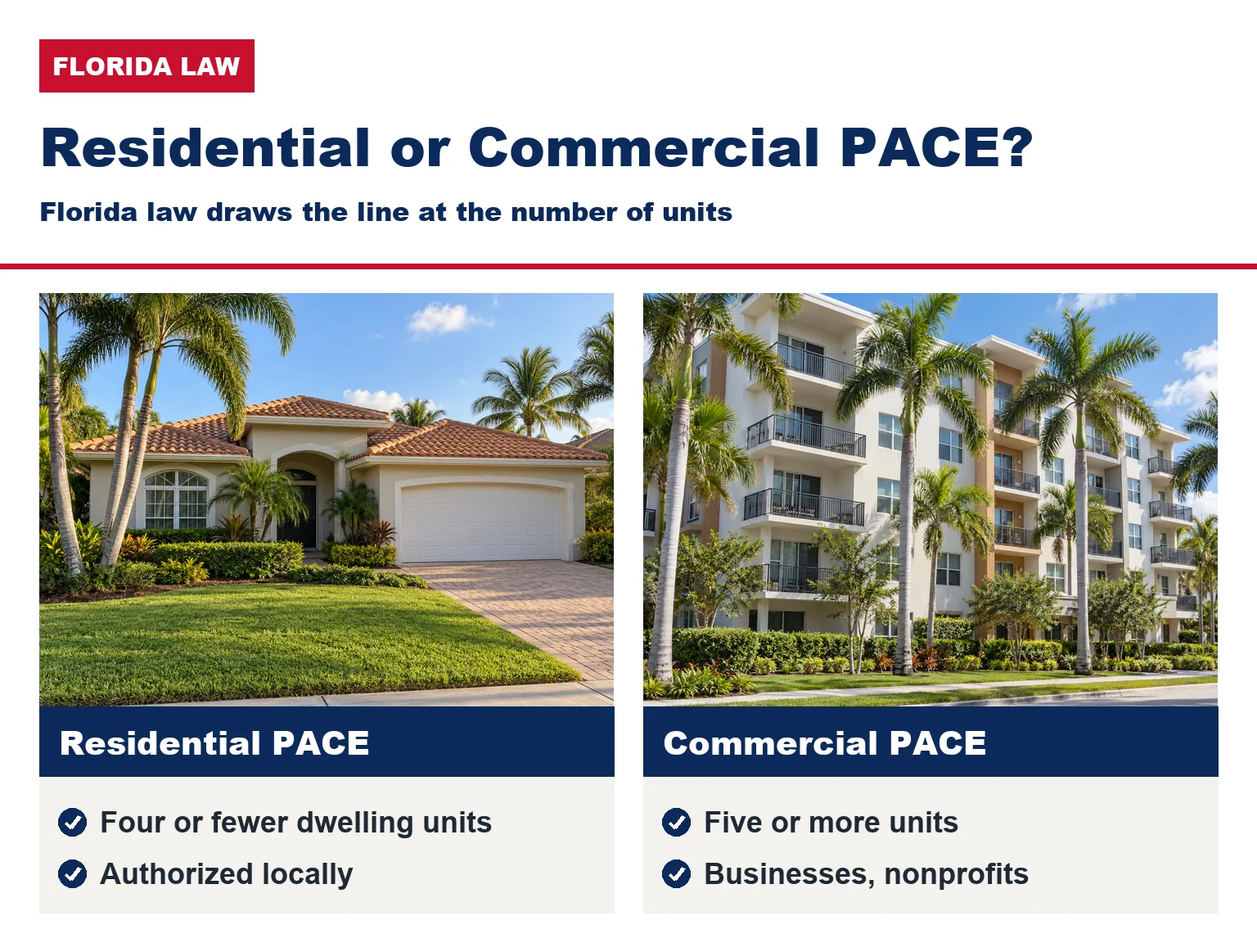
Florida draws the same line. Under state law, residential property is zoned residential or multifamily residential and has four or fewer dwelling units; buildings with five or more units count as commercial.
Florida PACE Law Under Section 163.08
Florida’s PACE law is section 163.08, Florida Statutes. It allows financing only for property inside the area of an authorized program, so the first question is always where you live.
For the list of projects the law covers, see the nine project groups Florida PACE lists.
Section 163.081 adds the local step for homes: no residential program can run in a county or city until that government approves it by ordinance or resolution.
Local governments can also team up through an interlocal agreement. A county or city may deauthorize a program by repealing its ordinance or resolution, although agreements already recorded continue.
How to Check Whether Your Florida County or City Has a PACE Program
Because authorization is local, the answer can differ between two homes a few miles apart. These four steps tell you whether a program covers your address and who runs it.
- Find your local government. Your property appraiser’s record for the parcel shows whether the home is inside a city or in the unincorporated county. That tells you which government’s authorization applies.
- Ask for the ordinance or resolution. Call the county or city clerk, or search the commission’s agenda records for “PACE” or “qualifying improvements.” Ask which program administrators are authorized and whether any authorization was repealed.
- Find the registered contractor page. Under section 163.083, each program administrator must keep an easily accessible web page showing the status of its registered contractors and any penalties.
- Check any offer against that page. If a salesperson brings up PACE, confirm the program is authorized for your address and that the contractor appears as registered and in good standing.
Once you know a program covers your home, read every disclosure and the cancellation rules before you sign. Florida’s checks and steps are covered in our guide to PACE mechanics linked above.
What USA Home Improvement Does and Does Not Do
USA Home Improvement installs ES Windows impact windows and doors and handles roofing in South Florida. We do not lend money or run a PACE program.
Financing may be available for qualified homeowners through independent third-party providers. Terms, eligibility and availability depend on the program and location. You can review financing options for qualified homeowners before you choose a way to pay.
Whatever you decide about payment, a written price comes first. Compare ES Windows impact windows for Florida homes or our roof replacement for South Florida homes to see what the project involves.
PACE State Availability: Quick Answers
Is residential PACE available in every Florida county?
No. A residential program can operate only where the county or city has authorized a program administrator by ordinance or resolution, and an authorization can be repealed. Check with your local government for your exact address.
If my state has commercial PACE, can I use it for my house?
Usually not. Commercial programs such as those in Hawaii and Texas serve non-residential and larger multifamily property. A single-family home needs a residential program, which PACENation lists only in California, Florida and Missouri.
Why do websites list different numbers of PACE states?
Some count states with a PACE law, others count states with an active program, and some count commercial programs only. Laws also change, so check the date and scope of any list before relying on it.
Next Step: Get a Written Price for Your Project
Whatever way you pay, start with a written price for the work itself, and read every disclosure before you sign anything tied to your home.
USA Home Improvement is licensed (CGC1526707) and insured and has served Florida homeowners for more than 15 years. Every project is permitted, and our installation team holds direct certification from the manufacturer.
Call (877) 554-6373 or get a free written estimate for your project for impact windows, impact doors or roofing.