Skip to content


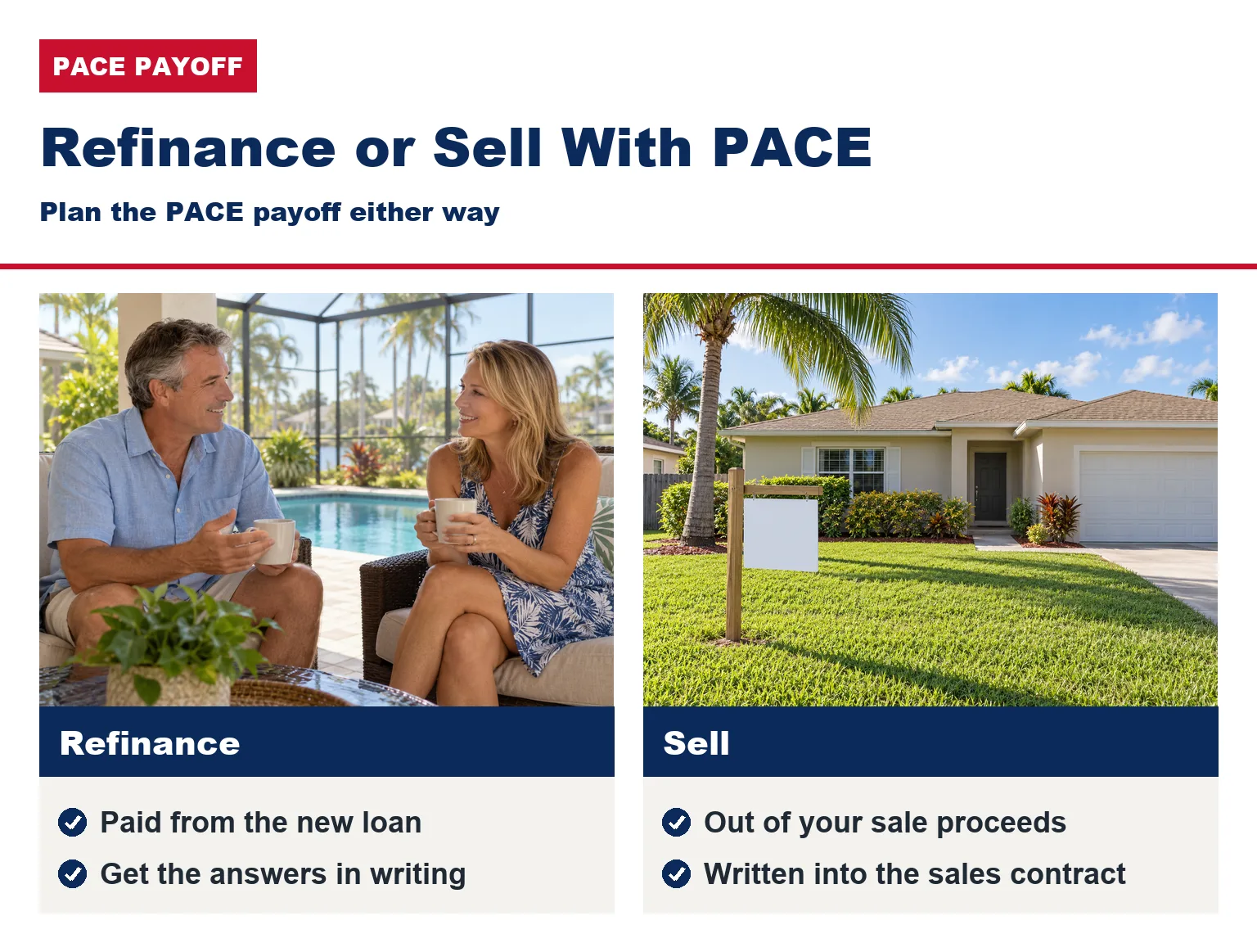
Yes, you can refinance a Florida home that has a PACE assessment, but most mortgage programs will require the PACE balance to be paid off at or before closing. Fannie Mae, Freddie Mac and FHA loans do not allow a PACE lien that ranks ahead of the mortgage to stay on the property.
The same rules shape what happens when you sell. This guide explains the rule for each loan type, the refinance paths that clear a PACE balance, how the payoff works, and what to ask your lender before you apply or list the home.
Why a PACE Lien Matters to Your Mortgage Lender
A Florida PACE assessment is a lien on the property that ranks with your property taxes. Under section 163.081, Florida Statutes, the recorded assessment is a lien “of equal dignity to county taxes and assessments,” and it is collected on your property tax bill.
Mortgage lenders want their loan to be the first lien on the home. Fannie Mae’s Selling Guide notes that PACE loans typically have automatic first lien priority over mortgages, and its mortgage documents prohibit a lien with senior status to the mortgage. That conflict is the reason a refinance usually triggers a payoff.
Your current mortgage is protected in one way. Florida law makes a mortgage clause unenforceable if it would call your loan due only because you took PACE financing. For a side-by-side look at the two kinds of lien, see how a PACE lien compares with home equity.
PACE Rules by Mortgage Type: Fannie Mae, Freddie Mac, FHA and VA
The rule depends on who buys, insures or guarantees your new mortgage. Ask your loan officer which program the loan will use, then check it against this table.
| Loan type | Can the PACE lien stay? | What usually happens |
|---|---|---|
| Fannie Mae | Only if the PACE program gives no lien priority over first mortgages | PACE paid off as part of the refinance or sale |
| Freddie Mac | Only if the PACE lien is truly subordinate | PACE paid in full through a cash-out or no cash-out refinance |
| FHA forward mortgage | No | PACE paid off; counted as existing debt in a rate-and-term refinance |
| FHA reverse mortgage (HECM) | No | PACE paid off at closing, and HECM proceeds may be used |
| VA-guaranteed loan | The VA loan must hold a first lien | Ask the VA lender how it treats the PACE lien |
| Other lenders | Set by each lender | Ask before you apply; the CFPB says most lenders will not refinance with PACE on the house |
Fannie Mae and Freddie Mac Loans
Fannie Mae’s Selling Guide says it will not buy mortgages on homes with an outstanding PACE loan, unless the PACE program does not provide for lien priority over first mortgages. The loan application form also asks borrowers to disclose PACE liens with priority over the first mortgage.
Freddie Mac takes the same position. It will buy a mortgage on a home with PACE only if the PACE obligation is, and will remain, in a truly subordinate lien position. Otherwise the PACE obligation must be paid in full through a no cash-out or cash-out refinance.
The Federal Housing Finance Agency (FHFA), which oversees both companies, put it plainly: a homeowner with a first-lien PACE loan cannot refinance into a Fannie Mae or Freddie Mac mortgage, and a buyer cannot use one of those loans to buy the home.
FHA Loans Under HUD Handbook 4000.1
FHA will not insure a forward mortgage on a home that stays encumbered with PACE. HUD Handbook 4000.1 states that properties which will remain encumbered with a PACE obligation are not eligible for FHA mortgage insurance.
The refinance rules give you a way to clear it. HUD Mortgagee Letter 2017-18 treats a PACE balance as existing debt that may be paid off with a rate-and-term refinance. It also keeps the option of a cash-out refinance to pay off PACE.
The lender must tell the appraiser that the PACE payoff is a condition of loan approval.
VA Loans
A VA-guaranteed loan must be secured by a first lien on the property, under 38 U.S.C. 3703(d)(3)(A). The lender is responsible for securing that first-lien position.
VA’s PACE guidance, Circular 26-16-18, allowed a PACE assessment to stay only if its lien was never senior to the VA loan for the full outstanding balance. That circular has since expired, so ask your VA lender in writing how it handles a Florida PACE lien before you apply.
Refinance Paths That Pay Off a PACE Assessment
Most homeowners clear a PACE balance in one of three ways, and the right one depends on your equity and your goal for the new loan.
- Rate-and-term or no cash-out refinance: the PACE balance is paid from the new loan. FHA counts it as existing debt, and Freddie Mac allows it when Freddie Mac already owns or securitized your current mortgage.
- Cash-out refinance: you borrow more than your current mortgage and part of the cash pays the PACE balance in full. FHA and Freddie Mac both allow this.
- Pay it off before the refinance: you use savings to clear the PACE balance first, then apply with no PACE lien on the title.
Equity is the limit. Rolling a PACE balance into a mortgage raises the loan amount, so the new loan must still fit the program’s rules for your home’s appraised value. If it does not, the payoff has to come from your own funds, or the refinance may not work for now.
If you are still deciding how to pay for a project, our guide to home improvement financing in Florida compares every option.
Financing may be available for qualified homeowners through independent third-party providers. Terms, eligibility and availability depend on the program and location. You can review current financing options for qualified homeowners before your estimate.
Selling a Florida Home With a PACE Assessment
You can sell a home with a PACE assessment, but the buyer’s loan usually decides whether the balance must be paid off at closing. The Consumer Financial Protection Bureau (CFPB) says most lenders will not make a mortgage to the buyer when there is a PACE loan on the house.
The rules above apply to the buyer too. A buyer using a Fannie Mae or Freddie Mac loan cannot buy a home with a first-lien PACE loan on it. For an FHA purchase, Handbook 4000.1 requires the sales contract to say the seller will pay off the PACE obligation at or before closing.
In practice, that means the payoff usually comes out of your sale proceeds. A cash buyer, or a buyer whose lender allows the lien, may agree to take over the payments, and the CFPB notes the buyer then becomes responsible for them. Either way, the choice should be written into the sales contract.
Florida also requires a written PACE disclosure to the buyer no later than when you sign the sales contract. Our guide to how PACE financing works in Florida covers that disclosure. If you are also weighing upgrades before listing, read about home improvements that pay off before selling.
How Paying Off a PACE Assessment Works
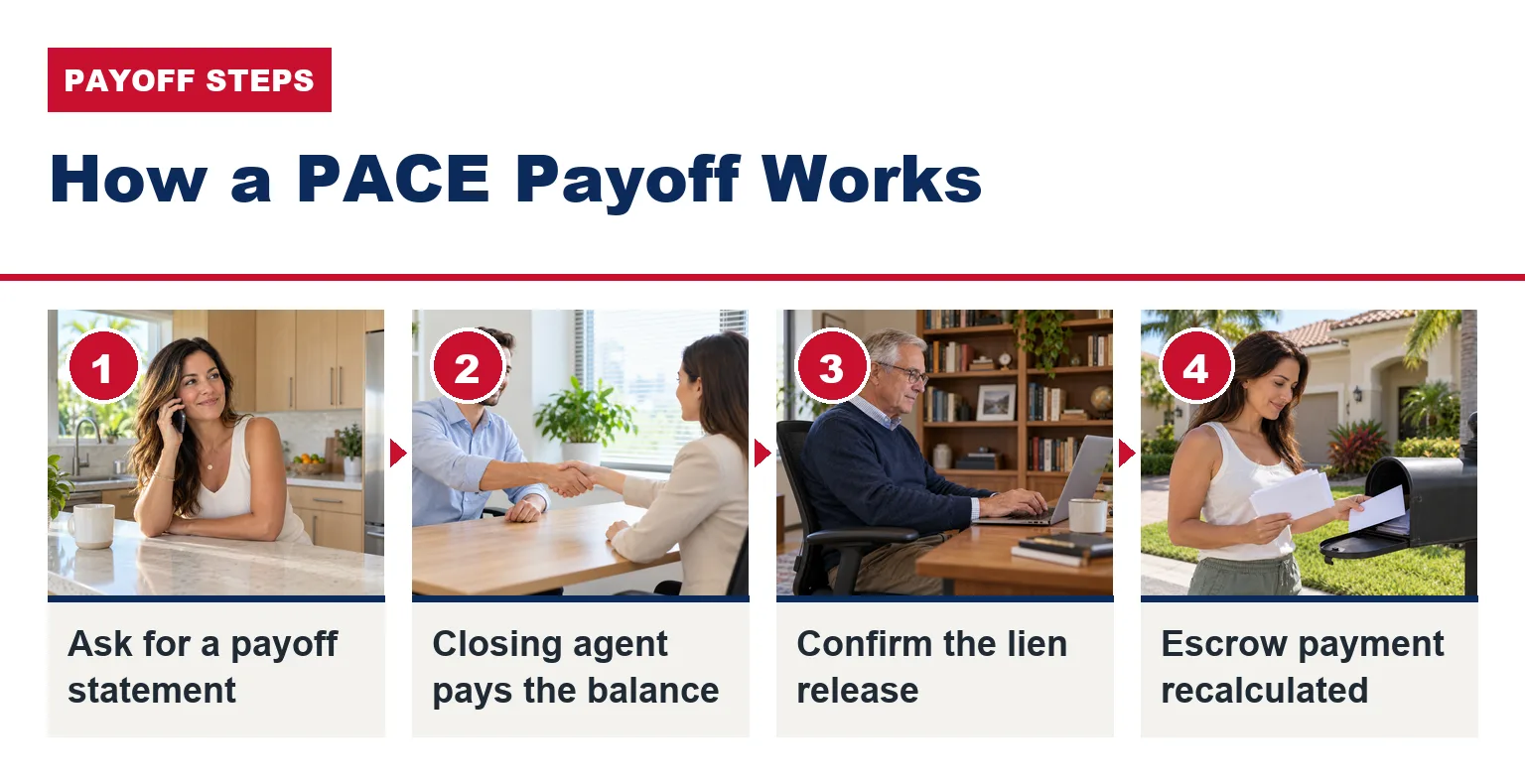
Paying off a PACE assessment starts with a written payoff amount from the PACE program or its third-party administrator, both named in your financing agreement. Ask for a payoff statement that is good through your expected closing date.
Florida law lets you repay a residential PACE assessment at any time without prepayment fees beyond nominal administrative costs. To compare what you would owe with your original terms, read how Florida PACE rates and fees are set.
At a refinance or sale, the closing agent usually pays the PACE balance from the closing funds, the same way an existing mortgage is paid. Give the closing agent the payoff statement early, because a refinance or sale may not close until the PACE payoff amount is confirmed.
After closing, ask the program administrator to confirm the lien release is recorded and that the assessment will come off future tax bills. If your taxes are paid through escrow, also ask your servicer when the escrow payment will be recalculated.
Questions to Ask Your Lender Before You Refinance or Sell
Ask these questions before you pay an application fee or sign a listing agreement. Get the answers in writing so you can compare lenders.
- Which program will this loan use: Fannie Mae, Freddie Mac, FHA, VA, or the lender’s own portfolio?
- Does that program require my PACE balance to be paid off, and can the payoff be part of the new loan?
- Will paying off PACE make this a cash-out refinance, and does that change my rate or the amount I can borrow?
- Does my equity cover the new mortgage plus the PACE payoff after the appraisal?
- Who orders the PACE payoff statement, and how long is it good for?
- How will my escrow payment change once the PACE assessment is gone from my tax bill?
For questions about deducting PACE payments or mortgage interest, read whether PACE payments are tax deductible and ask a tax professional about your own return.
PACE Refinance and Sale FAQs
Can I refinance into a reverse mortgage if I have PACE?
Yes, but the PACE balance must go. HUD Mortgagee Letter 2017-18 makes paying off a PACE obligation a mandatory obligation at the closing of an FHA reverse mortgage (HECM), and the HECM proceeds may be used to pay it. Ask the HECM lender to include the payoff in your closing figures.
Will paying off PACE make my refinance a cash-out refinance?
It can. Freddie Mac allows a PACE payoff in a no cash-out refinance only when it already owns or securitized the mortgage being refinanced; otherwise the payoff runs through a cash-out refinance. FHA counts the PACE balance as existing debt in a rate-and-term refinance, so ask how your loan will be classified.
Can a lender that keeps my loan in-house refinance with PACE in place?
Possibly, because a lender that keeps the loan in its own portfolio sets its own rules. The CFPB says most lenders will not refinance a mortgage while a PACE loan is on the house, so ask early and get the answer in writing before you pay an application fee.
Who pays off the PACE balance when I sell, me or the buyer?
The sales contract decides, but the buyer’s loan usually pushes the payoff onto the seller. An FHA purchase requires the seller to pay it off at or before closing. A cash buyer may agree to take over the payments.
Plan Your Upgrades With a Future Refinance or Sale in Mind
If you may refinance or sell in the next few years, choose project financing with that date in mind, and price the work first so every offer is easy to compare. USA Home Improvement exclusively sells ES Windows impact windows for South Florida homes and impact doors, and every project is permitted.
You can receive the Florida Product Approval number for each window and door on request. USA Home Improvement is licensed (CGC1526707) and insured and has served Florida homeowners for more than 15 years.
Get a free estimate or call (877) 554-6373.