Skip to content


Florida law bars PACE programs and contractors from telling you whether a PACE assessment is tax deductible, so this guide does not answer that for you. It sets out what IRS publications say in general, and a tax professional can apply them to your return.
In Florida, PACE is repaid as an assessment collected with your property tax bill. Below you will find how that assessment is billed, the IRS rules on real estate taxes, special assessments and interest, and the records to bring to your tax preparer. It is general information, not tax advice.
What Florida Law Says About PACE Tax Claims
Florida law bars PACE program administrators, third-party administrators and qualifying improvement contractors from making “any representation as to the tax deductibility of a non-ad valorem assessment” when they communicate with a property owner. That rule is in section 163.085, Florida Statutes.
The same section lets them encourage you “to seek the advice of a tax professional regarding tax matters related to assessments.” So if a salesperson promises a PACE tax write-off, treat it as a warning sign and check the other red flags in how Florida PACE works.
How a PACE Assessment Appears on Your Florida Tax Bill
A Florida PACE assessment is a non-ad valorem assessment that the tax collector collects with your property taxes, under section 163.081, Florida Statutes.
Your yearly tax notice lists “Ad Valorem Taxes” and “Non-ad Valorem Assessments” in separate parts, each with the levying authority and amount, as section 197.3635 requires. A PACE assessment sits in the non-ad valorem part. Show your tax professional both parts of the bill.
Before you sign, the PACE disclosure must show “the interest charged and estimated annual percentage rate” and the total estimated annual costs, including program fees. To understand those numbers, read how PACE interest and program fees are set.
If you are still choosing how to pay, you can compare every way to pay for home improvements before you decide.
IRS Rules on Deducting State and Local Real Estate Taxes
IRS Topic 503 says “Deductible real property taxes are generally any state or local taxes on real property levied for the general public welfare.”
IRS Publication 530, the IRS guide for homeowners, adds the key test: “You can deduct the tax if it is assessed uniformly at a like rate on all real property throughout the community.”
IRS Publication 17 says the proceeds “must be for general community or governmental purposes and not be a payment for a special privilege granted or service rendered to you.”
Publication 17 also says deductible real estate taxes generally do not include taxes charged for local benefits and improvements that increase the value of the property.
A real estate tax deduction is an itemized deduction on Schedule A, and it counts toward the SALT limit. Publication 530 is direct about the trade-off: “If you itemize, you can’t take the standard deduction.”
If you take the standard deduction instead, you claim no itemized deductions, so no real estate tax deduction.
The State and Local Tax (SALT) Limit
Topic 503 limits the combined deduction for state and local taxes to $40,000 ($20,000 if married filing separately). Publication 530 says the limit is reduced if modified adjusted gross income is more than $500,000 ($250,000 if married filing separately), but not below $10,000 ($5,000 if married filing separately).
The limit covers state and local income or general sales taxes, real property taxes and personal property taxes together. Your tax professional can show how the limit affects your own return.
IRS Rules on Special Assessments for Local Benefits
Publication 530 says: “You can’t deduct amounts you pay for local benefits that tend to increase the value of your property.” Its examples are the construction of streets, sidewalks, or water and sewer systems, and it says “You must add these amounts to the basis of your property.”
The IRS allows one exception. You can deduct assessments for local benefits “if they are for maintenance, repair, or interest charges related to those benefits.” The Schedule A instructions give the example of a charge to repair an existing sidewalk “and any interest included in that charge.”
The exception comes with a proof rule. If only part of an assessment is for maintenance, repair or interest, Publication 530 says you must be able to show that part.
Publication 530 adds: “If you can’t show what part of the assessment is for maintenance, repair, or interest charges, you can’t deduct any of it.”
Publication 530 also notes that a local benefit assessment may be listed on your real estate tax bill. It tells you to use these rules to find “how much of it, if any, you can deduct.”
How these rules apply to a PACE assessment is a question for your tax professional.
Interest in an Assessment vs Home Mortgage Interest
Home mortgage interest falls under a separate IRS rule. IRS Publication 936 says the mortgage must be “a secured debt on a qualified home in which you have an ownership interest.”
Publication 936 limits the deduction to interest on the first $750,000 ($375,000 if married filing separately) of debt, with higher limits for older debt.
For home equity loans and lines of credit, Publication 936 says interest is deductible “only if the borrowed funds are used to buy, build, or substantially improve the taxpayer’s home that secures the loan.”
The rest of that comparison is in how PACE compares with a home equity loan.
Ask your tax professional how these IRS rules apply to the interest in a PACE assessment.
Home Improvements, Basis and Selling Later
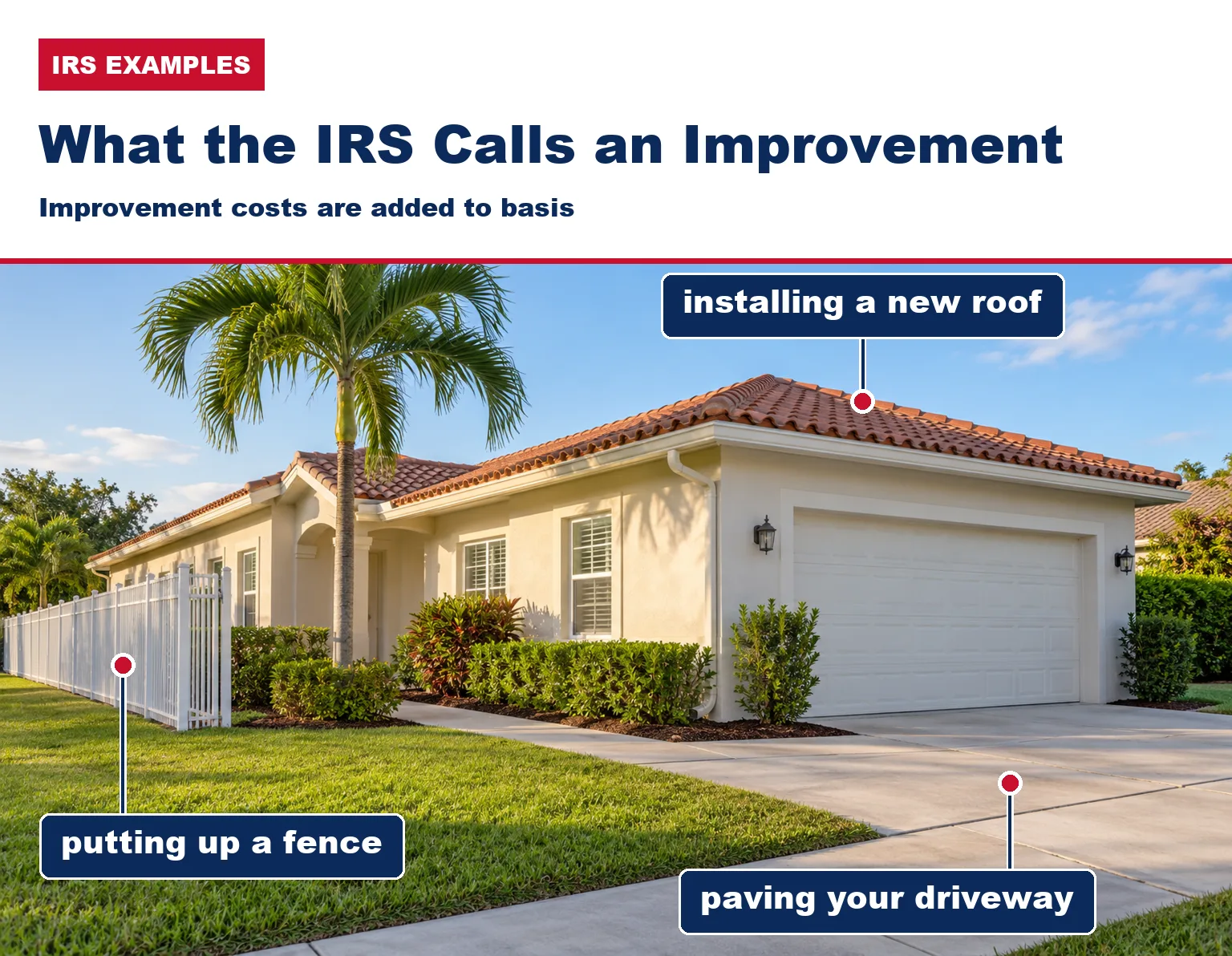
Publication 530 defines an improvement as work that “materially adds to the value of your home, considerably prolongs its useful life, or adapts it to new uses.”
Publication 530 says “You must add the cost of any improvements to the basis of your home. You can’t deduct these costs.” Its examples include putting up a fence, installing a new roof and paving your driveway.
Basis matters later. Publication 530 calls it “your starting point for figuring a gain or loss if you later sell your home.” Keep the improvement records with your home records, and read what happens to PACE when you sell.
Records and Questions to Bring to Your Tax Professional
Publication 530 says your records “must be clear and accurate and must be available to the IRS.” For a home with a PACE assessment, bring these to your tax appointment:
- Gather your PACE disclosure. The financing agreement and disclosure show the interest charged, the estimated annual percentage rate and the yearly costs, including program fees.
- Find the assessment line. Bring each year’s property tax bill with its “Non-ad Valorem Assessments” part, plus proof of payment or your escrow statement.
- Ask for a yearly payment breakdown. Ask the PACE program administrator for each year’s split of principal, interest and fees, and give it to your tax professional.
- Keep the project records. Keep the contractor’s contract, invoice and permit for the improvement, since Publication 530 says improvement costs are added to the basis of your home.
- Meet a tax professional. Ask whether you should itemize, how the SALT limit affects you, and how IRS rules apply to your PACE assessment.
PACE Tax Questions Homeowners Ask
Does paying property taxes through escrow change which year counts?
It can. The Schedule A instructions say that if your mortgage payments include real estate taxes, you can include only the amount the mortgage company actually paid to the taxing authority during the year. Your lender’s year-end escrow statement shows that amount, so bring it with your tax bill.
Can Florida homeowners deduct sales tax instead of income tax?
Yes, if you itemize. IRS Topic 503 says you can elect to deduct state and local general sales taxes instead of income taxes, by checking box 5a on Schedule A. Either choice counts toward the same SALT limit as your property taxes, so ask your tax professional which fits.
Who should I ask about my PACE assessment and taxes?
Ask a tax professional who knows your full return. Publication 530 lists enrolled agents and certified public accountants (CPAs) among tax return preparers, and it says to choose a preparer wisely. Bring the records listed above so the preparer can see every part of the assessment.
Next Step: Price Your Window, Door or Roof Project
USA Home Improvement exclusively sells ES Windows aluminum and vinyl impact windows and impact doors. You can browse the impact window styles we install or our roof replacement and repair services.
Every project is permitted, and you can receive the Florida Product Approval number for each window and door on request.
Financing may be available for qualified homeowners through independent third-party providers. Terms, eligibility and availability depend on the program and location. You can review the financing options for qualified homeowners before your estimate.
For tax questions about PACE or any financing, ask a tax professional. This article is general information, not tax advice.
USA Home Improvement is licensed (CGC1526707) and insured and has served Florida homeowners for more than 15 years.
Get a free estimate or call (877) 554-6373.