 Skip to content
Storm-Ready Sash
Before a storm, close the lower sash fully and engage the window’s supplied locks. Protection depends on the complete approved assembly and its installation, not just the style name.

It can be a practical choice when you want vertical operation without an outward-swinging sash. Check the opening you can actually use, the effort to lift it and how you will reach it after furniture is in place.
The upper sash stays fixed. The sash position and product design determine the usable opening; the full frame size is not the ventilation opening.
Where an emergency escape and rescue opening is required, the clear opening and applicable replacement rules must be checked for that room. “Single hung” by itself does not establish compliance.
Consider sill height, your reach and the effort to raise, lower and latch the sash. A deep counter or large piece of furniture can make an otherwise suitable window awkward to use.
Five details to compare before you choose a single-hung window.
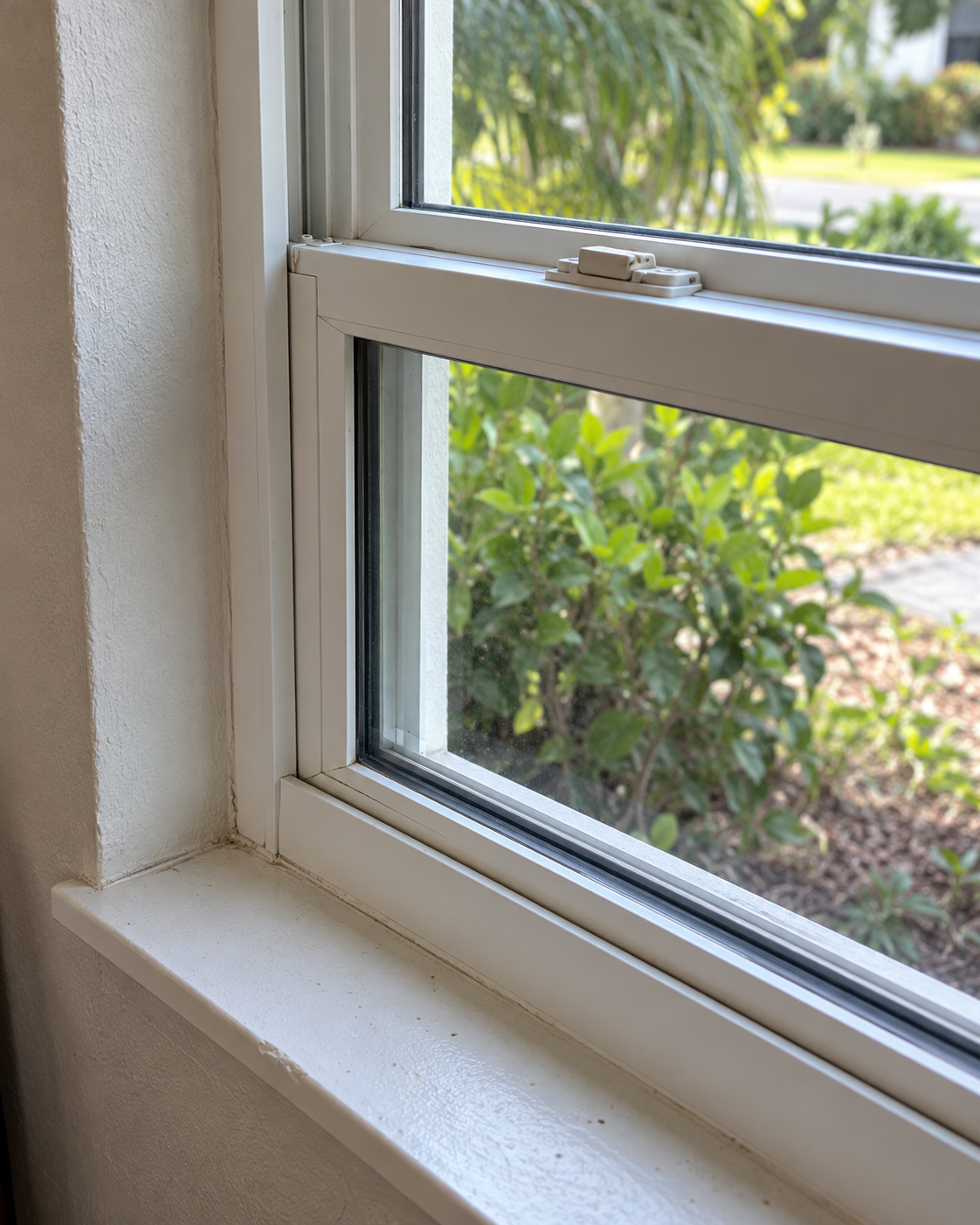
Before a storm, close the lower sash fully and engage the window’s supplied locks. Protection depends on the complete approved assembly and its installation, not just the style name.
The glass, frame, seals and installation all affect sound transmission. Ask for test data for the exact assembly if bedroom noise is a priority; a single-hung design alone does not establish a sound rating.
Choose the glass for the room’s sun exposure and daylight needs. Compare U-Factor and solar heat gain for the exact window; having one fixed sash does not by itself prove a lower energy bill.
Your insurer determines any applicable wind-mitigation credit. Keep permits, final records and the applicable Florida Product Approval or Miami-Dade NOA for the installed windows; ask your insurer which inspection records it needs.
Check that the lower sash closes smoothly and all supplied locks engage as designed. Follow the selected model’s operating instructions; do not force a sticking sash or assume every model uses the same hardware.
The better fit depends on the opening and how you want to use it. Compare movement and clearance first, then check each exact product’s approval and usable opening.
| Style | How it opens | Why consider it? | Check before choosing |
|---|---|---|---|
| Single hung | The lower sash lifts; the upper stays fixed. | Vertical operation without an outward swing. | Lifting effort, reach, clear opening and access to the outside glass. |
| Horizontal roller | One or more panels slide sideways. | A broad opening where side-to-side movement is convenient. | Panel configuration, track cleaning and the opening left when the panel moves. |
| Casement | A side-hinged sash swings outward. | An alternative worth comparing when operating the window by a handle suits the room. | Outside swing clearance, handle reach and exact clear-opening dimensions. |
No style is automatically the strongest, quietest or bedroom-compliant. Those comparisons require the actual product and installation details.
Looking for a window that stays closed to frame a view? Compare fixed picture impact windows alongside an operable window where ventilation is needed.
These signs deserve a closer look at the window and the surrounding opening. An inspection helps determine whether repair or replacement is the better approach.
A sash that sticks may have worn hardware, alignment issues or frame damage. Have the cause checked before deciding whether repair or replacement is the better approach.
Air movement near the meeting rail can indicate a sealing or fit problem. Inspect the sash, weatherstripping and surrounding opening so the proposed work addresses the cause.
Staining or soft material near the sill may indicate water entry. Check the window, drainage and surrounding wall; replacing the unit alone may not resolve every leak.
For an early single-hung replacement budget, the Florida program’s general impact-window benchmark provides a starting point: about $900–$1,750 per window. It is not a Single Hung or ES-model price list. Read the published general Florida window-cost benchmark.
The measured size, glass, finish, access and surrounding repairs determine your actual quote. Large or complex work can exceed this reference band. Read what drives impact-window costs in Florida.
Planning guidance, not a USAHI quote or a guaranteed price limit.
Get a price for your actual openings →Source: My Safe Florida Home’s published cost benchmark, dated July 2025, based on a 1,750-square-foot Florida home; checked October 2026. The source does not itemize installation, permits or repairs. Confirm those inclusions in your written quote.
Whether you replace one window or several, compare the full installation scope first. Financing may be available for qualified homeowners through independent third-party providers. Review financing options for current terms, eligibility and program availability.
Compare the windows and work included in your quote, then review the available payment options.
Ask how both sides of the glass are reached. Do not assume the sash tilts in or lifts out; follow the selected model’s care instructions and plan safe access for upper floors.
Keep the movement path clean using the manufacturer’s method. Have sticking, damaged seals or blocked drainage checked; avoid forcing the sash or covering drainage openings.
Check that the sash closes and all supplied locking hardware engages correctly. Keep the window closed and locked during storms; do not rely on a partially open position for protection.
Exact model, measured size, frame finish, glass package, screen and hardware where included.
Required pressures, applicable approval and any room-specific clear-opening requirement.
Removal, supporting-frame repairs, sealing, trim restoration, access and inspection coordination. See why impact-window installation details matter.
Product and workmanship warranty terms, care instructions and final project records.
For whole-home planning, return to our South Florida impact-window service. Use our impact-window buying checklist when comparing proposals.
Read your dedicated window guide, then discuss the actual address and proposed work with USAHI. Local requirements are part of planning the project.
These are the practical details to settle before the window goes on the order.
A single-hung window has one moving lower sash and a fixed upper sash. A double-hung window has two operable sashes. Tilt-in cleaning, opening limits and hardware depend on the model; do not assume those features from the style name.
No. The upper sash remains fixed, and the lower sash moves within the frame. Use the actual clear-opening dimensions when comparing ventilation or checking an escape-opening requirement.
They can be combined in an available approved configuration. Confirm the glass package for the exact model and size, then compare its energy ratings. An impact label alone does not establish Low-E glass or a particular energy performance. Compare Low-E, tint and other impact-window glass options.
Ask for the current approval covering the exact product, size, glass and installation. Confirm impact classification, required pressures and HVHZ suitability where applicable using the official Florida approval search.
A correctly fitted replacement provides a new operating assembly, but the surrounding opening still needs inspection. Ask whether the difficulty comes from hardware, alignment, frame damage or the wall so the work addresses the cause.