Skip to content

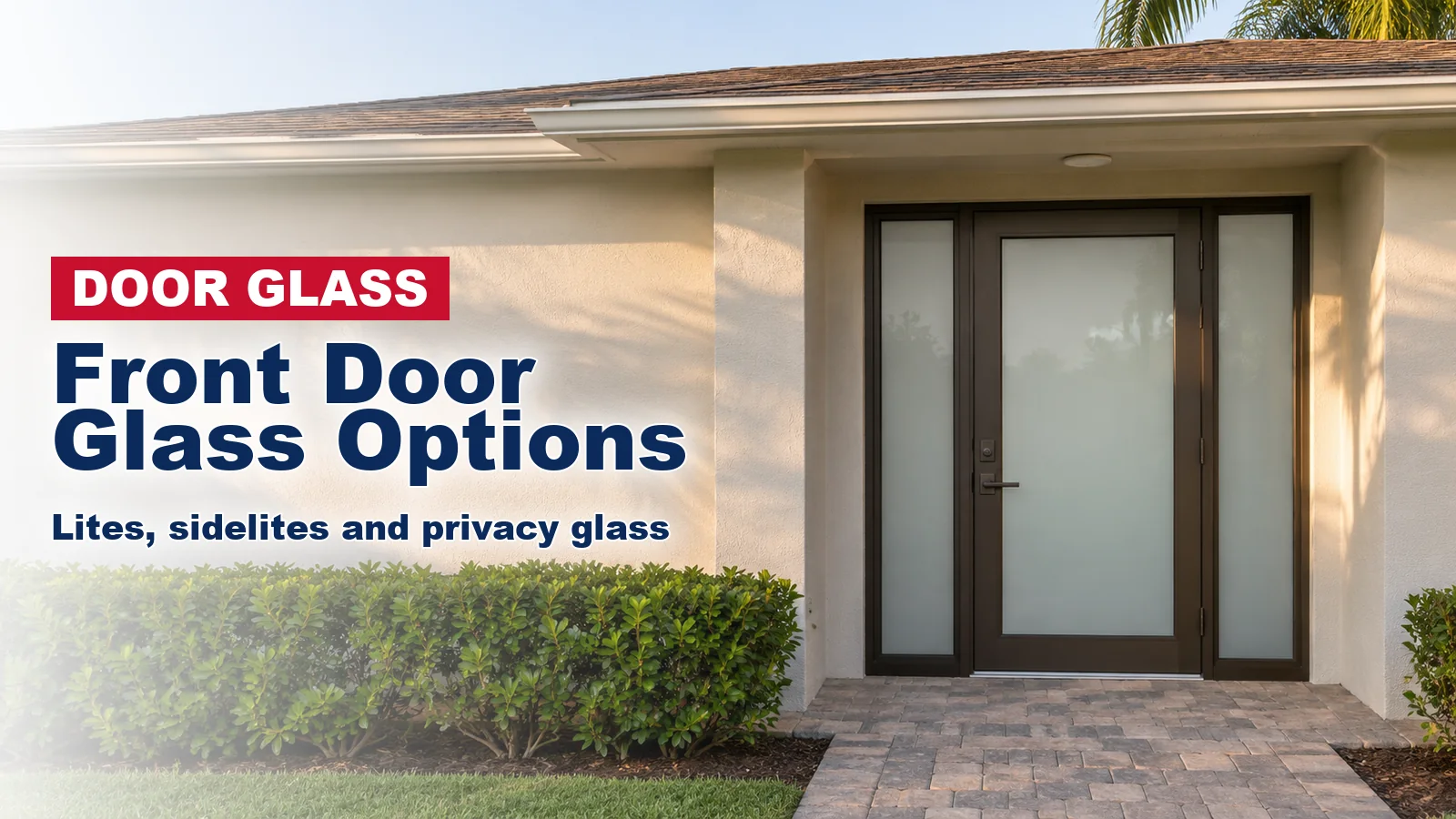
The main impact front door glass options are full-lite, 3/4-lite and half-lite doors, with or without sidelites and a transom, in clear, privacy or decorative glass. With impact glass there is one extra rule: the glass must be a type listed in the door’s product approval, because the door is tested as one assembly.
This guide explains each style, how much privacy it gives, what changes with laminated impact glass, and how to match the glass to your entry.
Front Door Glass Styles: Full-Lite, 3/4-Lite and Half-Lite
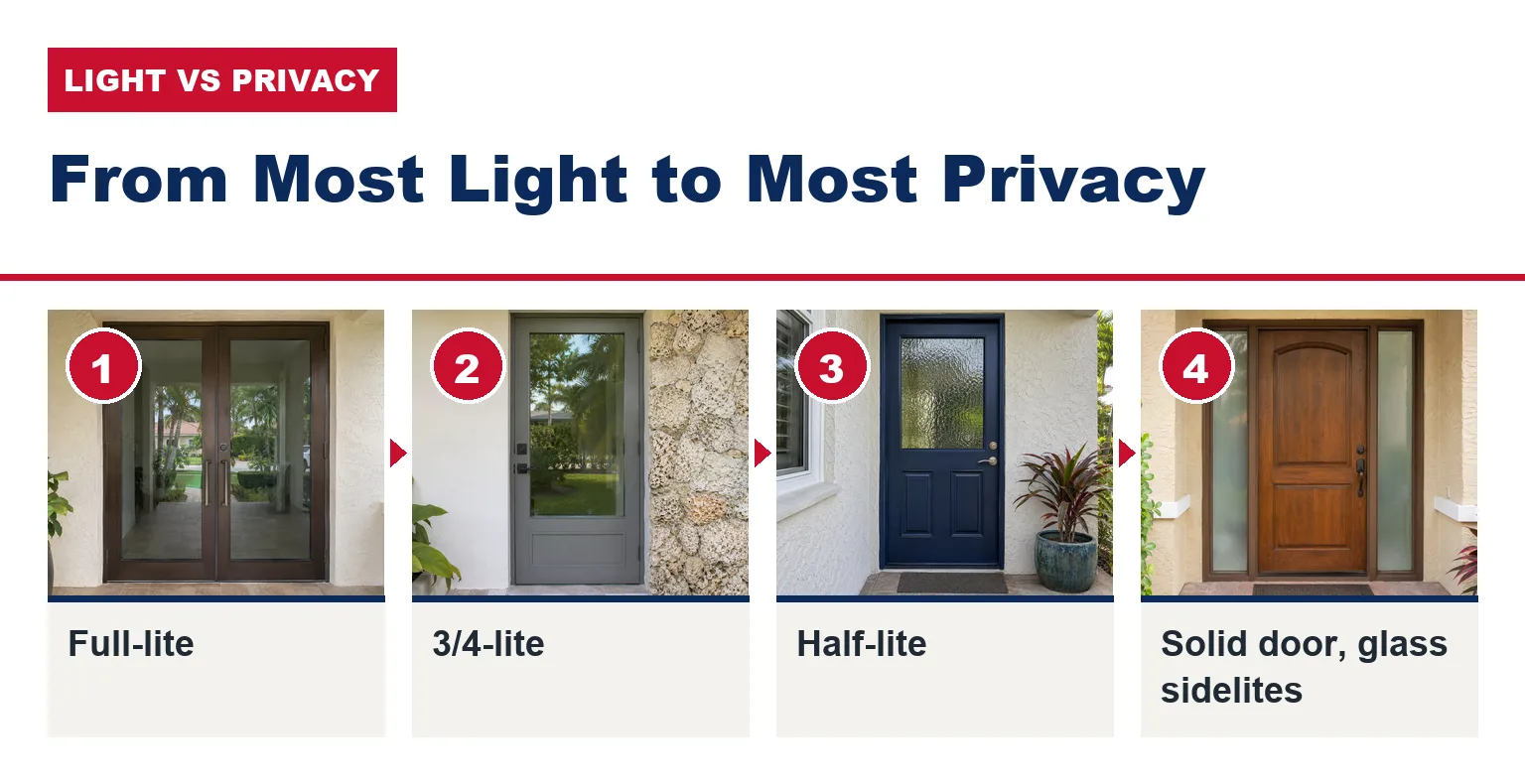
A “lite” is a pane of glass set in a door. Front door styles are named by how much of the door the glass covers, from top to bottom. More glass means more daylight in the entry and more view into the house.
| Style | Where the glass sits | Daylight | Privacy with clear glass |
|---|---|---|---|
| Full-lite | Nearly the full height of the door | Most | Lowest; pair with privacy glass on a street-facing entry |
| 3/4-lite | Upper three quarters, solid panel at the bottom | High | Low to medium |
| Half-lite | Upper half, solid panel below | Medium | Medium; the lower half stays closed |
| Quarter-lite or small lite | A small panel near the top | Low | Highest |
| Solid (opaque) | No glass in the door; light can come from sidelites or a transom | Only from sidelites or transom | Highest in the door itself |
Full-glass impact French doors for a double front entry sit at the full-lite end of this table. For the differences between French, sliding and pivot doors, see our overview of which impact door types fit your home.
What Changes When the Front Door Glass Is Impact Glass
Impact glass is laminated: layers of glass bonded to a plastic interlayer. A Miami-Dade approval for an impact door lists its approved interlayer, such as PVB, and the glass is tested and approved as part of the whole door, frame and hardware together.
The Florida Building Code, Residential, Section R301.2.1.2 says exterior glazed openings in wind-borne debris regions “shall be protected from windborne debris,” using tests such as ASTM E1996 and ASTM E1886 or TAS 201, 202 and 203. A glazed front door is a glazed opening, so its glass needs impact glass or a protective covering.
That approval is why your glass list is shorter than a regular door catalog. In one Miami-Dade Notice of Acceptance (NOA) for an outswing glazed door with sidelites, the county refers to design pressure ratings “for unit sizes Vs glass type.” Change the glass or the size, and the rating can change.
- The label tells you what was approved. FBC Residential Section R609.3 requires a label with the model or series, the positive and negative design pressure, the impact rating if applicable, and the Florida or Miami-Dade product approval number.
- Swapped parts need proof. Section R609.10 says door components can be substituted only if they meet the door standard or are evaluated and give equal or greater structural performance.
- Ask for the number. USA Home Improvement customers can receive the Florida Product Approval number for each window and door on request.
USA Home Improvement installs ES Windows impact doors for South Florida homes, and every project is permitted, so the building department reviews the approval. Learn how to tell whether a door is hurricane rated, and see when replacing a door needs a permit in Florida.
Sidelites and Transoms: More Light Around the Door
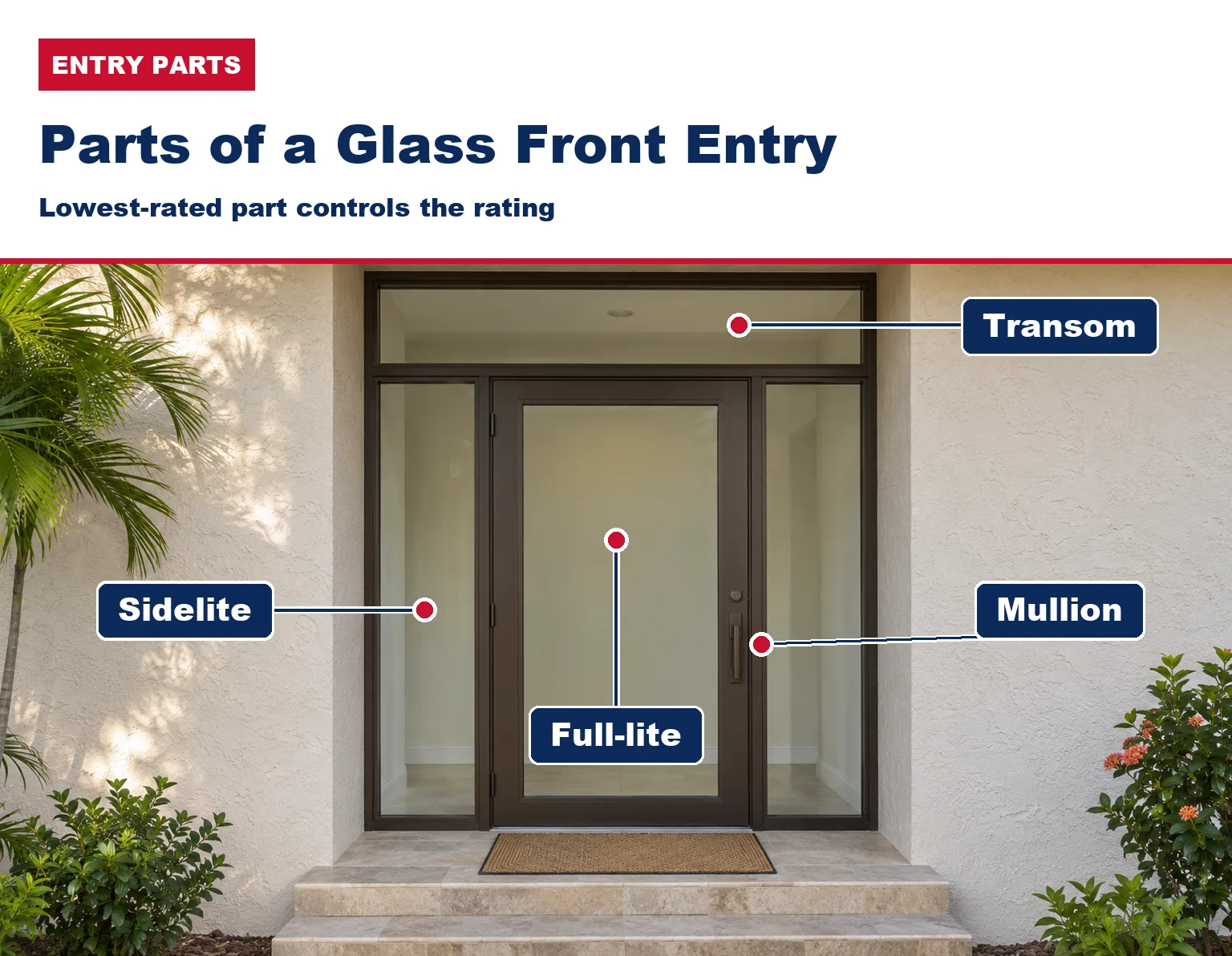
A sidelite is a tall, narrow glass panel beside the door; a transom is a glass panel above it. Both bring daylight into the entry without adding glass to the door itself, so a solid or half-lite door can still feel bright.
Sidelites are an option on our impact French doors.
With impact doors, the door, sidelites and transom are often joined by a mullion, the vertical or horizontal bar between units. The same Miami-Dade NOA says the lower design pressure of the door, sidelites or mullion “shall control when doors are mulled,” and it limits a transom to a maximum height.
Design pressure is the wind pressure, positive and negative, that a unit is rated to resist. Our guide to what design pressure means for windows and doors explains how to read it. Another NOA for inswing doors limits narrow-stile sidelites to 18 inches or less, so sidelite width can be capped too.
Sidelites near a door also count as a safety-glazing location. FBC Residential Section R308.4.2 covers glass within 24 inches of either side of a closed door when the bottom edge is less than 60 inches above the floor, with listed exceptions. Section R308.4.1 treats glass in the door itself the same way.
Picking between a full-lite door and a door with sidelites? Request a free impact door estimate or call (877) 554-6373, and ask to see which glass and sidelite sizes the approval lists for your opening.
Privacy Glass for a Front Door: Frosted, Textured, Rain and Tinted
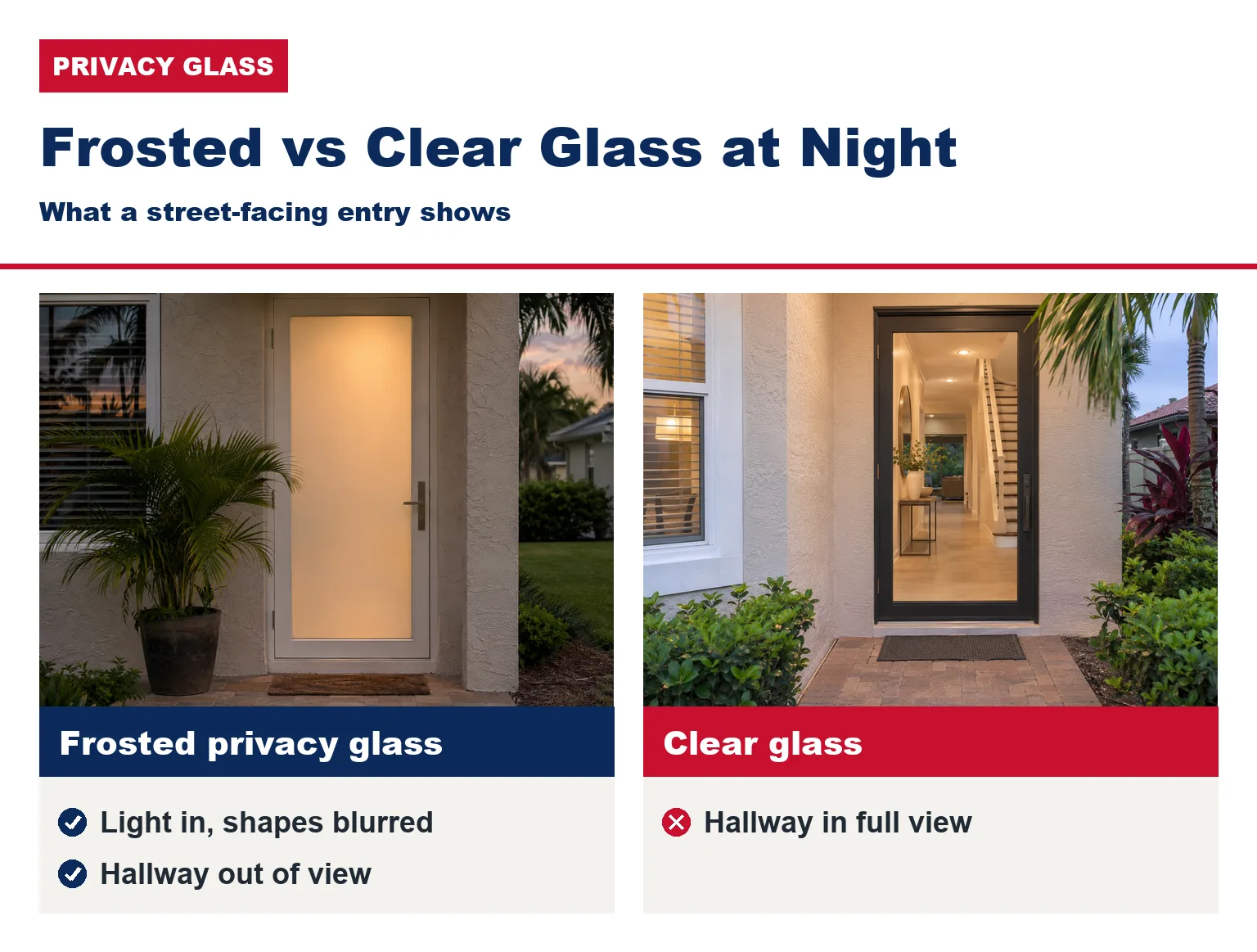
Privacy glass lets light into the entry while blurring the view of the hallway behind it. Door glass makers grade patterns by privacy level, so the same door can look open or closed depending on the glass. These are the common types:
- Frosted glass has a surface made cloudy by acid etching or sandblasting. Light passes through evenly, and shapes behind it blur.
- Textured or patterned glass has a pattern pressed into its surface. The pattern scatters the view; heavier textures hide more.
- Rain glass is a textured pattern with a look of running water. It suits a door that faces the street but still needs light.
- Tinted or gray glass darkens the view in daylight. A lit room shows through tint at night, so tint alone is daytime privacy.
Low-E glass is different: a thin coating that cuts heat, not a privacy finish. Our page on impact sliding doors with privacy glass options lists privacy and Low-E glass, and our impact glass guide covering Low-E, tint and turtle glass explains the coatings in depth.
Some door glass makers also build blinds between the glass panes for adjustable privacy. If you want that, ask whether the impact door you are considering lists it in its approval.
Near a sea turtle nesting beach, Florida rule 62B-33.005(13) calls for tinted glass or similar light control on windows and doors visible from the nesting areas, for projects that need a state coastal construction permit.
Decorative Glass and Grids on Impact Doors
Decorative glass on an impact door has to be a glass type the door’s approval lists. Code Section R301.2.1.2 covers all exterior glazed openings in wind-borne debris regions, so a beveled or patterned design still needs to be part of an impact-tested door.
Grids are the simpler way to add style. ES Windows lists Colonial, Brittany or full-view glazing styles and flat or OG grid options for its Elite line, which includes French and sliding glass doors. Our door pages list flat and ogee muntins, the bars that divide the glass into smaller panes.
Before you fall for a design, check that it exists in the series you are buying and that the grid style is approved for your door size. HOAs may also set style rules for front doors, so check yours before you order.
Privacy vs Light: Matching the Glass to Your Entry
The right front door glass depends on what the entry faces and what sits behind the door. Use the situation, not the catalog photo, to choose:
- Door faces the street or a sidewalk: a half-lite or 3/4-lite door, or full-lite with frosted or heavy textured glass, keeps the hallway out of view.
- Door opens straight into the living room: privacy glass in the door, clear glass only in a transom high above eye level.
- Dark foyer under a covered porch: full-lite or clear sidelites bring in the most daylight where privacy matters less.
- Entry faces strong afternoon sun: a smaller lite or a Low-E or tinted glass type, and compare the SHGC on the label.
- Home near a nesting beach: check your city and state turtle lighting rules before choosing clear glass.
How Door Glass Shows Up on the Energy Label
More glass changes a door’s energy numbers, and the label shows it. The National Fenestration Rating Council (NFRC) says a door’s rating is “based on its glass configuration.” Its label lists U-factor (lower keeps heat in better) and solar heat gain coefficient, or SHGC (lower resists solar heat).
ENERGY STAR also sorts doors by glass amount. To earn the label, a door with half-lite glass or less needs U-factor 0.23 or lower and SHGC 0.23 or lower. A door with more than half-lite glass in the Southern zone needs U-factor 0.28 or lower and SHGC 0.23 or lower.
So a full-lite and a half-lite version of the same door can carry different ratings. Compare the label for the exact glass and size you are ordering, not the brochure number for the series.
Impact Front Door Glass FAQs
Can I replace just the glass in my impact front door?
Only with glass that matches what the door’s approval lists. The glass is part of the tested assembly, and FBC Residential Section R609.10 lets door components be swapped only if they meet the door standard or are evaluated to give equal or greater structural performance.
Ask the door’s manufacturer or your installer, and check with your building department before changing it.
Does a front door with glass have to be impact rated in Florida?
In a wind-borne debris region, the glass in a front door must be protected, either by impact-rated glass or by an approved covering such as shutters, under FBC Residential Section R301.2.1.2. See where Florida requires impact windows and doors to check your area.
Do sidelites need safety glass?
Often, yes. FBC Residential Section R308.4.2 treats glass within 24 inches of a closed door as a hazardous location when its bottom edge is less than 60 inches above the floor, unless an exception applies. Ask your installer to confirm the door and sidelite glass meet both the impact rule and the safety-glazing rule.
Is a glass front door easy to break into?
Impact door glass is laminated, with a plastic interlayer bonded between the glass layers. Miami-Dade approvals for impact doors can list a forced entry test among the tests submitted for the door.
Ask to see the approval for the exact door in your quote, and pair the glass with a good lock.
How much does an impact front door with glass cost?
Your price depends on the door size, the number of sidelites and transoms, the product series and the glass you choose. Each glass package is priced on its own, so ask to compare two options at your estimate. Our page on impact front door pricing covers price factors.
Can I add privacy glass later?
Plan privacy at the order stage. Impact door glass is part of an approved assembly, so a later swap must use a glass type the approval lists. If you are thinking of adding a film to the glass, ask the door’s manufacturer first whether it is allowed.
Choose the Door Style First, Then the Glass the Approval Allows
Start with how much light and privacy your entry needs, pick the lite size and any sidelites, then choose the glass from the list your door’s approval allows. Ask to see the label details for the exact size before you sign.
Our South Florida impact door buying guide covers the rest of the decision.
Compare financing options for an impact door project. Financing may be available for qualified homeowners through independent third-party providers. Terms, eligibility and availability depend on the program and location.
USA Home Improvement is licensed (CGC1526707) and insured and has served Florida homeowners for more than 15 years. We sell ES Windows exclusively, and our installation team holds direct certification from the manufacturer.
Get a free estimate or call (877) 554-6373.