 Skip to content

Hurricane window film, tape and ordinary storm windows do not make regular glass approved opening protection in Florida. The Florida Building Code asks for impact-rated glass or a tested, approved covering on every glazed opening in the wind-borne debris region. The state wind mitigation form saves its top ratings for verified products.
This guide compares hurricane window film vs impact windows and the other cheap fixes, shows what the code and the insurance form accept, and explains how to check any product before you pay.
What Florida Counts as Approved Opening Protection
Florida counts impact-resistant glass or an approved impact-resistant covering, such as a tested shutter, as opening protection. Section R301.2.1.2 of the Florida Building Code, Residential says exterior glazed openings in wind-borne debris regions “shall be protected from windborne debris.”
That protection must pass the large missile test of ASTM E1996 and ASTM E1886, or TAS 201, 202 and 203, or AAMA 506, as applicable. Glass in garage doors follows an approved impact standard or ANSI/DASMA 115.
The same section allows precut plywood panels as an exception, within limits on building height and wind speed. Plywood is a stopgap you put up before each storm.
The wind-borne debris region covers areas with a design wind speed of 140 mph or more, and areas within 1 mile of the coast at 130 mph or more. Palm Beach County classifies the whole county as wind-borne debris region. Miami-Dade and Broward sit in the stricter High-Velocity Hurricane Zone (HVHZ).
The large missile is a 9-pound 2×4 fired at 50 feet per second, and the code applies it to glass within 30 feet of the ground. Our explainer on how strong hurricane impact windows really are walks through each test.
Every product also needs an approval: a Florida Product Approval number, searchable through the Florida Building Commission product approval search, or a Miami-Dade Notice of Acceptance (NOA).
For ratings and county rules in more depth, see our ultimate guide to impact windows in South Florida, or browse the ES Windows impact windows we install.
Hurricane Window Film vs Impact Windows and Other Fixes Compared
Approved impact windows and approved shutters meet the large missile requirement; film systems and storm windows count only if that exact product carries a large missile approval. The table compares the common options on the questions that decide whether they count.
| Option | Stops the glass from breaking? | Meets the large missile test? | Best wind mitigation form result | Storm prep |
|---|---|---|---|---|
| Masking or duct tape | No | No | Not listed as protection | Tape every pane |
| Window film alone | No, it holds pieces after a break | No | Not Level A, B or C (the form has no row for film) | None |
| Film with an attachment system | No; the attachment seals the film to the frame | Only if that exact system is approved for it | Depends on the verified approval | None |
| Storm windows | Not designed to | Only if approved as impact-rated | Depends on the verified approval | Close or install |
| Approved hurricane shutters | Yes, debris hits the shutter | Yes, when installed per the approval | Level A or B when verified | Close or put up |
| Impact windows | Glass can crack but is built to stay in the frame | Yes, when approved | Level A or B when verified | None |
Film and storm windows look like a cheaper shortcut, but the original glass, frame and anchors stay the same. Weighing shutters against impact glass instead? Our comparison of impact-resistant windows versus hurricane shutters covers that choice.
What Hurricane Window Film Does and Does Not Do
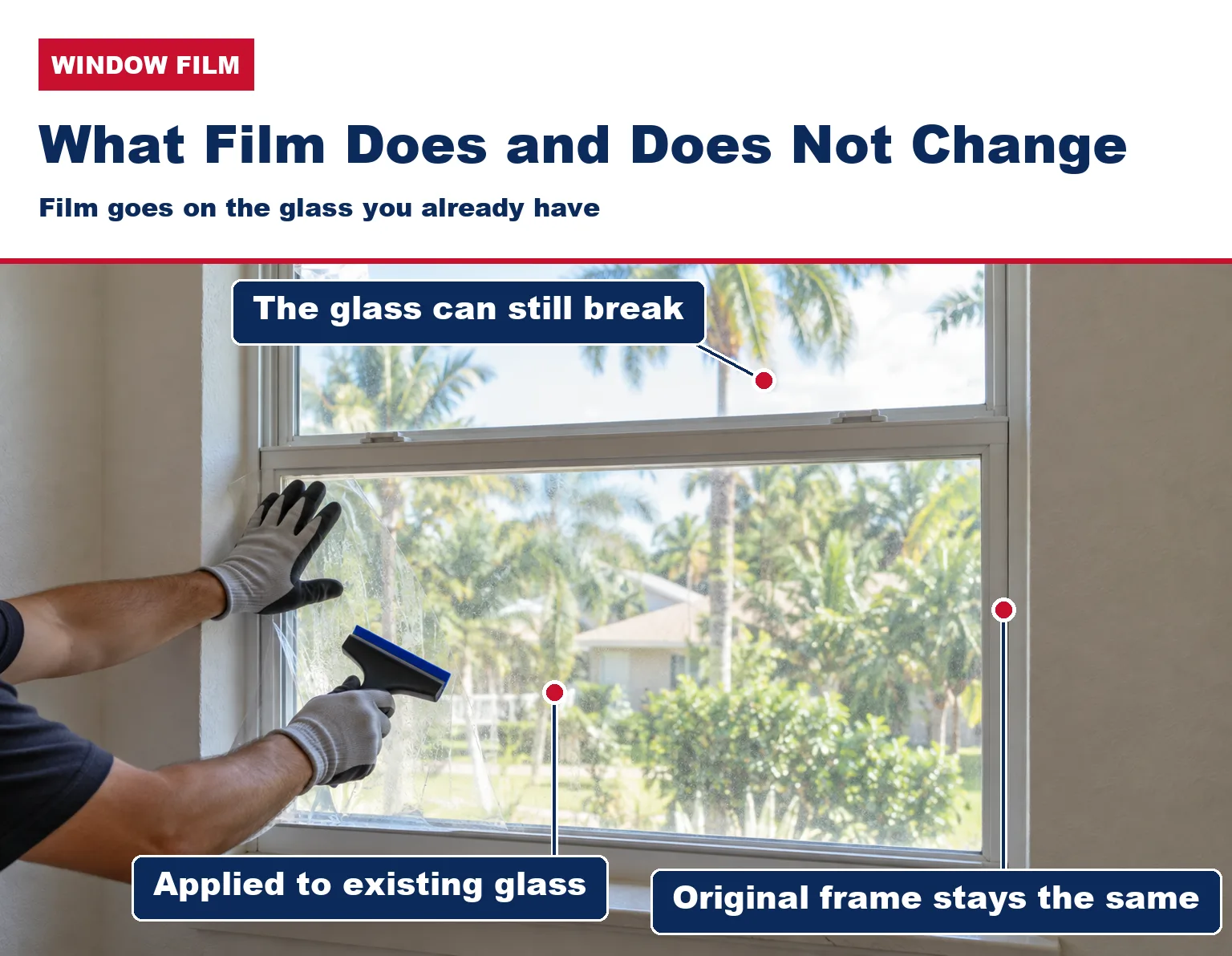
Hurricane window film is a clear safety film applied to existing glass. It is designed to hold the pieces together after the glass breaks, so the glass can still break. The International Window Film Association (IWFA), the film industry’s own trade group, says film can reduce the hazard from flying glass shards.
The same IWFA article on window film and hurricanes is clear about the limits: “No applied film can make a standard window ‘hurricane proof.'” It adds that film does not remove the risk of glass breakage, frame failure, water intrusion or structural damage.
Code officials have said the same thing. In a 2005 press release from Palm Beach County’s Building Code Advisory Board, the board wrote that window film “does not qualify under the Florida Building Code as approved hurricane protection for single-family dwelling units.”
Some film systems come with an attachment system that seals the film to the frame. One such system holds a Miami-Dade NOA, but its approval rates it “Small Missile Impact Resistant.”
That is not enough for most homes. The code requires the large missile test for glass within 30 feet of the ground, which includes the first and second floors of a typical house.
What film can do:
- Hold glass fragments together after the glass breaks.
- Make easy entry through a window harder, which the IWFA lists as a use for security films.
What film alone cannot do:
- Stop the glass from breaking.
- Strengthen the frame or the anchors that hold the window in the wall.
- Meet the code’s large missile requirement on its own.
- Reach Level A or B on the wind mitigation form.
Why Taping Windows Does Not Protect Them
Taping windows does nothing to stop a hurricane from breaking the glass. A NOAA Hurricane Research Division paper on effective shutters calls tape “the most worthless type of protection” for windows.
The NOAA paper says taping does little or nothing to prevent breakage, may result in larger and more dangerous pieces of flying glass, and is extremely difficult to remove after the storm.
If a storm is close and you have no approved protection, plywood fastened to the wall is the emergency fallback. Our guide on how to protect your windows during a hurricane lists every option and what to do before the storm.
Storm Windows: When They Count and When They Do Not
A storm window is a second window mounted over or behind your existing one. Many are sold to cut drafts and keep out weather, and a storm window does not count as opening protection unless that exact product is approved as impact-resistant.
Impact-rated storm windows do exist. The same NOAA paper lists a “new type of impact-resistant storm window” among the options homeowners were using.
Treat a storm window like any other product: ask for its Florida Product Approval or NOA, and check that it covers the large missile test, your opening size and, in Miami-Dade or Broward, use in the HVHZ.
If you inherited storm windows or film with a house, our guide explains how to check the labels and papers that prove a hurricane rating.
What the OIR-B1-1802 Wind Mitigation Form Gives Credit For
The wind mitigation form, OIR-B1-1802, rates your home by the weakest form of wind-borne debris protection on any opening. Section 9 of the current revision (Rev. 04/26), published by the Florida Office of Insurance Regulation, covers windows, entry doors, sliding glass doors, skylights, glass block and garage doors.
Levels A and B require products listed in the Florida or Miami-Dade product approval system that pass cyclic pressure and large missile tests. The levels in plain English:
- Level A: verified cyclic pressure and 9-pound large missile (4.5 pounds for skylights), tested to TAS 201, 202 and 203, ASTM E1886 and E1996, SSTD 12, or ANSI/DASMA 115 for garage doors.
- Level B: verified cyclic pressure and a 4 to 8 pound large missile.
- Level C: verified plywood or OSB meeting Table 1609.1.2 of the 2007 Florida Building Code.
- Level N: products that appear to be A or B but are not verified, and other protective coverings that cannot be identified as A, B or C.
- Level X: no wind-borne debris protection.
- Level Z: damaged openings in need of repair or replacement.
Film alone, tape and storm windows without a large missile approval cannot reach Level A or B.
The form rates the house by its weakest opening, so one filmed window, or an old garage door, can lower the result. That is why impact-rated garage doors for South Florida homes belong in the same plan as the windows.
Homes with openings that need replacement do not qualify for wind mitigation rate differentials, and the form stays valid for up to five years if the structure does not change. Each insurer sets its own credit, so see which home upgrades can lower your insurance rates for how the credits work.
Honest Pros and Cons: Cheap Fixes vs Impact Windows
Film, tape and storm windows cost less upfront than impact windows. Prices vary by product, opening size and installer, so compare written quotes that name the exact product and its approval number.
- Cheap fixes, pro: lower upfront cost, and film goes on existing glass with no new frames.
- Cheap fixes, con: not code opening protection, no Level A or B, and the original glass, frame and anchors remain the weak point.
- Impact windows, pro: always in place with no storm prep, and approved products count for the code and can reach Level A or B when verified.
- Impact windows, con: higher upfront cost, a permit for every job, and no protection against flooding or storm surge.
- Impact windows, lead time: at USA Home Improvement, manufacturing takes about 6 to 8 weeks depending on project scope, and a job takes about 3 months start to finish, though it can vary.
If cost is the barrier, financing options for impact window projects may be available for qualified homeowners through independent third-party providers. Terms and eligibility depend on the program and location.
How to Check Any Product Before You Pay
Check the approval, not the sales pitch. These five steps work for impact windows, shutters, film systems and storm windows.
- Ask for the FL or NOA number: get the Florida Product Approval number or Miami-Dade NOA for the exact product, not just the brand.
- Look it up and check expiry: search floridabuilding.org or the Miami-Dade product approval search, and check the expiration date. Miami-Dade approvals are valid for five years.
- Confirm large missile rating: glass within 30 feet of the ground needs the large missile test, not only the small missile test.
- Match size, pressure and zone: the approval must cover your opening size, the design pressure your opening needs, and use in the HVHZ, which Miami-Dade and Broward require.
- Permit it and keep the papers: make sure the job is permitted, and keep the approval numbers for your wind mitigation inspector.
USA Home Improvement exclusively sells ES Windows impact windows and impact doors, and every USA Home Improvement project is permitted. Customers can receive the Florida Product Approval number for each window and door on request, and our installation team holds direct certification from the manufacturer.
Hurricane Window Film and Impact Window FAQs
Does hurricane window film lower homeowners insurance in Florida?
Each insurer sets its own credits, but film alone cannot reach Level A or B, the levels the wind mitigation form ties to its “Hurricane” factor. If a seller promises a discount for film, ask your insurer in writing before you buy.
Can a receipt prove my windows are protected?
Not on its own. A receipt helps when it names the exact product and its approval number for each opening, but the inspector still verifies the product. Products that look rated but lack documentation fall to Level N, so keep approval numbers, permits and labels.
Is tape better than nothing if a storm is a day away?
No. NOAA research says tape does little or nothing to prevent breakage and can make the glass pieces larger. Put up plywood fastened to the wall instead; our step-by-step guide shows how to install plywood over windows for a hurricane.
Do impact windows protect against flooding or storm surge?
No. Impact windows are tested for wind-borne debris and wind pressure, not for floodwater or storm surge. In a flood or evacuation zone, plan flood protection separately and follow evacuation orders.
Choose Protection That Counts Before the Next Storm
If you want protection that satisfies both the code and the wind mitigation form, choose approved impact windows and doors or approved shutters for every opening. Use film only as an add-on for shard control, and skip the tape.
USA Home Improvement is licensed (CGC1526707) and insured and has served Florida homeowners for more than 15 years.
Get a free estimate or call (877) 554-6373.