Skip to content


Home improvement 101 in Florida comes down to seven steps before any work starts: a written budget, a permit check, a license check on the state DBPR website, proof of insurance, the right project order, a written contract, and lien protection so you never pay twice.
This guide walks through each step in plain terms, with the Florida laws behind them, so you can plan a first project before you sign anything or pay a deposit.
Step 1: Set a Written Budget Before You Call Anyone
A home improvement budget starts with a written list of what you want done and the most you are willing to spend. Writing it down first keeps a sales visit from setting your budget for you.
Get written estimates from at least two licensed contractors for the same scope, and compare them line by line: products, permit fees, removal of old materials and cleanup. Keep a reserve for surprises, such as damaged framing found once old windows or roofing come off.
Watch the deposit. Under section 489.126 of the Florida Statutes, a contractor who takes an initial payment of more than 10 percent of the contract price on a home project must apply for permits within 30 days and start work within 90 days after the permits are issued.
Those deadlines do not apply when the contractor has just cause, or when you agreed in writing to a longer period. Read any deposit terms before you sign.
If a contractor misses these deadlines, Florida law has you send a written demand by certified mail, return receipt requested, to the address in the contract, asking the contractor to apply for permits, start the work or refund the payment.
If you will not pay cash, financing may be available for qualified homeowners through independent third-party providers. Terms, eligibility and availability depend on the program and location.
Our guide to ways to finance a home improvement project compares the options, and you can review financing options for qualified homeowners before your estimate.
Step 2: Find Out Whether Your Project Needs a Permit
Many Florida home projects need a building permit. Section 553.79 of the Florida Statutes makes it unlawful, unless the law provides otherwise, to construct, alter, modify or repair a building without first getting a permit from the local enforcing agency, which is your city or county building department.
Your building department decides which jobs need a permit, so call it or check its website before work starts. Every USA Home Improvement project is permitted, including ES impact windows for Florida homes and impact doors.
If you live in a community with a homeowners association, check its rules as well. HOA approval is needed only when the property has an HOA, but when it applies, get it before the work is scheduled.
You can pull a permit yourself as an owner-builder, but read the rules first. Under section 489.103(7), the exemption covers a one-family or two-family home for your own use or occupancy, not offered for sale or lease.
You must sign the permit application yourself and directly supervise all work not done by licensed contractors. If you sell or lease the home within 1 year after the work is complete, the law presumes the work was done for sale.
The owner-builder disclosure you sign says you are the responsible party of record on the permit and may be held liable for injuries to unlicensed workers on your property. For most first projects, a licensed contractor who pulls the permit is the safer choice.
Step 3: Check the Contractor’s License on the DBPR Website
Check every contractor’s license on the Florida Department of Business and Professional Regulation (DBPR) website before you sign. It takes a few minutes and is one of the simplest ways to avoid an unlicensed contractor.
- Find the license number. Under section 489.119(5)(b), a contractor’s registration or certification number must appear on each offer of services, bid, contract and advertisement.
- Search it on the DBPR license search.
- Match the name. The license holder, or the business it qualifies, should match the company on your estimate. If they differ, ask the contractor to explain.
- Check the status. Look for a current, active license, and note any listed discipline.
The results show whether a contractor is certified or registered. A certified contractor may work anywhere in Florida, while a registered contractor may contract only in the local areas where that registration applies, according to section 489.105.
Licensing also protects your contract. Section 489.128 says contracts entered into by an unlicensed contractor are unenforceable in law or in equity by the unlicensed contractor. For window and door work, our guide to choosing an impact window company in South Florida lists more questions to ask.
Step 4: Ask for Certificates of Insurance Before Work Starts
Ask every contractor for certificates of insurance before work starts, and keep copies with your contract. A certificate shows the insurer, the policy dates and the type of coverage.
- General liability insurance: covers damage the contractor’s work may cause to your home or property.
- Workers’ compensation: covers workers hurt on your property. Florida’s workers’ compensation law reaches construction employers with one or more employees, under section 440.02(20)(b)2.
Check that the policy dates cover your project and that the name matches the licensed business. The Florida Division of Workers’ Compensation keeps a public Proof of Coverage search where you can look up a business by name.
If a contractor says workers are exempt, ask for the exemption in writing and check it with the Division. When in doubt, call the insurer listed on the certificate.
Step 5: Put Your Projects in the Right Order
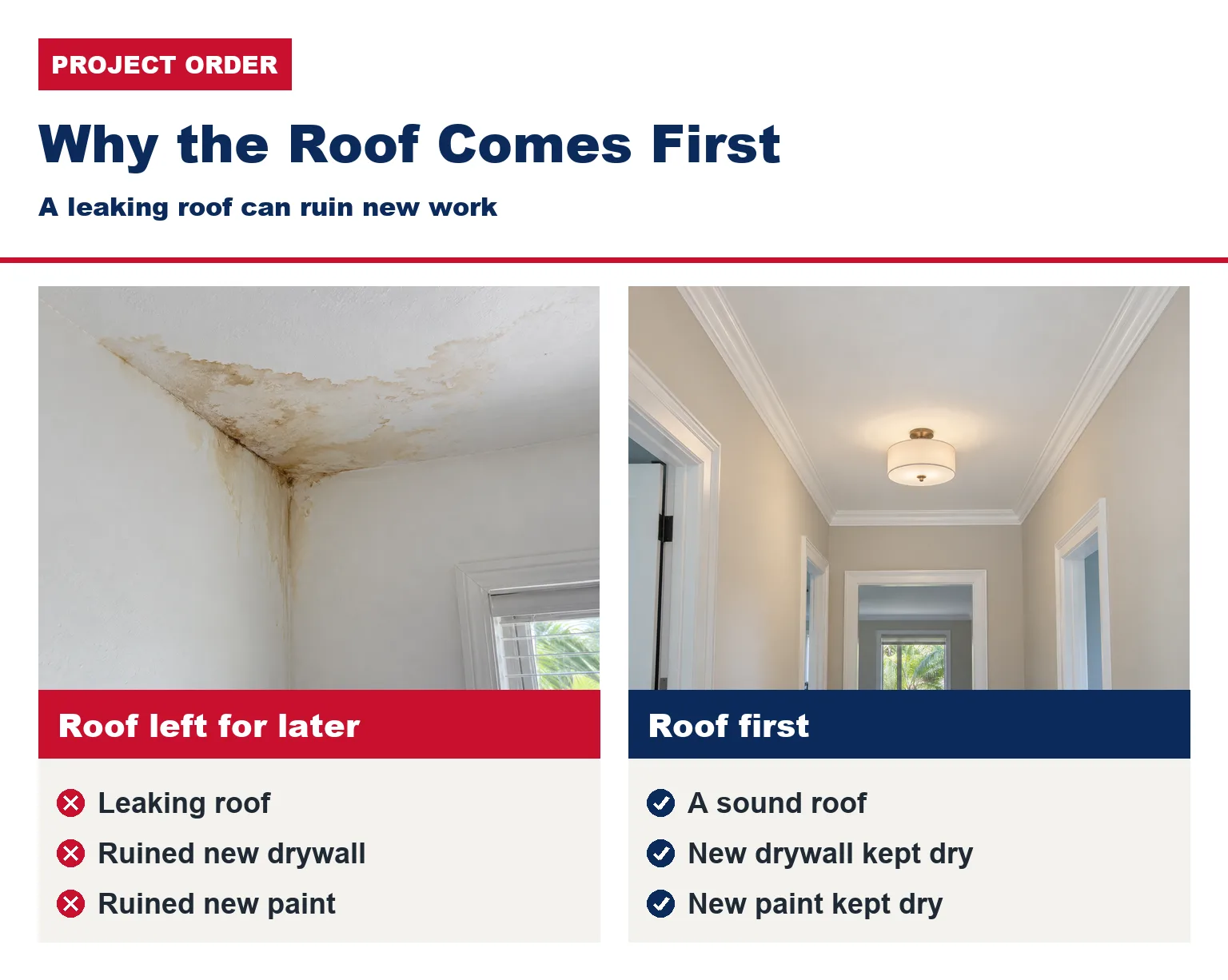
Do Florida home projects from the top down and the outside in: roof first, then windows and doors, then insulation and interior finishes. Each step protects the work that comes after it from water and wind.

Walk through the whole house before you choose. A cutaway like the one above shows how many systems a home has, and they do not all come from one contractor. List each one with its age and condition.
- Roof first. A leaking roof can ruin new insulation, drywall and paint, while a sound roof keeps them dry. Start with roof repair or replacement for South Florida homes if your roof is old or leaking.
- Windows and doors next. Openings let in wind, rain and heat. Our South Florida impact windows guide for homeowners explains the choices.
- Insulation after the shell is sealed. Attic insulation for Florida homes works best once the roof is sound.
- Paint and finishes last. Interior work comes after anything that could damage it.
Timing matters too. The National Hurricane Center says the Atlantic hurricane season runs from June 1 to November 30, so plan storm projects early.
Impact windows are made to order. At USA Home Improvement, manufacturing takes about 6 to 8 weeks depending on project scope, installation averages 1 to 2 days, and the whole process takes about 3 months start to finish, though it can vary.
To decide which projects matter most, see which Florida home projects to do first, and for lower cooling bills, our list of energy upgrades that suit Florida homes.
Step 6: Sign a Written Contract With Florida’s Required Notices
Never start a home project on a handshake. A written contract sets out what you are buying, what it costs and when you pay, and Florida law requires certain notices in most residential contracts.
Check that your contract includes:
- The contractor’s name, address and license number
- The full scope of work, with product names, sizes and the number of openings or squares
- Who pulls the permit and who arranges the inspections
- A payment schedule tied to finished stages of work, with final payment after the final inspection
- Start and finish expectations and how changes are approved in writing
- Warranty terms in writing
- The Florida Construction Lien Law disclosure
- The Florida Homeowners’ Construction Recovery Fund notice
The lien law disclosure comes from section 713.015. It applies to direct contracts greater than $2,500 for homes of up to four units, and must be printed in capitalized, boldfaced type on the first page of the contract or on a separate page, signed and dated by you.
That disclosure warns that unpaid workers and suppliers may have a claim against your property even if you have already paid your contractor in full. It recommends consulting an attorney if you have questions.
The recovery fund notice comes from section 489.1425, for contracts above $2,500. It explains that payment, up to a limited amount, may be available if you lose money because of specified violations of Florida law by a licensed contractor.
For impact windows and doors, ask for the Florida Product Approval number of each product. USA Home Improvement customers can receive that number for each window and door on request. Our guide on what happens during an impact window installation shows the steps after you sign.
Step 7: Use the Notice of Commencement and Lien Releases So You Don’t Pay Twice
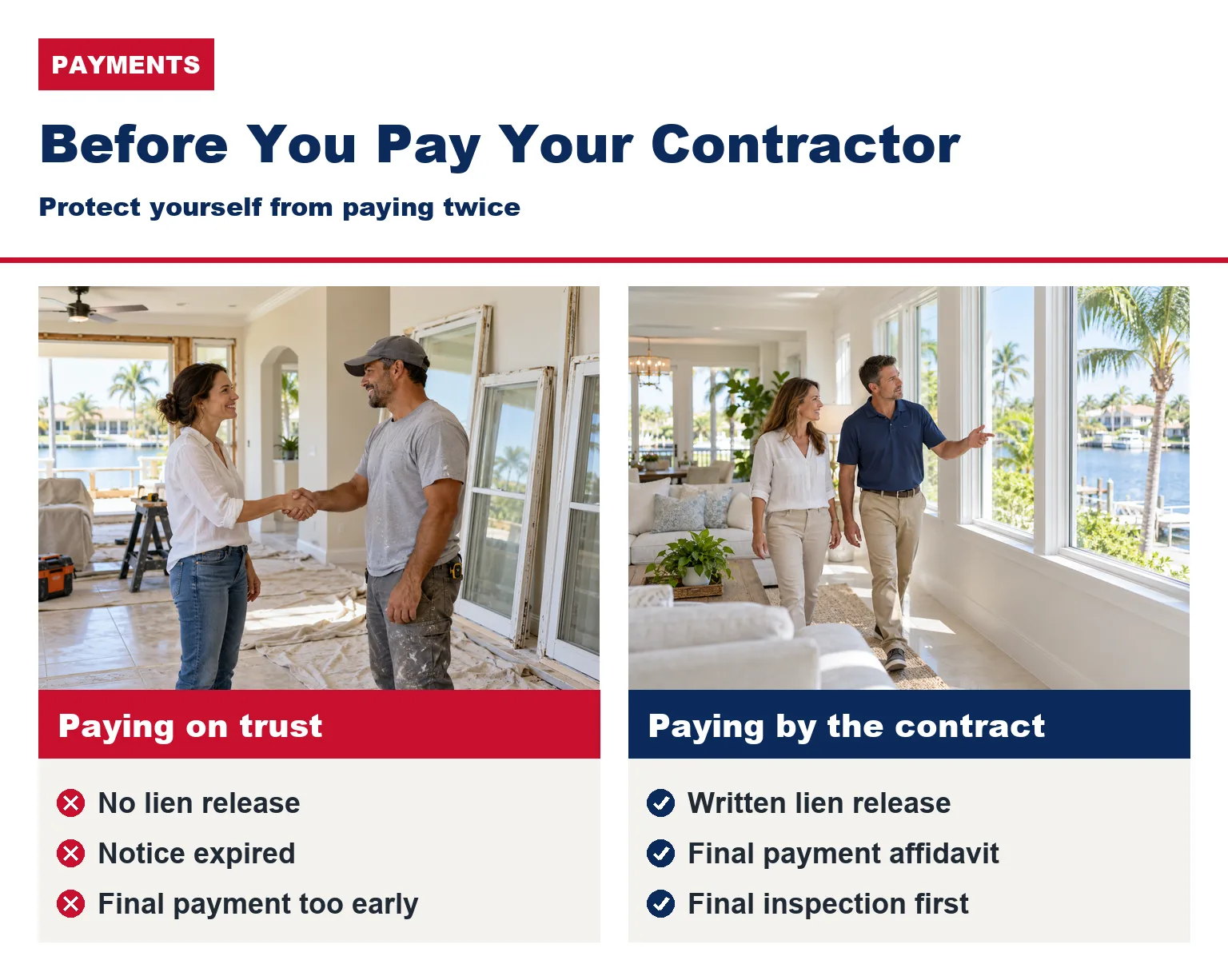
A Notice of Commencement is the Florida lien-law form that protects you from paying twice. Under section 713.13, the owner or the owner’s authorized agent records it with the county clerk before work begins, and posts a certified copy or a notarized statement at the job site.
This applies when the direct contract price is more than $2,500. Jobs of $2,500 or less are exempt under section 713.02(5).
The timing rules are strict:
- Before the first inspection: the notice must be recorded and posted at the site. For a direct contract greater than $5,000, a copy is also filed with the permit office, under section 713.135 (the limit is $15,000 for repairing or replacing an existing air-conditioning system).
- Within 90 days: if work does not actually begin within 90 days after recording, the notice is void.
- After 1 year: the notice expires 1 year after recording unless it states a different date. Payments made after it expires are improper payments that can result in paying twice.
Ask your contractor who prepares the form, but remember the law puts this duty on the owner or the owner’s authorized agent, so agree in writing who records it.
If you are financing the project, the state form says to consult your lender or an attorney before work begins or the notice is recorded.
Next, watch for a Notice to Owner. Subcontractors and suppliers send it to tell you they are working on your project.
Under section 713.06, when a payment comes due (other than the final one), the owner must pay, or make sure the contractor pays, the sum then due to each lienor who sent a notice before that payment.
Before each payment, ask for a written lien release from everyone who sent you a Notice to Owner. Before the final payment, get the contractor’s final payment affidavit, which states that those lienors have been paid in full or lists who has not been paid.
Home Improvement 101 FAQs
Do I need a permit to replace windows in Florida?
Ask your building department, because it decides which jobs need a permit. Florida law makes it unlawful to alter or repair a building without a permit where one is required. Every USA Home Improvement window and door project is permitted, and we handle the permit for you.
Can I act as my own contractor in Florida?
Yes, as an owner-builder, if you are improving a one-family or two-family home for your own use, not for sale or lease, and you directly supervise all work not done by licensed contractors. Condo owners should ask their building department first. You become the responsible party on the permit.
How much deposit can a contractor ask for in Florida?
Florida law sets no single deposit cap. If a contractor takes more than 10 percent of the contract price up front, it must apply for permits within 30 days and start work within 90 days after permits are issued, unless it has just cause or you agreed in writing to a longer period.
Your Next Step: Make the List, Then Get Two Licensed Estimates
Write down what you want done, set your top budget, and call two licensed contractors for written estimates. Check each license and insurance certificate before you sign, and keep every lien release in one folder until the job is paid.
USA Home Improvement is licensed (CGC1526707) and insured and has served Florida homeowners for more than 15 years. We handle the permits and coordinate HOA approval, and our installation team holds direct certification from the manufacturer.
Call (877) 554-6373 or request your free, no-obligation estimate for impact windows, impact doors or roofing.