Skip to content

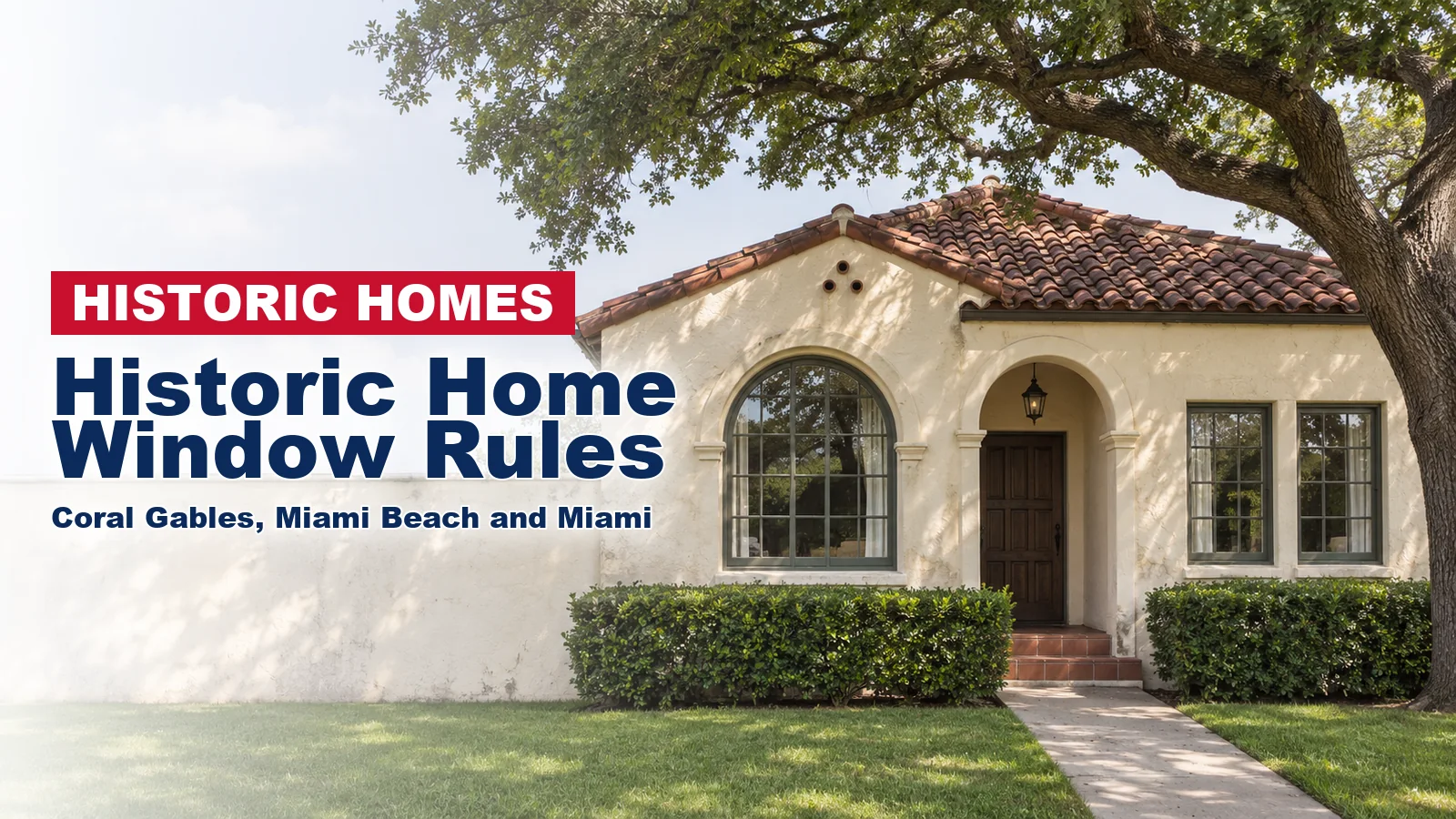
You can replace the windows on a designated historic home in Coral Gables, Miami Beach or Miami, and impact windows built for South Florida storms can be part of the plan. You also need the city’s historic approval, a Certificate of Appropriateness, to get the window permit.
Reviewers mainly check that the new windows keep the building’s original look: the opening size, the muntin pattern, the frame profile and the glass. This guide explains how to check your home’s status, who approves the work in each city, and the order to do things in.
Is Your Home Historic? Local Designation vs the National Register
Your home needs historic review for windows when the city has designated it, either on its own or as part of a local historic district. That local designation is what brings in the Certificate of Appropriateness, often shortened to COA.
A National Register listing alone works differently. The National Park Service’s National Register FAQ says listing places no federal restrictions on a private owner, unless the project uses federal funding or federal permits. Local rules are where window review comes from.
Each city gives you a way to check an address:
- Coral Gables: the Historical Resources and Cultural Arts Department links a map of historic districts and properties and publishes the list of locally designated properties.
- Miami Beach: the city says it has 14 local historic districts. Its Historic Property Viewer shows whether a building is contributing or non-contributing, and both kinds are reviewed.
- Miami: the city’s steps to determine a historic property use its zoning map; a property highlighted in orange or purple on the historic layers is designated.
If the result is unclear, ask the city’s historic preservation office before you order windows.
Who Approves Historic Window Replacement in Coral Gables, Miami Beach and Miami
All three cities require a Certificate of Appropriateness for window replacement on a designated property, but the reviewer and the extra steps differ.
| City | Who reviews a window replacement | Extra steps the city lists | Fast permit programs |
|---|---|---|---|
| Coral Gables | Historic Preservation staff for minor work; the Historic Preservation Board for substantial changes | Board of Architects recommendation before the COA application; “Final Historical” inspection | Same Day Permit Program excludes historic properties |
| Miami Beach | Planning Department staff, if the work meets the COA criteria; changes may go to the Historic Preservation Board | Original microfilm drawings; green informational posting before the permit is issued; Planning Final inspection | Walkthrough Plan Review takes window permits, but not work under a board order such as an HPB order |
| Miami | Staff for a Standard COA; the Historic and Environmental Preservation Board (HEPB) for a Special COA | Window and door schedule, existing and proposed dimensions, profile section, manufacturer brochure | Homeowner’s Express Review and Walk-Thru Express exclude historic districts |
Coral Gables. The city’s guide Preserving Our Past says a COA is required before most exterior work begins and before a building permit can be issued. Minor work such as repairs in-kind may be handled by staff, while substantial changes go to the Historic Preservation Board.
Miami Beach. The Miami Beach Planning FAQs say window replacement may be approved by staff, “provided the scope of work satisfies the Certificate of Appropriateness criteria”. Other modifications may still need the Historic Preservation Board.
Miami. The city’s page on how to repair or renovate a historic property says a COA is required for any work on historic properties, including small projects like window replacements.
Repairs and minor alterations usually need a Standard COA from staff; new construction, demolition and major alterations usually need a Special COA from the HEPB.
Doors follow the same path. All three cities’ window checklists cover doors too, so a replacement French, sliding or entry door on a designated home also needs historic review; see our impact door options for older homes.
What Historic Reviewers Look For: Muntins, Frame Profile, Opening Size and Glass
Historic reviewers check whether a new window looks like the one the building was designed with. The city guidelines keep naming four things: the opening size, the muntin pattern (the bars that divide the glass), the frame profile, and the glass color or tint.
Coral Gables reviews the work under the Secretary of the Interior’s Standards for Rehabilitation. Its preservation guide warns that a different window type can radically alter a home’s character even when the opening size stays the same.
The guide adds that in rehabilitation, the best solution is the return to the original window configuration.
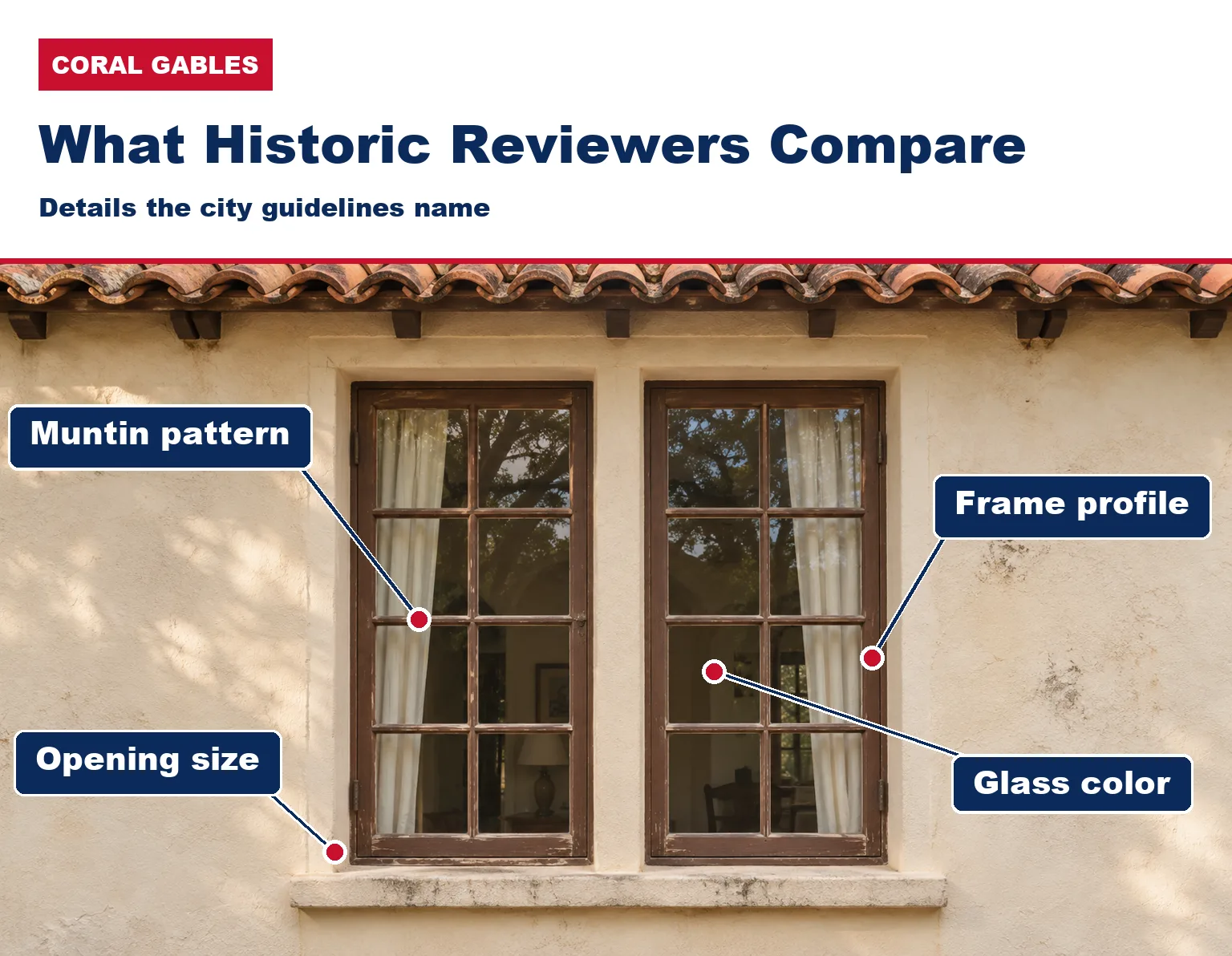
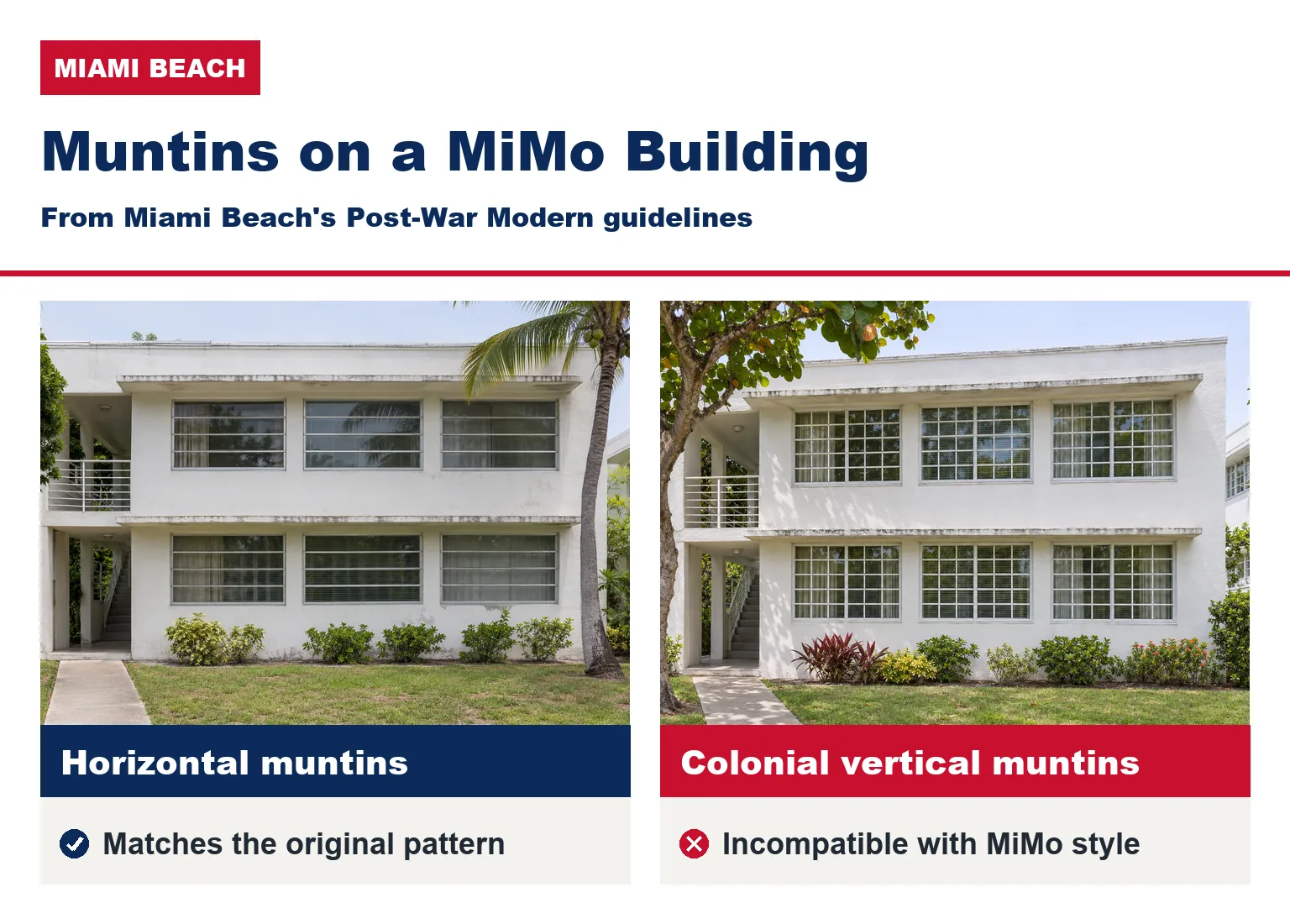
For Post-War Modern buildings, built from about 1945 to the mid-1960s, Miami Beach’s MiMo Design Guidelines spell out window details:
- Keeping and refurbishing original windows is normally preferred; when that is not possible, replacements should copy the original patterns and finishes as far as the Florida Building Code allows.
- Window replacement in a historic district or on a historic site requires the building’s original microfilm drawings, which the Building Department keeps.
- Applied muntins must be fixed to both sides of the glass, and exterior muntins should have a pyramid or rounded profile.
- Colonial-style windows with vertical muntins are called incompatible with Post-War Modern buildings.
- Post-War Modern buildings almost always had horizontally oriented panes, so horizontal muntins match the original pattern.
- Keeping the original size and configuration of window openings is called essential, especially on the main facade.
Glass counts too. Miami Beach’s City-Wide Design Guidelines discourage dark or reflective tinting and reflective coatings in any local or National Register historic site or district. Our guide to clear, Low-E and tinted impact glass choices explains those options.
Miami’s Standard COA checklist shows what its staff compare. It asks for a window and door schedule with the materials, size, type, operation, color and finish of each opening, plus a scaled profile section of the new windows and the manufacturer’s brochure.
A change in how the window opens is part of that review. If you are weighing styles, compare how casement, single-hung and horizontal roller windows open before you choose.
USA Home Improvement installs ES Windows impact windows in aluminum and vinyl. Bring the city’s window requirements to your estimate so the frame, muntin and glass options can be checked against them before anything is ordered.
Impact Windows and Shutters on Historic Buildings
Historic status does not rule out impact windows. Miami Beach’s City-Wide Design Guidelines, which apply to historic buildings in its districts, allow force resistant laminated glass in place of removable shutters on the first and second levels, and call for it on the third level and above.
For Post-War Modern (MiMo) buildings, the city’s MiMo guidelines go further: whenever windows must be replaced, hurricane impact windows are strongly recommended because they do not require shutters.
Where shutters are used, the City-Wide guidelines call for removable tracks and panels on the first two levels, put up only for a hurricane watch or warning, and the MiMo guidelines prefer removable aluminum panels. Permanently mounted accordion and roll-down shutters are reviewed case by case.
The City-Wide guidelines are older and tell applicants to check with Board staff that they are current.
Coral Gables and Miami review an impact window the same way they review any replacement: by its look against the historic design.
The building code still applies to the new window. Coral Gables, for example, asks for the Florida Product Approval or Miami-Dade Notice of Acceptance with the permit, and copies of the approval drawings must match the original approval exactly.
USA Home Improvement customers can receive the Florida Product Approval number for each window and door on request, which helps when the city asks for product details.
Arched or shaped openings are common on older homes. See how shaped architectural impact windows are planned around the opening.
The Order of Approvals: Historic Review First, Then the Building Permit
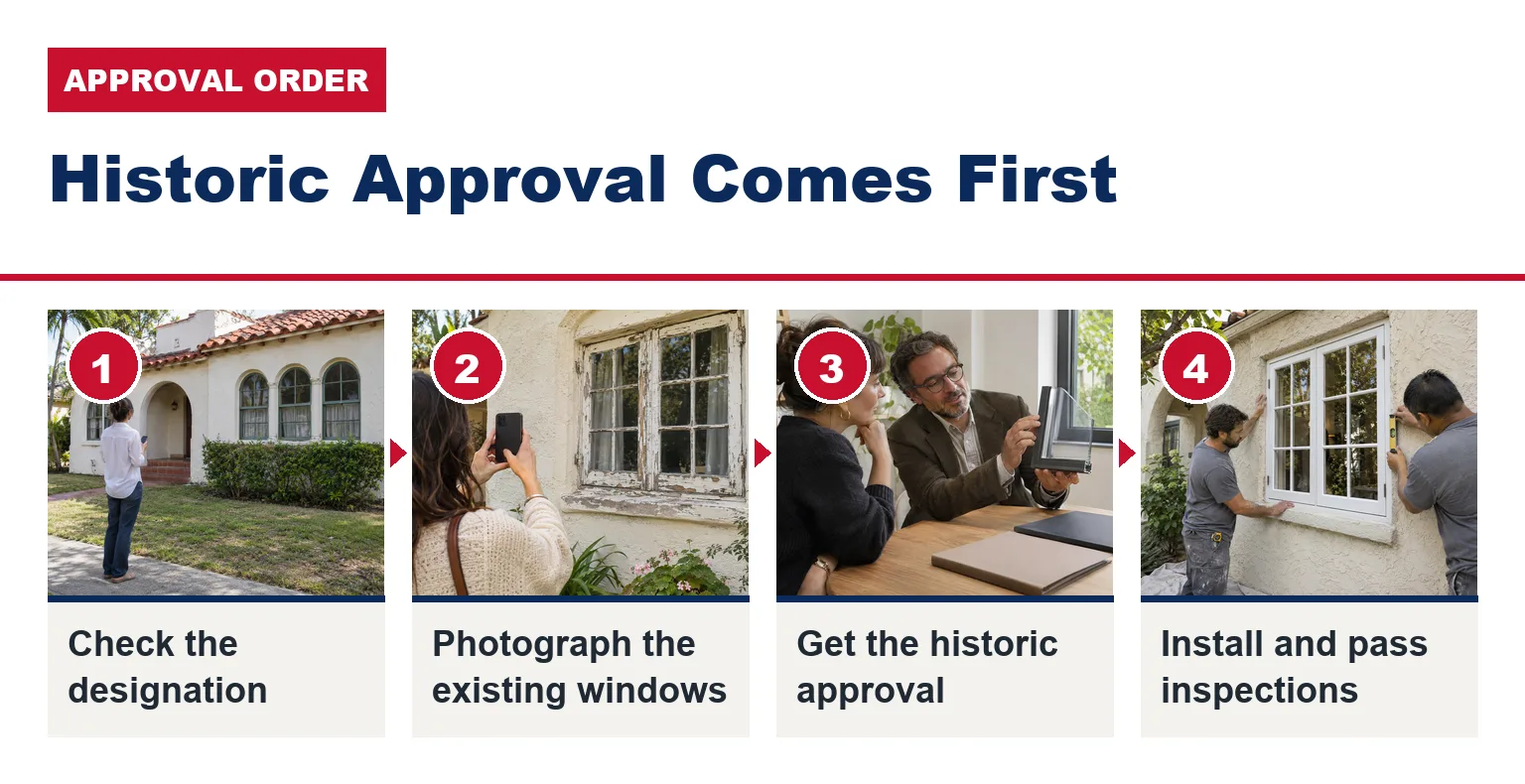
Historic review comes before the building permit is issued. Coral Gables says a COA is needed before a permit can be issued, Miami Beach requires its historic posting before permit issuance, and Miami asks for the COA documents as part of the permit. A practical order looks like this:
- Check the designation. Use the city tool for your address and note whether the building is in a district or individually designated.
- Photograph the existing windows. Coral Gables asks for color photos of existing conditions, Miami asks for numbered key photos, and Miami Beach asks for photos of the windows to be replaced.
- Get the historic approval. In Coral Gables, the COA form says the Board of Architects recommendation must come before the COA application. In Miami Beach, a green 11 x 17 informational posting must go up at the front of the property before the permit is issued.
- Install and pass inspections. Coral Gables lists a Final Historical inspection after the bucks and anchors inspections, and Miami Beach lists a Planning Final before the Building Final.
Plan for the review in your schedule. For USA Home Improvement projects, manufacturing takes about 6 to 8 weeks depending on project scope, and installation averages 1 to 2 days.
The whole process takes about 3 months start to finish, though it can vary. On a designated home, historic review is an added step on top of that.
If a Miami Beach project has to go to the Historic Preservation Board, the city says hearings are generally scheduled three to four months after application. Window replacement that meets the criteria can be approved by staff instead.
Every USA Home Improvement project is permitted. Read what a window replacement permit involves in Florida for the building side. If your property also has an HOA, its approval is separate; this guide to what your HOA can decide about impact windows covers it.
Ready to price windows that fit your home’s historic plan? Request a free impact window estimate.
Historic Window Replacement FAQs
Does historic status add fees in Coral Gables?
No extra fee comes from the status itself. Coral Gables’ preservation guide says there are no additional fees because of the historic status of the property. You still pay the normal permit fees for the window work.
My Miami Beach home was found architecturally significant. Is it historic?
No. The Miami Beach Planning FAQs say a determination that a single-family home is architecturally significant does not give it any type of historic designation. Check the Historic Property Viewer or ask Planning to confirm whether the property is in a local historic district.
Does a non-contributing building in a Miami Beach district need review?
Yes. The Miami Beach Planning FAQs say all buildings in a local historic district are reviewed under the Certificate of Appropriateness criteria, regardless of whether they are contributing or non-contributing.
What if my home’s original windows were replaced long ago?
Reviewers look for evidence of the originals. Miami Beach’s MiMo guidelines point to the original microfilm drawings and say that if no evidence exists, the building’s design is the best guide. Old photos, drawings or surviving windows on a side wall can help you show the original pattern.
Can I appeal a Historic Preservation Board decision in Coral Gables?
Yes. The Coral Gables COA application form says board decisions may be appealed to the City Commission no later than 10 days after the ruling. Ask the Historical Resources and Cultural Arts Department how to file before that window closes.
Bring the City’s Requirements to Your Window Estimate
Start with your property’s status, then get the city’s design expectations in writing before you choose a window. A quote built around the approved pattern, frame and glass avoids paying twice.
USA Home Improvement is licensed (CGC1526707) and insured and has served Florida homeowners for more than 15 years. Our installation team holds direct certification from the manufacturer, and we offer a 15-year warranty and a 1-year labor warranty on most jobs, plus a transferable warranty.
For styles, costs and county rules, see our complete South Florida impact window guide. When your city’s requirements are in hand, get a free estimate or call (877) 554-6373.