Skip to content

PACE financing in Florida pays for a qualifying home improvement through a program your county or city has authorized, and you repay it as a non-ad valorem assessment on your property tax bill. The assessment is a lien on the home, recorded in the county’s public records.
The rules sit in sections 163.08 to 163.087 of the Florida Statutes. This guide explains who can offer PACE, what the program must check and tell you before you sign, how to cancel, and what the federal Truth in Lending rule adds.
What PACE Financing Is Under Florida Law
Florida’s statute does not use the word PACE. It calls the projects “qualifying improvements” and the lender a “program administrator,” defined in section 163.08, Florida Statutes as a county, a municipality, a dependent special district or a separate legal entity created by interlocal agreement.
A program administrator may offer residential PACE in a county or city only if that county or city has authorized it by ordinance or resolution. The administrator may hire third-party administrators to run the program, and the program administrator levies the assessment.
Residential PACE covers property zoned residential or multifamily residential with four or fewer dwelling units. Buildings with five or more units count as commercial property and follow a separate section. Only the owner of record can apply; renters and other occupants cannot.
Florida first authorized this kind of financing in 2010. The Legislature rewrote it in chapter 2024-273, Laws of Florida, effective July 1, 2024, which created the residential rules in section 163.081 and the consumer protections described below.
Which Home Improvements Florida PACE Can Pay For
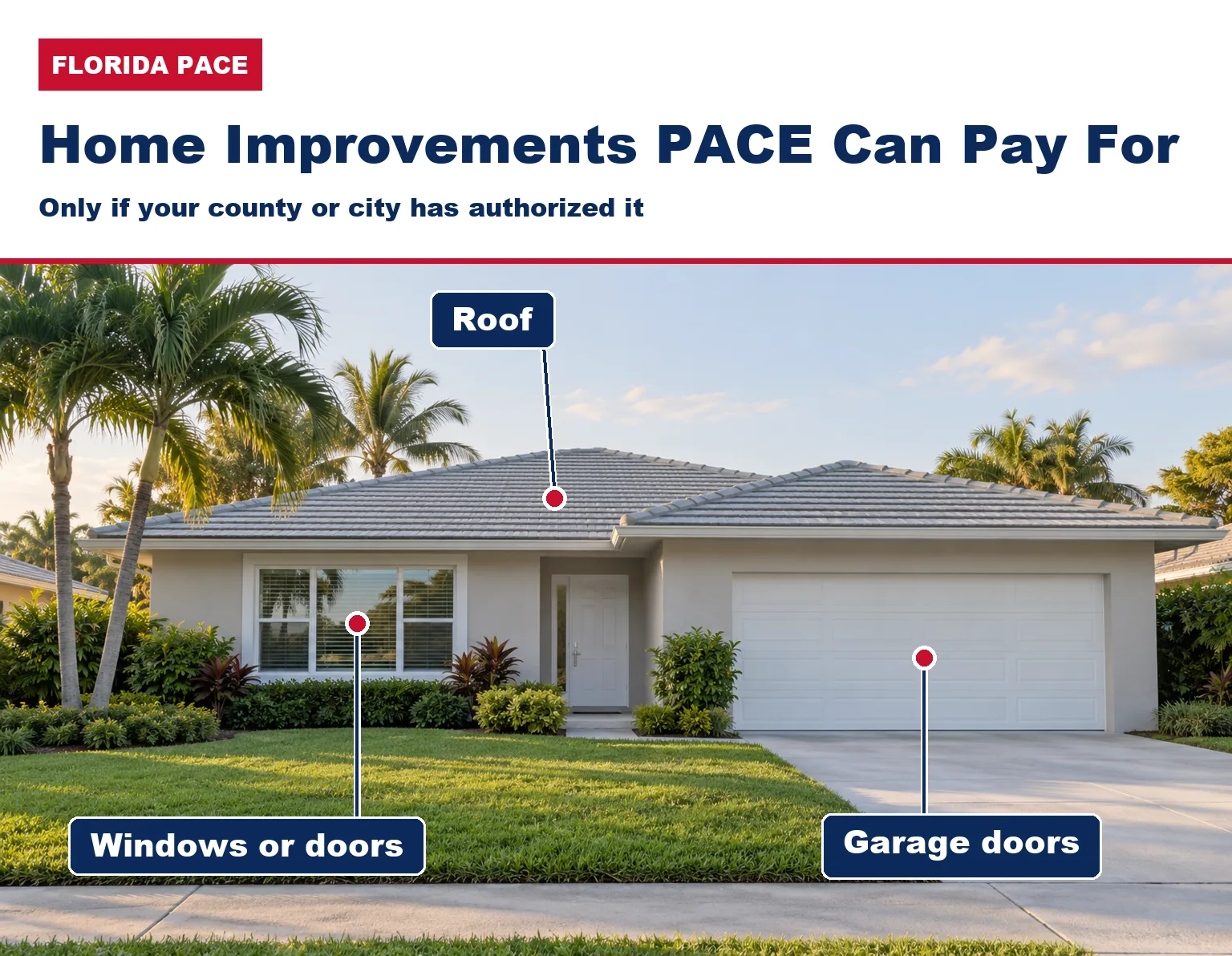
For homes, the statute lists permanent improvements in nine groups. They include repairing or replacing a roof, “replacing windows or doors, including garage doors, with energy-efficient, impact-resistant, wind-resistant, or hurricane windows or doors,” storm shutters, energy-efficient cooling, insulation, water heaters, permanent generators, solar and flood-resistance work.
The full list and real project examples are in our guide to which projects qualify for Florida PACE funding. Two of the listed hurricane projects are new ES Windows impact windows for Florida homes and a roof replacement that strengthens deck attachment.
How the PACE Assessment Is Collected on Your Property Tax Bill
The program administrator levies a non-ad valorem assessment, which the tax collector collects with your property taxes under section 197.3632. Under section 163.081, Florida Statutes, a PACE assessment does not get the discount for early payment that applies to other parts of the bill.
If your mortgage lender pays your taxes from escrow, the lender may raise your monthly escrow payment to cover the yearly assessment. Plan for that increase in your monthly budget, not only for the yearly tax bill.
The term may not be longer than the weighted average useful life of the main improvement, and never more than 20 years. The agreement may not use negative amortization, a balloon payment, or prepayment fees beyond nominal administrative costs, and you may repay the balance at any time.
Interest and program fees vary by program. See what sets Florida PACE rates and fees before you compare offers. For income tax questions, read whether a PACE assessment is tax deductible and ask a tax professional.
PACE Lien Priority and What Happens If You Miss a Payment
The recorded PACE agreement gives notice that the assessment is “a lien of equal dignity to county taxes and assessments from the date of recordation.”
Florida law makes property taxes “a first lien, superior to all other liens” (section 197.122), so a lien of equal dignity ranks with your taxes, ahead of a mortgage. That is why lenders look closely at PACE.
The lien cannot be enforced by making the rest of the unpaid, non-delinquent balance due at once. Missing a payment is still serious: the required disclosure warns of penalties, fees including attorney fees, court costs, and a tax certificate that could result in you losing the property.
Your existing mortgage cannot be accelerated only because you signed a PACE agreement; the statute makes such a clause unenforceable. When you sell or refinance, though, a mortgage lender may require you to pay off the full PACE balance.
A seller with an unpaid PACE balance must give the buyer a written disclosure, in the contract or separately, stating that the property “is subject to an assessment” under section 163.081 and that the assessment is not based on the property’s value.
What a Florida PACE Program Must Check Before You Sign
Before entering a financing agreement, the program administrator must make 13 findings from public records, your statements, your records and your credit reports. These are the checks that matter most to a homeowner:
| Check | What section 163.081(3) requires |
|---|---|
| Size of the assessment | All PACE assessments on the home total no more than 20 percent of the just value set by the property appraiser, unless your mortgage holder consents in writing |
| Ability to pay | Estimated yearly PACE payments are no more than 10 percent of your annual household income, confirmed by reasonable evidence, not only your statement |
| Property taxes | Taxes and assessments on the bill are current and not delinquent for the past 3 years, or your period of ownership if shorter |
| Mortgage | You are current on all mortgage debt on the home; no unreleased notice of default recorded in the past 3 years (or your period of ownership, if shorter) |
| Bankruptcy | No bankruptcy within the last 5 years, unless it was discharged or dismissed more than 2 years before you applied |
| Other liens and fines | No involuntary liens, such as construction liens, and no open code-enforcement fines unless the improvement fixes the violation |
| Reverse mortgage | The home has no reverse mortgage or home equity conversion mortgage |
| Term | Not longer than the useful life of the main improvement, and no more than 20 years |
The findings and the evidence behind them must be documented and given to you before the agreement is approved and recorded. The program must also check for other PACE agreements on the home, including ones not yet recorded.
If the improvement is estimated at $10,000 or more, the program must advise you in writing that the best practice is to get estimates from more than one unaffiliated, registered contractor.
No agreement may be made for a total cost, including fees and interest, under $2,500, or for new construction without a certificate of occupancy.
The Written Disclosure and Your 3-Day Right to Cancel
A Florida PACE agreement may not be signed until the program gives you a written financing estimate and disclosure. You must acknowledge each item in writing. The disclosure must show, among other items:
- The estimated total financed, with the itemized cost of the improvement, program fees and capitalized interest
- The estimated yearly assessment and the average monthly amount you would need to save for it
- The term, the assessment schedule and the estimated due date of the first payment
- The interest charged and the estimated annual percentage rate
- That you may cancel within 3 business days, and repay early without penalty beyond nominal administrative costs
- That a lender may require payoff when you sell or refinance
- That utility or insurance savings are not guaranteed and do not reduce the assessment
- That missed payments can lead to a tax certificate and loss of the property
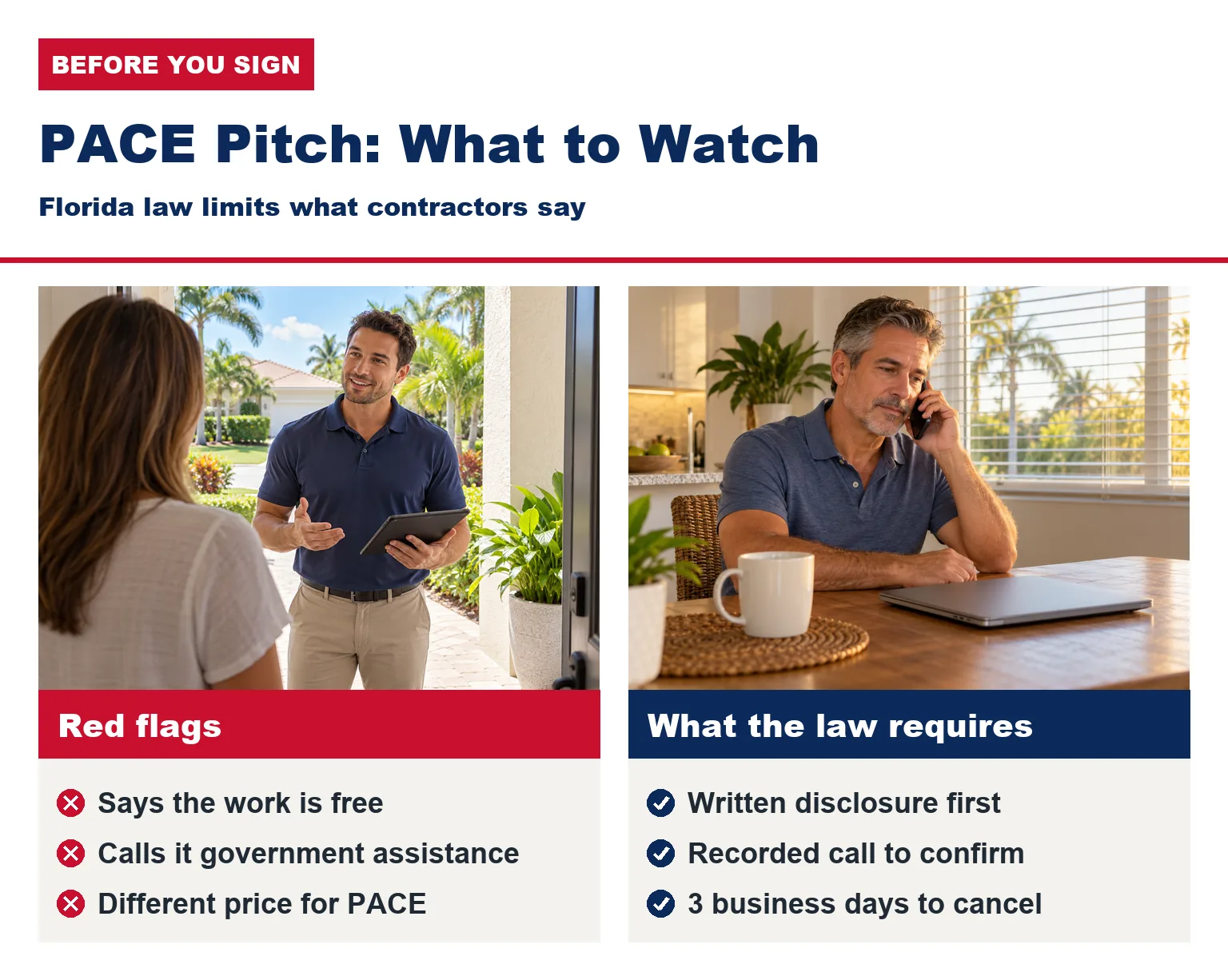
Before approval, the program must also hold a recorded phone call with you to confirm each finding and disclosure. Treat that call as your chance to ask about anything you did not understand on paper.
You may cancel on the program’s form within 3 business days after signing, with no financial penalty. Under section 163.086, Florida Statutes, a canceled agreement cannot be enforced and the contractor may not begin work under the canceled contract.
One caution: if you waive the right to cancel, or cancel but let the contractor go ahead with the installation, the work contract stays enforceable.
If a change order would raise the cost by 20 percent or more, or expand the scope by more than 20 percent, the program must send an updated disclosure and get your written approval first.
How PACE Financing Works in Florida, Step by Step
These are the steps Florida law sets for a residential PACE project, with its deadlines:
- Check your county program. Confirm that your county or city has authorized a program administrator for your address.
- Get contractor estimates. Use a contractor registered with that program; for jobs of $10,000 or more, compare more than one estimate.
- Apply as the owner of record. The program reviews your records, credit reports, income and the property’s tax and lien history.
- Review the written disclosure. Acknowledge each item, then confirm it on the recorded phone call.
- Notify your mortgage lender. At least 5 business days before signing, you must send each mortgage holder or servicer written notice with the maximum amount and maximum yearly assessment.
- Sign, then wait 3 business days. This is your cancellation window.
- The agreement is recorded. The program submits it to the county’s public records within 10 business days after signing and the cancellation period.
- The work is done and permitted. Before final payment to the contractor, the program confirms the work is complete or the final permit is closed.
- Pay on your tax bill. The assessment appears on your property tax bill, starting on the estimated first due date shown in your disclosure.
Red Flags to Watch for Before You Sign a PACE Agreement
Florida law limits what programs and contractors may say. Under section 163.085, Florida Statutes, the program, its third-party administrator and the contractor may not suggest that PACE is a government assistance program, that the work or financing is free, or that it need not be repaid.
They also may not make any claim about whether the assessment is tax deductible; they may only suggest you ask a tax professional.
A contractor may not charge a different price because the job is financed through PACE, and the contract must state all pricing and change-order terms. The program, its third-party administrator and the contractor may not offer you cash or anything of material value explicitly conditioned on signing.
A contractor may advertise PACE or ask you to join a program only if the program has registered it and it is in good standing.
Under section 163.083, Florida Statutes, each program must post a web page showing registered contractors and any that are on probation, suspended or terminated. Check that page before you sign.
Each program must also post an annual report with its complaints and defaults. If PACE still looks right, compare it with other choices in our comparison of PACE and home equity loans and the wider guide to financing a home improvement.
The Federal CFPB Rule for PACE Financing
A federal rule now applies on top of Florida law. The Consumer Financial Protection Bureau’s final rule on residential PACE financing amends Regulation Z under the Truth in Lending Act and took effect March 1, 2026.
The rule treats a PACE transaction as credit and applies the mortgage ability-to-repay rule in 12 CFR 1026.43. If you pay taxes through escrow, the creditor must also consider the higher monthly escrow payment the PACE assessment will cause.
PACE transactions get their own Loan Estimate and Closing Disclosure forms, and a PACE transaction is not a “qualified mortgage.” A PACE company that makes or shapes the credit decision is responsible for the ability-to-repay rule too, and can be held liable under the Truth in Lending Act.
Where USA Home Improvement Fits
USA Home Improvement installs ES Windows aluminum and vinyl impact windows, impact doors, and roofing. Every project we do is permitted, and you can ask for the Florida Product Approval number for each window and door.
Financing may be available for qualified homeowners through independent third-party providers. Terms, eligibility and availability depend on the program and location. Ask about current options at your estimate or see how third-party project financing works.
Florida PACE Financing: Quick Answers
Does Florida PACE check my credit?
Yes. The program must base its findings on public records, your statements and records, and your credit reports. It must also confirm your income with reasonable evidence, because yearly PACE payments may not exceed 10 percent of your household income.
Can I sell my home with a PACE assessment?
Yes, but you must give the buyer the written assessment disclosure, and the buyer’s lender or your own may require the balance paid off. See how refinancing and selling work with PACE before you list.
Is PACE a government program?
No. A county or city must authorize the program, and the program administrator is a local government or an entity local governments create, but PACE is not government assistance. It is financing you repay with interest and fees on your property tax bill.
Florida law forbids the program, its third-party administrator and the contractor from presenting it as government assistance or as free.
Can renters or a large condo building use residential PACE?
No. Only the owner of record can apply; renters and other occupants are excluded. A building with five or more units counts as commercial property, which falls under a separate section, s. 163.082. Florida is one of several states that offer PACE financing programs.
Next Step: Check the Program, Then Price the Project
Start by confirming that a program covers your address, then get the improvement priced on its own. Read every line of the disclosure and use the 3 business days if anything is unclear.
USA Home Improvement is licensed (CGC1526707) and insured and has served Florida homeowners for more than 15 years.
Request a free estimate for your project or call (877) 554-6373.