Skip to content


There is no single interest rate for Florida PACE financing: each program sets its own rate, and the fees, term and yearly assessment decide what you really pay. Published figures give a rough range.
The numbers that count are the interest rate and estimated APR on your own written financing estimate. This guide shows what public sources state about Florida PACE interest rates and fees, what drives them, and how to compare offers using the disclosures Florida law requires before you sign.
What Published Sources Say About Florida PACE Interest Rates
Two public sources give useful PACE rate figures, and both describe ranges or averages, not offers. The Florida PACE Funding Agency, one of the program administrators working in Florida, states on its FAQ page, first posted in 2023 and updated since: “Interest rates for PACE range from approximately 6% – 12.99%.”
The same page adds: “Closing fees are approximately 6.99% of the loan amount.” The Consumer Financial Protection Bureau (CFPB) PACE report, published in 2023, measured PACE loans made in Florida and California between July 2014 and June 2020.
| Source | What it states | What it covers |
|---|---|---|
| Florida PACE Funding Agency, FAQ page | Rates “approximately 6% – 12.99%”; closing fees “approximately 6.99% of the loan amount” | One program’s published terms |
| CFPB report, Table 4 | Average interest rate of 7.32% for Florida PACE loans | Florida loans made July 2014 to June 2020 |
| CFPB report, Table 8 | Average estimated APR of 8.289% for Florida PACE loans | Florida loans, same period |
| CFPB report, section 3.1 | Half of all PACE loans had rates “between 7.2 and 8.3 percent” | Florida and California loans, same period |
None of these figures is a quote for your home. The Florida PACE Funding Agency describes repayment “at a fixed rate,” and Florida law bars balloon payments and negative amortization in residential PACE agreements.
What Sets a PACE Interest Rate and the Total Cost
The program that writes your financing agreement sets the rate and fees, not the state. Under section 163.081, Florida Statutes, a program may offer residential PACE only where the county or city has authorized it by ordinance or resolution, so the programs and their prices differ by location.
The money comes from private investors. The Florida PACE Funding Agency says: “All funding for this program comes from selling bonds into the private market.”
Project Type Matters More Than Your Credit Score
The CFPB found that “PACE interest rates are mainly correlated with project type and State, rather than loan terms or consumer credit risk.” Home equity loans and mortgages, by contrast, are typically priced in part on each borrower’s own risk, the CFPB notes.
In Florida, almost 63 percent of the PACE loans the CFPB studied paid for disaster-related improvements. In the same data, Florida PACE loans for windows averaged an estimated APR of 8.105%, roofing 8.241% and disaster-related work 8.329%.
If you are pricing storm protection, see the ES Windows impact windows we install, and check which home projects qualify for Florida PACE first.
Term Length Follows the Improvement
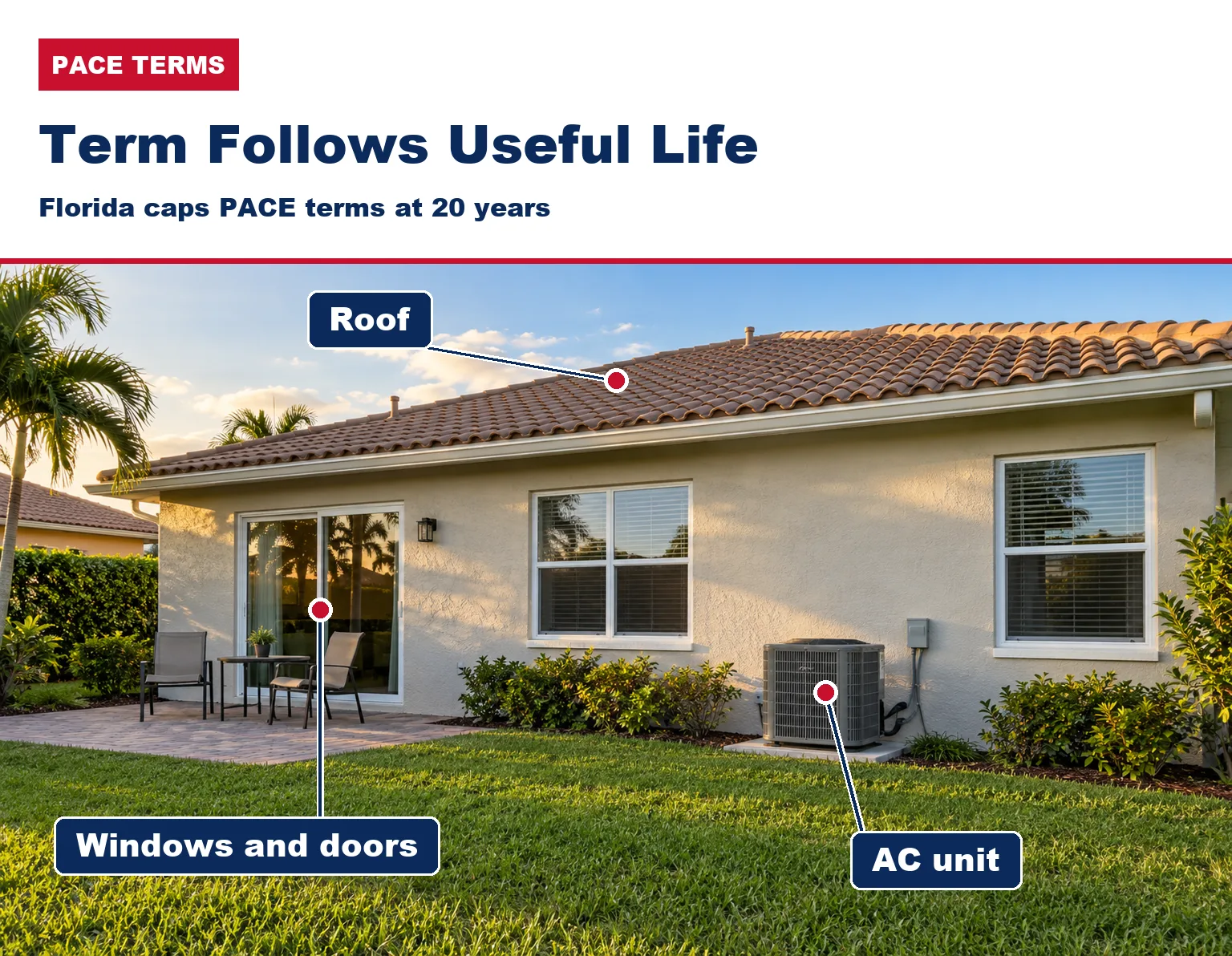
Florida caps the term at the weighted average useful life of the main improvement financed, and never more than 20 years. The Florida PACE Funding Agency gives an example: “a roof might be financed for 20 years, but an HVAC system would be less.”
So a roof, windows and doors, and an AC unit can each carry a different maximum term. A longer term lowers each yearly payment but adds years of interest, so ask for the total cost at each term the program offers.
Limits on the Amount and the Yearly Payment
Before you sign, the program must find that all PACE assessments on the home do not exceed 20 percent of its just value, unless your mortgage holder consents in writing. It must also find that the yearly PACE payments do not exceed 10 percent of your household income.
The total cost, “including program fees and interest,” must be at least $2,500. Programs may offer reduced fees or interest rates as promotions, but Florida law says those must be reflected in the financing agreement, not paid to you as cash.
Interest Rate vs APR: Which Number to Compare
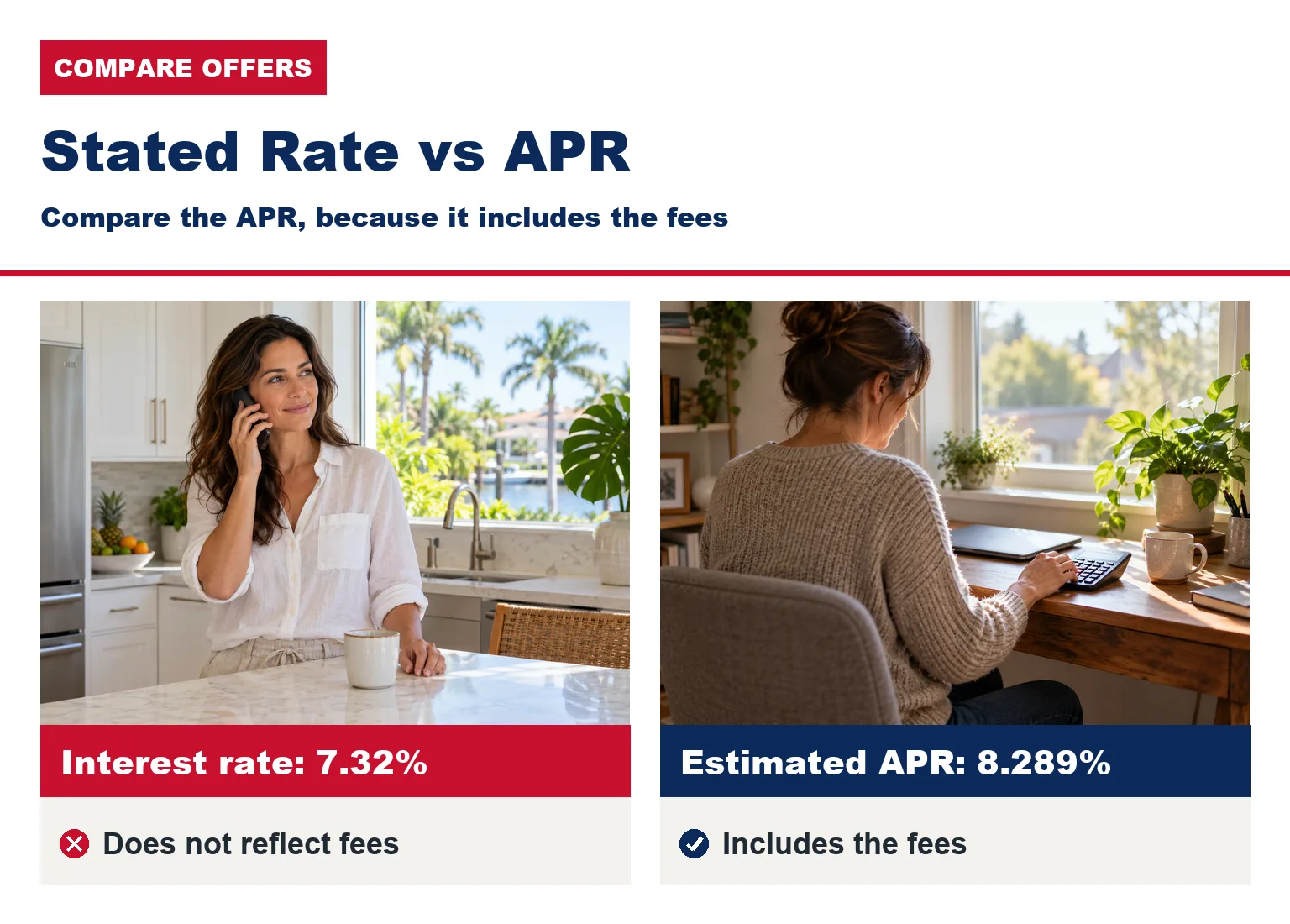
Compare the APR, because it includes the fees. The CFPB explains that an interest rate “does not reflect fees or any other charges,” while the annual percentage rate (APR) reflects the interest rate plus points, broker fees and other charges you pay to get the loan.
For PACE the gap is real. In the CFPB study, estimated APRs “tended to be a full percentage point above the nominal interest rate,” because fees averaged about $1,300 per loan. Florida loans averaged an interest rate of 7.32% and an estimated APR of 8.289%, and only the APR includes the fees.
Florida’s written financing estimate must show both: “The interest charged and estimated annual percentage rate.” Two offers with the same interest rate can have different APRs when one charges higher fees.
Take care when you compare PACE with a home equity line. The CFPB warns that a closed-end loan’s APR includes fees while a HELOC’s APR does not, so read our side-by-side look at PACE and home equity loans before you choose.
Fees and Charges Built Into a PACE Assessment
Most PACE fees are financed, not paid at signing. The Florida PACE Funding Agency says “All closing fees are included in the financing total,” and a CFPB memo notes that “fees are generally rolled into the loan balance.” Financed fees then carry interest for the whole term.
Using that program’s published figure, a closing fee of about 6.99% works out to roughly $699 for every $10,000 of loan amount, before any interest.
Capitalized interest can be in the balance too. Florida law allows interest included in the original balance, and the itemized total on your estimate must show it.
The CFPB report explains that Florida assessments must be placed by June 30 to appear on that year’s tax bill, which is due in November.
Check for yearly charges as well. The estimate must show “the total estimated annual costs” under the agreement, “including program fees,” so compare that line, not just principal and interest.
The price of the work must not change. Under section 163.085, a contractor “may not provide a different price” for a PACE-financed improvement than it would otherwise charge, so ask for the cash price in writing.
The Cost Disclosures Florida Requires Before You Sign
A Florida PACE agreement may not be signed until the program gives you a written financing estimate and disclosure, and you must acknowledge each item in writing.
These are the lines that decide your cost, and what to check on each:
| Line on the Florida estimate | What to check |
|---|---|
| Estimated total amount financed, itemized (improvement, program fees, capitalized interest) | The improvement cost matches the contractor’s cash price |
| Estimated annual assessment | You can pay it with each year’s property taxes |
| Term and assessment schedule | The years fit the useful life of the work |
| Interest charged and estimated APR | Compare the APR between offers |
| Total estimated annual costs, including program fees | Any yearly fee on top of principal and interest |
| Average monthly amount to save | Set it aside, or ask your lender about escrow |
| Estimated due date of the first payment | Which year’s tax bill carries the first payment |
The same estimate also lists your rights, including a 3-day cancellation window and penalty-free early repayment, and a federal CFPB rule now treats PACE as credit under the Truth in Lending Act. For those protections, see how PACE financing works in Florida.
How to Compare Two PACE Offers Step by Step
Put two estimates side by side for the same project and work through them in this order.
- Get the cash price. Ask the contractor for the price in writing without financing; Florida law says it must be the same as the financed price.
- Compare the estimated APR. The lower APR usually means lower interest and fees for the same amount and term.
- Total the full-term cost. Multiply the total estimated annual costs by the number of years, then compare that total with the cash price.
- Check the first payment date. A later first tax bill can mean more capitalized interest in the balance.
- Tell your mortgage servicer. Do it in writing at least 5 business days before you sign; the servicer may raise your monthly escrow to cover the assessment.
- Get more than one estimate for larger jobs. For work estimated at $10,000 or more, the program must advise you in writing that the best practice is estimates from more than one unaffiliated, registered contractor.
Florida law also has the program pay the contractor’s final funds only after the work is complete or the final permit is closed.
How PACE Rates Compare With Other Ways to Pay
PACE has usually cost more than borrowing against your home and less than a credit card.
For loans made from July 2014 to June 2020, the CFPB report found that PACE loans “have interest rates that are substantially higher than normal rates for mortgages or home equity loans (although much lower than credit card rates).”
What PACE changes is how you repay: through your property tax bill, with a lien on the property. Weigh that with the APR and total cost, and see our guide to financing a home improvement project for cash, home equity, personal loans and state programs.
Paying for Impact Windows, Doors or a Roof
USA Home Improvement does not directly provide financing. Financing may be available for qualified homeowners through independent third-party providers. Terms, eligibility and availability depend on the program and location.
You can review the financing options for window and roof projects before your estimate. If the work is a roof, see our roof replacement work for Florida homes.
Every USA Home Improvement project is permitted, and customers can receive the Florida Product Approval number for each window and door on request.
Florida PACE Rates and Fees FAQs
Can I pay off a Florida PACE assessment early?
Yes. Florida law bars prepayment fees or fines on residential PACE agreements other than nominal administrative costs. The Florida PACE Funding Agency says an early payoff reflects “interest only for the period the assessment was on the property.” Ask the program for a written payoff amount first.
Does the PACE part of my tax bill get the early-payment discount?
No. Section 163.081 says the PACE assessment “shall not be subject to discount for early payment,” even though it is collected with your property taxes. Budget the full assessment amount each year, whenever you pay the rest of the bill.
Is PACE interest tax deductible?
Florida law bars PACE programs and contractors from making any representation about the tax deductibility of the assessment, though they may suggest you ask a tax professional. Our article on whether PACE assessments are tax deductible explains the questions to bring.
Do I have to pay off PACE when I sell or refinance?
You may have to. The required disclosure says a mortgage lender may require you to pay off the full amount owed when you sell or refinance, and a seller must give the buyer a written PACE disclosure. See what happens to PACE when you refinance.
Choose the Offer With the Lowest Total Cost You Can Carry
Pick the PACE offer, or the other option, with the lowest APR and full-term total for the same project, and an annual assessment you can pay every year. If an offer shows only a rate, ask for the written financing estimate before you sign anything.
USA Home Improvement is licensed (CGC1526707) and insured and has served Florida homeowners for more than 15 years.
Get a free estimate or call (877) 554-6373.