 Skip to content

Impact windows are windows built with laminated glass and a reinforced frame that are tested to stay closed after being hit by wind-borne debris and then pushed and pulled by hurricane winds. This impact windows FAQ gives short answers about ratings, protection and its limits, noise, energy, UV, care, lifespan and shutters.
Each answer leads with the direct reply and points to the article that covers it in depth. For the full picture in one place, start with our complete guide to impact windows in South Florida.
Impact Window Basics: What They Are and How They Work
What exactly are impact windows?
Impact windows, also called hurricane windows, are complete window units, glass and frame together, that have passed missile impact and cyclic wind pressure tests. They protect the opening on their own, with no shutters to close. USA Home Improvement installs hurricane-rated replacement windows in single-hung, horizontal roller, casement, awning and fixed styles.
How do impact windows work?
Impact windows work because of laminated glass: layers of glass bonded to a tough plastic interlayer, usually PVB or the stiffer SGP. If debris cracks the glass, the interlayer holds the pieces in place, and the heavy frame and anchors keep the unit in the wall. The opening stays closed, so wind and rain stay outside.
How can I tell if my windows are already impact windows?
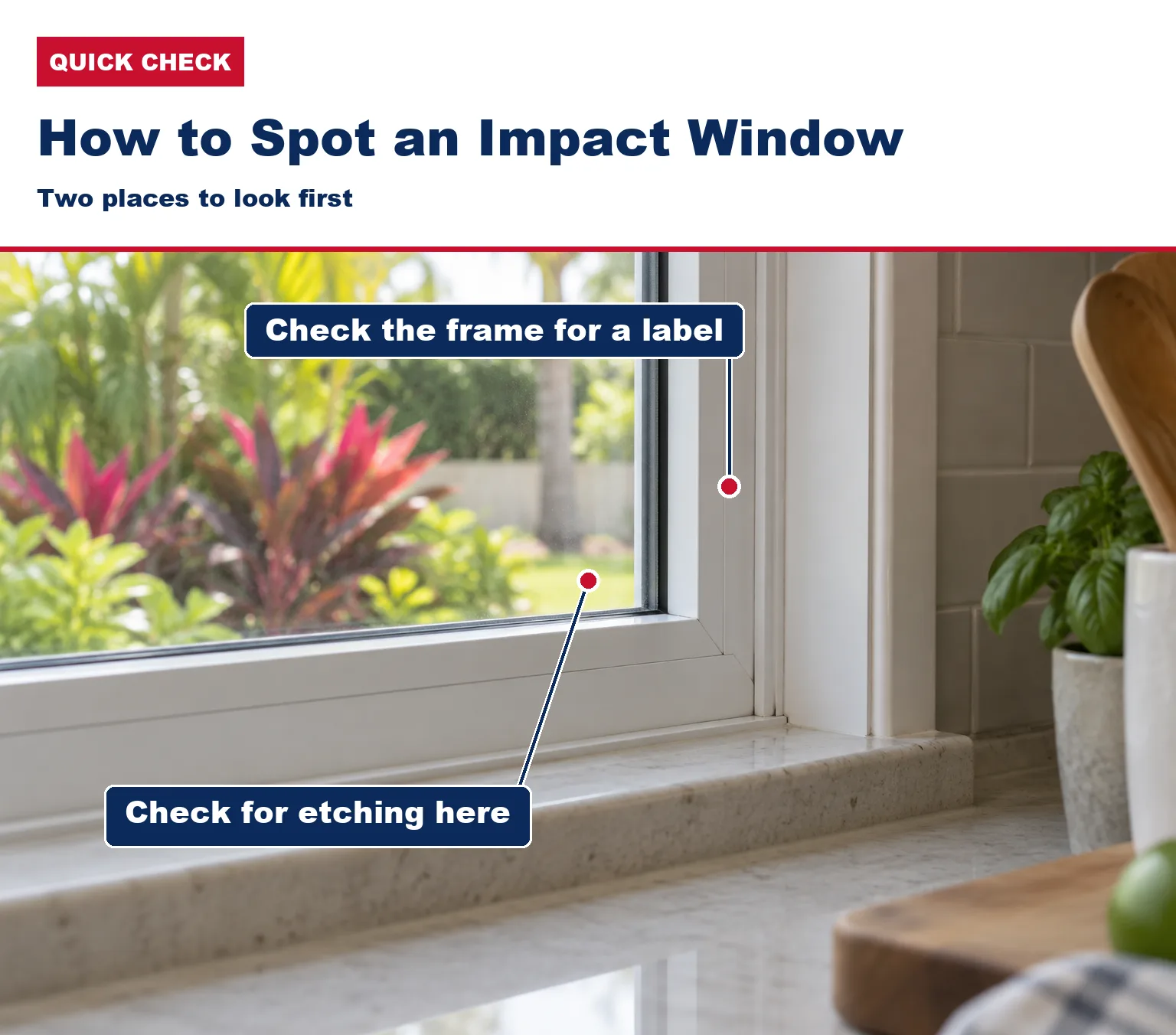
Look for a small etching in a corner of each glass pane and a label on the frame, then check for two close reflections in the glass. These quick signs are listed in our quick ways to spot impact glass. For insurance or a sale, confirm the approval number and permit record.
Can impact windows be made in custom sizes and shapes?
Yes. Impact windows are made to measure for each opening, and many makers offer arches, circles, transoms and other shapes. The limit is the product approval: every size and shape must fall inside what was tested.
For unusual openings, see our arched and custom-shaped impact windows. Skylights need their own approved impact product.
Impact Window Ratings: NOA, FL Number, Design Pressure and Missile Tests
Are impact windows required in South Florida?
The Florida Building Code requires opening protection in the wind-borne debris region, which includes South Florida. Impact windows are one way to meet it; approved shutters are the other. Existing windows that were legal when installed do not have to be replaced, but new or replacement windows must meet the current code for your address.
What is a Miami-Dade NOA, and what is an FL number?
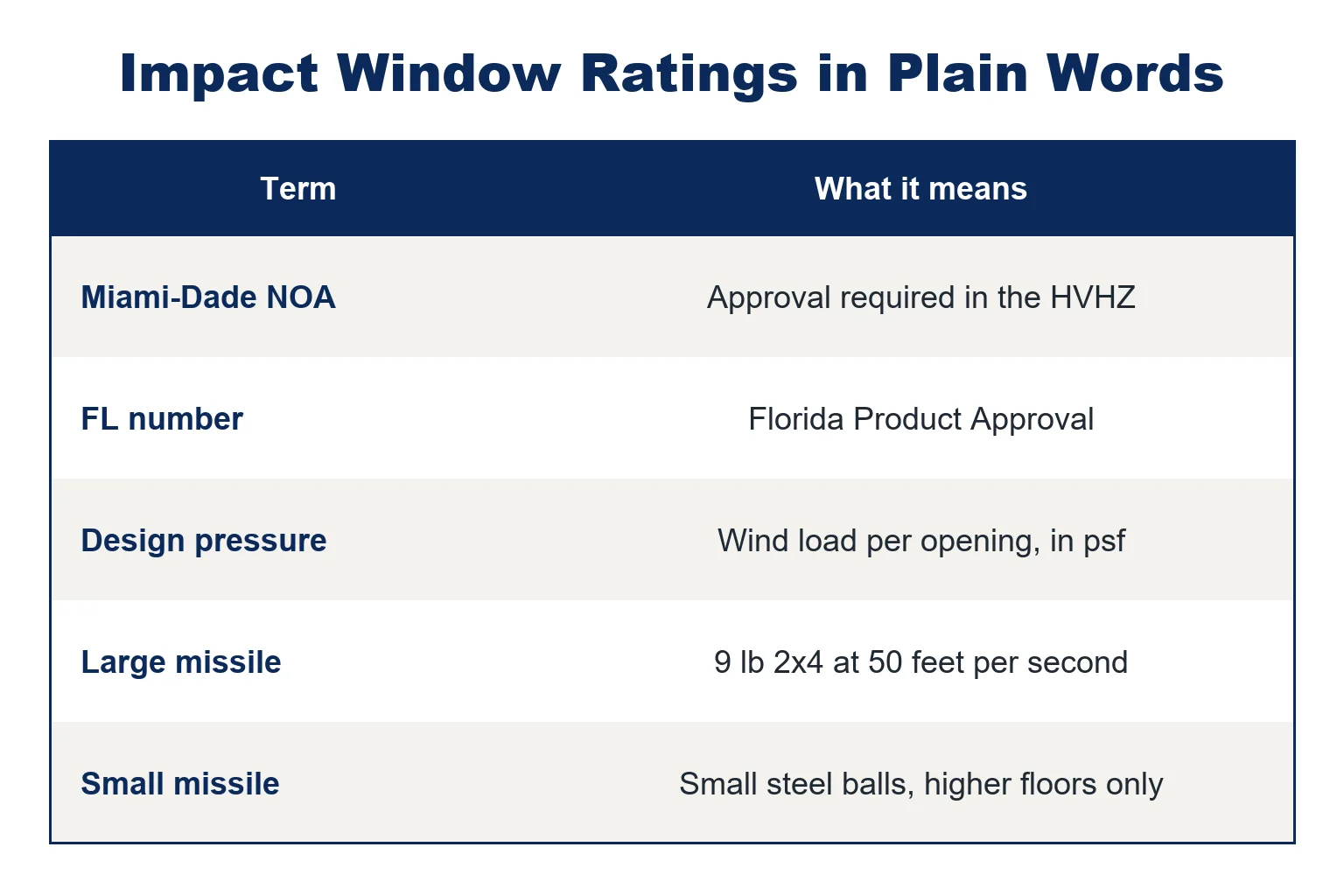
Both are product approvals. A Miami-Dade Notice of Acceptance (NOA) is issued by Miami-Dade Product Control and is required in the High-Velocity Hurricane Zone, which covers Miami-Dade and Broward. A Florida Product Approval (FL number), searchable on floridabuilding.org, is used in Palm Beach County and across the state.
What does design pressure (DP) mean?
Design pressure is the wind load a window is rated to resist, shown in pounds per square foot (psf) as a plus and a minus figure. Plus is pressure pushing in; minus is suction pulling out. DP is set per opening, not by storm category.
Our four things to check before buying impact windows explains how to match it.
What is the difference between large missile and small missile impact windows?
Large missile windows pass a test where a 9-pound two-by-four hits the glass at 50 feet per second. The Florida Building Code requires large missile protection for glass within 30 feet of the ground, which covers almost every house. Small missile ratings use small steel balls and suit only glass higher up.
How are impact windows tested?
Impact windows are lab tested in three stages. In the HVHZ, TAS 201 fires the missile, TAS 202 checks static air pressure and water resistance, and TAS 203 pushes and pulls the damaged unit through thousands of pressure cycles. Outside the HVHZ, ASTM E1886 and E1996 do the same job.
See TAS 201 test overview from Intertek.
Hurricane Protection and Its Limits
Can impact windows withstand a direct hit from large debris?
Yes, within their rating. A large missile impact window is tested to stay closed after a hit from a 9-pound two-by-four, and then to hold through repeated wind pressure. The glass may crack, but it should not open.
Debris heavier or faster than the test can exceed any rating. Read what impact glass can and cannot withstand.
What happens if impact glass cracks during a storm?
A cracked impact window has done its job if it stayed closed: the interlayer kept the opening sealed. It still needs replacing after the storm, because cracked glass has lost much of its strength for the next one.
Photograph the damage for your insurer before any repair, and have the replacement done to the product’s approval.
Do impact windows protect against flooding or storm surge?
No. Impact windows protect against wind and flying debris, not rising water. Flood water and storm surge come in at ground level through doors, walls and floors, and windows are not designed or tested to hold back standing water.
If your home is in a flood zone, plan flood protection and flood insurance separately from your windows.
Do impact windows keep rain out during a hurricane?
Impact windows are tested for water resistance against wind-driven rain, and the approval states the water pressure each unit is rated for. Keeping water out also depends on installation: sealing, flashing and the joint between frame and stucco.
Very strong gusts can still push some water past any window, which is why weep holes must stay clear.
Do impact windows stop break-ins?
Impact windows make break-ins harder. Laminated glass may crack when struck, but the interlayer holds it together, so a burglar cannot simply smash a pane and climb through. Impact windows are not burglar-proof, and locks still need to be closed.
Breaking through takes time and noise, which is often enough to discourage an intruder.
Noise, Energy, UV and Natural Light
Do impact windows reduce noise?
Yes. The thick laminated glass and its interlayer dampen traffic, lawn equipment and aircraft noise better than ordinary single-pane windows. How much depends on the glass package and the walls around it.
Compare windows by their STC and OITC ratings, not by a percentage. Our guide on how much quieter impact windows make a home explains both.
Are impact windows energy efficient?
Impact windows can be, if you choose the right glass. Low-E coatings and insulated laminated glass cut heat gain, which matters most in a Florida summer. Laminated glass alone is not automatically efficient.
Check the NFRC label for the U-factor and solar heat gain coefficient (SHGC); lower numbers mean less heat gets through.
Do impact windows block UV rays?
Yes, the interlayer in laminated glass filters most ultraviolet light. Eastman, maker of Saflex interlayers, says its standard PVB screens about 99 percent of UV up to 380 nanometers on its interlayer UV performance page. Blocking UV slows fading of floors and furniture, but visible light and heat still cause some fading.
Will impact windows make my home darker?
Not with clear glass. Clear laminated glass lets in natural light much like standard windows. Tinted, gray or reflective glass reduces glare, heat and visibility from outside, but also cuts some daylight.
If light matters in a room, ask for the visible transmittance (VT) figure on the NFRC label and see a sample before you order.
Everyday Use, Care and Lifespan
Can I open impact windows like normal windows?
Yes. Operable impact windows such as single-hung, horizontal roller, casement and awning units open, close and lock like ordinary windows. They feel heavier because the glass is thicker, but good hardware makes them easy to use.
Keep them closed and locked during a storm; fixed picture impact windows do not open at all.
How do I clean and maintain impact windows?
Clean the glass with mild soap, water and a soft cloth, and avoid abrasive pads, razor blades and pressure washers on the seals. Regularly vacuum the tracks, clear the weep holes so water can drain, and check that locks and rollers move freely. Lubricate hardware only with what the manufacturer recommends.
Do impact windows hold up to salt air near the coast?
Impact windows can last near salt water if the frame finish and hardware are made for coastal use. Ask for the finish type and whether hardware is stainless steel or coated for salt exposure. Rinse frames and tracks with fresh water regularly, because salt left on aluminum and hardware speeds up pitting and corrosion.
How long do impact windows last?
Impact windows are built for many years of service, but there is no single lifespan. It depends on the frame material, the finish, how close you live to salt water, how well the unit was installed and how the seals and hardware are maintained. The written manufacturer and workmanship warranties are the most reliable guide.
What do impact window warranties cover?
Impact window warranties come in two parts. The manufacturer’s warranty covers defects in glass, frame and hardware, often with different terms for each. The installer’s workmanship warranty covers the installation.
Get both in writing and keep them with your approval and permit papers. Coverage varies by brand, as our guide to comparing impact window brands and series shows.
Can damaged impact windows be repaired?
Often, yes, for parts other than the glass. Worn rollers, locks, screens, balances and weatherstripping can usually be repaired or replaced. Cracked or delaminated impact glass needs a replacement glass panel or a new unit, and the repair must keep the window inside its product approval.
Ask your installer or the manufacturer rather than a general glass shop.
Impact Windows vs Hurricane Shutters
How do impact windows compare to hurricane shutters?
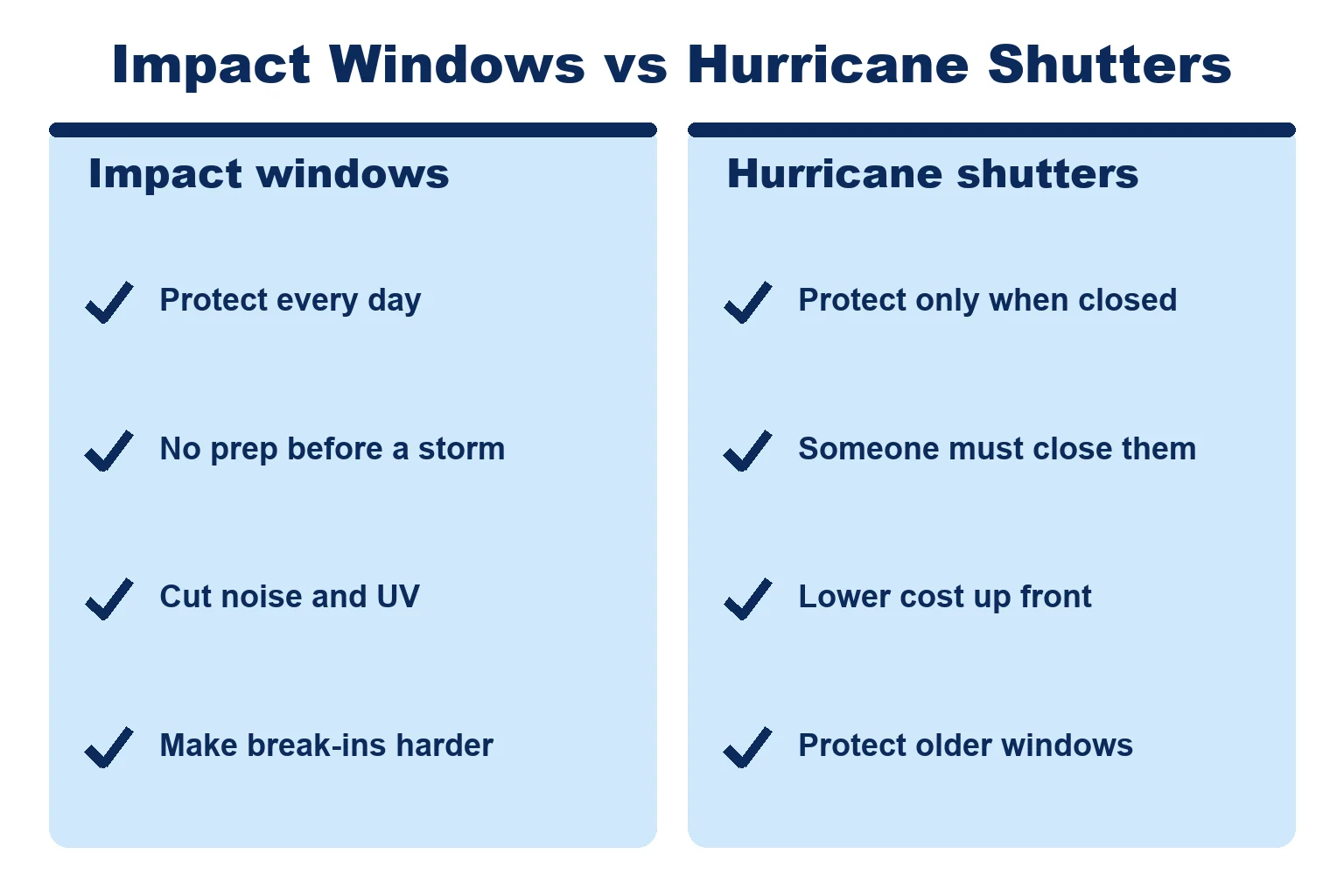
Impact windows protect every day with no prep, while shutters protect only once someone closes them before a storm. Impact windows also cut noise and UV and make break-ins harder. Approved shutters cost less up front and protect older windows.
Our side-by-side of impact windows compared with hurricane shutters covers prices and trade-offs.
Do I still need shutters if I have impact windows?
No. Approved impact windows protect the opening on their own, so shutters are not required on top of them. Some homeowners add shutters on large or exposed openings as a second layer, which is a personal choice.
Other openings without protection, such as an old sliding door or garage door, remain weak points to plan for.
Cost, Permits and Insurance: Short Answers
Buying questions have their own page, our impact window buying FAQ on cost and permits. The short versions:
- Cost: it depends on the number, size and style of openings, the glass package and the approval needed for your county.
- Permits: replacing windows in Florida needs a building permit, and your installer should pull it.
- Timeline: windows are made to order, so allow time for measuring, permits and fabrication before installation day.
- Insurance: Florida insurers must offer credits for opening protection, based on a wind mitigation inspection.
- Grants and tax credits: availability changes, so check current programs before you count on them.
- Paying over time: qualified homeowners can use our financing options for impact window projects.
Still Have a Question About Impact Windows?
If your question is about your own home, such as which rating your openings need or whether your current windows qualify, the fastest answer is a free in-home estimate. We measure each opening, explain the approval and design pressure it needs, and give you a written quote. Call USA Home Improvement at (877) 554-6373.
USA Home Improvement is licensed (CGC1526707) and insured and has served Florida homeowners for more than 15 years.