Skip to content

An impact garage door in Florida is rated for two things: wind pressure and a hit from wind-borne debris. A wind-load-only door is rated for pressure alone, with no debris test.
The difference decides whether the door meets the impact rules in Broward and Miami-Dade, counts for Florida’s sales tax refund, and how it rates on a wind mitigation inspection.
The 9th Edition (2026) Florida Building Code takes effect December 31, 2026, and revises the garage door wind load table.
Impact-Rated vs Wind-Load-Only Garage Doors: What Each Rating Means
A wind-load rating shows how much wind pressure a garage door can hold, both pushing in and pulling out. That number is the design pressure, written in pounds per square foot (psf) as a positive and a negative value.
Florida’s residential code accepts three tests for that pressure rating: ANSI/DASMA 108, ASTM E330 Procedure A or TAS 202, with TAS 202 required in the High-Velocity Hurricane Zone (Section R609.4, 8th Edition).
An impact rating adds a debris test: the door is struck with a large missile, then put through repeated pressure cycles to show it still holds.
For garage doors, Florida’s forms accept ANSI/DASMA 115 or the window and door impact standards: ASTM E1886 and E1996, AAMA 506, or TAS 201, 202 and 203.
Every impact-rated door also carries a wind pressure rating, but a wind-rated door is not impact rated unless its label and approval say so.
| Wind-load-only door | Impact-rated door | |
|---|---|---|
| Tested for | Wind pressure (design pressure) | Wind pressure plus large-missile impact and cyclic pressure |
| Typical standards | ANSI/DASMA 108, ASTM E330, TAS 202 | ANSI/DASMA 115, ASTM E1886/E1996, AAMA 506, TAS 201, 202 and 203 |
| Broward and Miami-Dade | Not enough on its own for the impact rule | Meets the impact rule when approved for the opening |
| Florida sales tax refund | Not a qualifying product | Can qualify if the home qualifies |
| Wind mitigation form | Level D at best (doors without glass) | Level A or B, by missile test |
Why the Garage Door Is the Weak Point in a Hurricane
The garage door is usually the biggest opening in a house. NOAA’s hurricane season advice calls the garage door the most vulnerable part of the home and says it must be able to withstand hurricane-force winds.
The danger is what happens after it gives way. FEMA’s home preparation tips say wind entering through an opening this large causes grave problems for the rest of the home, especially the roof.
FEMA suggests replacing old garage doors and tracks with a door approved for both wind pressure and impact protection.
The Florida Division of Emergency Management lists garage doors among the five critical areas where wind can enter. It says garage doors should be impact resistant or have a protective covering properly secured to the opening.
USA Home Improvement installs impact garage doors and handles the permit for each job. You can compare impact garage doors rated for wind and debris. Because a failed garage door loads the roof, it also helps to know what the 2026 code changes for re-roofs.
Which South Florida Homes Need an Impact-Rated Garage Door
Broward and Miami-Dade make up Florida’s High-Velocity Hurricane Zone (HVHZ), where outside doors fall under the impact rule.
Section 1626.1 of the Florida Building Code says every part of the building envelope, including outside doors, must meet impact test criteria or be protected by a device that does.
For a garage door there, that means an impact-rated door approved for the opening, or an approved impact device in front of a wind-rated door. Our guide to Miami-Dade impact door approvals covers the county approval side.
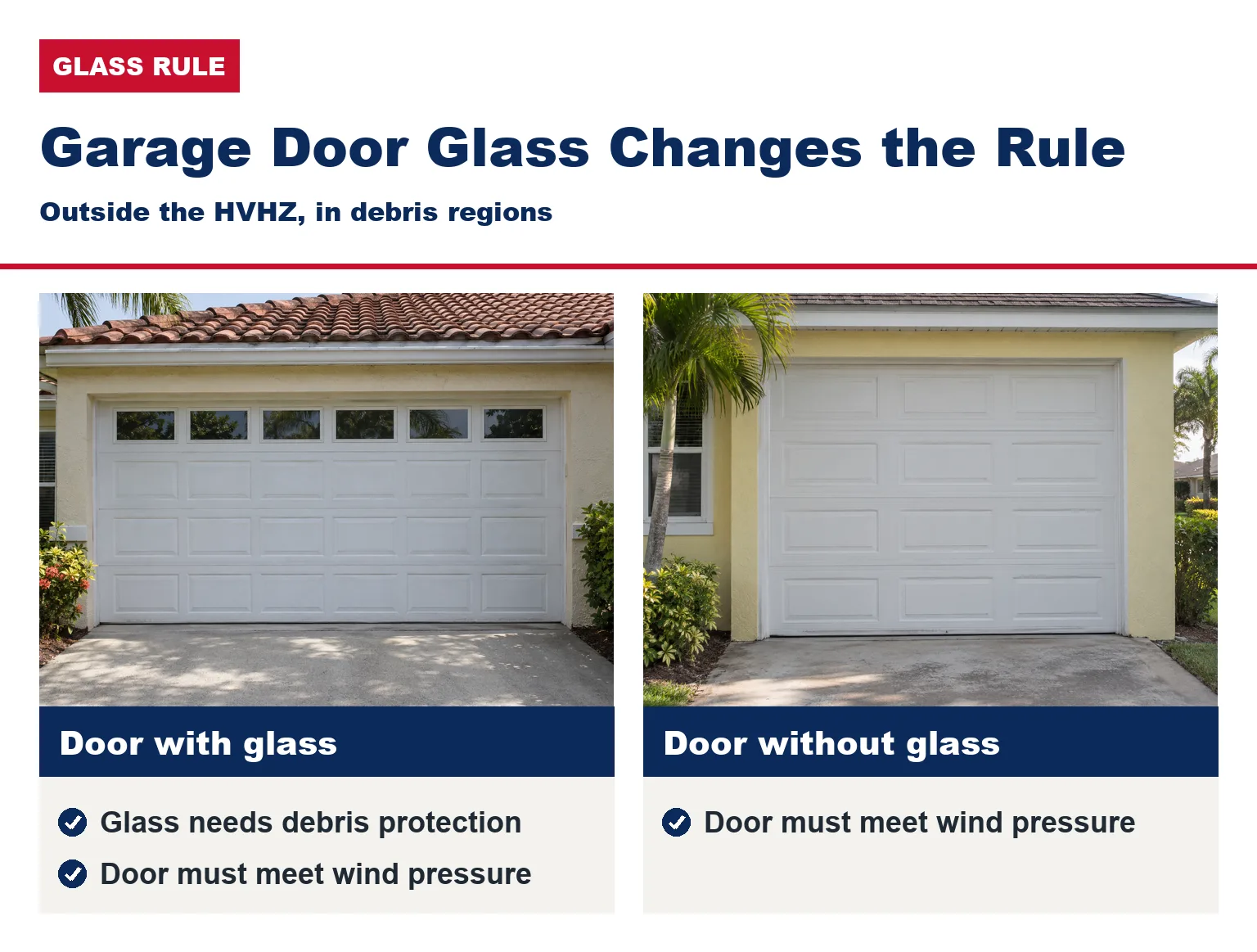
Outside the HVHZ, as in Palm Beach County, the residential debris rule (Section R301.2.1.2) covers exterior glazed openings in windborne debris regions. Glass in a garage door there must be protected from windborne debris, by glazing tested to an approved impact standard or ANSI/DASMA 115, or by an approved covering.
Every garage door, with or without glass, must meet the design wind pressure for its opening.
The Florida Building Code defines a windborne debris region as land within 1 mile of the coast where the design wind speed (Vult) is 130 mph or more, or anywhere it is 140 mph or more. Your building department can confirm the wind speed for your address.
A replacement garage door must meet the code’s wind provisions (Florida Building Code, Existing Building, Section 707.4). One limited exception: in homes built before the Florida Building Code, a glazed garage door replaced within limits on glass area may not need debris protection, though it must still meet wind pressure.
Windows follow the same logic: see Florida’s impact window requirements.
Not sure which rating your garage needs? Ask for a free garage door estimate or call (877) 554-6373, and we will check the opening and the permit requirements for your address.
What the 2026 Florida Building Code Changes for Garage Doors
The 9th Edition (2026) Florida Building Code takes effect December 31, 2026. Our homeowner guide to the 9th Edition code covers the dates and permit timing. For garage doors, the Florida Building Commission’s analysis of changes lists these updates.
- The wind load table is updated. Table R301.2(4) gives garage door wind pressures by door size and wind speed for a home with a 30-foot mean roof height in Exposure B, a standard terrain category. According to the Commission’s residential analysis of changes, the pressures “have been revised slightly to correlate with changes in ASCE 7-22,” the national wind load standard.
- The 0.6 factor is spelled out. Section R609.4 now clarifies that pressures from the LRFD provisions of ASCE 7 “are permitted to be multiplied by 0.6.” In plain words, ASCE 7 gives a higher, strength-level pressure, and the code allows multiplying it by 0.6 to get the lower nominal pressure that garage door ratings use. It is the same wind written two ways, not a weaker door.
The Building volume of the code also renames garage doors “vehicle access doors,” according to the Commission’s Building analysis of changes.
The official analysis of changes does not list changes to TAS 201, 202 or 203.
Product approvals still have to be brought in line with the new code, through the routes explained in our guide to 2026 product approval changes. Ask your installer whether the garage door’s approval covers the 9th Edition.
How to Tell if a Garage Door Is Impact-Rated or Wind-Load-Only
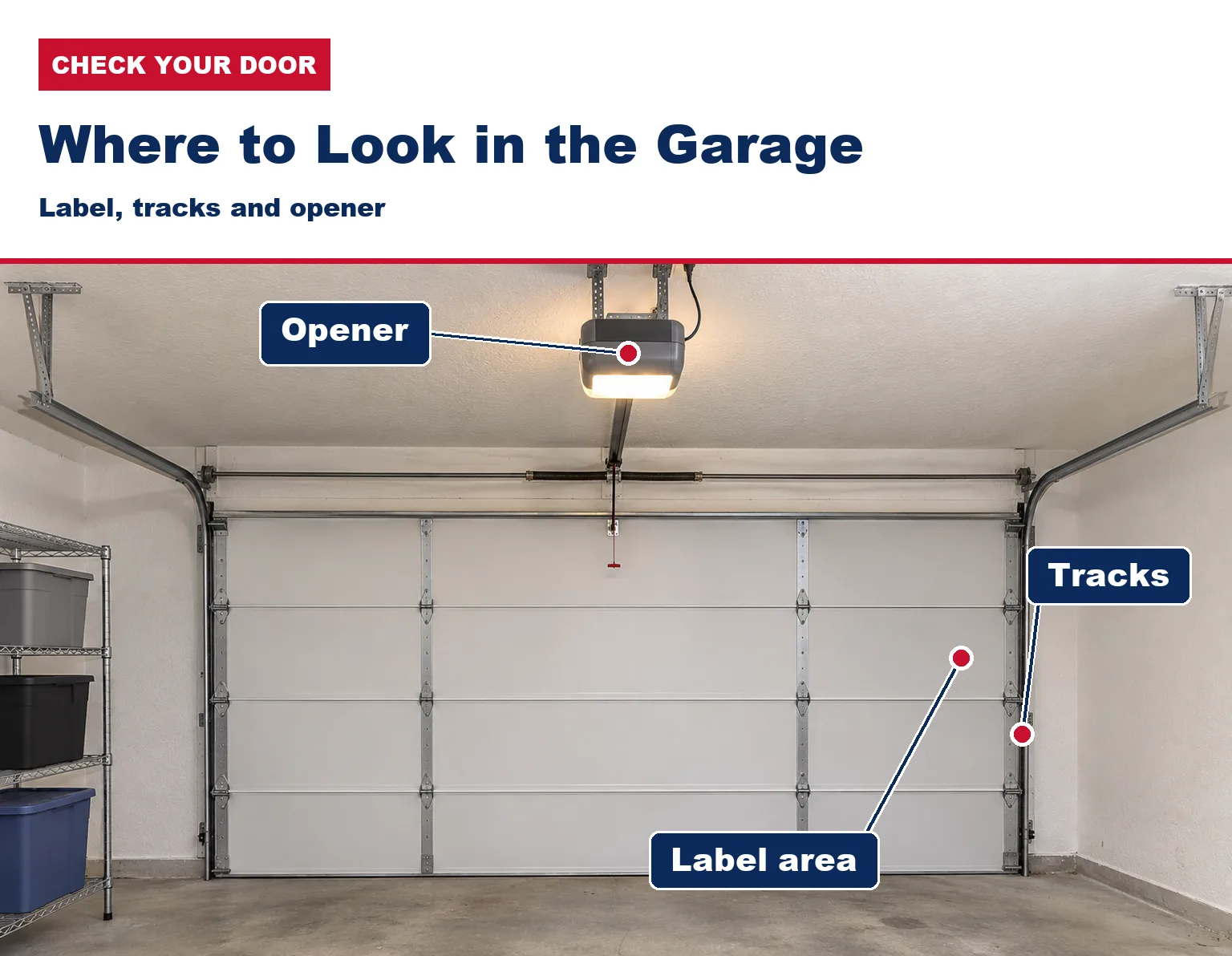
The label tells you. It is usually on the inside of the door, on a panel edge or near the track. Florida’s residential code requires a permanent garage door label from the manufacturer (Section R609.4.1, 8th Edition), and it must show:
- The manufacturer and the model or series number
- The positive and negative design pressure rating
- Whether the door is impact rated, if it is
- The installation drawing reference number
- The Florida Product Approval or Miami-Dade approval number, where one applies
- The test standards the door meets
Pressure numbers with ANSI/DASMA 108 or ASTM E330 alone point to a wind-load-only door. An impact mark with ANSI/DASMA 115 or TAS 201, 202 and 203 points to an impact-rated door. You can confirm the approval number on Florida’s product approval site or Miami-Dade’s NOA search.
No label means the rating is unknown. Our guide on reading hurricane rating labels shows where labels hide on each kind of opening.
While you are in the garage, check the door panels, the tracks and the opener. Dents, bent tracks or uneven closing are reasons to have it inspected.
The wind mitigation form says openings that need replacement do not qualify for wind mitigation rate differentials.
Only Impact-Rated Garage Doors Count for the Sales Tax Refund
Florida’s home hardening sales tax refund covers impact-resistant garage doors, not wind-load-only ones. The Department of Revenue’s Form DR-26HH defines the product as a garage door system designed to resist wind and wind-borne debris, “rated for impact resistance and wind pressure.”
The accepted standards are the impact standards listed above, ANSI/DASMA 115 included. A door with only a design pressure rating does not meet that definition.
The refund applies to purchases from July 1, 2026, through June 30, 2029, and the home must qualify too. Our guide to the Florida sales tax refund on impact products covers who qualifies and how to claim.
How the Garage Door Affects Your Wind Mitigation Inspection
The wind mitigation form rates your home by its weakest opening, and the garage door is one of them. The 2026 version of the Uniform Mitigation Verification Inspection Form (OIR-B1-1802) asks for the weakest form of wind-borne debris protection and names garage doors in that category.
A garage door without glass that is verified for wind pressure only is Level D on the form. Even with every glazed opening at the top level, the best the form can then record is A.2, not A.1.
A.2 also needs every other non-glazed opening, such as entry doors, at Level A or D.
A.1 needs every non-glazed opening, garage door included, at Level A, or no non-glazed openings at all.
A garage door with glass is listed with the glazed openings, so unprotected glass in it can pull down the rating for the whole house. What each level is worth depends on your insurer. See which home upgrades can lower your insurance premium before you choose.
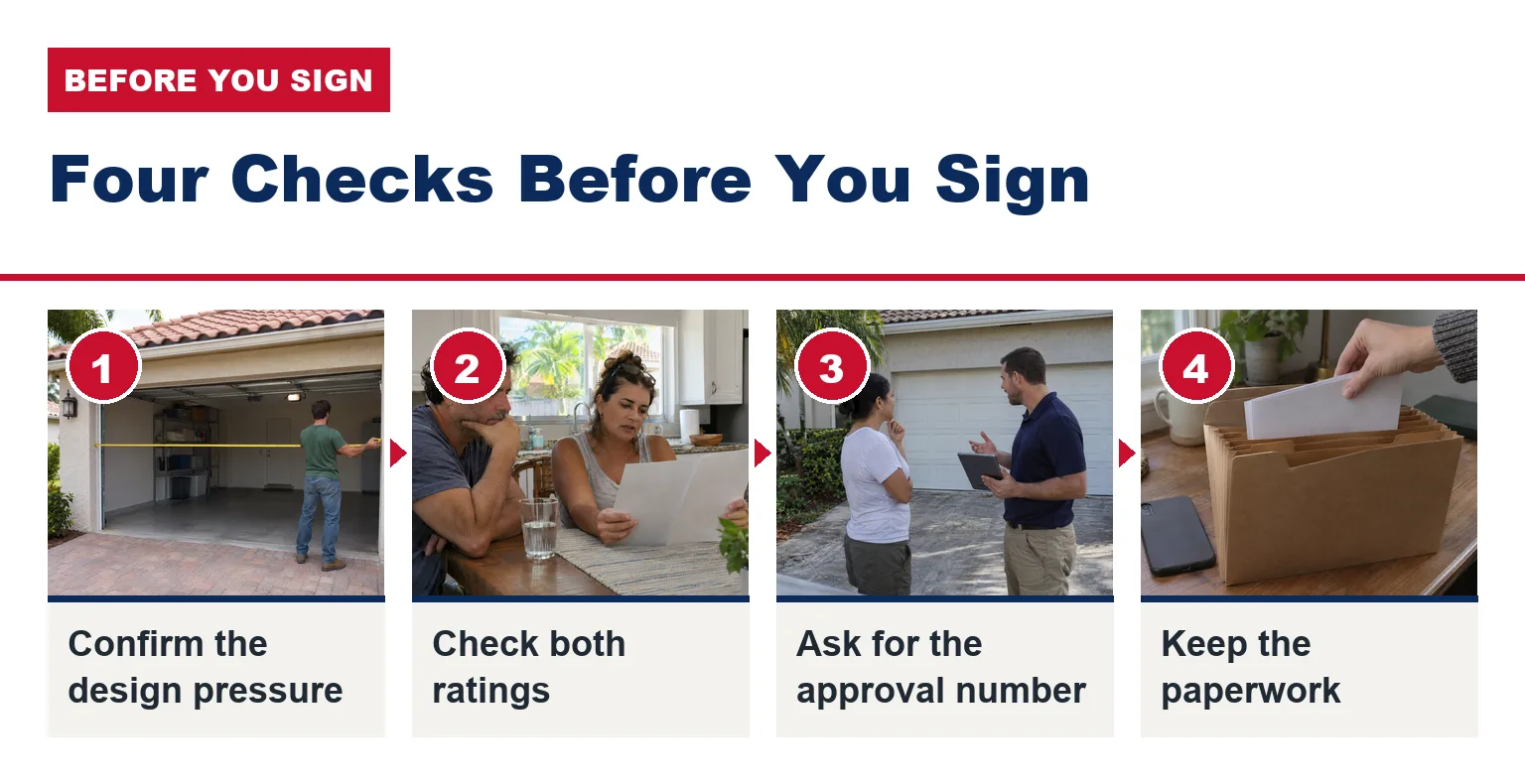
Four Checks Before You Sign a Garage Door Quote
A good quote answers these four points in writing.
- Confirm the design pressure. The door’s positive and negative ratings should meet or beat the pressures required for your opening.
- Check both ratings. If you want the refund or the best wind mitigation level, the door needs an impact rating as well as a wind pressure rating.
- Ask for the approval number. The Florida Product Approval or Miami-Dade NOA should cover your door size and design, and the quote should name it.
- Keep the paperwork. Keep the permit, the approval number, a photo of the label and the receipt showing sales tax paid.
Impact Garage Door FAQs
Do I need an impact garage door if my windows are already impact rated?
In Broward and Miami-Dade, outside doors fall under the impact rule, so a replacement garage door there needs an impact rating or an approved impact device. Elsewhere it depends on glass and location. On the wind mitigation form, a wind-load-only garage door caps an impact-window home at A.2.
Can I add impact glass to my existing garage door?
Be careful. A garage door’s approval covers the door as it was tested, so swapping panels or adding glass on your own can leave it outside its approval. Ask the manufacturer or installer whether an approved glazed version exists for your model and size.
Does the 2026 code make my current garage door illegal?
Not by itself. The 9th Edition sets the rules for new work, so a replacement door permitted after it takes effect must meet it. An older door can still hold back your wind mitigation rating.
How do I know which design pressure my garage needs?
It depends on the door’s width and height, the design wind speed for your address, the roof height and the exposure category. The code table covers common cases; others are calculated from ASCE 7. Your installer and building department confirm the number.
Choose the Rating Before You Choose the Style
If you live in Broward or Miami-Dade, or you want the refund or a top wind mitigation level, choose an impact-rated garage door. If you choose wind-load-only elsewhere, make sure the design pressure fits your opening and any glass is impact rated or protected.
Ask about financing for impact garage door projects. Financing may be available for qualified homeowners through independent third-party providers. Terms, eligibility and availability depend on the program and location.
USA Home Improvement is licensed (CGC1526707) and insured and has served Florida homeowners for more than 15 years. We handle the permit on every project.
Get a free estimate or call (877) 554-6373.