 Skip to content

Impact door requirements in Miami-Dade come down to three things: the door must carry a current Miami-Dade Notice of Acceptance (NOA) or a Florida Product Approval valid in the High-Velocity Hurricane Zone, it must be installed under a building permit, and it must pass inspection. Condo and HOA homes usually need association approval too.
This guide shows how to look up an NOA, what goes into a door permit, what the inspector checks, and how Broward and Palm Beach differ. For door types, testing and costs across the region, start with our South Florida impact door guide.
Why Miami-Dade Has the Strictest Impact Door Rules
Miami-Dade has the strictest rules because it sits in the High-Velocity Hurricane Zone (HVHZ). The HVHZ is the part of the Florida Building Code that applies only to Miami-Dade and Broward counties, with tougher wind and testing requirements than the rest of the state.
For doors, that has two practical effects. First, glass doors need opening protection: either impact-rated glass or an approved shutter or panel over the opening. Second, every exterior door you replace needs an approved product, even a solid door with no glass.
Miami-Dade’s permit checklist asks for the current NOA for each exterior door, garage door and glass door.
So in Miami-Dade, “impact door” is not just a feature on a brochure. It is a specific tested product, installed a specific way, and checked by the building department.
That is why you should ask for the approval number of each of the impact doors we install in Miami-Dade before you sign. We give you the Florida Product Approval number for each door on request.
What a Miami-Dade NOA Covers on an Impact Door
A Miami-Dade Notice of Acceptance (NOA) is the county’s approval document for a building product. It is issued by Miami-Dade Product Control after the manufacturer’s test reports and drawings are reviewed against the code.
An NOA for a door covers the whole door system as tested: the panels, glass, frame, hinges or rollers, locks, threshold and the anchors that hold it to the wall. It also sets limits.
The NOA lists the approved sizes and configurations, the design pressure the door is rated for, the glass types allowed and how the door must be installed. A door that is larger than the approval, or anchored differently, is outside its NOA.
Two more rules matter when you buy:
- NOAs expire. Each NOA states an expiration date, and Miami-Dade only accepts approvals for the current building code. The county’s Fast Track disclosure says expired “out of code cycle” approvals are not acceptable.
- Florida Product Approval can also work. Miami-Dade’s permit page says Florida Building Commission product approvals are acceptable. In the HVHZ, check that the Florida approval says it is valid for use in the HVHZ.
The lab tests behind an NOA, such as the large missile impact and pressure cycling, are explained in our guide to hurricane impact door testing.
How to Look Up an NOA in the Miami-Dade Product Control Database
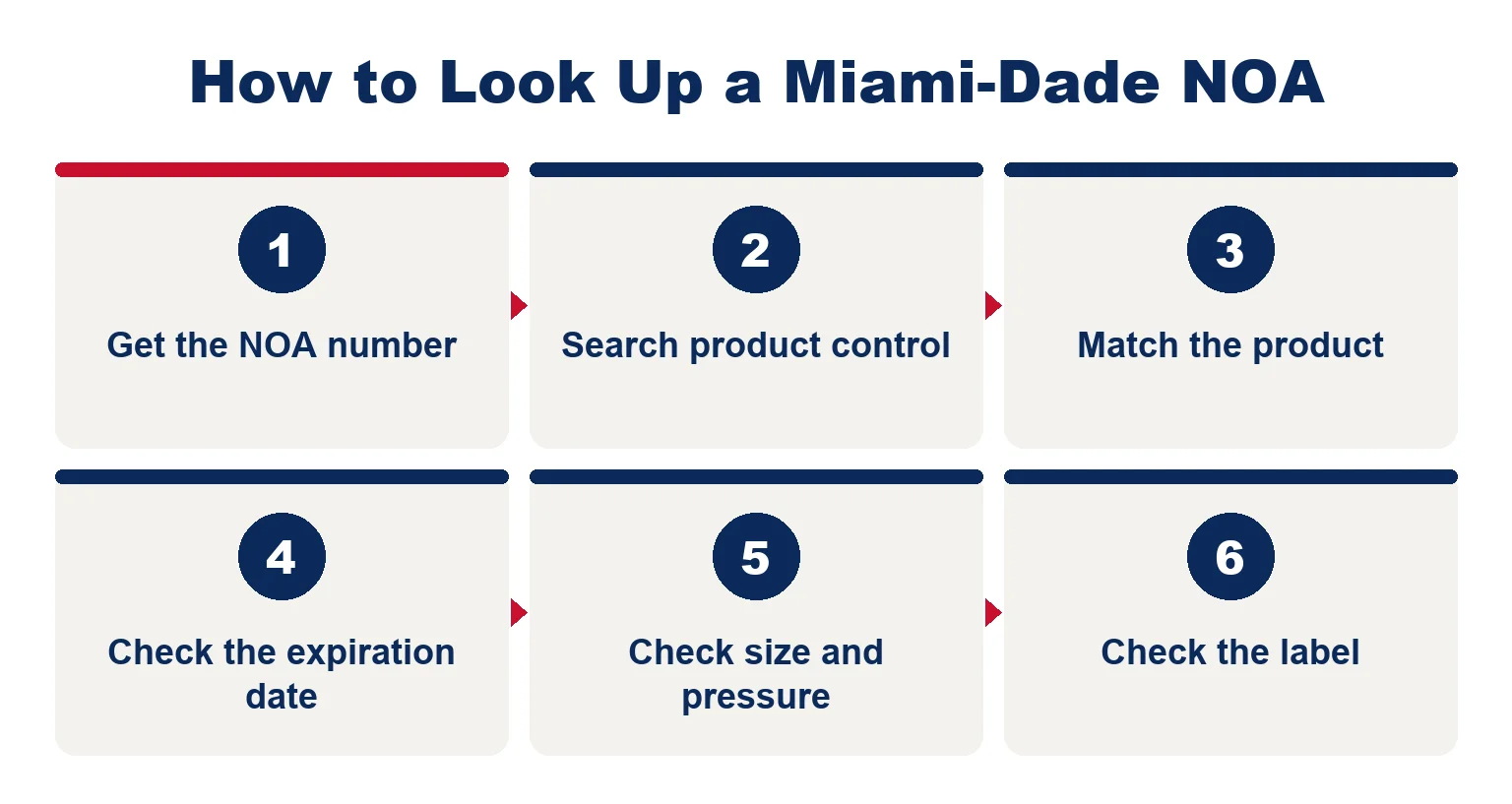
You can check any impact door’s NOA yourself in a few minutes. Miami-Dade publishes approvals in an online product approval search, linked from the Product Control page, and each NOA opens as a PDF.
- Get the NOA number for each door. Ask your installer for it on the quote, door by door. NOA numbers follow a pattern of two digits, a dash, four digits, a dot and two more digits.
- Search the product control database. Search by the NOA number, or by manufacturer if you only know the brand.
- Match the product. Open the NOA and confirm the manufacturer, door series and door type match what you were quoted. A brand name alone is not enough.
- Check the expiration date. The NOA must be current on the day the permit is applied for.
- Check size and design pressure. Make sure your opening size and panel layout are within the approved limits, and that the design pressure meets what your home needs at that opening.
- Check the label after installation. NOAs set how the product must be marked. Look for the manufacturer label on the door frame that shows the Miami-Dade approval.
If the approval is a Florida Product Approval instead, search it by its FL number on floridabuilding.org and check that it covers the HVHZ.
Permits for Replacing Impact Doors in Miami-Dade
Replacing an exterior door in Miami-Dade needs a building permit, and the office that issues it depends on your address. In unincorporated Miami-Dade, permits come from the county’s Department of Regulatory and Economic Resources (RER).
Many cities, including Miami, Miami Beach and Coral Gables, run their own building departments with their own forms, so check which one covers your home.
The county’s windows, shutters and doors permit page lists the same core papers for a door replacement:
- A completed building permit application for the work.
- A contact sheet.
- An elevation drawing of each wall with a replaced opening, showing each door’s size and product approval number.
- The current NOA (or Florida approval) for each product used. A different door model needs its own approval.
Several rules can change the permit. These come from the county’s Fast Track window and door disclosure statement:
- Fast Track is for exact swaps. It covers single-family homes and townhouses with a mean roof height of 30 feet or less, and only exact changeouts. Making an opening larger, adding one or closing one needs a regular permit review.
- The 25% rule. When more than 25% of the glazed openings are replaced, all the replaced glazed openings must meet impact requirements, with impact glass or an approved protection device. Glass doors count as glazed openings.
- The energy rule. If the window and door work is worth more than 30% of the building’s assessed value, the energy code requirements apply too.
- Garage doors have their own permit category. A garage door replacement is permitted and inspected separately.
Taller condo buildings follow stricter rules. For threshold buildings, such as those over three stories or 50 feet, the county requires a threshold inspection by a state-certified special inspector. A licensed installer normally pulls the permit for you; our team handles this for impact window and door installation in Miami.
What the Building Inspector Checks on a New Impact Door
The inspector checks that the door was installed the way its approval and permit say. For a standalone door permit under Miami-Dade’s Fast Track process, a final inspection is requested once the door is in, but before the interior frame perimeter is caulked, sealed or finished.
That timing is deliberate. The inspector needs to see the shim space and the fasteners, so the county also says not to install fastener cover plates that would hide them. A garage door replacement gets its final inspection once the overhead door is completely installed.
The county may do the inspection on site or by video.
After the permit is closed, keep the NOA, the permit record and your invoice together. A wind mitigation inspector uses them to confirm your doors count as protected openings, and a buyer’s inspector may ask for them when you sell.
HOA and Condo Approval for Impact Doors in Miami
If you live in a condo or a community with an HOA, get written association approval before you order doors. Impact doors are made to order, and a rejected color or style after fabrication is an expensive mistake.
Florida law limits how far an association can say no. Under Section 720.3035(6) of the Florida Statutes, every HOA board must adopt hurricane protection specifications that comply with the building code, and it may not deny an owner’s application for hurricane protection that meets those specifications.
The law names impact-resistant windows and doors and reinforced garage doors as hurricane protection.
Condominiums have a similar rule in Section 718.113(5). The board must adopt hurricane protection specifications for each building and may not refuse an owner’s installation that conforms to them. In both cases, the association can still require you to match the community’s existing look, such as frame color.
Before you apply, ask the association for:
- Its current hurricane protection specifications (frame color, glass tint, style).
- Its application form and what it needs from you, often the NOA and a product sheet.
- For condos, who is responsible for the doors under the declaration, the owner or the association.
- Any building rules for work hours, elevator use or contractor insurance.
How Broward and Palm Beach Rules Differ From Miami-Dade
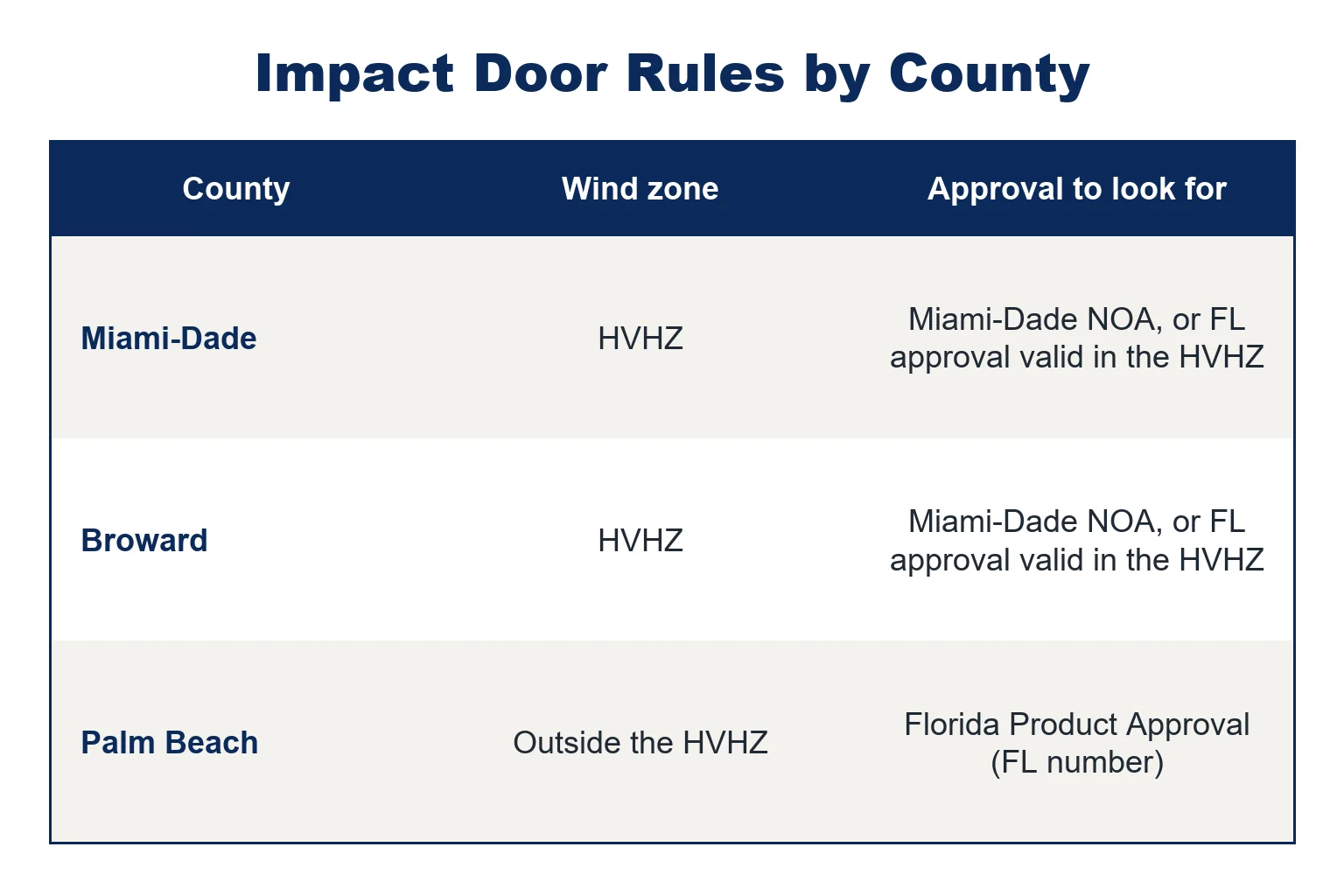
Broward follows almost the same door rules as Miami-Dade, because it is also in the HVHZ. Palm Beach County is outside the HVHZ, so the approval and testing route is different, although the whole county still needs hurricane-rated openings.
| County | Wind zone | Approval to look for | Permit from |
|---|---|---|---|
| Miami-Dade | HVHZ | Miami-Dade NOA, or Florida Product Approval valid in the HVHZ | RER or your city building department |
| Broward | HVHZ | Miami-Dade NOA, or Florida Product Approval valid in the HVHZ | Your city or county building department |
| Palm Beach | Wind-borne debris region, outside the HVHZ | Florida Product Approval (FL number); a Miami-Dade NOA is often accepted | Your city or county building department |
A few Palm Beach details are worth knowing. Palm Beach County treats the entire county as a wind-borne debris region. Products are approved under the state’s Florida Product Approval rule (Rule 61G20-3), and the county allows a local product approval case by case when a product has no state approval.
Some towns add their own review: the Town of Palm Beach sends shutter, window and door work through design review and asks for an HOA letter where one applies.
In every county, the permit office, forms and fees are local, so confirm the process with the building department for your address before work starts.
How to Pick a Door That Will Pass Miami-Dade Review
A door passes Miami-Dade review when its approval covers the exact opening: the size, the panel layout, the swing and the design pressure your home needs at that spot. Check the approval for each layout before you choose a style, and make sure the look also matches your HOA’s specifications.
- Patio openings: multi-panel impact sliders approved per layout come in several panel arrangements. Each panel layout has to be covered by the approval.
- Swing doors: in-swing and out-swing French impact doors suit openings where you want a wide, classic entrance. Each swing direction is its own setup in the approval and can carry a different rating.
- Garages: impact-rated garage doors close the largest opening on most houses and have their own permit.
Price depends on the door type, size, glass and installation work, so compare written quotes for the same approved product. Our Florida impact door cost breakdown shows what changes the price, and our checklist explains how to find an impact door company that pulls the permit and follows the approval.
For cleaning and salt-air care, see why impact doors matter for Miami homes.
Impact Door Rules in Miami: FAQs
Can I install an impact door myself in Miami-Dade?
Miami-Dade has an owner-builder route with an extra permit form, but the door must still be installed exactly as its NOA shows and pass inspection. Most homeowners hire a licensed installer, because anchoring, shimming and sealing mistakes are what fail inspections and cause leaks.
Can I replace just the glass in my impact door?
Yes, a damaged impact pane can usually be replaced, but the new glass must match what the door’s approval allows. Ask the installer to confirm the glass type with the manufacturer. Replacing it with ordinary glass leaves the opening unprotected.
Does a door approved for Palm Beach work in Miami-Dade?
Only if its approval covers the HVHZ. Many Florida Product Approvals are valid outside the HVHZ only. In Miami-Dade, look for a current Miami-Dade NOA or a Florida approval that says it is valid in the HVHZ.
How do I know if my existing doors are already impact rated?
Look for a manufacturer label on the frame, check the glass for an impact marking, and ask for the permit history of the house. Our guide shows how to tell if your existing doors are hurricane rated.
Let Us Handle the Approval, Permit and Inspection
Getting impact doors right in Miami-Dade means the right approved product, a clean permit and a door that passes inspection the first time. Our team quotes the approval for every door, pulls the permit and schedules the inspection.
If budget is the concern, look at our monthly financing for door replacements, or call (877) 554-6373 for a free consultation.
USA Home Improvement is licensed (CGC1526707) and insured and has served Florida homeowners for more than 15 years.