Skip to content

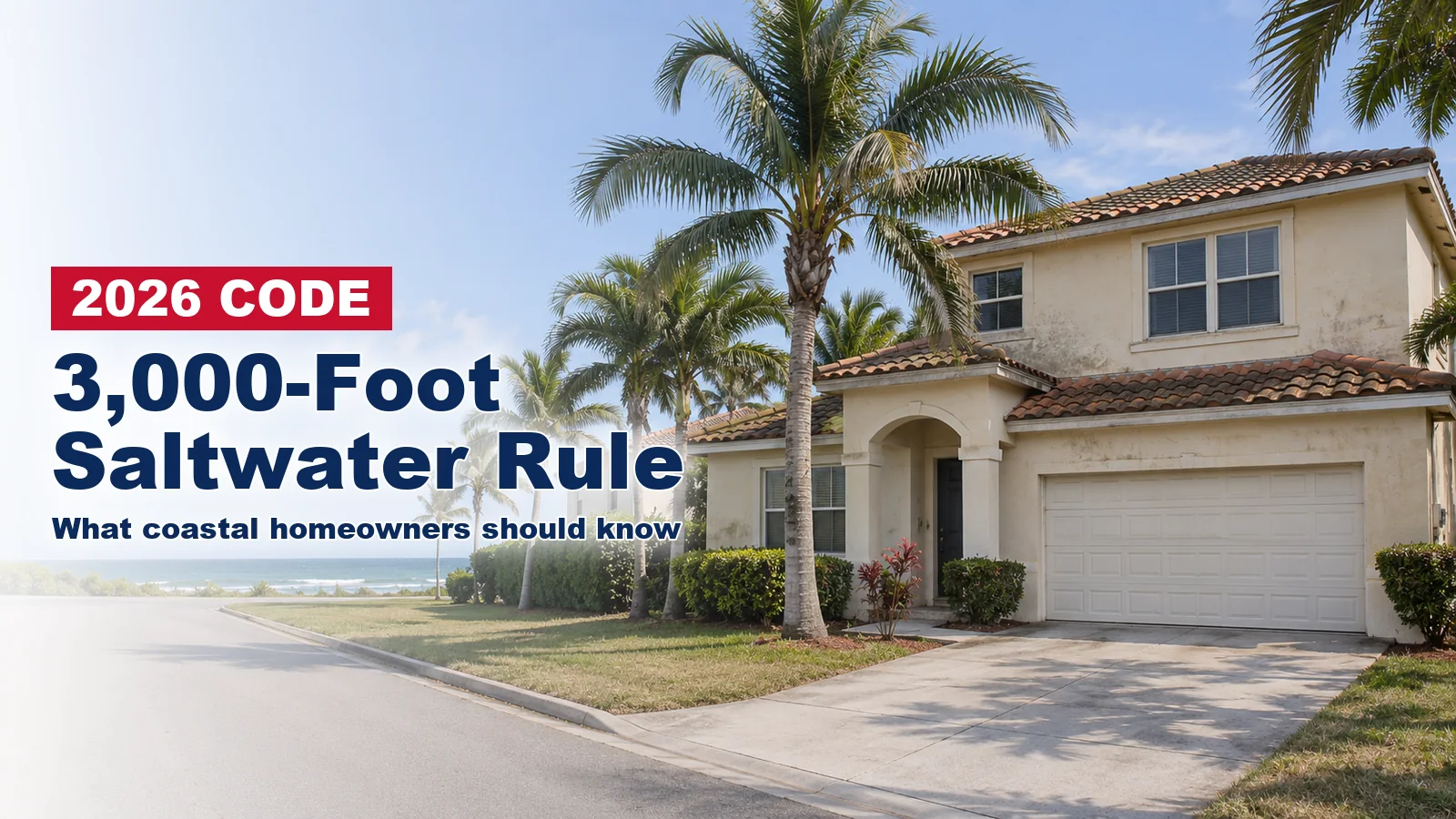
From December 31, 2026, the 9th Edition (2026) Florida Building Code requires corrosion-resistant fasteners and connectors in new permitted work on homes within 3,000 feet of a saltwater coastline. The new Section R332 sets the level by distance and exposure: stainless steel for outdoor hardware within 300 feet, and set grades of galvanizing elsewhere.
The rule reaches the hardware in floors, walls, wall coverings and roof framing, plus the nails, screws and clips that hold a roof covering. This guide shows how to tell if your home is inside the line, which parts are covered, and what to ask before a coastal roof or window project.
For the effective date, permit timing and county cutoffs, see our guide to the 2026 Florida Building Code for South Florida homeowners.
What the 3,000-Foot Saltwater Rule Says
The core rule is one sentence. Section R332.1 of the Florida Building Code, Residential says: “Fasteners and connectors in areas within 3,000 feet (914 m) of a saltwater coastline shall comply with Sections R332.1.1 and R332.1.2.”
The only exception is for “fasteners and connectors fully embedded in concrete or mortar.” Everything else in the band must meet the corrosion level that Table R332.1 assigns to it.
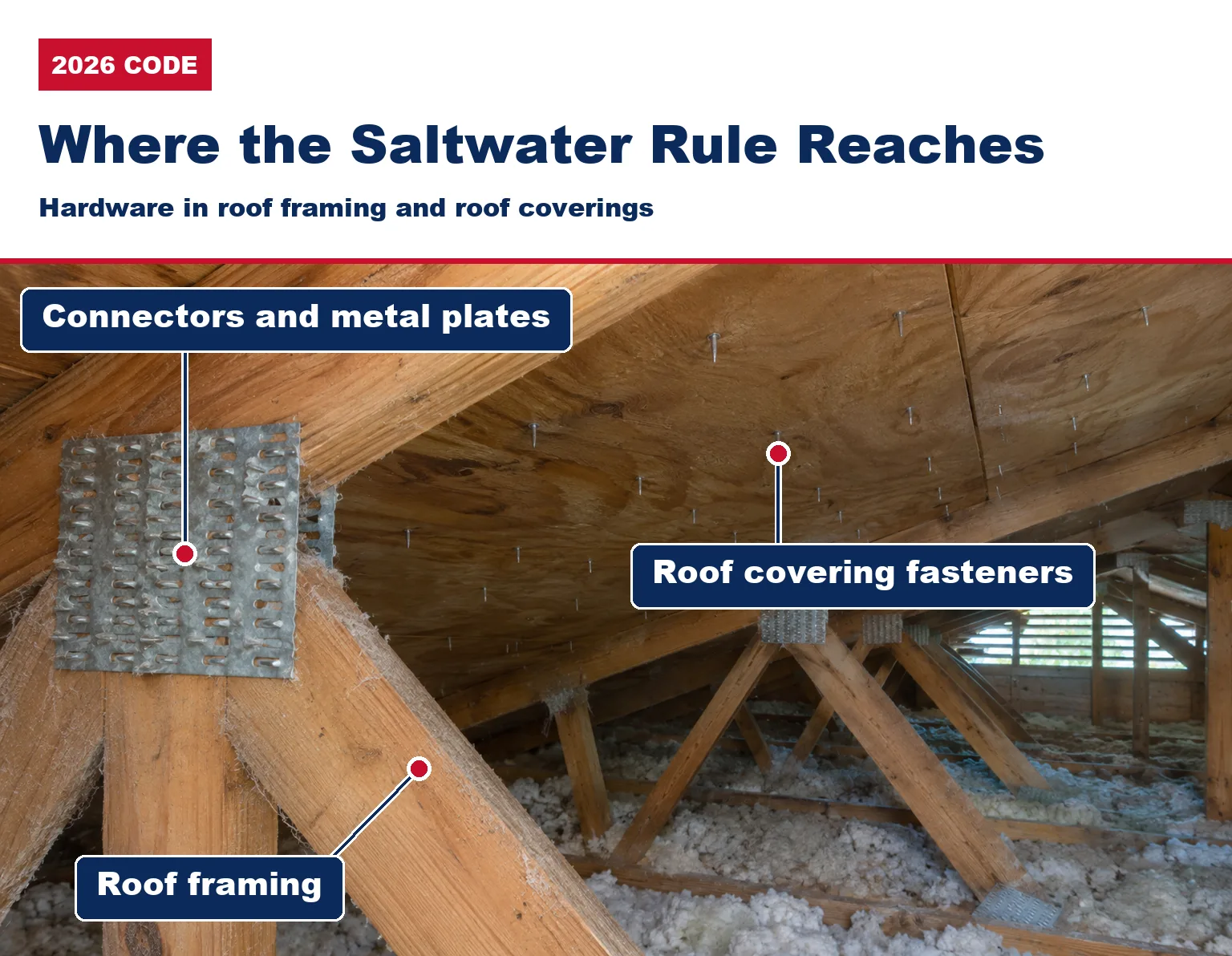
In plain words, fasteners are the screws, bolts, lag screws (with their nuts and washers), nails and glulam rivets that hold parts together. Connectors and metal plates are the metal pieces that join framing members, for example straps, hangers and the toothed plates on roof trusses.
According to the Florida Building Commission’s analysis of changes, the levels depend on distance from the coastline and on “the level of exposure to salt-laden air.” The Florida Building Code, Building carries the same rule as Section 1711.
How to Tell If Your Home Is Within 3,000 Feet of a Saltwater Coastline
3,000 feet is about 0.57 of a mile, and the code draws a second, closer line at 300 feet. The quickest check takes a few minutes with a phone:
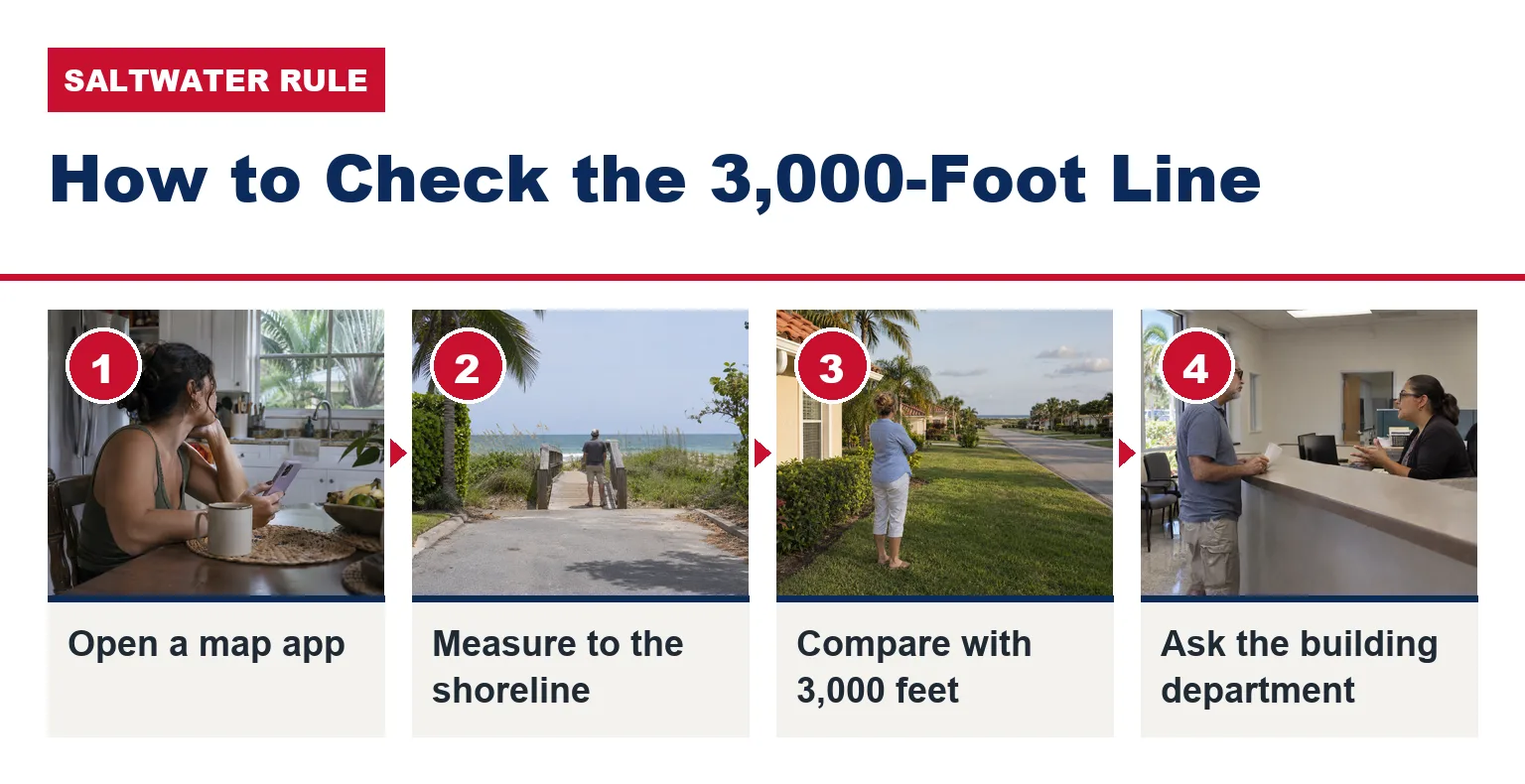
- Open a map app and find your house.
- Measure to the shoreline with the app’s distance tool: once to the nearest ocean or bay shoreline, and once to the nearest canal or Intracoastal water.
- Compare with 3,000 feet, and with 300 feet if you live close to the water.
- Ask the building department how it measures before you rely on your own reading.
Canals and the Intracoastal Waterway are the hard cases. FRSA, the Florida roofing contractors’ association, points out that the code does not define where the coastline is.
FRSA also reported that a declaratory statement request may already be before the state, asking whether the distance also counts from saltwater and brackish canals and rivers connected to the coast.
Engineering Express, a Florida engineering firm, reads “saltwater coastline” as a coastal saltwater body subject to crashing waves and does not generally treat inland canals as coastline. That is one firm’s interpretation. The building official for your city or county makes the call for your permit.
Which Parts of the House the Saltwater Rule Covers
The 2026 residential code points to Section R332 from five places, so the rule follows the hardware through the house:
- Floors (R501.3): floor framing hardware, including wood decks, which the code covers in the same chapter.
- Walls (R601.3): fasteners and connectors in wall construction, such as wood-framed walls.
- Wall coverings (R701.3): the fasteners that hold exterior wall coverings, such as siding.
- Roof framing (R801.4): the hardware in roof and ceiling construction, such as truss and rafter connections.
- Roof covering fasteners (R904.5.1 to R904.5.3): nails, screws and clips. Each section says that within 3,000 feet of a saltwater coastline they “shall comply with Section R332.”
Hardware fully embedded in concrete or mortar is exempt, which matters in a concrete block house. Outside that exception, Table R332.1 sets a level for fasteners and connectors outdoors and in unconditioned spaces such as the attic.
Planning a new roof near the water? See how USA Home Improvement handles roof replacement for South Florida homes, with permitting handled for you.
Stainless Steel or Galvanized: How Distance and Exposure Set the Level
Table R332.1 sets the level by two things: distance from the coastline and how exposed the hardware is to salt air. The code’s footnote describes four kinds of location:
- Exterior partially sheltered: outside and exposed to salt air, but not reached by fresh rainwater that would rinse the salt off.
- Exterior open exposed: outside and exposed to salt air, but rinsed by rain and more likely to dry.
- Unconditioned interior vented enclosed: inside a part of the building with vents that let salt air in, such as a vented attic.
- Unconditioned interior unvented enclosed: inside the building, but not in the air-conditioned living space.
| Location of the hardware | Within 300 feet | 300 to 3,000 feet |
|---|---|---|
| Outside (partially sheltered or open exposed) | Fasteners: stainless steel. Connectors and plates: Type 316 stainless steel | Fasteners: galvanized. Connectors and plates: enhanced galvanized |
| Inside, vented (such as a vented attic) | Fasteners: galvanized. Connectors and plates: enhanced galvanized | Fasteners: galvanized. Connectors and plates: enhanced galvanized |
| Inside, unvented, outside the living space | Fasteners: galvanized. Connectors and plates: standard galvanized | Fasteners: galvanized. Connectors and plates: standard galvanized |
So stainless steel is required only for outdoor hardware within 300 feet. Stainless fasteners must be Type 304, 305 or 316, and stainless connectors Type 316. Galvanized fasteners must meet a listed zinc coating standard or salt-spray test result.
For connectors, enhanced galvanizing includes a G185 zinc coating, which is heavier than the G90 coating allowed for standard galvanizing. A protective coating under the truss plate standard TPI 1 is also allowed for both.
The code also requires fasteners to be compatible with the connectors they hold, “to prevent corrosion from galvanic action between dissimilar materials.” In plain words, mixing the wrong metals can make one of them corrode faster.
What the Saltwater Rule Means for a Re-Roof Near the Coast
Within 3,000 feet of a saltwater coastline, the nails, screws and clips that hold a new roof covering must meet Section R332, and so must any new roof framing hardware. A re-roof is one of the most common projects where coastal homeowners will see this rule on a quote.
FRSA’s technical director wrote that Florida’s existing roofing fastener rules were already demanding, and that the new section should change the required fasteners in only a few situations, mainly for buildings very close to saltwater.
He also warned that many galvanized shingle fasteners sold for use beyond the 3,000-foot line may not meet the new rule. FRSA suggests that roofers write on the purchase order that the galvanized fasteners meet one of the code’s listed methods, or use stainless steel.
For you, that becomes one line to request on the roofing quote: which fasteners will be used and how they meet Section R332. Other roof rules change on the same date, from underlayment laps to drip edge; see what else changes for roofs under the 2026 code.
Planning roof or window work near the coast? Request a free estimate or call (877) 554-6373. Every USA Home Improvement project is permitted.
Does the Saltwater Rule Cover Impact Window and Door Anchors?
Ask before you sign, because the answer depends on how your building department reads the wall chapter. The code’s pointer to R332 for walls (R601.3) sits in the same chapter as the section on exterior windows and doors (R609).
Ask how the rule applies to the anchors and screws that attach a window or door to your wall. Engineers who prepare product approvals are already planning for it.
Engineering Express, which prepares Florida Product Approval drawings, lists anchors, screws, straps and clips that secure a product to the building as hardware that “may be affected,” and says it is updating applicable drawings and approval documents.
USA Home Improvement installs ES Windows aluminum and vinyl impact windows for coastal homes, plus impact doors. Customers can receive the Florida Product Approval number for each window and door on request, so you can see the approval that applies. Here is how to check whether your windows and doors are hurricane rated.
For the other window and door rules in the new code, read 2026 code updates for windows and doors.
Salt-Air Care for Windows and Doors Near the Ocean
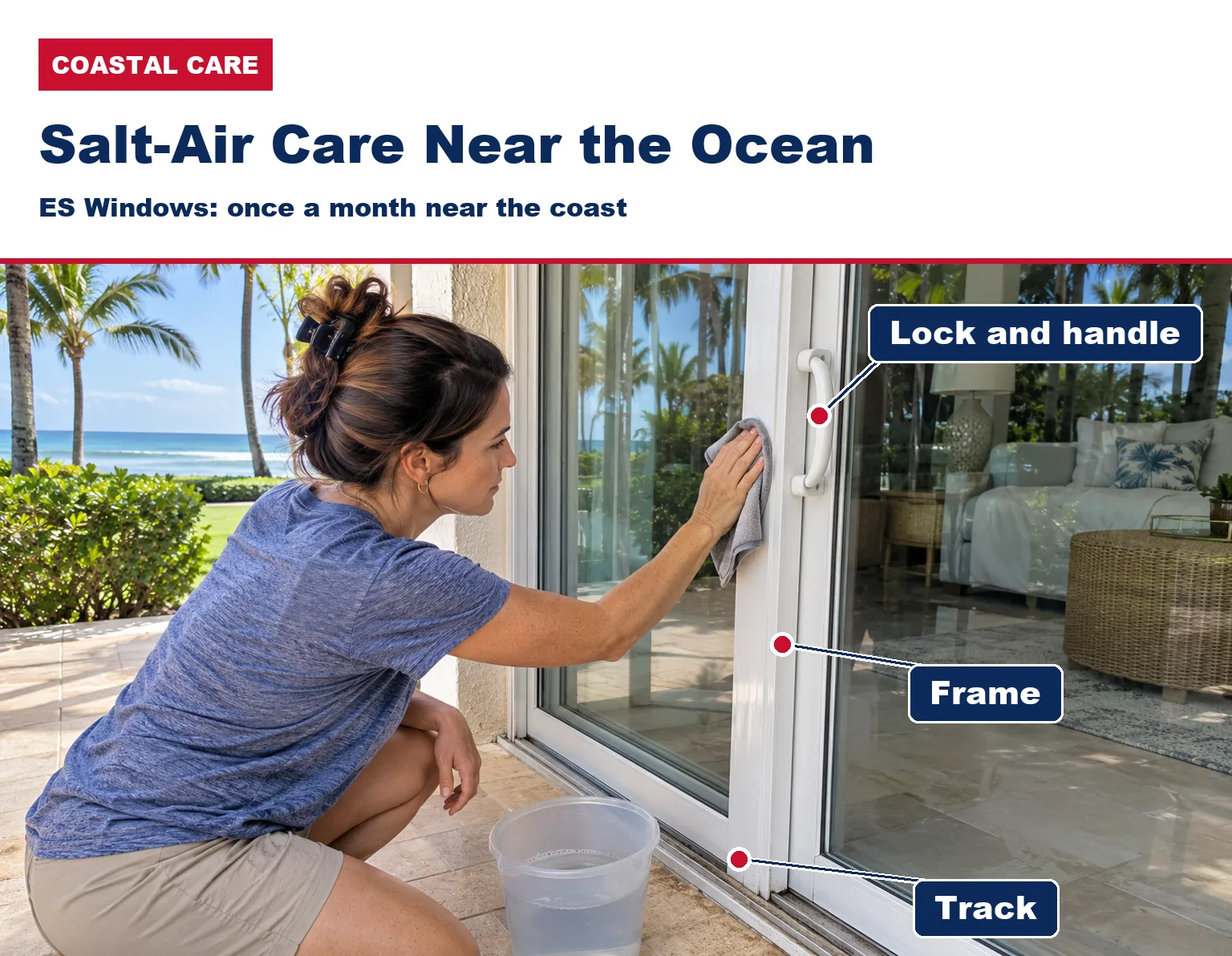
Homes near the ocean need more frequent window and door cleaning: the ES Windows care and maintenance page recommends once a month near the coast. Rinse the frame, track, lock and handle. Our salt-air care routine for impact windows and doors covers what to use, what to avoid and a simple schedule.
Planning new openings near the coast? Our guide to choosing coastal impact windows compares frames, styles and costs.
Questions to Ask Before a Coastal Roof or Window Project
Bring these questions to any contractor quoting work within about a half mile of the water:
- Is my home within 300 feet or 3,000 feet of a saltwater coastline, and how did you measure it?
- Which exposure applies to each part of the job: outside, a vented attic or an unvented space?
- Which fasteners and connectors does the quote specify: stainless steel, or which level of galvanizing?
- For windows and doors, which installation anchors do the approval documents call for at my address?
- Does the quote list the fastener and connector levels for each exposure, in writing?
Saltwater Rule FAQs
Do I have to replace the hardware on my existing home?
Not by itself. A new code edition sets the rules for new permit applications, and Section R332 applies to the fasteners and connectors used in work permitted under the 2026 code, such as a re-roof, new roof framing or a new deck, not to hardware the project leaves in place.
Does the saltwater rule apply in Miami-Dade and Broward?
Yes. The code defines the High-Velocity Hurricane Zone as Broward and Miami-Dade counties, and most residential chapters send HVHZ homes to a separate HVHZ chapter. Section R301.1, though, says HVHZ buildings “shall comply with Sections R302 to R332, inclusive,” which includes the saltwater section.
Is a hurricane strap set in concrete exempt?
Only hardware “fully embedded in concrete or mortar” is exempt. A strap that runs from the concrete beam on top of a block wall up into the attic is partly exposed, so do not assume it is exempt. Your building official makes the final call.
Will the saltwater rule make my project cost more?
It depends on your distance from the water, how exposed each part is and the hardware the job already used. FRSA expects roofing fasteners to change in only a few situations. Ask for the fastener and connector specification in writing so you can compare quotes on the same basis.
Where can I read the saltwater rule myself?
Section R332 is in Chapter 3 of the Florida Building Code, Residential, which can be read free on the ICC code website. The Florida Building Commission’s analysis of changes for the 9th Edition summarizes the section and lists the related changes in each chapter.
Check the Line Before You Sign
If your home is more than 3,000 feet from a saltwater coastline, Section R332 does not apply to work on it. If it is inside the line, or near a canal where the answer is unclear, settle the distance and the fastener specification before you sign a roof or window contract.
USA Home Improvement is licensed (CGC1526707) and insured and has served Florida homeowners for more than 15 years. We sell ES Windows exclusively, and our window and door installation team holds direct certification from the manufacturer.
Get a free estimate or call (877) 554-6373.