Skip to content


The 2027 Atlantic hurricane names are Ana, Bill, Claudette, Danny, Elsa, Fred, Grace, Henri, Imani, Julian, Kate, Larry, Mindy, Nicholas, Odette, Peter, Rose, Sam, Teresa, Victor and Wanda. The 2027 Atlantic hurricane season runs from June 1 to November 30, 2027.
This guide gives the official list with pronunciations and explains what earns a storm a name, how names are retired and what happens if all 21 are used. It ends with what South Florida homeowners can do before the first name is used.
The 2027 Atlantic Hurricane Names, in Order
The 2027 names come from the National Hurricane Center (NHC) tropical cyclone names page, and the World Meteorological Organization (WMO) Atlantic list shows the same 21 names. The first named storm of 2027 is Ana, the second Bill, and so on down the list.
The pronunciations below come from the NHC’s Atlantic storm name pronunciation guide.
| Order | 2027 name | How the NHC says it |
|---|---|---|
| 1 | Ana | AH-nah |
| 2 | Bill | bill |
| 3 | Claudette | klaw-DET |
| 4 | Danny | DAN-ee |
| 5 | Elsa | EL-suh |
| 6 | Fred | frehd |
| 7 | Grace | grayss |
| 8 | Henri | ahn-REE |
| 9 | Imani | ee-MAH-nee |
| 10 | Julian | JOO-lee-uhn |
| 11 | Kate | kayt |
| 12 | Larry | LAIR-ree |
| 13 | Mindy | MIN-dee |
| 14 | Nicholas | NIH-kuh-luss |
| 15 | Odette | oh-DEHT |
| 16 | Peter | PEE-tur |
| 17 | Rose | rohz |
| 18 | Sam | sam |
| 19 | Teresa | tuh-REE-suh |
| 20 | Victor | VIK-tur |
| 21 | Wanda | WAHN-duh |
The 2027 list is the same one used in 2021, with one change. Imani takes the place of Ida, a name the WMO retired in 2022, so Imani is the only name on the list that has not been used before.
When the 2027 Atlantic Hurricane Season Starts and Ends
The 2027 Atlantic hurricane season starts on June 1 and ends on November 30, 2027. The NHC glossary defines hurricane season as the part of the year with a relatively high incidence of hurricanes, June 1 to November 30 for the Atlantic, the Caribbean and the Gulf.
Storms do not always follow the calendar. The NHC climatology page notes that tropical cyclone activity sometimes occurs before and after those dates, and it puts the peak of the Atlantic season on September 10.
Off-season storms still get names, based on the calendar date. The NHC’s rule means a storm that forms in late December 2026 takes a name from the 2026 list, while a storm that forms in February 2027 takes its name from the 2027 list, starting with Ana.
For homeowners, June 1 is a planning date, not a promise of quiet weather before it. If you want new windows in place before the season, look early at the ES Windows impact windows we install in South Florida homes, because manufacturing alone takes weeks.
What Counts as a Named Storm
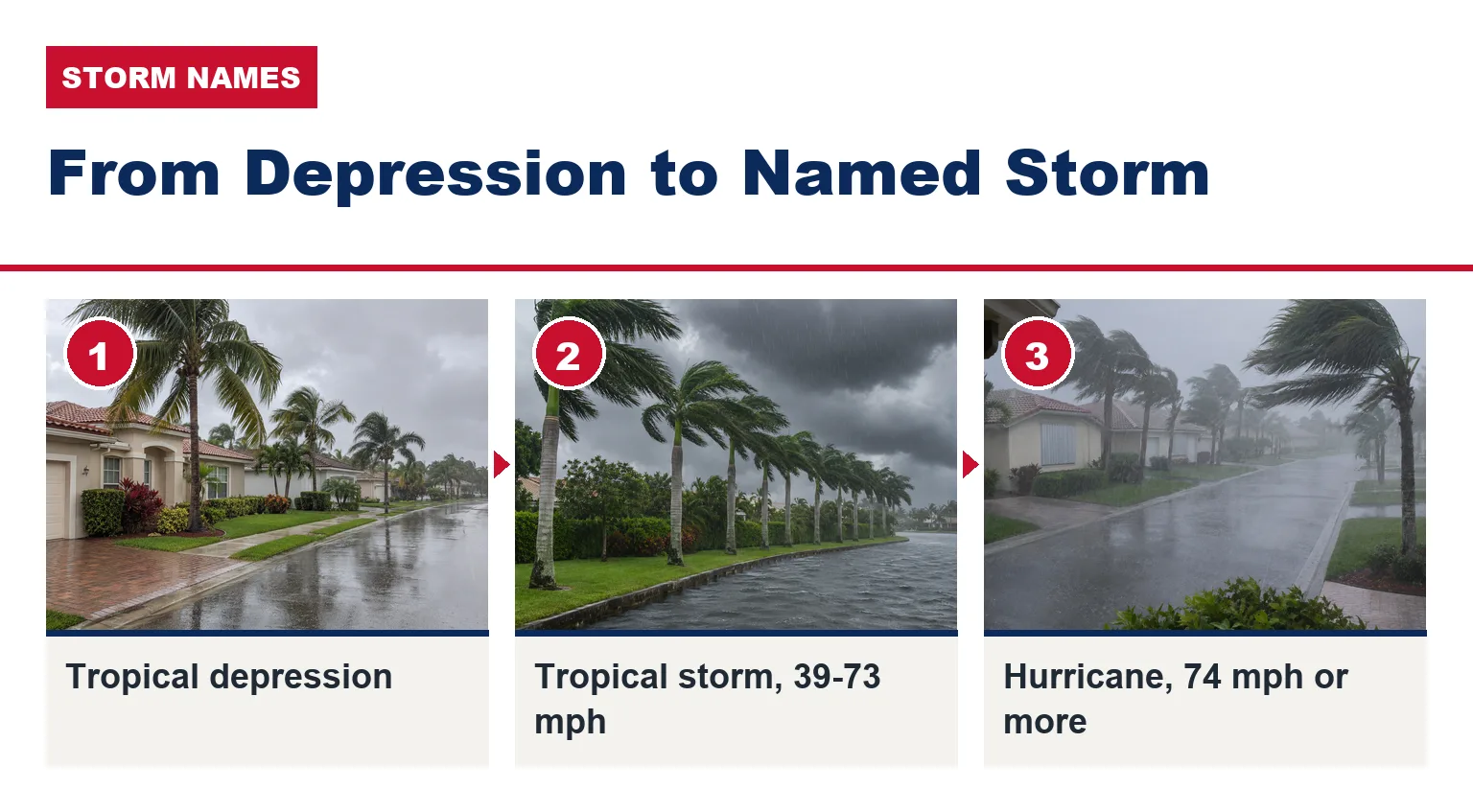
A storm gets a name when it reaches tropical storm strength. The NHC classifies a tropical storm as a tropical cyclone with maximum sustained winds of 39 to 73 mph (34 to 63 knots).
The NHC also names subtropical storms with winds of 39 mph or more. In 2021, the last time this list was used, both Ana and Wanda started as subtropical storms.
NOAA’s JetStream weather school says the same in plain words: once a tropical cyclone reaches winds of at least 39 mph, it is typically called a tropical storm and assigned a name. A tropical depression, with sustained winds of 38 mph or less, is not named yet.
A named storm that strengthens to 74 mph or more is called a hurricane, as Ida was in 2021. At 111 mph or more, Category 3 or higher on the Saffir-Simpson Hurricane Wind Scale, it is a major hurricane.
So a name tells you a storm has reached at least tropical or subtropical storm strength. It does not tell you how strong the storm is now or where it is heading; the NHC advisories for that storm do.
How Atlantic Hurricane Names Are Chosen and Rotated
The NHC does not pick hurricane names. The WMO’s Regional Association IV Hurricane Committee keeps the Atlantic lists, and the WMO naming fact sheet says the names are proposed by its members’ national weather services.
Six lists are used in rotation, and each one comes back every six years. The NHC gives the example that the 2026 list will be used again in 2032. By the same rotation, the 2027 list returns in 2033.
Each Atlantic list has 21 names. The WMO says it leaves out Q, U, X, Y and Z because it is hard to find six suitable names for each of those letters, and it balances English, French and Spanish names to reflect the region the storms reach.
The names also alternate between male and female. You can see it at the top of the 2027 list: Ana, Bill, Claudette, Danny.
Planning window or door upgrades before the 2027 season? Request a free estimate from USA Home Improvement or call (877) 554-6373.
Why Ida Is Not on the 2027 List: How Hurricane Names Are Retired
A hurricane name is retired when a storm is so deadly or costly that using the name again would be inappropriate for reasons of sensitivity, in the NHC’s words. Any WMO member country can ask, and the Hurricane Committee decides at the session that follows the season.
That is why the 2027 list has Imani. In April 2022, the WMO Hurricane Committee retired Ida because of the death and destruction the Category 4 hurricane caused in the United States in 2021, and Imani replaced it.
In March 2026, the committee retired Melissa from the 2025 season and chose Molly, which the WMO says will be used in 2031. A name retired after the 2026 season would be replaced on the 2026 list, which returns in 2032, so it cannot change the 2027 names.
Many retired names are familiar in Florida. The NHC list of retired Atlantic names includes Andrew (1992), Charley (2004), Wilma (2005), Irma (2017), Ian (2022) and Milton (2024).
Our look back at five of the worst hurricanes in Florida’s history covers several of those storms.
What Happens if the 2027 List Runs Out
If more than 21 named storms form in 2027, the extra storms take names from the WMO’s supplemental Atlantic list. In order, it reads Adria, Braylen, Caridad, Deshawn, Emery, Foster, Gemma, Heath, Isla, Jacobus, Kenzie, Lucio, Makayla, Nolan, Orlanda, Pax, Ronin, Sophie, Tayshaun, Viviana and Will.
The supplemental list replaced the Greek alphabet. Greek letters were used twice, in 2005 and in 2020, a season with 30 named storms. In March 2021, the WMO Hurricane Committee ended the use of the Greek alphabet.
The committee gave its reasons. Greek names drew attention away from storm impacts and safety messages, some were confusing in other languages, and Zeta, Eta and Theta sounded alike. Names on the supplemental list can be retired and replaced too.
Running out is uncommon. Based on 1991 to 2020, the NHC says an average Atlantic season has 14 named storms, 7 hurricanes and 3 major hurricanes.
Before the First 2027 Name Is Used: Plan Your Windows Now
Ana can arrive before June 1, because the first named storm of 2027 takes that name whenever it forms. That makes the off-season the practical time for a window project.
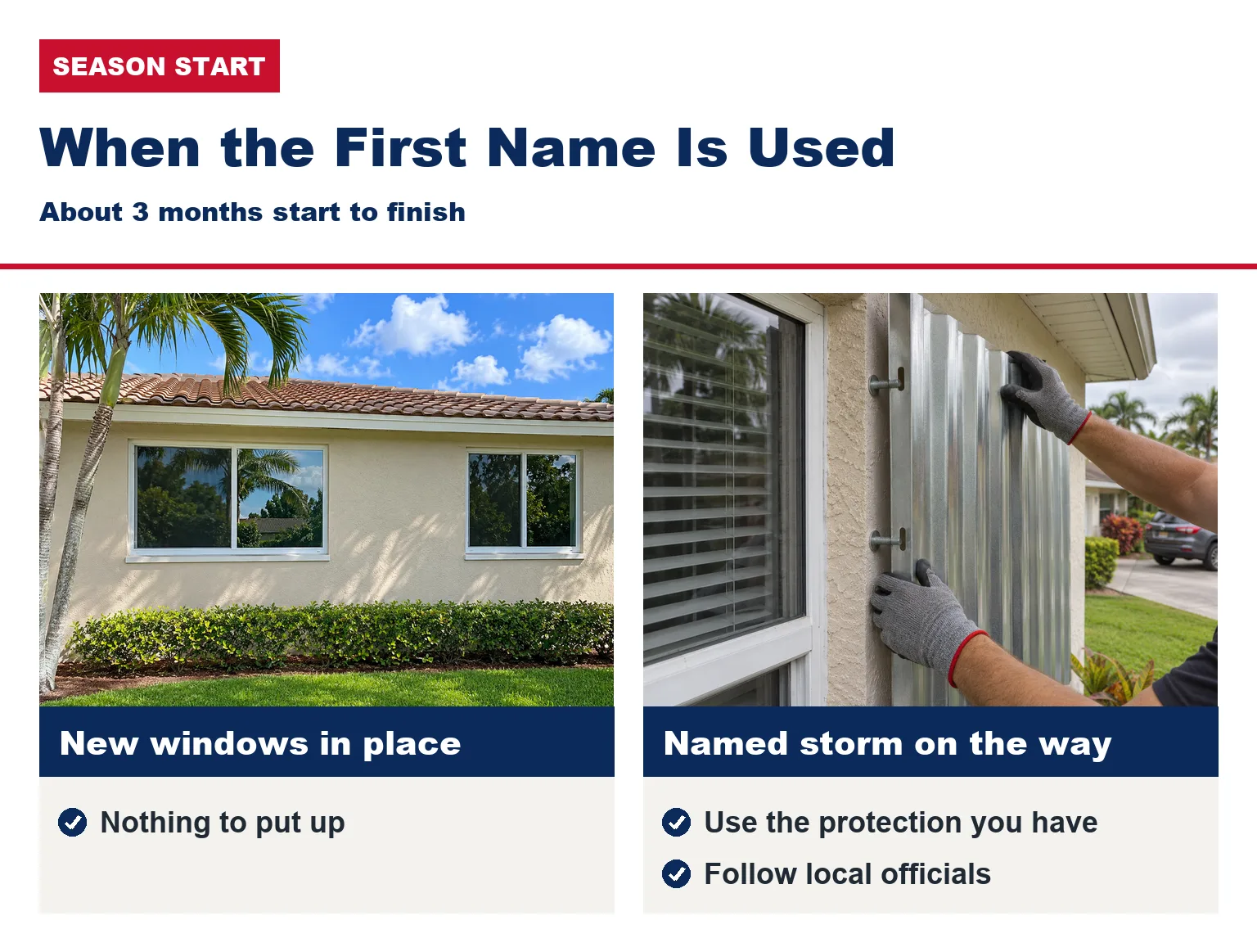
At USA Home Improvement, manufacturing takes about 6 to 8 weeks depending on project scope, and installation averages 1 to 2 days. The whole process takes about 3 months start to finish, though it can vary.
Every USA Home Improvement project is permitted, and HOA approval is needed only when the property has an HOA. Our installation team holds direct certification from the manufacturer.
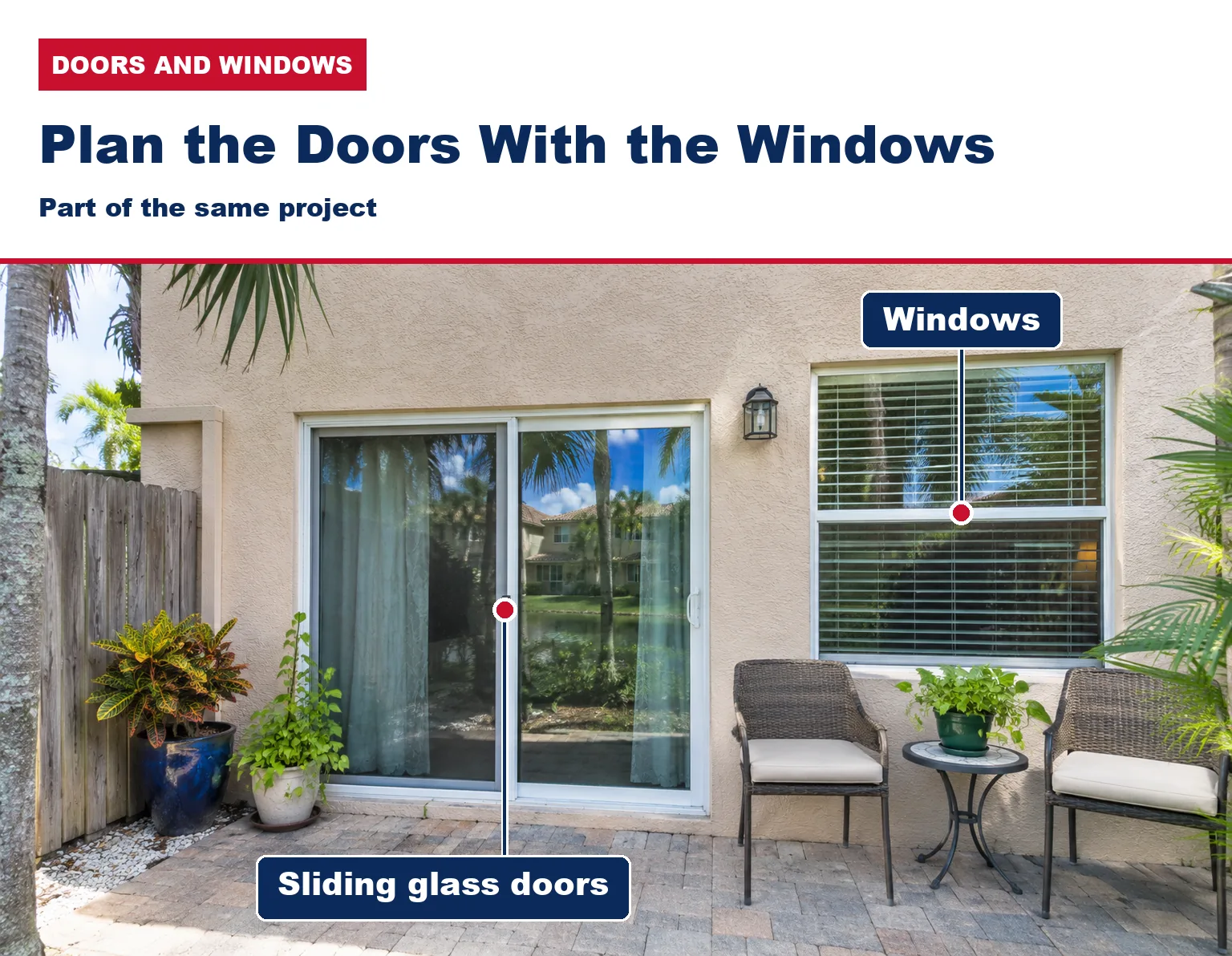
Plan the doors with the windows. Sliding glass doors and entry doors are openings too, and impact doors for patios and entries can be part of the same project.
If a named storm is already on the way, a new order will not be ready for that storm, so use the protection you have: shutters, panels or plywood for the storm in front of you. Impact windows do not change an evacuation order; follow local officials.
Before you sign, check when Florida’s code requires impact windows or shutters and how an impact rating differs from a “hurricane window” label.
For budgets, see Florida impact window prices and what drives them. Our South Florida impact window guide to styles, frames and county rules brings the rest together.
2027 Hurricane Names FAQs
What is the first hurricane name of 2027?
Ana is the first Atlantic name of 2027. The first storm to reach tropical or subtropical storm strength in 2027, even one that forms before June 1, is named Ana. It is only called Hurricane Ana if its sustained winds reach 74 mph or more.
Will there be a Hurricane Imani in 2027?
Only if 2027 has at least nine named storms and the ninth one strengthens to 74 mph or more. Imani is the ninth name on the list and replaced Ida, which the WMO retired in 2022. In the NHC’s 1991 to 2020 averages, the ninth named storm forms around September 16.
Do hurricane names repeat?
Yes. The six Atlantic lists rotate, so the 2027 list was last used in 2021 and returns in 2033. The only change comes when the WMO retires a name for a deadly or costly storm and chooses a replacement, as it did when Imani replaced Ida.
Can a storm be named before hurricane season starts?
Yes. A storm that reaches tropical or subtropical storm strength before June 1 still gets a name, from the list for that calendar year. In 2021, for example, Ana was already a subtropical storm on May 22. A storm that forms in spring 2027 would take the first unused 2027 name.
Can I get a hurricane named after someone?
No. The NHC says it does not control the naming of tropical storms; the WMO committee sets the lists in advance. The WMO also notes that tropical cyclones are not named after individuals, so requests for a person’s name are not taken.
Plan Your 2027 Window Project Before Ana Forms
If you want windows with nothing to put up when the 2027 names start, begin the project early in the year. The whole process takes about 3 months start to finish, though it can vary, so winter is the right time for a free estimate.
See ways to pay for an impact window and door project. Financing may be available for qualified homeowners through independent third-party providers. Terms, eligibility and availability depend on the program and location.
USA Home Improvement is licensed (CGC1526707) and insured and has served Florida homeowners for more than 15 years.
Get a free estimate or call (877) 554-6373.