Skip to content

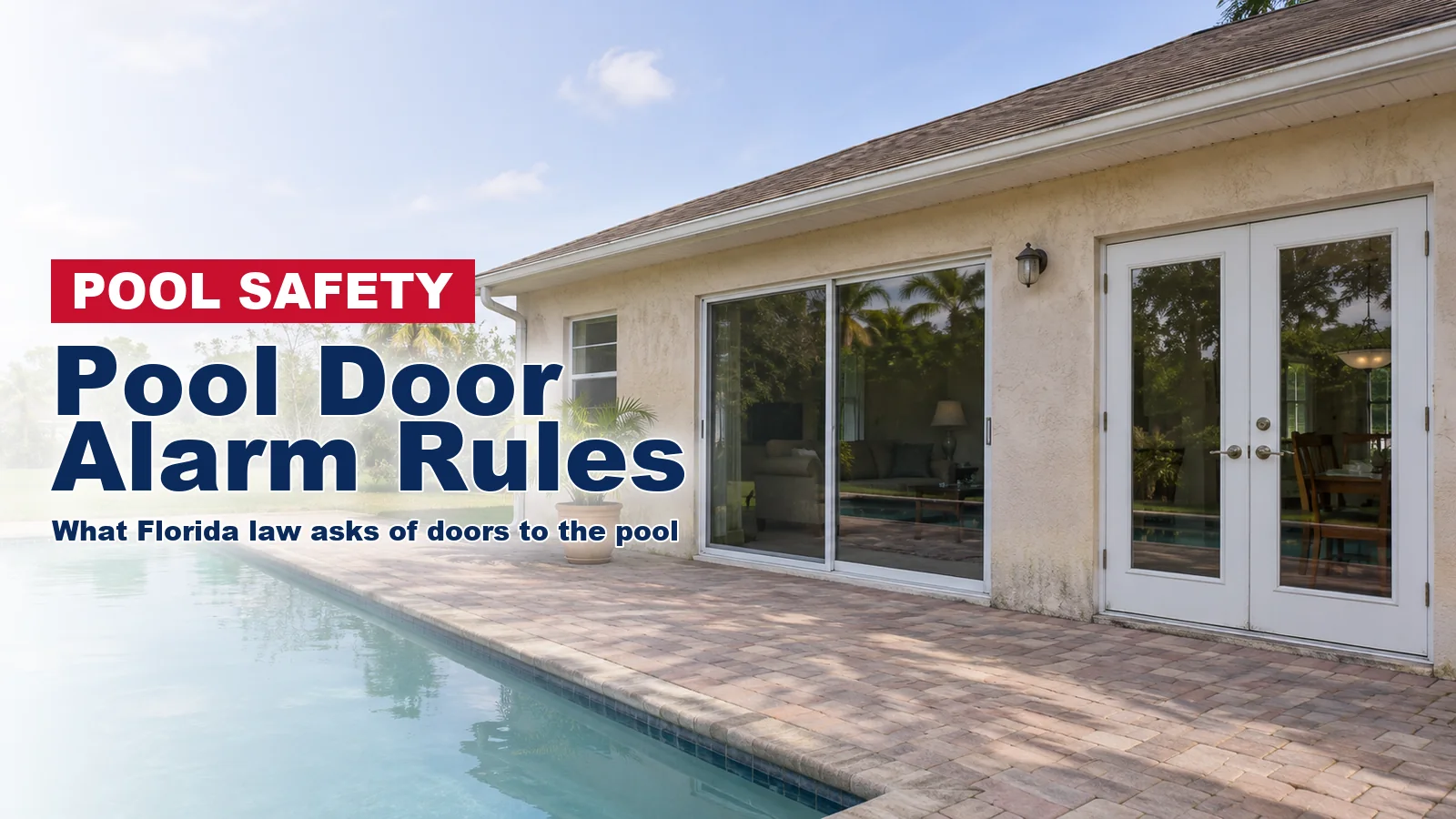
Florida does not require door alarms on every home pool. The Residential Swimming Pool Safety Act, section 515.27, says a new residential pool needs at least one of five safety features to pass final inspection, and door alarms are one of them.
The Florida Building Code goes further. It requires a barrier around an outdoor pool unless the pool has an approved safety cover, and where the house wall is part of that barrier, it requires exit alarms, self-closing doors or an in-pool alarm.
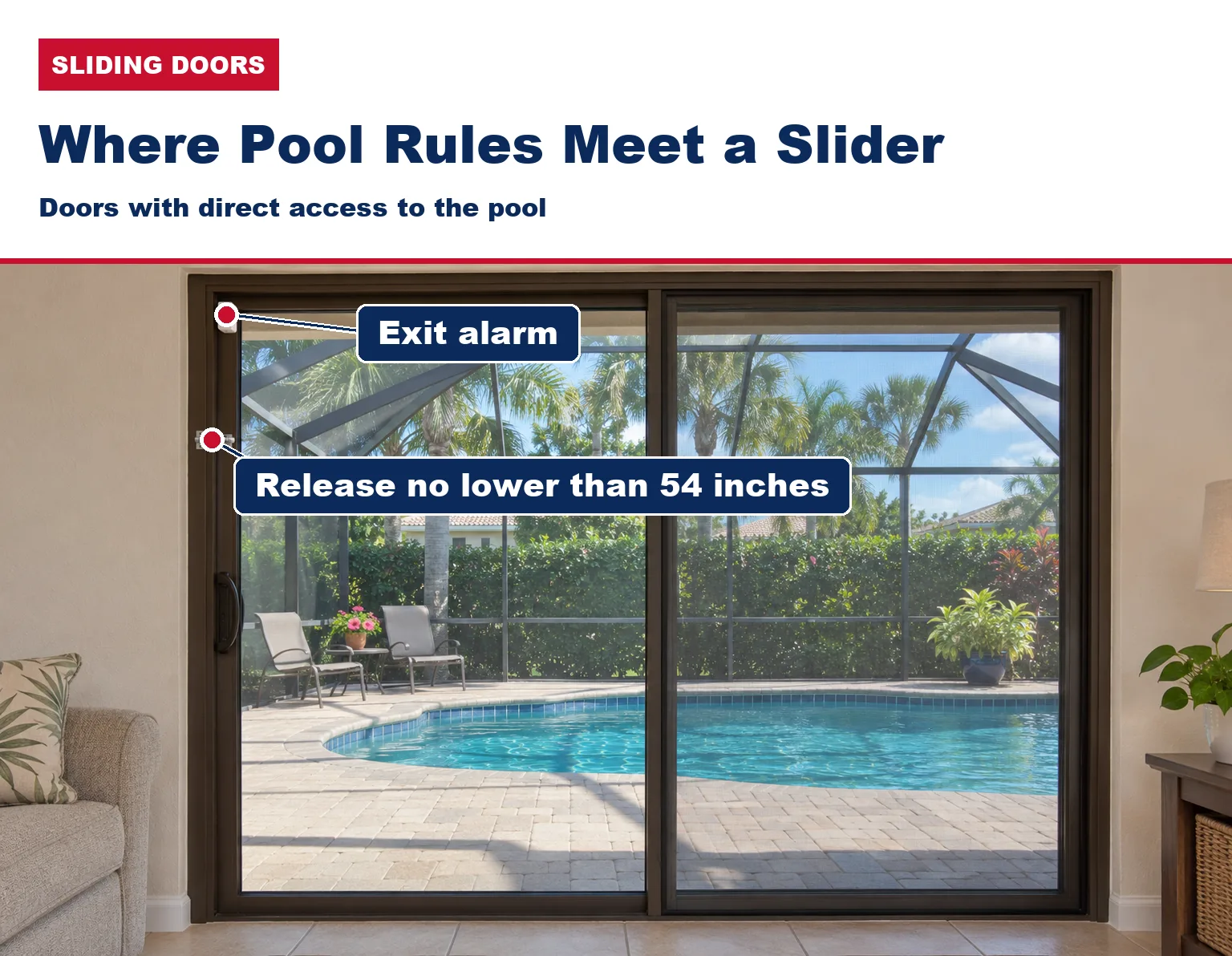
Exit alarms must be rated at least 85 dBA at 10 feet. Self-closing doors need a release no lower than 54 inches above the floor. The sections below show how each fits impact sliding doors for pool patios and impact French doors for a patio.
What Florida’s Pool Safety Act Requires
Chapter 515 of the Florida Statutes, the Preston de Ibern/McKenzie Merriam Residential Swimming Pool Safety Act, applies to pools at a detached one-family or two-family home, or a one-family townhouse not more than three stories high. That is how section 515.25 defines residential.
A “swimming pool” under the same section is any structure for swimming or recreational bathing with water over 24 inches deep. That includes in-ground and aboveground pools, hot tubs and nonportable spas.
To pass final inspection and receive a certificate of completion, section 515.27(1) says the pool must meet at least one of these requirements:
- (a) A barrier. The pool is isolated from access to the home by an enclosure that meets the barrier rules of section 515.29.
- (b) A safety cover. The pool has an approved safety pool cover, which the Act defines as one meeting ASTM standard F1346-91.
- (c) Exit alarms. “All doors and windows providing direct access from the home to the pool must be equipped with an exit alarm that has a minimum sound pressure rating of 85 dB A at 10 feet.”
- (d) Self-closing doors. “All doors providing direct access from the home to the pool must be equipped with a self-closing, self-latching device with a release mechanism placed no lower than 54 inches above the floor.”
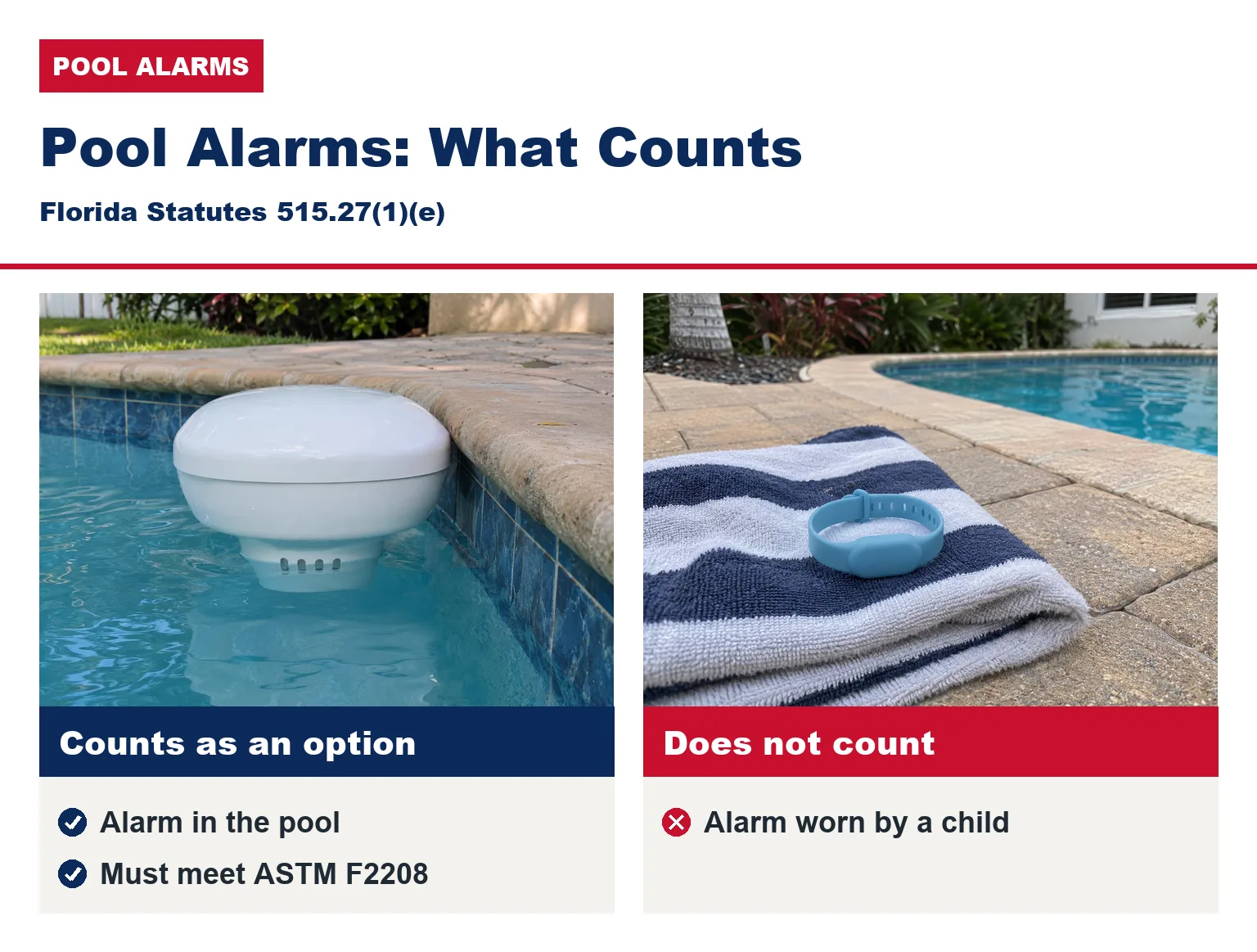
- (e) An in-pool alarm. A pool alarm that sounds when someone enters the water, independently certified to ASTM F2208. An alarm worn by a child does not count.
Section 515.27(2) makes a new residential pool without one of these features a misdemeanor of the second degree. No penalty applies if, within 45 days after a citation, the person adds a feature and attends a drowning prevention education program.
Your city or county can go further. Under section 515.37 of the Act, the Act does not apply where a local pool safety ordinance is equal to or more stringent than the state law.
The Florida Building Code, which your building department inspects against, is stricter than the Act. Section R4501.17.1 says an outdoor residential pool must have a barrier, and section R4501.17 exempts only a pool with an approved safety cover.
Where the house wall is part of that barrier, section R4501.17.1.9 requires one of three features: exit alarms on doors and windows that open to the pool, self-closing doors, or an in-pool alarm.
Exit Alarm Rules for Doors and Windows That Open to the Pool
An exit alarm, as section 515.25 defines it, is a device that makes “audible, continuous alarm sounds” when any door or window that gives access from the home to the pool area, with no enclosure in between, is opened or left ajar.
Section R4501.17.1.9 of the Florida Building Code, Residential (8th Edition, 2023) says the alarm must comply with UL 2017, the safety standard the code names for these devices.
The code also says any deactivation switch, the button that lets an adult pass through without the alarm sounding, must sit at least 54 inches above the threshold. Separate alarms are not needed for every opening if sensors wired to a central alarm sound when contact is broken at any opening.
The code exempts three kinds of windows:
- Screened or protected windows with a bottom sill height of 48 inches or more, measured from the interior finished floor at the pool access level.
- Windows facing the pool on a floor above the first story.
- Screened or protected pass-through kitchen windows 42 inches or higher with a counter beneath.
Local forms can add more. The City of Tamarac pool notice in Broward County says the alarm must sound when the door and its screen are opened, be heard throughout the house, and allow deactivation for no more than 15 seconds.
| Item | Florida Statutes 515.27 | Florida Building Code R4501.17.1.9 | Tamarac pool notice (example) |
|---|---|---|---|
| Alarm loudness | 85 dB A at 10 feet | 85 dBA at 10 feet | 85 dB A at 10 feet |
| Alarm standard | Not named | UL 2017 | UL 2017 |
| Deactivation switch | Not addressed | At least 54 inches above the threshold | At least 54 inches above the threshold; lasts no more than 15 seconds |
| Self-closing door release | No lower than 54 inches above the floor | Minimum of 54 inches above the threshold | No lower than 54 inches above the floor or deck |
| Window exceptions | None listed | 48-inch sill, upper floors, 42-inch pass-through | None listed |
Self-Closing, Self-Latching Doors and the 54-Inch Rule
A self-closing, self-latching door shuts on its own and latches without anyone turning a lock, so a young child cannot leave it open or reach the release.
The statute measures the 54 inches from the floor; the building code measures from the threshold. The code also asks for “positive mechanical latching/locking” approved by the authority having jurisdiction, meaning your local building department.
This option names doors only. If a window in the same wall also opens onto the pool, ask your building department how that window is handled before you rely on door hardware alone.
How the Rules Apply to Sliding Glass Doors and French Doors
A slider or French pair that opens onto the pool area with no fence in between is a door with direct access.
Sliding glass doors. Exit alarms on sliders usually use a contact sensor on the moving panel. On a multi-panel slider, ask how every moving panel is covered, since the code allows sensors wired to a central alarm.
If the slider has a screen, a local form like Tamarac’s may expect the alarm to sound when the screen opens too. For self-closing hardware, ask your installer whether a closer can be fitted to the specific door and whether it touches the parts the product approval covers.
USA Home Improvement installs ES Windows impact sliding glass doors for patios and pool decks. Pool decks also bring water to the sill, so read why impact sliding doors can leak before you choose a sill height.
French doors. On a pair of impact French doors, both leaves can open onto the pool, so treat both as doors to the pool. Ask your building department how the inactive leaf, usually held by bolts at the top and bottom, is handled.
A self-closing latch must release at 54 inches or higher, well above a normal handle. Ask whether the latch hardware is part of the door’s tested assembly.
Planning new doors to the pool? Request a free impact door estimate or call (877) 554-6373, and tell us which pool safety feature your home uses now.
Screen Enclosures, Fences and When the House Wall Is the Barrier
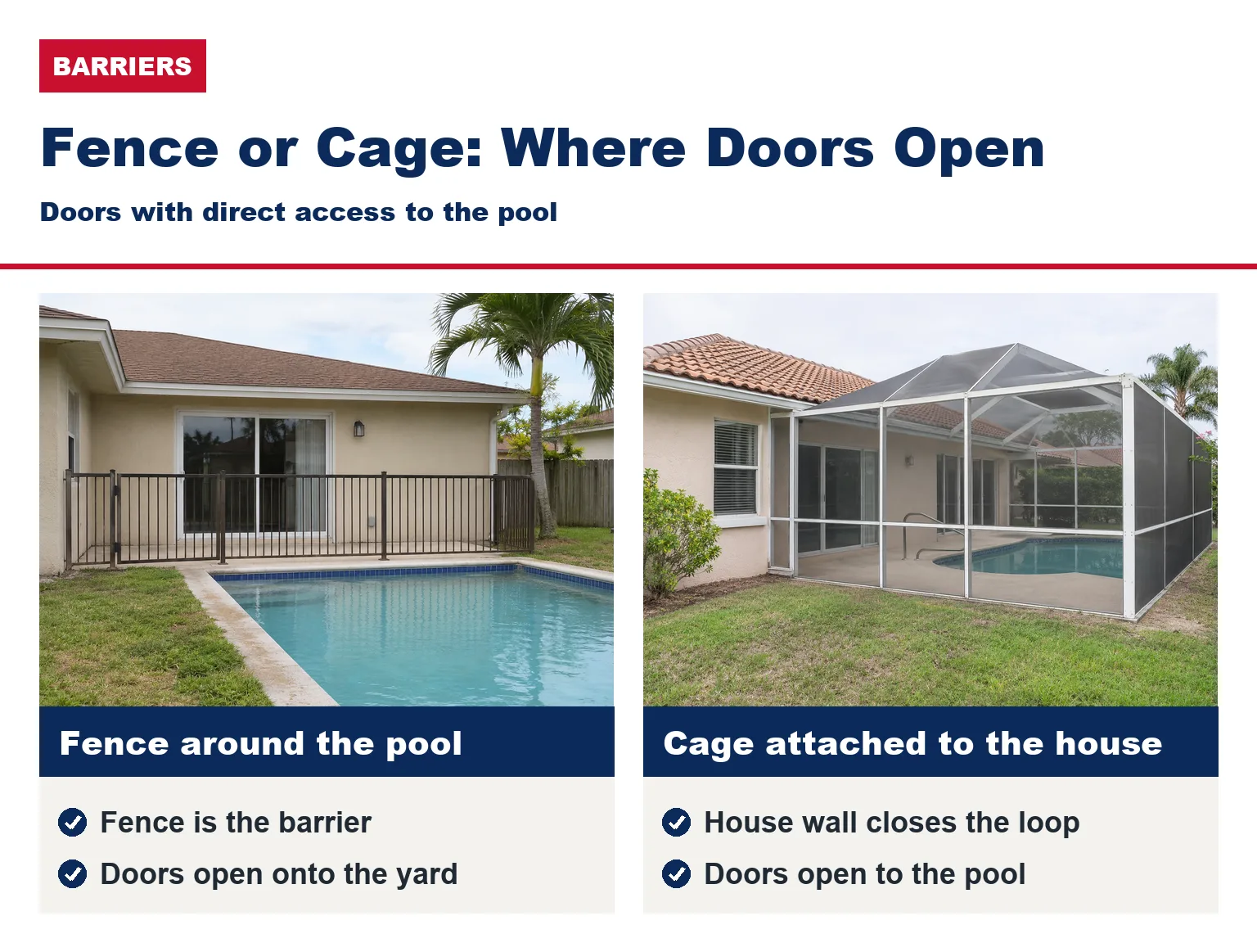
In the building code, the door options apply where the house wall is part of the pool’s barrier. If a fence around the pool fully separates it from the house, the fence is the barrier, and the doors open onto the yard, not the pool.
Section 515.29 says a barrier must be at least 4 feet high on the outside, have no gaps a young child could crawl under, squeeze through or climb over, and use gates that open outward, close by themselves and self-latch. The Act defines a young child as anyone under 6.
Under the barrier rule in section 515.29(4), a house wall with no door or window that opens to the pool can serve as part of the barrier on its own. A wall with such openings can stay part of the barrier when one of the three code features is added.
Building code section R4501.17.1.11 says a screen enclosure that meets the barrier rules may be part or all of the barrier. When a cage attached to the house encloses the pool, the house wall closes the loop, so the doors open to the pool directly.
Your building department decides how a specific layout is classified.
Replacing Patio Doors Near a Pool: What to Ask First
The Act’s inspection rule is written for new pools, but a door replacement can still remove the feature your pool passed with. Swapping an alarmed slider for a new door without the alarm contacts leaves that opening unprotected.
- Which safety feature did the pool pass with? Door alarms, self-closing doors, a fence, a cover or an in-pool alarm. Your building department’s pool permit records may show it.
- Will the alarm move to the new door? Ask who reinstalls the sensors, and test the alarm afterward.
- Where is the latch release? If you use self-closing hardware, measure the release height from the new floor or threshold, since a new sill can change it.
- Does the hardware fit the product approval? Ask whether alarm contacts or a closer attach without changing parts the approval covers. Customers of USA Home Improvement can receive the Florida Product Approval number for each door on request.
- Is the replacement permitted? Every USA Home Improvement project is permitted. See when Florida requires a permit to replace doors.
Unsure about your current slider? See how to tell if doors are hurricane rated. For cost ranges, read how impact door prices are set.
Adding a New Pool to a Home With Existing Patio Doors
If you are building a new pool, section 515.33 says the licensed pool contractor or builder must give you a document with the Act’s requirements and the Department of Health’s drowning prevention publication.
Building code section R4501.19 says the barrier inspection must be done before the pool is filled, except for vinyl liner and fiberglass pools. Settle the safety feature first.
Section numbers here come from the 8th Edition (2023) Florida Building Code. Our 2026 Florida Building Code guide for homeowners explains when the next edition takes over.
Florida Pool Door Alarm FAQs
Do hot tubs and spas need door alarms too?
Hot tubs and nonportable spas with water over 24 inches deep count as swimming pools under section 515.25 and the building code’s definition, so the same rules apply, including the code’s barrier unless the spa has an approved safety cover.
A portable spa with a safety cover that complies with ASTM F1346-91 is exempt under section 515.37.
Does the law apply to a pool built years ago?
Section 515.27 ties the safety feature to a pool’s final inspection, and its penalty applies to new residential pools, so the Act is not written as a retrofit rule for older pools. Local ordinances can be stricter, so ask your building department before you change a door that opens onto the pool.
Can an in-pool alarm replace door alarms?
Yes, where the house wall is part of the barrier. Building code section R4501.17.1.9 lists a pool alarm independently certified to ASTM F2208 as one option, but it does not replace the barrier itself, and an alarm worn by a child does not count.
Do condo and community pools follow the same rule?
No. The Act covers pools at detached one-family and two-family homes and townhouses up to three stories, and section 515.37 exempts public pools.
Do the rules change if my doors are impact doors?
No. Impact glass protects the opening from wind-borne debris, but a child can still open the door, so the same alarm, self-closing or other option applies.
Pick the Safety Feature First, Then the Door
Before you order a new slider or French doors to the pool, decide which safety feature your home will use. If it is door alarms or self-closing doors, plan the new door and its hardware around it.
Compare financing options for impact door projects. Financing may be available for qualified homeowners through independent third-party providers. Terms, eligibility and availability depend on the program and location.
USA Home Improvement is licensed (CGC1526707) and insured and has served Florida homeowners for more than 15 years. We sell ES Windows exclusively, and our installation team holds direct certification from the manufacturer. Our guide to impact doors in South Florida covers every door style.
Get a free estimate or call (877) 554-6373.