Skip to content

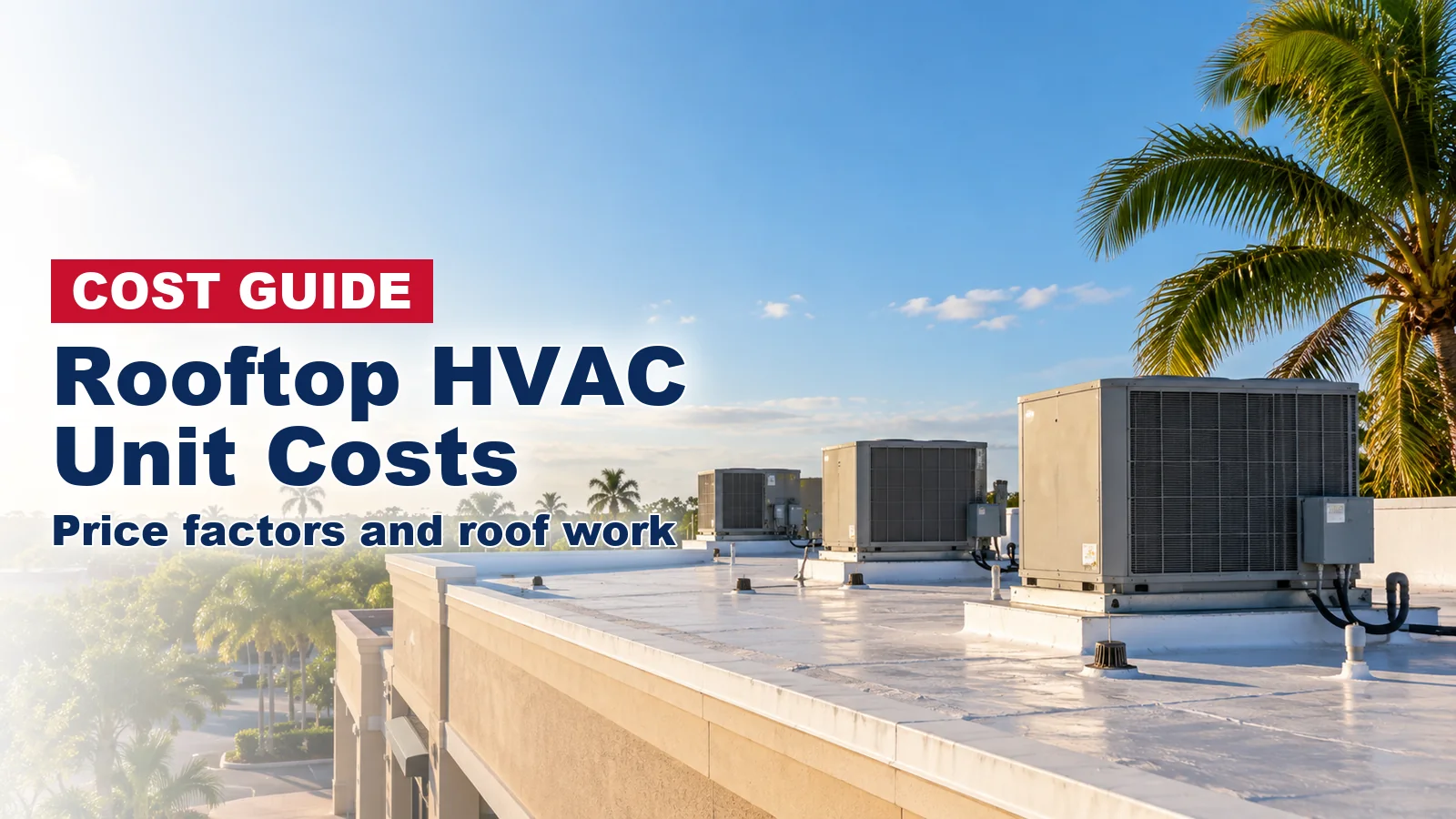
A typical small commercial rooftop air conditioner (90 kBtu/h, or 7.5 tons) costs about $13,560 installed, according to a national 2023 study for the U.S. Energy Information Administration (EIA), in 2022 dollars. An ENERGY STAR unit is estimated at $14,970 and the most efficient at $17,600.
Your quote will move with the unit’s size, efficiency, features and how hard the roof is to work on. This guide explains each cost factor, then shows how rooftop units affect a commercial roof replacement: the curbs, the flashing and the permits.
What a Commercial Rooftop HVAC Unit Costs: Federal Estimates by Efficiency Level
The EIA figures come from Updated Buildings Sector Appliance and Equipment Costs and Efficiencies, prepared by Guidehouse and Leidos and published in March 2023. The study prices one air-cooled packaged rooftop air conditioner of 90 kBtu/h with electric heat or no heat.
| Efficiency level (2023) | Equipment cost | Total installed cost | Installed cost per kBtu/h |
|---|---|---|---|
| Meets the federal standard (also the typical unit) | $9,490 | $13,560 | $151 |
| ENERGY STAR Version 4.0 | $10,340 | $14,970 | $166 |
| Highest efficiency | $12,210 | $17,600 | $196 |
All figures are in 2022 dollars. EIA describes these as typical values for a generic product, not the highest or lowest prices on the market, so treat them as a national budgeting baseline, not a quote.
EIA does not publish a price per ton. Its $151 per kBtu/h figure is for the 7.5-ton example unit, so a larger or smaller unit will not scale exactly.
The difference between the equipment cost and the installed cost covers the work to put the unit on the roof and connect it. That share grows when a crane, a new curb or roof repairs are part of the job.
Factors That Contribute to the Cost of a Rooftop HVAC System
Six factors decide most of the price of a rooftop unit: its size, its efficiency, the features you add, the brand and model line, how hard the roof is to reach, and what the unit will cost to keep running. Knowing them helps you compare quotes line by line.
Unit Size and Your Building’s Cooling Load
Size is one of the biggest cost factors. Rooftop units are rated in tons or in thousands of Btu per hour (kBtu/h), and the EIA example unit of 90 kBtu/h is a 7.5-ton unit. Larger units cost more to buy and lift.
The right size comes from your building’s cooling load, not from floor area alone. The main inputs are:
- Insulation: a well-insulated building holds conditioned air better and can need a smaller unit.
- Property size: more space to cool or heat needs more capacity.
- Number of people: every occupant adds heat, so a busy store or office needs more cooling.
- Other sources of heat: kitchens, servers and warehouse equipment add load.
Ask the HVAC contractor for a written load calculation. A unit sized by rule of thumb can cost more than you need, or fall short on the hottest days.
Efficiency Level and the Federal Minimum
Higher efficiency costs more up front. In the EIA study, the most efficient 90 kBtu/h unit costs $17,600 installed, against $13,560 for one that meets the federal standard.
Since January 2023, the U.S. Department of Energy minimum for small air-cooled commercial packaged air conditioners with electric heat or no heat is an IEER of 14.8, as listed in the same EIA study. IEER is a part-load rating, so compare it across quotes, not just the EER.
Add-ons and Controls
The features you choose change the cost of your rooftop unit. Basic units cost less than units with air purifiers, humidifiers, smart thermostats, UV lamps and similar extras.
These options raise the price but may be necessary for your facility. Ask for each add-on as its own line so you can see what it costs and decide whether you need it.
Manufacturers and Model Lines
Each manufacturer prices its rooftop units differently, and so does each model line within a brand. Two quotes can look far apart simply because they name different capacities or efficiency levels.
Before you compare brands, line the quotes up on the same tonnage, the same IEER and the same features. Then compare the warranty terms each manufacturer and contractor put in writing.
Roof Access, Crane Lifts and Curb Work
Getting the unit onto the roof can move the price as much as the unit itself. Building height, street access for a crane, and whether the new unit fits the existing curb all show up in the installed cost.
When a new unit has a different footprint, the old curb may need an adapter or a new curb, and new curb work involves the roof. The rules for that work are in the next section.
Maintenance and Service Life
EIA lists an average life of 21 years for commercial rooftop air conditioners and an annual maintenance cost of about $370 for the 90 kBtu/h unit, in 2022 dollars. Maintenance includes checking belts, replacing filters, cleaning coils and drain pans, and checking refrigerant pressure.
A unit’s age matters when you plan the roof. A unit near the end of its life may be worth replacing while the roof under it is open.
How Rooftop Units Affect a Commercial Roof Replacement
Rooftop units sit on curbs or stands that tie into the roof, so a roof replacement means working around every unit or lifting it off.
The Florida Building Code sets curb heights or support clearances under the unit and how the flashing is rebuilt, with separate sections for the High-Velocity Hurricane Zone (HVHZ) of Broward and Miami-Dade. Local permit forms add their own steps.
Curbs and Clearance Under the Unit
Outside the HVHZ, Section 1510.10 of the Florida Building Code, chapter 15, says roof-mounted mechanical units “shall be mounted on curbs raised a minimum of 8 inches (203 mm) above the roof surface.” Units on raised stands, with roofing under them, need the clearance in Table 1510.10.
That clearance grows with the width of the unit. It starts at 14 inches for units less than 24 inches wide and reaches 48 inches for units more than 60 inches wide. The clearance lets roofers repair or replace the roofing under the unit later.
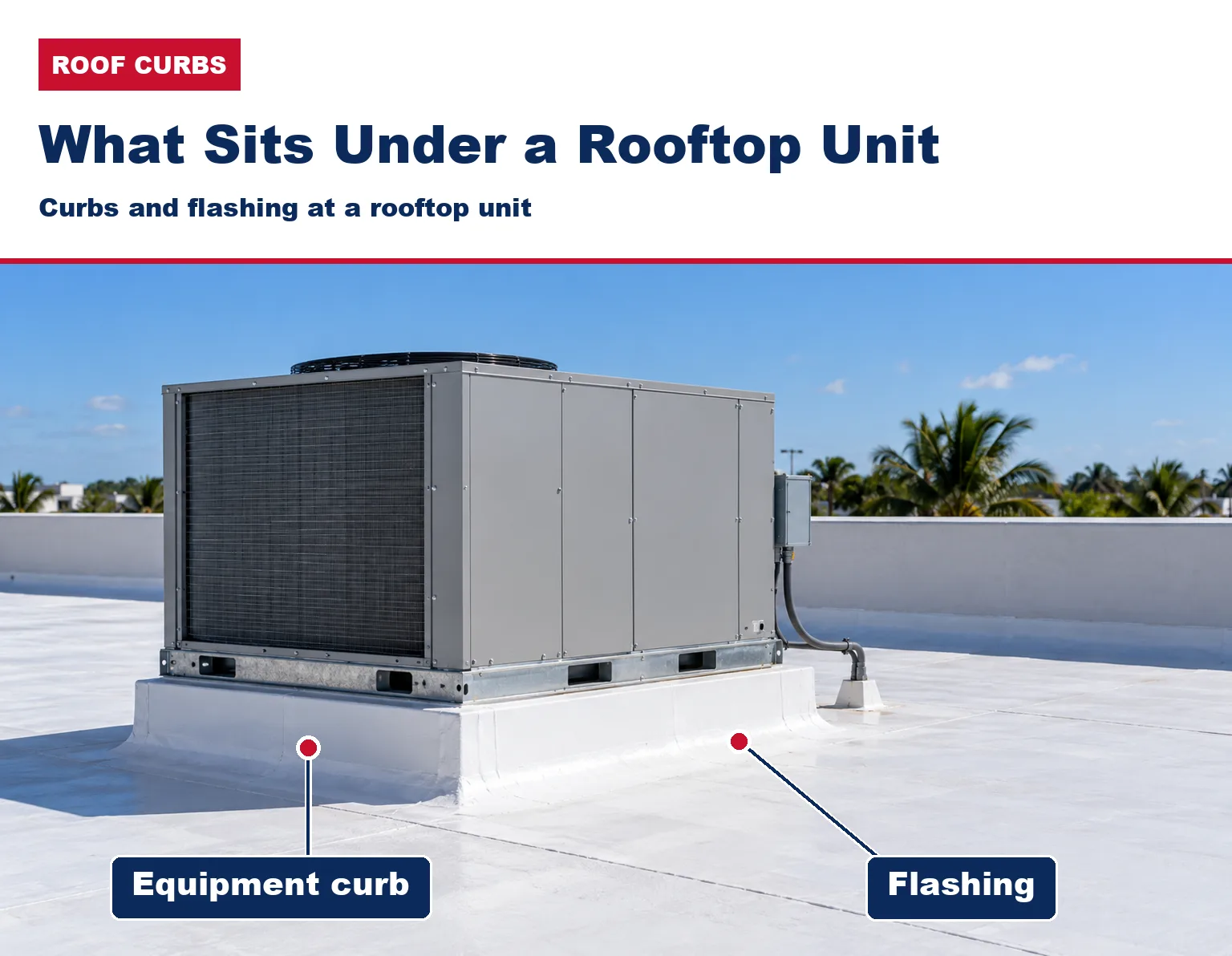
Existing equipment does not have to meet the table if the building official finds it gives enough clearance to repair, recover, replace or maintain the roofing system. Ask your roofer to check each unit’s equipment curb before the job is priced.
In Broward and Miami-Dade, Section 1522.2 says “All rooftop equipment and supports shall be secured to the structure” and does not permit wood sleepers. Table 1522.3 sets leg heights from 14 inches for equipment up to 24 inches wide to 48 inches for equipment 61 inches and wider.
Section 1522.3.2 matters most on a reroof: where rooftop equipment is moved to do the work, its supports must meet the clearances in Table 1522.3. Under Section 1522.3.3, existing equipment that the building official finds has sufficient clearance need not comply.
Flashing at Curbs and Penetrations
The flashing at the curb is where a reroof around rooftop units succeeds or leaks. Outside the HVHZ, under Section 1511.5, existing vent flashing, metal edgings, drain outlets, collars and metal counterflashings are not reinstalled when they are rusted, damaged or deteriorated.
Section 1511.6 adds: “Flashings shall be reconstructed in accordance with approved manufacturer’s installation instructions or RAS 111.” In the HVHZ, Section 1514.2.5.2 says roof penetrations “shall be suitably flashed with curbs, collars, pitch pans” or another approved method.
In practice, the flashing at the curb is rebuilt with the new roof, not patched around the old one. Ask each roofing quote to say how the curbs will be flashed and which manufacturer’s system it follows.
Permits and Paperwork for Rooftop Equipment
A commercial reroof needs a building permit, and rooftop units can add paperwork. Section 105.1 of the Florida Building Code requires a permit before anyone will “construct, enlarge, alter, repair, move, demolish” a building or its systems. Every USA Home Improvement project is permitted.
In Broward County, a mandatory countywide Rooftop Mounted Equipment Affidavit (Board Policy 22-03) goes with the roofing permit application and lists all rooftop equipment. If an A/C unit has no existing code-approved curb or stand, the form says a mechanical permit is required for the proposed curb or stand.
The same form says equipment removed during reroofing “shall be reinstalled in compliance with the code in effect at the time a reroofing permit is issued.” The Florida Building Code, Mechanical, Section 301.15 requires mechanical equipment and supports exposed to wind to be designed and installed to resist wind pressures.
The HVAC side belongs to a licensed air-conditioning contractor. Section 489.105 of the Florida Statutes lets that contractor disconnect and reconnect power wiring at the unit’s dedicated disconnect on single-phase systems, and its low-voltage control wiring. Ask your contractors who will handle the power wiring if your unit is three-phase.
The EPA Section 608 program requires certification for technicians who service equipment that could release ozone depleting refrigerants.
For the roof itself, see our flat roof replacement and roof coating services, and bring your HVAC contractor’s plan for each unit to the roofing estimate.
Timing a Unit Replacement With the Reroof
Plan the roof and the rooftop units as one project when both are ageing. If a unit will be replaced within a few years anyway, doing it during the reroof means the curb and its flashing are built once, for the unit that will stay.
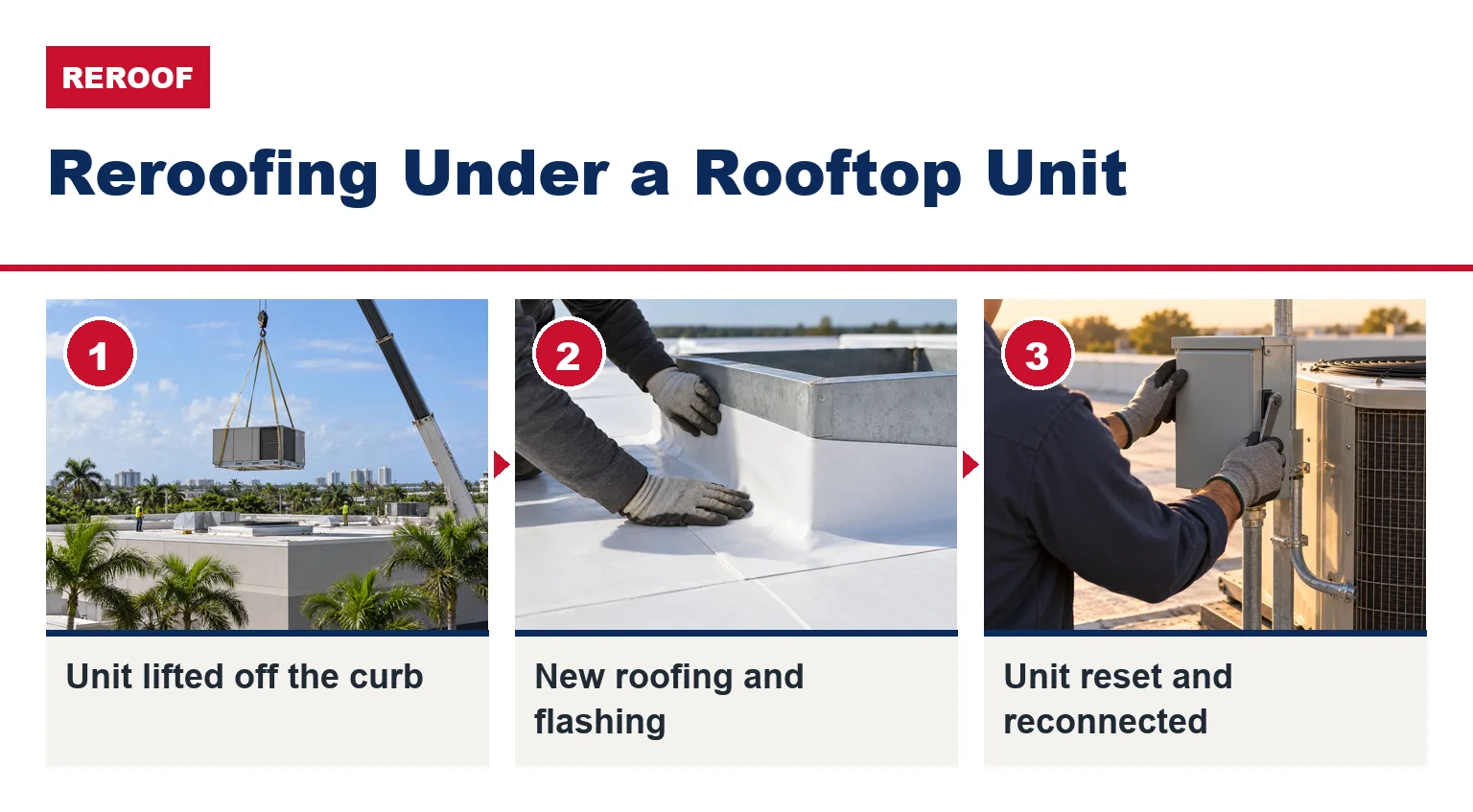
The usual order is simple: the HVAC contractor disconnects the unit and it is lifted off the curb, the roofer installs the new roofing and flashing, and then the unit is reset and reconnected.
If you are not sure the roof needs replacing yet, check the signs that a roof needs replacing. Ahead of storm season, also look for common roof damage worth repairing before storms.
Rooftop HVAC and Roof Replacement FAQs
Does a new rooftop unit need a new curb?
Not always. If the existing curb is code-approved and fits the new unit, it can often stay. If there is no existing code-approved curb or stand, Broward’s affidavit says a mechanical permit is required for the proposed curb or stand.
Who disconnects the rooftop unit during a reroof?
A licensed air-conditioning contractor disconnects and reconnects the unit’s controls, and single-phase power wiring at its dedicated disconnect. Ask who handles three-phase wiring, and use an EPA Section 608 certified technician for refrigerant work.
You can confirm a contractor’s license on the Florida DBPR license search, and read more on checking a contractor’s license before you hire.
How long does a commercial rooftop unit last?
EIA lists an average life of 21 years for commercial rooftop air conditioners. Actual life depends on maintenance, salt air and how hard the unit runs, so compare the unit’s age with the roof’s age when you plan either job.
Plan the Roof and the Rooftop Units Together
Budget the rooftop unit from a sourced baseline, then compare quotes on the same size, IEER and features. If the roof under the units is near the end of its life, schedule both jobs together so the curbs and flashing are done once.
The roof is only part of a building’s storm protection. For the openings, read why impact windows make sense for a business.
USA Home Improvement is licensed (CGC1526707) and insured and has served Florida homeowners for more than 15 years.
For a free roofing estimate, call USA Home Improvement at (877) 554-6373.