 Saltar al contenido

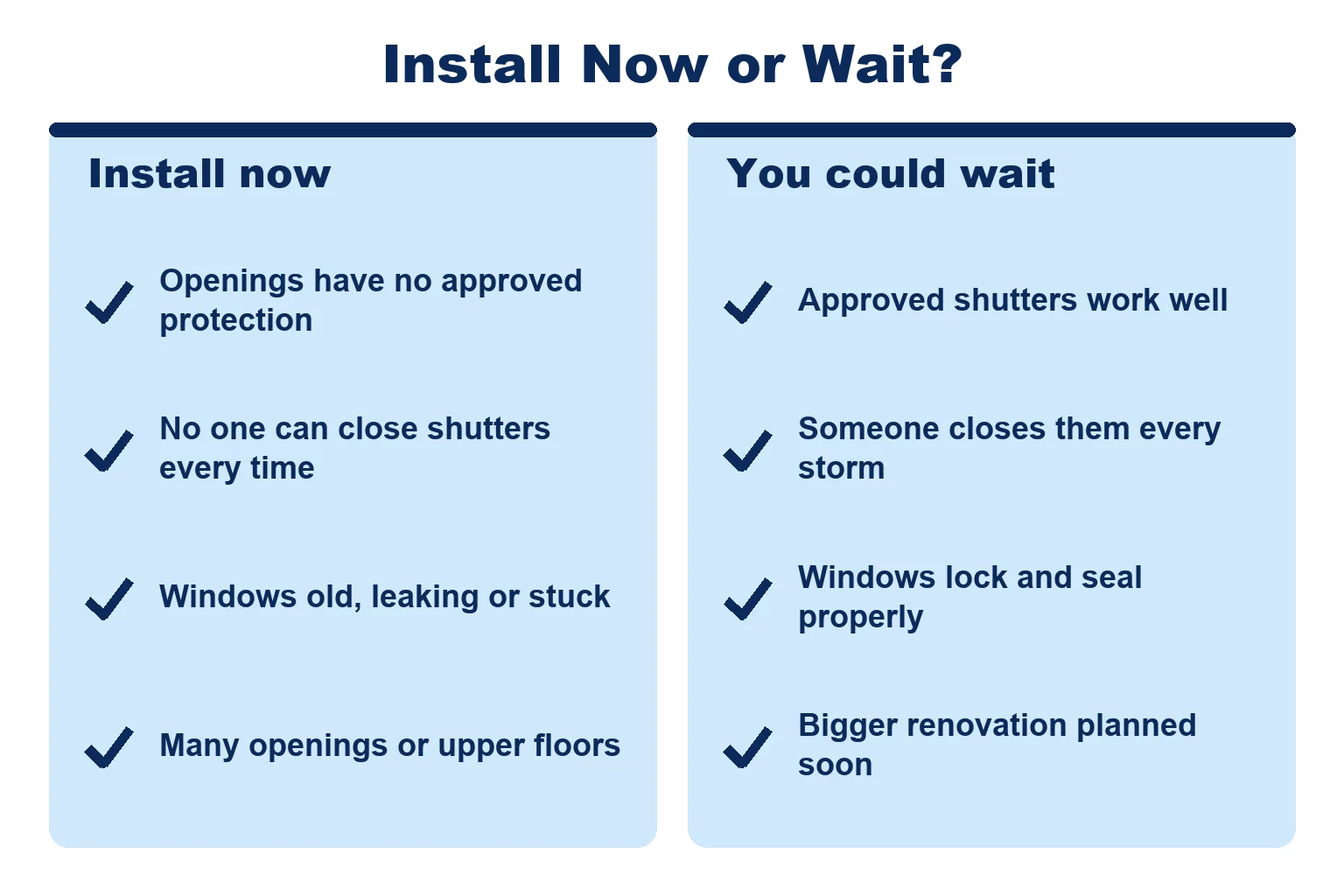
You should install impact windows if your glass openings have no approved hurricane protection, if nobody can reliably put up shutters before a storm, or if your windows are due for replacement anyway. You can reasonably wait if you already have approved shutters in good shape and someone who closes them every time.
This guide helps you decide for your own house: who benefits most, when approved shutters are enough, which openings to replace first and how to pay for it. For ratings, types and county rules in one place, read our complete South Florida impact window primer.
The Short Answer: Who Should Install Impact Windows
Impact windows make the most sense for homeowners who want protection that is always in place, with no prep when a storm is on the way. They replace the window itself, so the glass, frame and anchoring work as one tested unit that stays in the opening when debris hits it.
Three questions settle most decisions:
- Are your openings protected today? If not, you need impact windows or approved shutters before the next storm.
- Will someone close shutters every time? If the answer is “not always”, impact windows remove that risk.
- Are your windows old, leaking or hard to open? If you are replacing them anyway, the extra step to impact-rated glass is easier to justify.
If you answered yes to the first or third question, or no to the second, impact windows are likely the better fit. You can compare styles and frames on our impact window product lineup página.
Do You Have to Install Impact Windows by Law?
No, Florida law does not require impact windows specifically. In the wind-borne debris region, which covers most of South Florida, the Florida Building Code requires glass openings to be protected, and you can meet that with impact windows or with approved shutters.
The rule matters when you replace windows. New windows in Miami-Dade and Broward, the High-Velocity Hurricane Zone (HVHZ), need a Miami-Dade Notice of Acceptance (NOA) or a Florida Product Approval valid for the HVHZ. Palm Beach and the rest of the state use Florida Product Approval.
A permit is needed for window replacement, and the inspector checks that the product and its installation match the approval.
So the real choice is not “impact windows or nothing”. It is impact windows or shutters that meet the same rules, and which one suits your house and your household.
Who Benefits Most From Impact Windows
Impact windows pay off most for households where shutters are a weak link. The protection from wind and debris only works if it is in place, and impact glass is in place every day of the year.
- Homeowners who travel or live part of the year elsewhere. The house stays protected when nobody is there to close anything.
- Older homeowners or anyone who cannot climb ladders. Storm panels on upper floors are heavy and risky to fit.
- Homes with many or large openings. Every extra panel is more work and more storage before every storm.
- Homeowners already replacing old windows. The new windows have to meet the current code anyway.
- Anyone whose wind mitigation report shows unprotected openings. Fixing those openings can change your insurance credits.
The peace of mind is practical. When a storm turns toward your area, you are not racing the clock to fit panels or find plywood. The full list of gains, including security, noise, UV and energy, along with the honest limits, is in our article on the advantages of impact windows and doors.

Who Could Reasonably Wait
You can reasonably wait on impact windows if your home is already protected and your windows still work well. Waiting is a fair choice, not a risk, when these points are true:
- Every glass opening already has approved shutters, such as accordion or roll-down shutters, that are in good working order.
- Someone who lives in the house closes all of them before every storm, including upper floors.
- Your windows open, lock and seal properly, with no rot, rust or leaks.
- You plan a larger renovation soon and want to replace windows as part of it.
Waiting is not a good idea if any opening has no approved protection at all. Plywood is an emergency backup, not a long-term plan. If you are unsure about your current windows or shutters, find out whether your openings are hurricane rated antes de decidir.
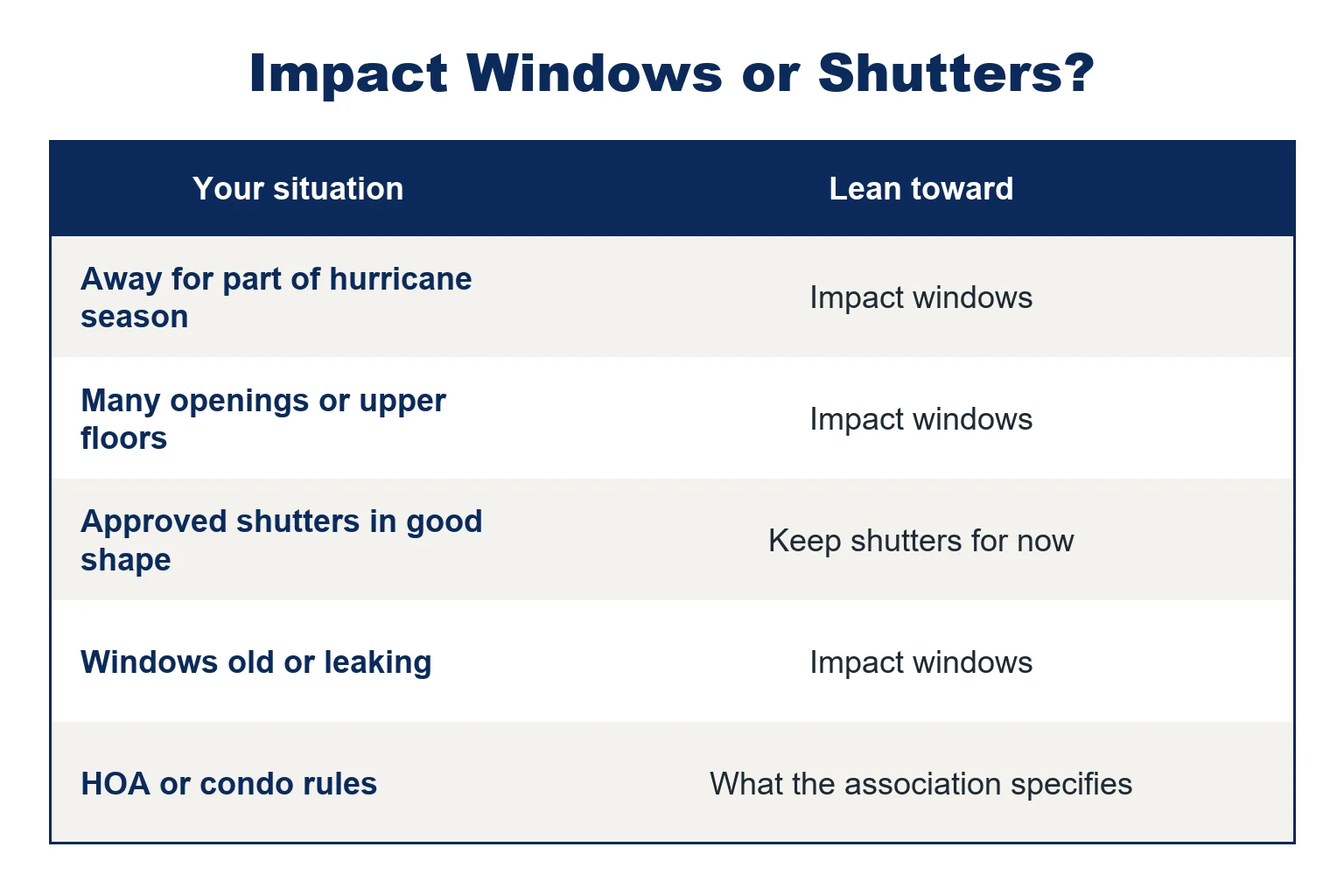
Impact Windows or Approved Shutters: Decide by Your Situation
Both impact windows and approved shutters can meet the code. The better choice depends on who is home, how many openings you have, your budget and your community rules.
| Your situation | Lean toward | Why |
|---|---|---|
| Away for part of hurricane season | Ventanas resistentes a impactos | Always on, no one needs to close anything |
| Many openings or upper floors | Ventanas resistentes a impactos | No panels to carry, fit or store |
| Approved shutters already in good shape | Keep shutters for now | The openings are already protected |
| Tight budget, unprotected openings | Phase impact windows, or shutters first | Protect every opening now, upgrade over time |
| Windows old or leaking | Ventanas resistentes a impactos | You are replacing them anyway |
| HOA or condo rules | Whatever meets the association’s specifications | Approval comes before the permit |
For protection levels and price ranges side by side, see our comparison of ventanas resistentes a impactos y persianas antihuracanes.
If You Are Away During Hurricane Season
If you are away for part of hurricane season, impact windows are usually the right choice. The Atlantic season runs from June 1 to November 30, according to the Centro Nacional de Huracanes, and a storm can form while you are out of state.
Shutters left open protect nothing, and paying someone to close them depends on that person being available when everyone else is preparing too.
Leaving shutters closed all season is an option some owners use, but it darkens the house and hides problems such as leaks.
If You Have Many Openings or Upper Floors
The more openings you have, the stronger the case for impact windows. Every storm panel has to be carried, placed, fastened and later stored, and upper-floor windows usually mean ladders. Accordion and roll-down shutters cut the work, but they still have to be closed and kept in working order.
Large glass is part of this count. Sliding glass doors and picture windows are the biggest openings in most homes, and impact sliding glass doors for your patio replace the hardest panels to fit.
If Your HOA or Condo Association Has Rules
If you live in an HOA, check the association’s hurricane protection specifications first. Under section 720.3035(6) of the Florida Statutes, every homeowners’ association must adopt hurricane protection specifications that comply with the building code.
The association may not deny an application for hurricane protection, including impact-resistant windows and doors, that conforms to those specifications. It can still set color and style and require you to follow the community’s look.
Condos work differently, because windows can be shared elements under the declaration and the board approval process varies. Our guide to impact windows for condos and commercial buildings covers those steps.
How Impact Windows Change Your Insurance Rates
Impact windows can lower the windstorm part of your premium, but usually only when every opening, including doors, sliding doors, the garage door and skylights, is protected and a wind mitigation inspection records it.
Approved shutters on the remaining openings can count, so a phased plan can still protect your credit; the steps to claim it are in our guide to home upgrades that lower insurance rates.

Replacing Impact Windows in Phases: What to Do First
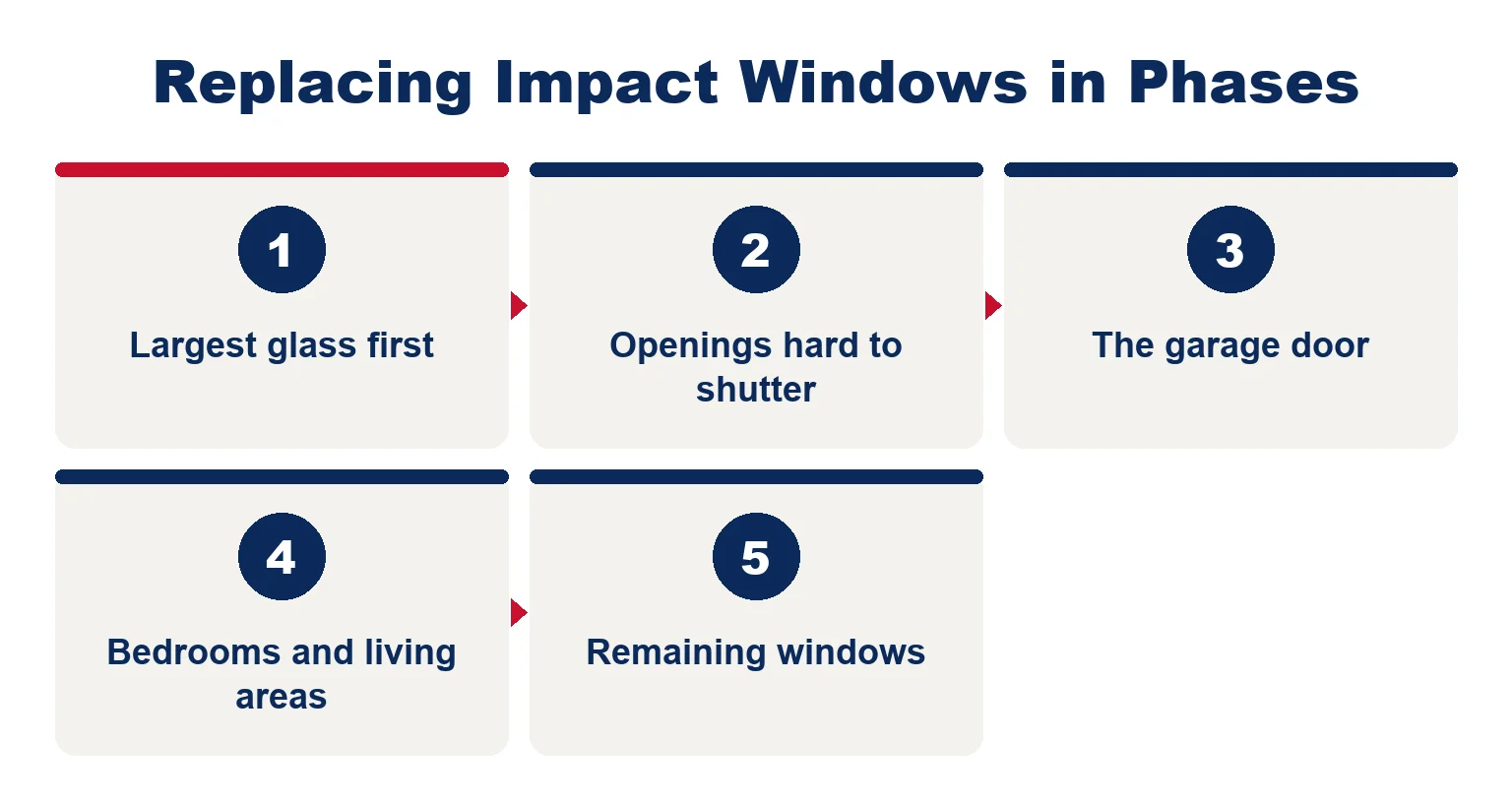
Yes, you can replace impact windows in phases, and many homeowners do. The rule is simple: every opening needs protection during every storm, so the openings you have not replaced yet still need approved shutters or panels.
A sensible order for most South Florida homes:
- Largest glass first. Sliding glass doors and picture windows are the biggest openings and the hardest to cover.
- Openings you cannot shutter easily. Upper-floor windows and any opening without approved protection come next.
- The garage door. A large garage door is one of the widest openings in the house. See our garage doors rated for hurricane impact.
- Bedrooms and living areas. These are the rooms your family uses during and after a storm.
- Remaining windows. Finish the set, then book a new wind mitigation inspection.
Phasing has trade-offs. Each phase may need its own permit and inspection, and matching frames and glass across phases is easier with the same product line. Ask your installer to quote the whole house once, then split it into phases, so the approvals and design pressure for each opening are planned together.
Paying for Impact Windows on a Real Budget
The cost of impact windows depends on the number, size and style of your openings, the design pressure each one needs, the glass package and the permit work. Our answers to common impact window buying questions explain what moves the price and what a quote should include.
Three ways homeowners make the project fit their budget:
- Financing. Independent third-party providers may offer financing plans for impact windows and doors, if available, to qualified homeowners, including $0 down, 0% interest plans and loans up to $100,000 with a soft credit check. PACE offers long-term, fixed-rate financing for eligible projects, with terms that vary by program.
- Phasing. Replace the openings that matter most now and the rest later, as described above.
- Grants. El estado Mi hogar seguro en Florida program has offered grants for hurricane upgrades to eligible homeowners. Funding and rules change, so check the program site before you plan around it, and do not start work before you have an award.
The insurance credit is not a reason to buy on its own, but it can offset part of the cost over time once every opening is protected.

Your Next Step: A Measured Quote for Every Opening
The best next step is a measured quote that lists every opening, the product approval and the design pressure for each, the glass, the permit and the installation details. With that in hand you can decide between a full replacement, a phased plan or keeping your shutters for now.

When you have more than one quote, compare them line by line on approvals, design pressure, permit and warranty. If you go ahead, here is what happens from quote to final inspection, so you know what to expect on installation day.
Impact Window Decision FAQs
Are impact windows worth it if I already have shutters?
Impact windows are worth it if closing your shutters is hard, slow or depends on someone who is not always home. If your shutters are approved, in good shape and always closed in time, they already protect the openings. Many owners keep them and switch to impact windows when the windows need replacing.
Can I install impact windows on only one side of the house?
Yes, but the other openings still need approved protection before every storm. Storms can push debris from any direction, so one protected side does not protect the house. Treat a one-side job as phase one of a whole-house plan and cover the rest with shutters until it is finished.
Can my HOA stop me from installing impact windows?
An HOA cannot deny impact windows that conform to its adopted hurricane protection specifications, under section 720.3035(6) of the Florida Statutes. It can set color and style rules and require the community’s look. Condo associations follow their own declaration and approval process, so check with the board first.
Not sure which way to go? Call USA Home Improvement at (877) 554-6373 and we will measure every opening, explain your options and quote a full or phased plan.
USA Home Improvement cuenta con licencia (CGC1526707) y seguro, y ha prestado sus servicios a propietarios de viviendas en Florida durante más de 15 años.