 Skip to content

Impact windows are not required everywhere in Florida, but in Miami-Dade, Broward, Palm Beach County and the rest of the wind-borne debris region, the Florida Building Code requires protected glass openings on new homes and most replacement windows. Impact-rated windows or approved shutters both meet that rule.
This guide explains who is required to have impact protection and when, how the replacement rules work, and what condo boards and HOAs can decide. It also covers the programs that reward protection without making it mandatory.
Who Has to Have Impact Protection in Florida
Whether you need impact protection depends on three things: where the home is, whether the work is new construction or a replacement, and how old the home is. The table covers the common situations under the current 8th Edition (2023) of the Florida Building Code.
| Your situation | Impact protection required? | Code source |
|---|---|---|
| New home in Miami-Dade or Broward (HVHZ) | Yes. Every glazed opening meets the impact tests or has a tested protection device | FBC Building 1626.1 |
| New home elsewhere in the wind-borne debris region | Yes. Impact glass or an approved covering | FBC Residential R301.2.1.2, Building 1609.1.2 |
| New home outside the wind-borne debris region | No debris protection rule. Windows still must resist design wind pressure | Wind-borne debris region definition |
| Replacing windows, doors or skylights in the wind-borne debris region or the HVHZ (all of Miami-Dade, Broward and Palm Beach) | Yes. The new units must meet Chapter 16 of the current code | FBC Existing Building 707.4; Building 1609.1.2 and 1626.1 |
| Small replacement (25 percent or less of the glass in 12 months) in an older one- or two-family home | Possibly not, if the home meets the exception’s age and zone conditions | 707.4 exceptions |
| Condo unit or HOA home | The code applies, plus the association’s hurricane protection specifications | F.S. 718.113(5), 720.3035(6) |
For how impact windows are built, tested and rated, see our South Florida impact window guide with ratings and tests.
Where You Live Changes the Rule: HVHZ, Wind-Borne Debris Region or Neither
Florida has three practical zones for opening protection. The strictest is the High-Velocity Hurricane Zone (HVHZ), which the Florida Building Code defines as Broward and Miami-Dade counties.
In the HVHZ, Section 1626.1 requires the whole building envelope, including outside doors, skylights and glass, to pass the impact tests or sit behind a device that does. Section 1620.2 sets design wind speeds for standard (Risk Category II) buildings at 175 mph in Miami-Dade and 170 mph in Broward.
The wind-borne debris region covers areas within 1 mile of the coastal mean high water line at a design wind speed of 130 mph or more, and all areas at 140 mph or more. Palm Beach County’s building division states that all of Palm Beach County is a wind-borne debris region.
Outside both zones, mainly inland areas below those wind speeds, the code has no debris protection requirement. Windows still must resist the design wind pressure for the site, so your building department’s wind speed map is the place to start.
New Construction: What the Code Requires for Every Glazed Opening
New homes in a wind-borne debris region must have protected glass openings. Section 1609.1.2 of the Florida Building Code, Building says glazed openings there “shall be impact resistant or protected with an impact-resistant covering” that meets an approved test standard such as ASTM E1996 or TAS 201, 202 and 203.
The test depends on height: the large missile test applies to glass within 30 feet of grade, and the small missile test above that. Garage doors and rolling doors can meet ANSI/DASMA 115.
The Florida Building Code, Residential (Section R301.2.1.2) applies the large missile test to every glazed opening on houses and townhouses in the debris region, at any height. On a new home, every opening is sized and approved in one plan.
Replacing Windows in an Existing Home: When Current Code Applies
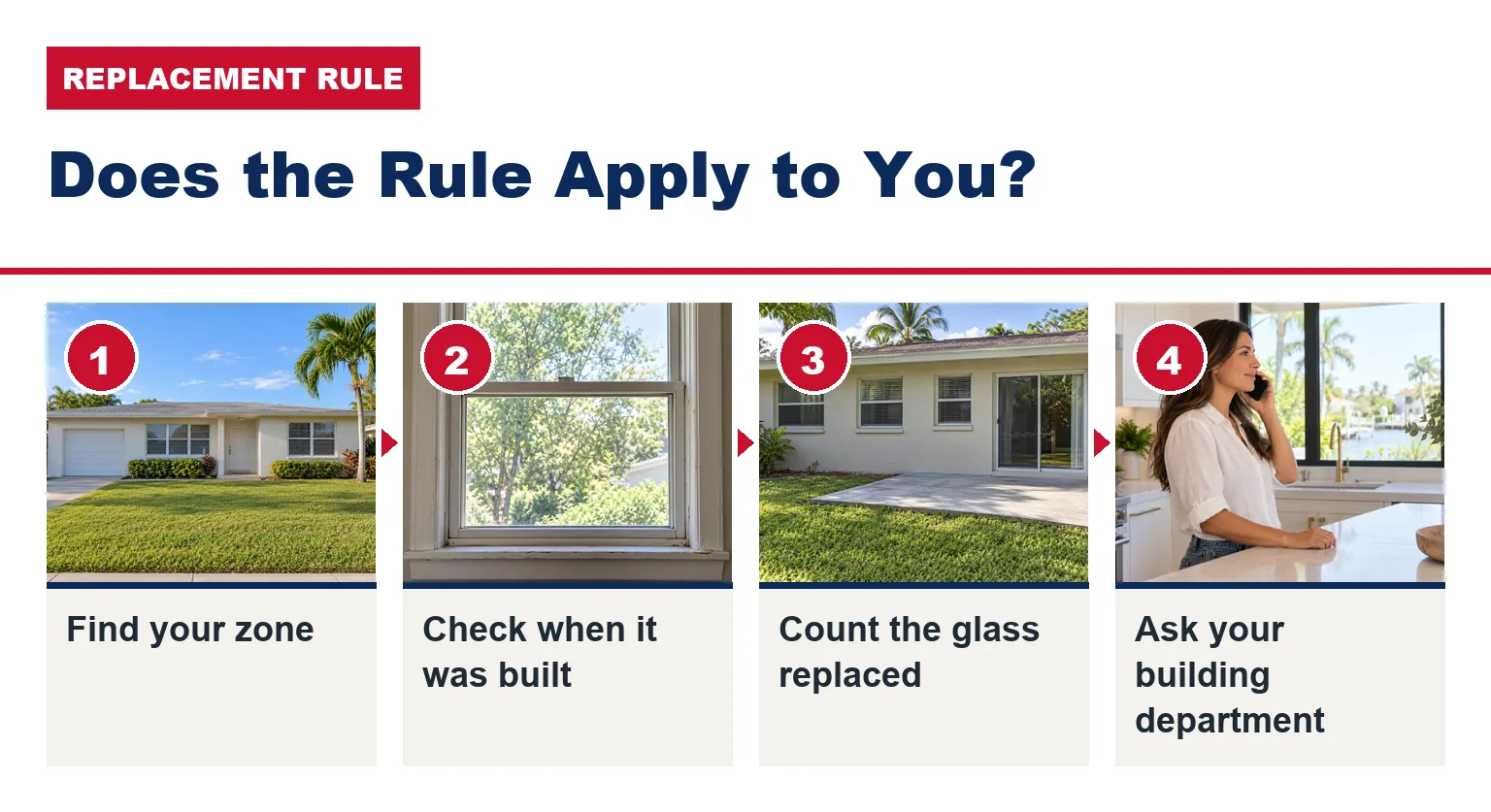
Replacement windows and doors must meet today’s code, even in an older house. Section 707.4 of the Florida Building Code, Existing Building says replaced garage doors, exterior doors, skylights and windows “shall be designed and constructed to comply with Chapter 16” of the Building code. Chapter 16 is where the debris protection rules live.
The rule covers the units you replace. Section 707.4 sets the standard for the replacement work; it does not order you to swap out windows you are not touching.
Two exceptions allow a small replacement without opening protection. Both are limited to one- and two-family dwellings, and both cap the replaced glass at 25 percent of the home’s total glazed area within any 12-month period:
- General exception (wind-borne debris region): the home was built under codes other than the Florida Building Code, and the replaced units are still designed for wind pressures for enclosed buildings. A City of Dunedin exception form describes these as homes permitted before March 1, 2002.
- HVHZ exception (Miami-Dade and Broward): the home was built under codes before September 1, 1994. This exception lists windows, skylights, sliding glass doors, patio doors and exterior doors with glazing, but not garage doors.
Go past 25 percent in 12 months, or own a newer home, and the replacements need impact protection. Your building department applies the exceptions at permit review, so in Miami-Dade and Broward ask which one it uses, and ask before you split a project to stay under the limit.
If you are replacing windows in Miami-Dade, Broward or Palm Beach, we install aluminum and vinyl ES Windows impact windows, and you can receive the Florida Product Approval number for each one on request. Request a free estimate for your replacement project to see what each opening needs.
Impact Glass or Approved Shutters: The Code Lets You Choose
The code sets a performance bar, not a product. Either the glass passes the impact tests on its own, or a tested covering such as a shutter does the job for it.
Under section 553.842 of the Florida Statutes, windows, exterior doors, shutters and impact protective systems need product approval before they are used in construction. A product also cannot be marketed as impact protection from wind-borne debris unless it is approved.
Shutters have to be closed before each storm, which is hard when you are away or cannot lift panels, while impact windows need no storm prep. Our comparison of hurricane shutters and impact windows for South Florida homes covers the trade-offs side by side.
Condos and HOAs: Who Sets the Rules for Your Windows
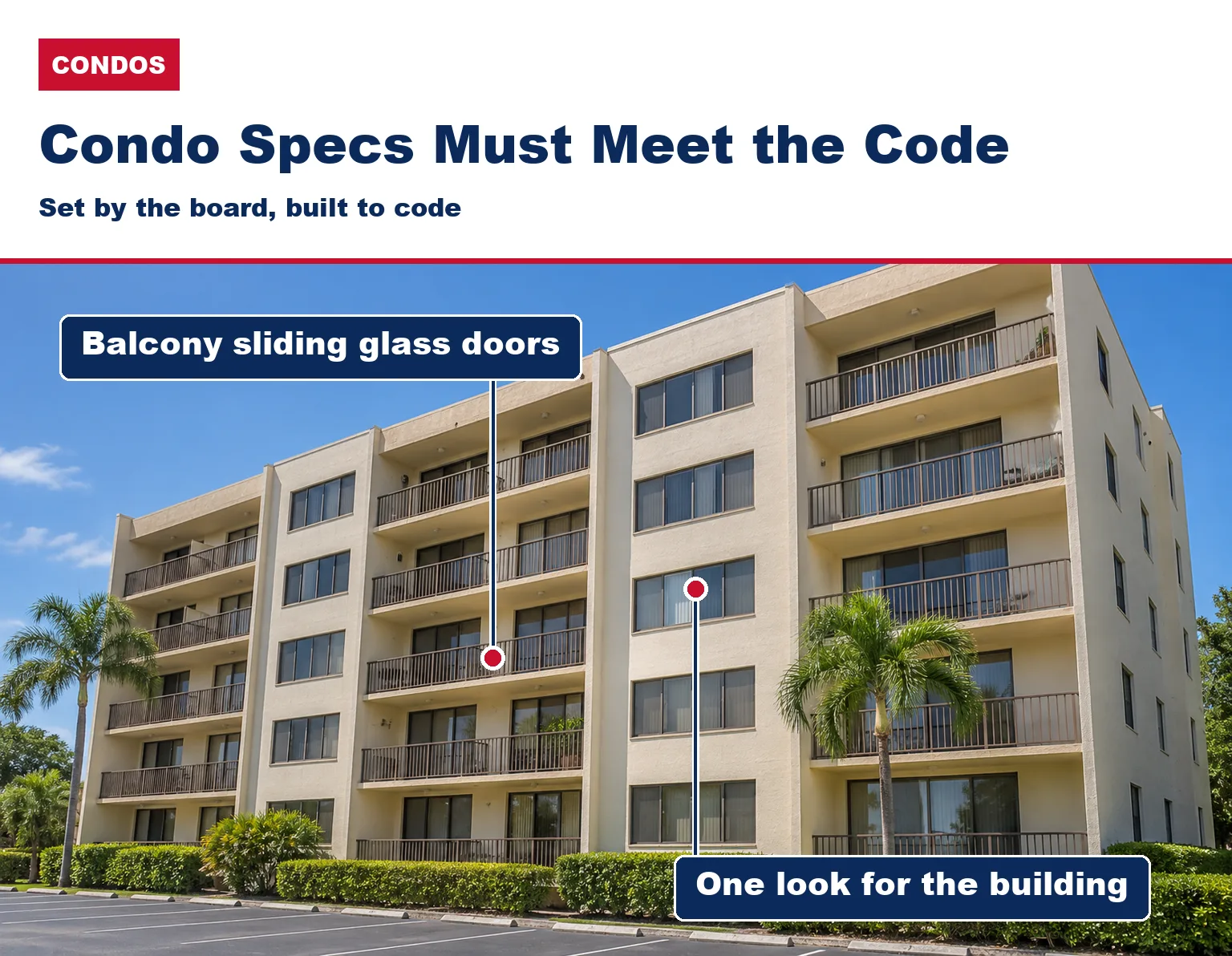
In a condo or HOA community, the building code still applies, and the association adds its own hurricane protection specifications. Florida law requires both kinds of association to adopt these specifications, and they must comply with the applicable building code.
For condos, section 718.113(5) of the Florida Statutes covers all residential and mixed-use condominiums. The board may install hurricane protection, or require owners to install it, with the approval of a majority of voting interests.
A condo board may not refuse an owner’s installation or replacement of hurricane protection that conforms to its specifications. The board may require it to match an existing unified building scheme for the building’s look.
For HOAs, section 720.3035(6) says the specifications may include the color and style of hurricane protection products. The board or architectural committee may not deny an application that conforms to them.
That statute lists impact-resistant windows and doors, storm shutters and reinforced garage doors as hurricane protection.
Condo window projects often add board approval and engineering. Our page on impact windows for businesses and condo buildings covers those larger jobs.
Insurance, Grants and Refunds Are Incentives, Not Mandates
No Florida insurance law orders you to install impact windows, but the law rewards you when you do. Section 627.0629 of the Florida Statutes requires residential property insurers to include discounts, credits or other rate differentials for wind mitigation features, including opening protection.
The credit depends on a wind mitigation inspection and on your insurer. To see how the form rates openings, read which home upgrades can lower Florida insurance rates.
The state’s My Safe Florida Home program offers free wind mitigation inspections and grants for eligible homes, and opening protection is an eligible improvement when the program’s initial inspection recommends it. Its program FAQ says grants depend on legislative appropriation and applications open in phases, starting with low-income homeowners aged 60 or older.
The program also says not to begin construction before you receive grant approval. A state sales tax refund may help too: see who qualifies for Florida’s sales tax refund on impact windows.
If cost is the barrier, ask about payment plans for qualified homeowners through third-party lenders. Terms, eligibility and availability depend on the program and location.
What the Permit Checks on a Window or Door Replacement
The permit is how your building department confirms the code is met. Plan review checks that each product has a valid approval for the opening, and the inspection checks that the product went in as the approval specifies.
In Miami-Dade and Broward, look for a Miami-Dade Notice of Acceptance (NOA) or a Florida Product Approval valid for the HVHZ. Elsewhere, a Florida Product Approval is the usual document. The approval must also cover the opening’s size and design pressure.
Every USA Home Improvement project is permitted, and our installation team holds direct certification from the manufacturer.
Want the details on paperwork? See our impact window permit and inspection answers for who pulls the permit and what the inspector looks at.
Florida Impact Window Requirement FAQs
Do I have to replace my windows when I buy an older house?
No, not under the building code: Section 707.4 covers only the windows you replace.
In a condo, check the declaration and any recorded vote certificate, since owners can be required to install hurricane protection by a majority vote or by the declaration itself. Unprotected openings can also lower your wind mitigation rating, so check whether the existing windows are hurricane rated.
Can my condo board or HOA make me install impact windows?
A condo board can require owners to install code-compliant hurricane protection after a majority vote of the voting interests, or without a vote when the declaration already assigns that work.
If code-compliant protection is already installed, the board cannot require the same type again until it reaches the end of its useful life or is needed to prevent damage.
The HOA statute works the other way. Section 720.3035(6) requires the board to adopt hurricane protection specifications, which may set color and style, and bars it from denying an application that meets them. Your community’s own covenants may add rules, so read them before you order.
Do sliding glass doors and entry doors need impact protection too?
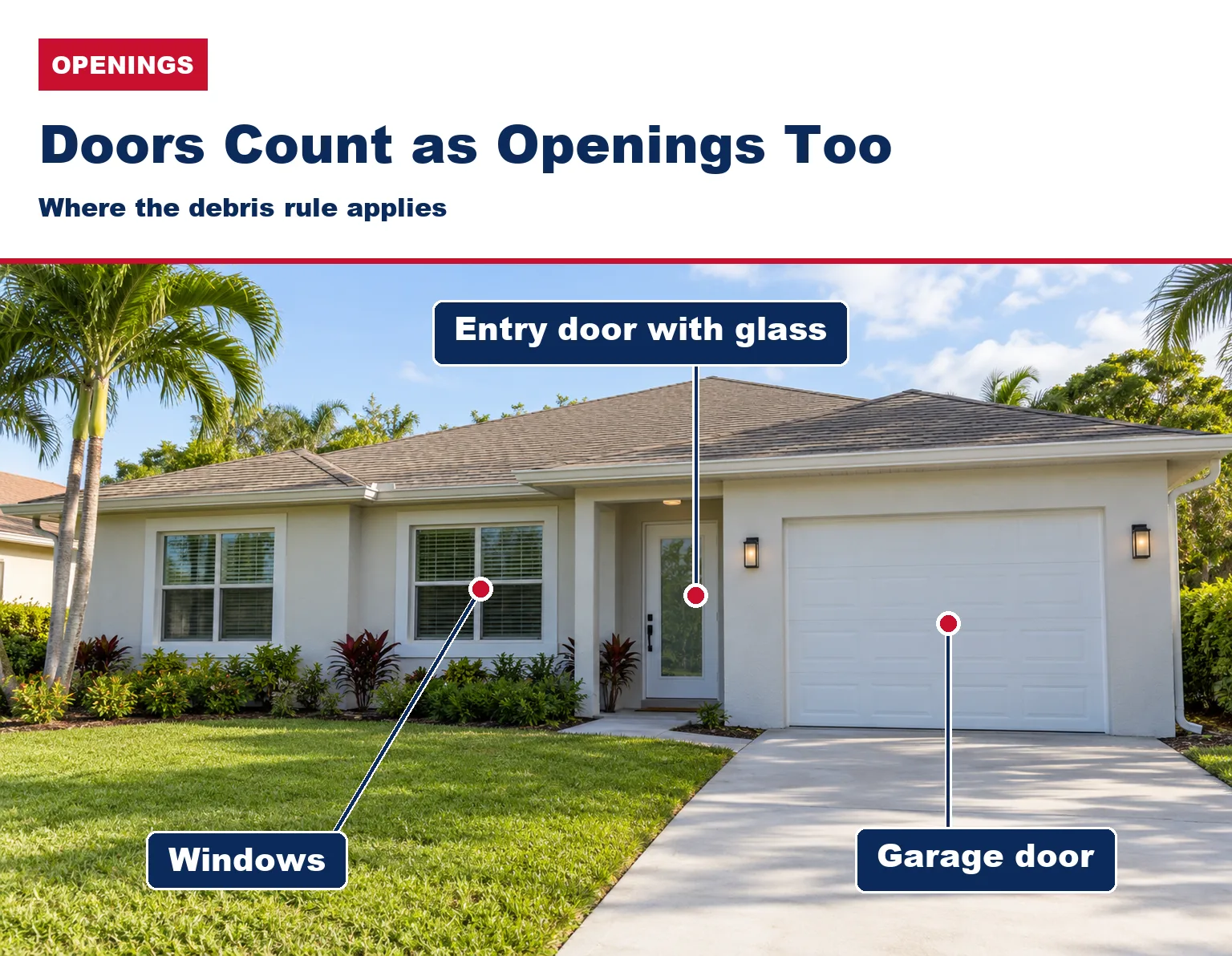
Yes, wherever the debris protection rule applies. Section 707.4 covers replaced exterior doors, sliding glass doors and garage doors, and in the HVHZ, Section 1626.1 names outside doors as part of the envelope. See our impact doors we install for entries and patios.
Can I protect some windows with shutters and others with impact glass?
Yes, the code asks that each glazed opening be impact resistant or covered by an approved impact-resistant device, so you can mix approved options. On the wind mitigation form, the home is rated by its weakest opening, so one unprotected window can lower the result.
Will the 2026 Florida Building Code change these rules?
The 9th Edition (2026) of the Florida Building Code takes effect December 31, 2026, and Miami-Dade applies it to permit applications submitted on or after that date. The rules in this article are from the current 8th Edition (2023), so ask which edition your permit will fall under.
Find Out What Your Home Needs Before You Buy
If your home is in Miami-Dade, Broward or Palm Beach County and you are replacing windows, plan on impact windows or approved shutters for every replaced opening, unless your building department confirms that a 25 percent exception applies.
A measured quote that lists the product approval for each opening is the clearest way to see what your project needs.
USA Home Improvement is licensed (CGC1526707) and insured and has served Florida homeowners for more than 15 years.
Get a free estimate or call (877) 554-6373.