 Saltar al contenido

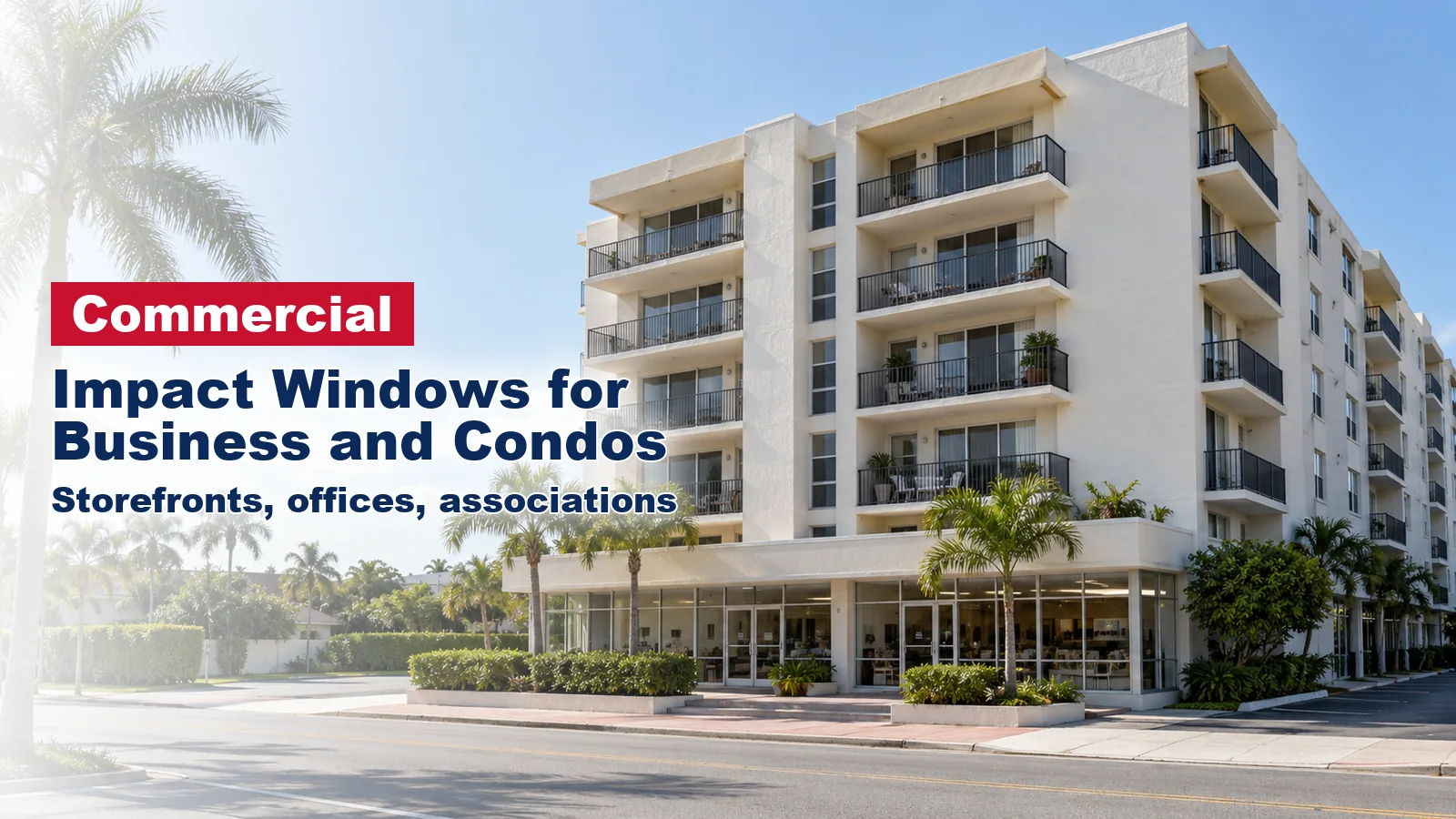
You should get impact windows for your business if your building has glass that needs storm protection and nobody wants to put up shutters before every hurricane. Approved impact glass protects the openings all season, makes smash-and-grab entry harder, and gives you cleaner paperwork for insurers and inspectors.
This guide covers storefronts, offices and condo buildings: what matters for each, how condo board approval and Florida condo law work, when you need engineering, and which documents to keep for your insurer.
Why Businesses and Condo Buildings in South Florida Choose Impact Windows
Commercial and condo buildings choose impact windows mainly because the protection is always in place. Florida Building Code requires opening protection in the wind-borne debris region, which means either impact-rated glazing or approved shutters. For a business, shutters mean staff time, storage and a boarded-up front before every storm.
Impact glass removes that job.
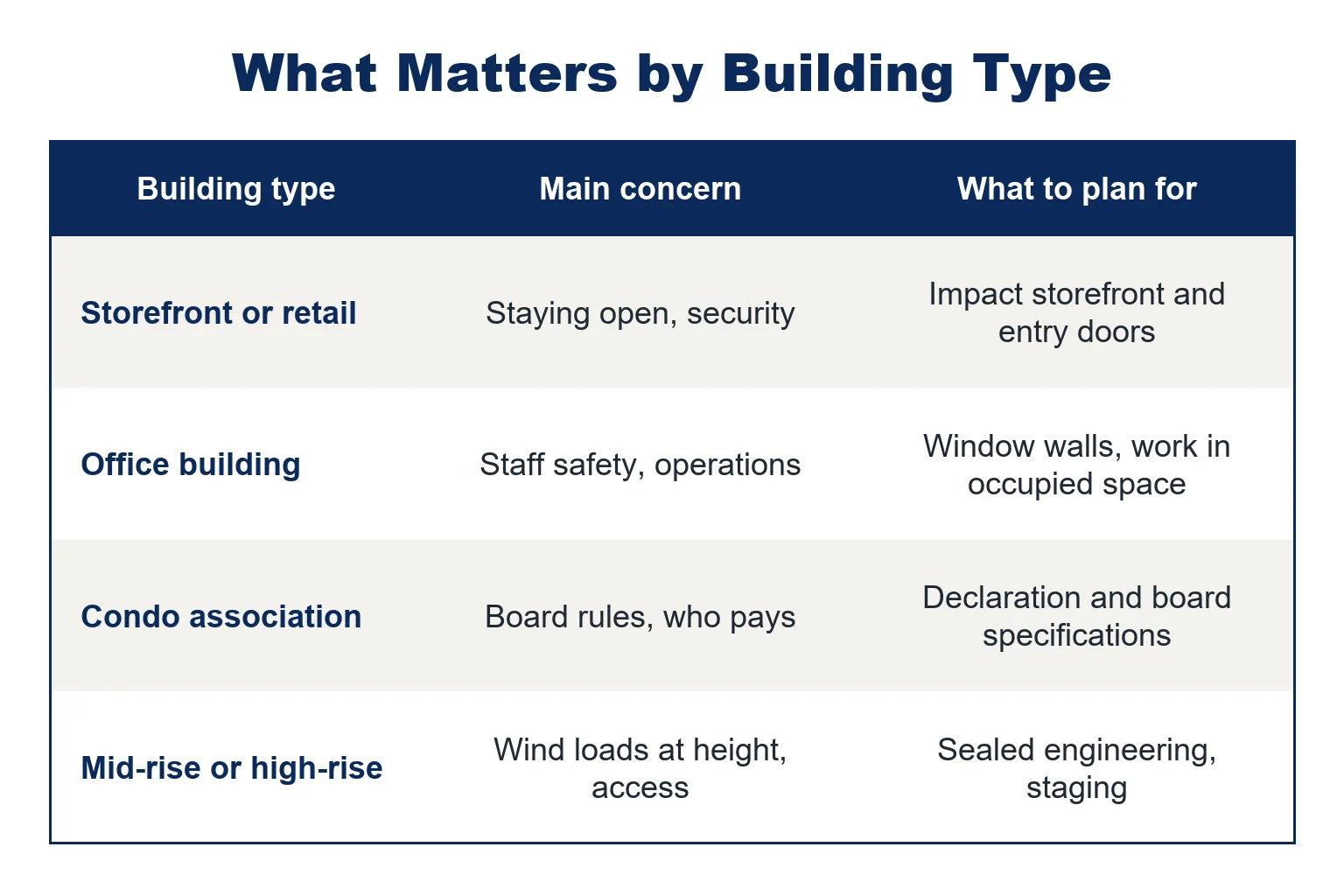
What matters most depends on the type of building:
| Building type | Main concern | What to plan for |
|---|---|---|
| Storefront or retail | Staying open, security, visibility | Impact storefront system and entry doors |
| Office building | Staff safety, comfort, operations | Window walls, permits, work in occupied space |
| Condo association | Board rules, who pays, uniform look | Declaration, board specifications, owner vote |
| Mid-rise or high-rise | Wind loads at height, access | Signed and sealed engineering, staging |
USA Home Improvement’s commercial impact window and storefront division works on condominiums, office towers, hotels and other commercial buildings, with permitting and engineering calculations handled as part of the project. For the basics, start with how impact window ratings and approvals work.
Impact Windows for Storefronts and Offices
Storefronts and offices use different glass systems than houses. Instead of single windows set into block walls, many commercial buildings use framed aluminum systems that run across a whole wall.
Storefronts and Retail Glass
An impact storefront system combines large fixed glass panels, aluminum framing and the entry doors in one tested assembly. The storefront is the face of the business, so the goal is protection without losing the view into the shop.
Three things to check on a storefront quote:
- The whole assembly is approved: the glass, frame and doors should be covered by the product approval for the size you are installing.
- The doors match the traffic: retail entry doors open and close all day, so ask about hardware, closers and thresholds suited to heavy use.
- The glass fits the use: tinted or Low-E laminated glass can cut glare and heat on a sun-facing display window.
Nuestro impact window, door and storefront product lines include commercial storefront, curtain wall and window wall systems. For wide openings at the back of a shop or a restaurant patio, impact sliding glass doors for large openings are another option.
Office Buildings and Mid-Rise Commercial
Office buildings often use window walls (glass set floor to floor between slabs) or curtain walls (glass hung on the outside of the structure). Both can be built with impact glass.
Height changes the testing. Florida rules call for the large missile test (a 9 lb 2×4 fired at 50 feet per second) for glazing within 30 feet of grade.
Glazing higher up is normally tested with a small missile instead, but upper floors face higher wind pressures, so the required design pressure (DP) for each opening usually climbs with height. To see what those tests mean in practice, read what impact window strength means in a storm.

Keep Your Business Open: Continuity and Security
The biggest business case for impact windows is continuity. If the glass holds, wind and rain stay out, and you are dealing with cleanup instead of a gutted interior, ruined stock and soaked equipment.
A few points to keep realistic:
- Impact windows protect openings, not the whole building. They do not stop flooding or storm surge, so a ground-floor shop in a flood zone still needs a flood plan.
- A cracked impact window is still doing its job. The laminated layer is designed to keep the glass in the frame, but the unit needs replacing afterward.
- Security improves, but nothing is break-in proof. Laminated glass is much harder to get through than ordinary glass, which slows down smash-and-grab theft. Keep your alarm and cameras.
Continuity also means people. With impact glass in place, staff are not climbing ladders to close shutters as a storm approaches, and they can head home to their own families sooner.
Save Time From Installing and Taking Down Hurricane Shutters
Impact windows save the time, labor and storage that shutters demand before and after every storm. Storm panels have to be carried, fastened and stored, and even accordion or roll-down shutters need someone on site to close and open them.
For a business, that work lands during the busiest days, when you are also securing stock, backing up data and planning closures. A boarded front also tells customers you are closed, sometimes for days after the storm has passed.
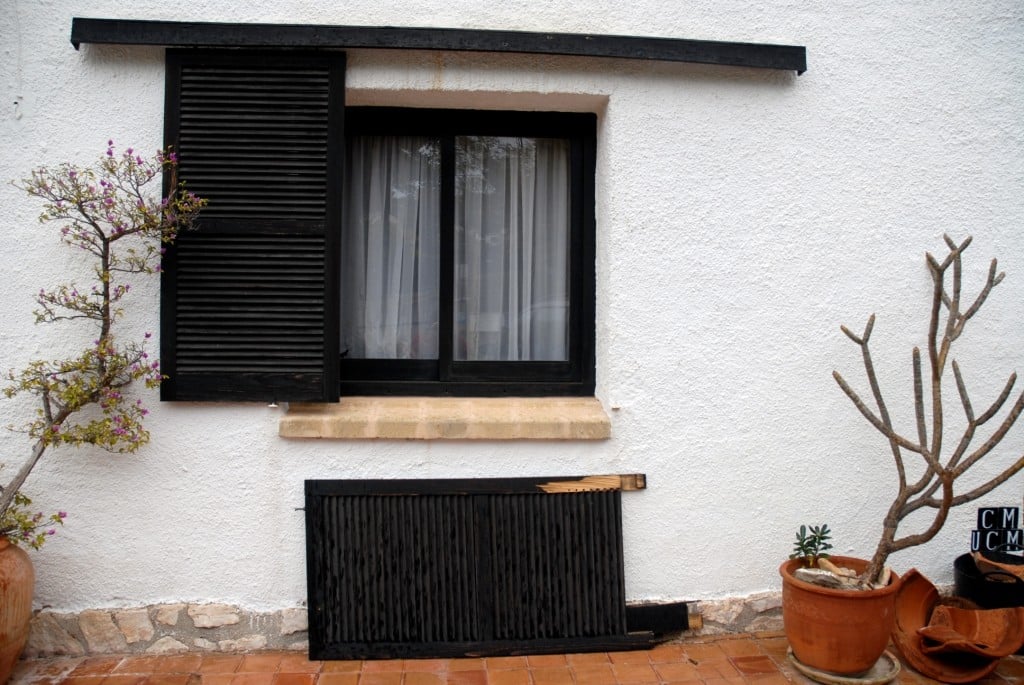
Shutters still make sense for some buildings, for example when the existing windows are in good condition and the budget is tight. Weigh both options with our comparison of impact windows versus hurricane shutters for protection.
Impact Windows for Condo Associations
Condo window projects start with one question: who owns the windows? The answer is in the declaration of condominium, and it decides who approves the work, who pays, and who signs the contract.
Common Elements vs Unit Owner Windows
In some buildings the windows and sliding doors are common elements maintained by the association. In others, the declaration makes each owner responsible for the windows of their own unit. Many buildings mix the two, for example with the association in charge of hallway and lobby glass and owners in charge of unit glass.
- If the association is responsible: the board runs the project, usually for the whole building, and the cost is a common expense.
- If owners are responsible: each owner hires a contractor, but the work must follow the board’s specifications and approval process.
Read the declaration and any board rules before you ask for quotes. A contractor cannot tell you who pays; the governing documents do.
What Florida Condo Law Says About Hurricane Protection
Florida condo law requires every residential and mixed-use condo association to adopt hurricane protection specifications for each building. Under section 718.113 of the Florida Statutes, those specifications can cover color, style and other factors, and they must comply with the building code.
Key points from section 718.113 for boards and owners:
- Installing, maintaining, repairing or replacing hurricane protection under this section is not treated as a material alteration of the common elements.
- The board may install hurricane protection, or require owners to install it, with the approval of a majority of the voting interests. No owner vote is needed when the declaration already makes the association responsible for the protection or the openings it covers.
- A board generally cannot refuse an owner’s request to install hurricane protection that meets the specifications, though it can require a uniform exterior look.
- Owners who already installed code-compliant protection can be excused from, or credited against, an assessment when the association later funds protection for units that do not have it.
Windows and exterior doors are also one of the items a structural integrity reserve study must cover under section 718.112 of the Florida Statutes, for condo buildings that are required to have one. That makes window replacement a budgeting question for the board, not just a storm question.
Confirm how these rules apply to your building with the association’s attorney.
Engineering and Sealed Drawings for Mid-Rise and High-Rise Buildings
Mid-rise and high-rise projects usually need engineering that a house does not. Wind pressure depends on the building’s height, shape, exposure and where each opening sits, with corners and upper floors facing higher loads.
Expect the building department to ask for wind load calculations and shop drawings signed and sealed by a Florida-licensed engineer, showing the product, the design pressure for each opening and how the frames anchor to the slab or wall. Curtain wall and window wall systems often need project-specific engineering on top of the product approval.
High-rise work also needs a plan for access: swing stages or lifts, elevator scheduling, protecting hallways, and notice to residents about which units are being worked on each day.
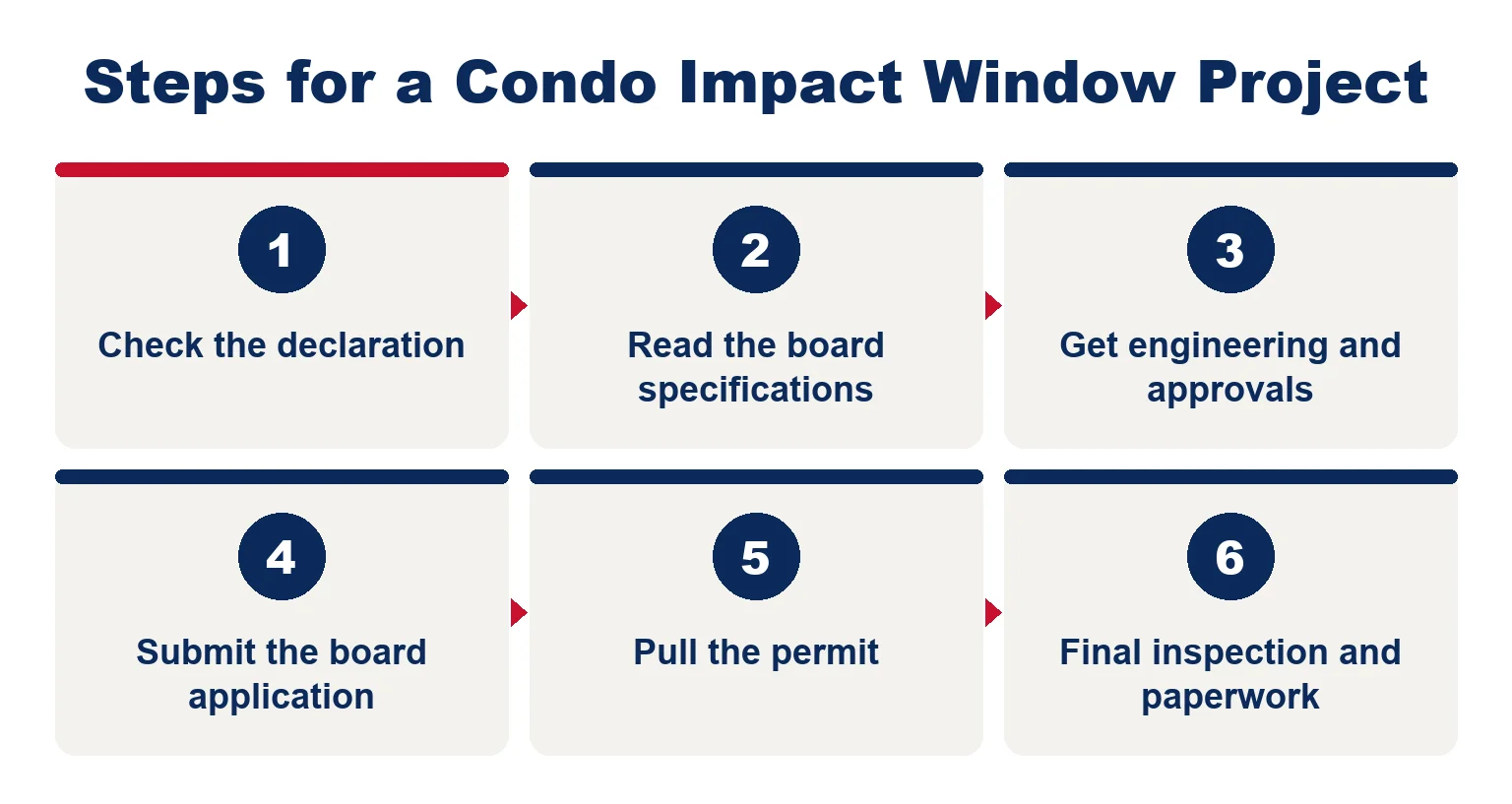
Steps for a Condo Impact Window Project
- Check the declaration: find out whether the windows are common elements or the owners’ responsibility.
- Read the board’s hurricane specifications: note the approved frame color, glass tint and style.
- Get engineering and product approvals: collect the approval numbers and, for taller buildings, the sealed drawings.
- Submit the board application: include the contractor’s license, certificate of insurance naming the association, and the product details.
- Pull the permit: the contractor files with the city or county building department.
- Pass final inspection and file the paperwork: give copies to the association and your insurer.
Permits, Product Approvals and Inspections for Commercial Buildings
Every commercial or condo impact window replacement needs a building permit and a final inspection. The permit ties the job to a specific approved product, installed the way its approval drawings require.
In Miami-Dade and Broward, the High-Velocity Hurricane Zone (HVHZ), products need an approval valid in the HVHZ, such as a Miami-Dade Notice of Acceptance (NOA). Palm Beach County and Southwest Florida use Florida Product Approval. In both systems, check that the approval covers the size and design pressure of each opening, not just the brand.
Not sure what is installed in a building you just bought or manage? Here is how to tell if windows are hurricane rated.
Reduce Your Commercial Property Insurance: Documents Insurers Ask For
Impact windows can help with commercial and condo association insurance, but only if you can prove what was installed. Credits and terms vary by insurer and policy, so ask your agent what they need before the project starts.
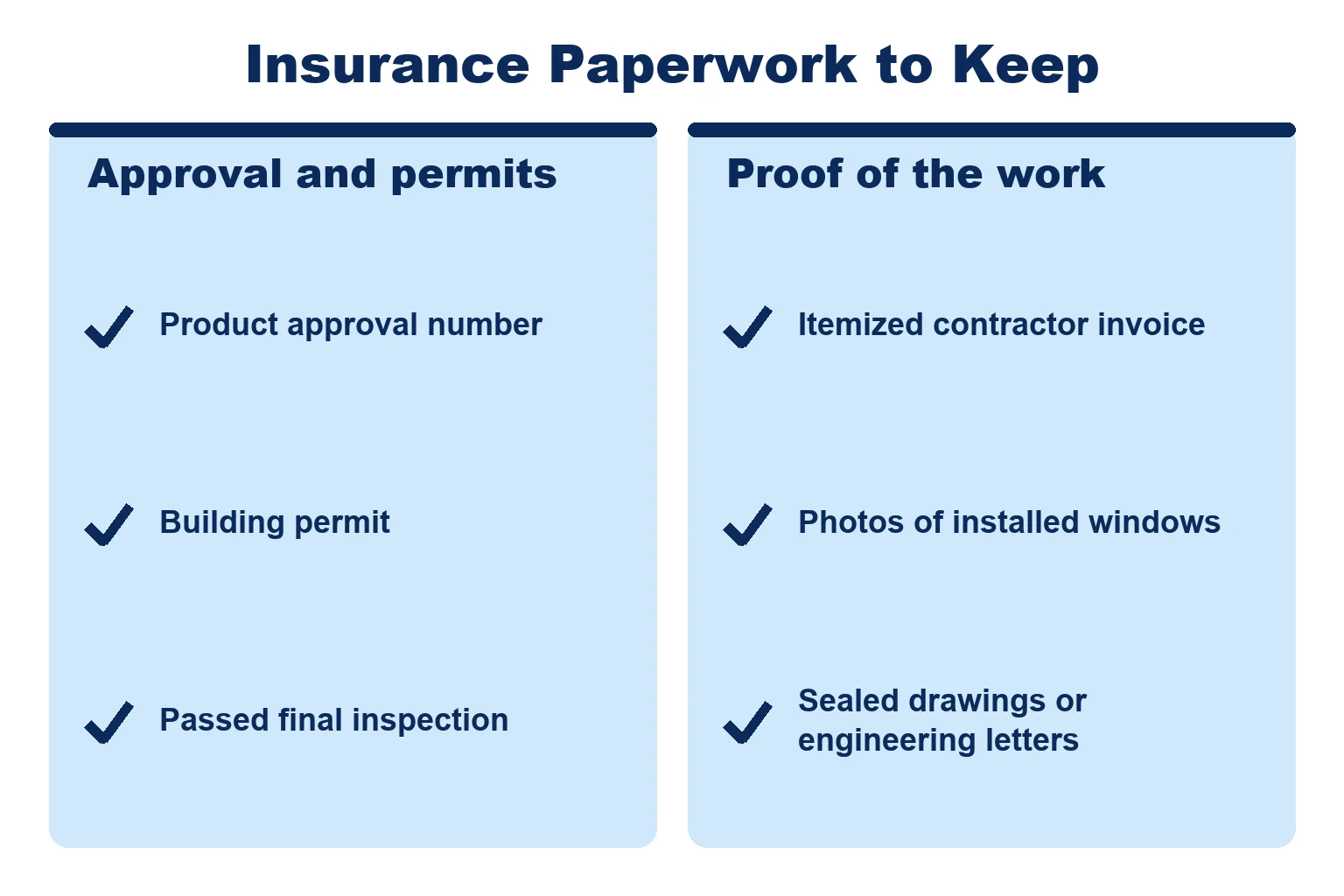
Keep one file with:
- The product approval number (NOA or Florida Product Approval) for every window and door system
- The building permit and the passed final inspection
- The contractor’s invoice listing each opening, product and glass type
- Photos of the installed windows, including any visible labels or glass etching
- Signed and sealed drawings or engineering letters, for mid-rise and high-rise jobs
- A wind mitigation or windstorm inspection report, if your insurer asks for one
Condo associations should also collect copies of owner-installed upgrades, since an owner’s paperwork can matter for the building’s coverage and for credits under section 718.113. For more ways to save, see home improvements that reduce insurance costs.

Lower Building Running Costs and a Better Place to Work
Impact windows can lower cooling costs and outside noise, but only when the glass package is chosen for it. Laminated glass on its own is about impact. Energy savings come from Low-E coatings, tints and insulated glass, so ask for the NFRC U-factor and solar heat gain figures on the quote.
For salons, restaurants and shops with big sunny windows, a lower solar heat gain helps the AC keep up and reduces fading on stock and furniture. For downtown offices, the laminated layer also cuts street noise and sirens, which helps people focus.
Our guide to how impact windows reduce outside noise explains the STC and OITC ratings to ask about.
What Drives the Cost of a Commercial Impact Window Project
Commercial impact window prices vary too much by building to quote a single figure. The main factors are:
- System type: individual windows, storefront, window wall or curtain wall
- Opening sizes and the design pressure required at each height
- Glass package: tint, Low-E, insulated laminated glass
- Engineering, permits and inspections
- Access: lifts, swing stages, working around tenants or residents
- Repairs found when old frames come out, such as concrete or stucco work
Get at least two itemized quotes and compare contractors and their quotes in detail. USA Home Improvement’s commercial division works with Tecnoglass and ES Windows systems; to understand the differences between makers, read which impact window brand to choose. Ask about ways to finance your window upgrade if the budget is the sticking point.
Commercial and Condo Impact Window FAQs
Can a condo owner install impact windows without board approval?
No, in most buildings the owner needs board approval first. Florida law requires associations to adopt hurricane protection specifications, and owner-installed windows must follow them for color, style and appearance. A board generally cannot refuse protection that meets those specifications, but it can reject products that do not.
Who pays for impact windows in a condo?
It depends on the declaration of condominium. If the windows are common elements, the association pays as a common expense. If owners are responsible for their unit windows, each owner pays, even when the board requires the upgrade.
Owners who already installed code-compliant protection can receive a credit in some cases.
Do impact windows replace a business’s flood plan?
No. Impact windows protect openings from wind and flying debris, but they do not stop flood water or storm surge. A ground-floor business in a flood zone still needs flood barriers, raised equipment and flood insurance where it applies.
Can impact windows be installed while my business stays open?
Often, yes. Installers can work in sections, one wall or a few openings at a time, so the rest of the space keeps running. Plan the schedule with your contractor around opening hours, deliveries and any areas that must stay secure.
Ready to protect your storefront, office or condo building? Call USA Home Improvement at (877) 554-6373 to talk with our commercial team about approvals, engineering and a project plan for your building.
USA Home Improvement cuenta con licencia (CGC1526707) y seguro, y ha prestado sus servicios a propietarios de viviendas en Florida durante más de 15 años.