 Saltar al contenido

Hurricane windows and impact windows are often the same product, but the two names do not promise the same thing. “Hurricane window” is a sales name. The Florida Building Code separates windows tested for wind pressure from windows tested for impact by wind-borne debris.
Only an impact-rated window protects the opening on its own. This guide explains what each label means, why a wind-rated window can still need shutters, how large and small missile ratings differ, where the HVHZ begins, and what to ask a seller before you sign.
Are Hurricane Windows the Same as Impact Windows?
Hurricane windows are the same as impact windows only when the window carries an impact rating. Section R609.2 of the Florida Building Code, Residential requires every exterior window to resist the design wind loads for its location. In a loose sense, almost any new window is “rated” for hurricane wind.
Impact resistance is a separate rating. Section R609.3 says the window’s permanent or temporary label must show the positive and negative design pressure rating and the “impact-resistance rating if applicable.” A window can carry a design pressure and no impact rating at all.
The state’s records keep the two apart as well. The Florida Product Approval search lists “Impact Resistant” and “Design Pressure” as separate fields, so ask which one a seller means by “hurricane.”
“Hurricane proof” is a sales phrase too, not a code rating. Approvals list the sizes, design pressures and missile rating a product was tested for, which tells you far more than any promise in an ad.
| What the window is rated for | What it was tested against | Typical Miami-Dade NOA wording |
|---|---|---|
| Wind pressure only | Design wind pressure, no missile | Design pressure listed, no impact rating |
| Small missile impact | Wind pressure plus small steel balls | “Small Missile Impact Resistant” |
| Impacto de misiles grandes y pequeños | Wind pressure plus a 9-pound 2×4 (large missile) | “Large and Small Missile Impact Resistant” |
USA Home Improvement installs ES Windows impact windows in aluminum and vinyl frames. You can browse the ES Windows impact window styles we install, or read our Guía completa sobre ventanas resistentes a impactos en el sur de Florida. for costs, styles and county rules.
Wind-Rated Windows Still Need Shutters in Debris Regions
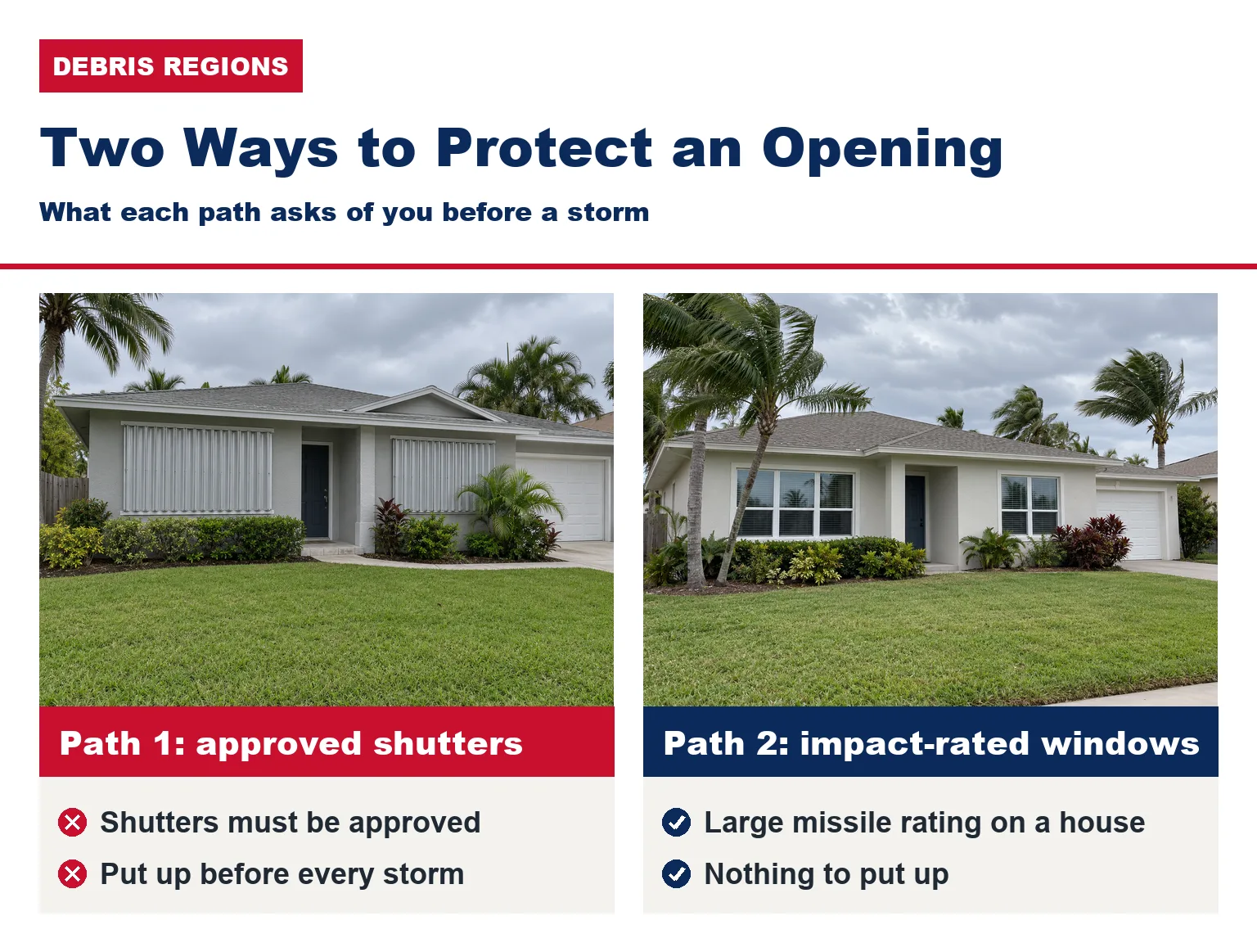
A window rated only for wind pressure still needs separate protection in Florida’s wind-borne debris region. Section R301.2.1.2 says exterior glazed openings there “shall be protected from windborne debris,” and it names the large missile test as the bar that protection must clear.
That leaves two everyday paths: a non-impact window behind tested, approved shutters, or an impact window that protects itself. The code also allows precut wood structural panels on some homes, within limits on roof height and wind speed, and our guide shows how to put up plywood over windows before a storm.
Palm Beach County treats its whole area as wind-borne debris region; for every zone and the replacement rules, see when Florida requires impact windows or shutters.
The state wind mitigation form, OIR-B1-1802, treats both paths alike. Level A covers glazed openings protected with “impact resistant coverings or products” listed in the Florida or Miami-Dade approval system that pass the cyclic pressure and 9-pound large missile tests.
The form rates the home by its weakest opening. See how opening protection can lower your insurance rates for the credit side.
Daily life with each path is different. Shutters must be closed or put up before every storm, while impact windows are always in place. Our side-by-side look at impact-resistant windows and hurricane shutters covers that choice, and our guide to hurricane window film compared with impact windows covers film sold as a hurricane upgrade.
Large Missile vs Small Missile: Which Rating Your Windows Need
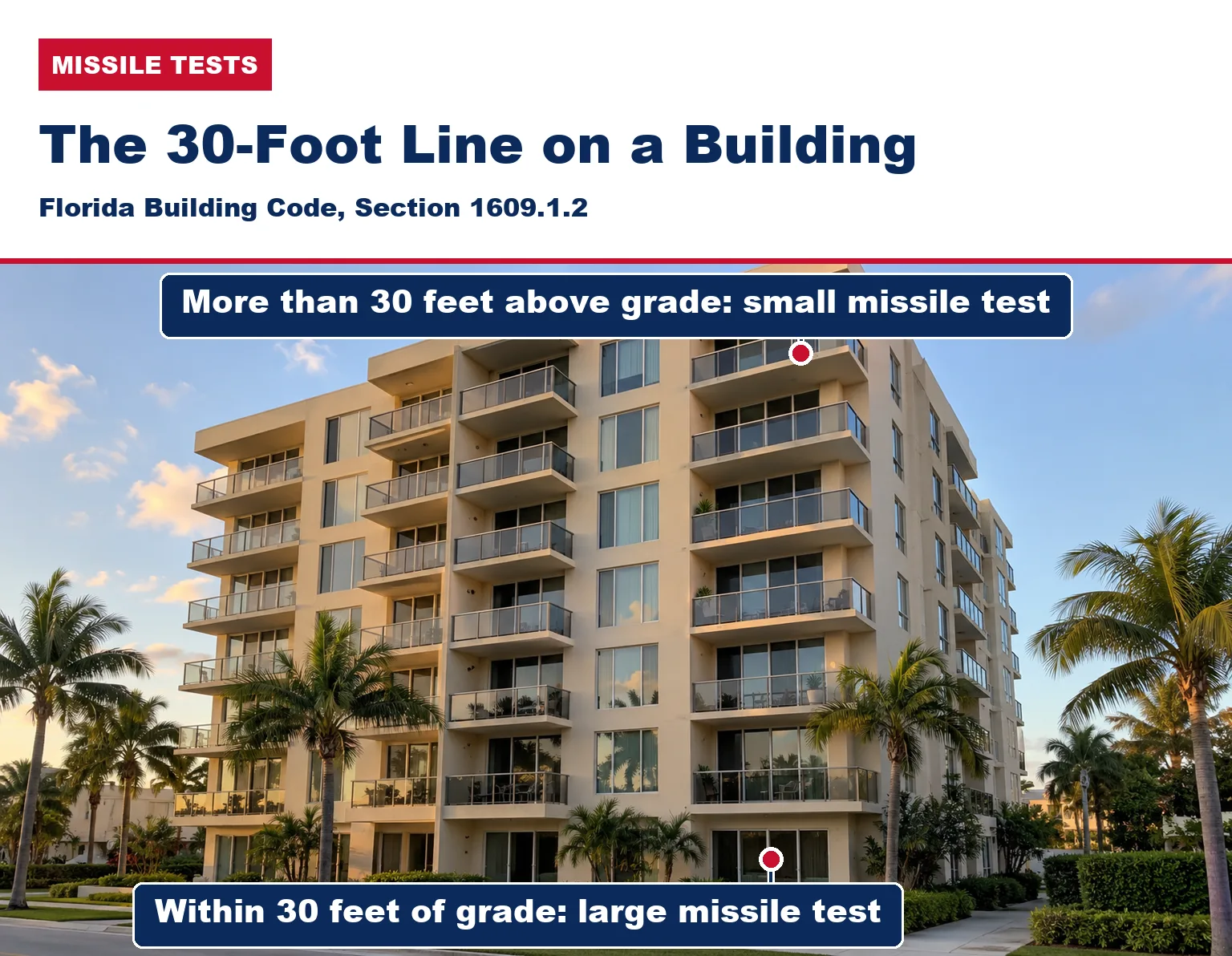
Most homes need the large missile rating. Section 1609.1.2 of the Florida Building Code, Building requires glazed openings within 30 feet of grade to meet the large missile test, and openings more than 30 feet above grade to meet the small missile test.
For houses, Section R301.2.1.2 of the Residential code names the large missile test for glazed openings in the wind-borne debris region, so a house quote should name a large missile product.
The code’s HVHZ section spells out both missiles. The large missile is a 9-pound 2×4 that hits the window at 50 feet per second. The small missile is a solid 2-gram steel ball, and each test specimen takes 30 of them at 130 feet per second.
Passing does not mean the glass comes out perfect. In the HVHZ large missile test, three specimens must stop two impacts without penetration, then survive cyclic wind pressure with no crack longer than 5 inches and 1/16 inch wide through which air can pass.
A window rated for small missile only fits glass more than 30 feet up, such as upper floors of a condo building. For a one- or two-story house, ask for an approval that reads “Large and Small Missile Impact Resistant.” Our explainer on ¿Qué tan resistentes son realmente las ventanas resistentes a los huracanes? walks through each test step.
HVHZ Approval: What Changes on the Product Documents
Homes in Miami-Dade and Broward follow the stricter High-Velocity Hurricane Zone (HVHZ) rules. Palm Beach County homes fall under the wind-borne debris region rules described above.
Section 1626.1 says every part of the building envelope in the HVHZ, including glazing, outside doors and skylights, “shall meet impact test criteria or be protected with an external protection device that meets the impact test criteria.” HVHZ impact tests follow the Florida protocols TAS 201 and TAS 203.
Wind pressure testing also changes. Section R609.3 says windows in the HVHZ must comply with TAS 202 and ASTM E1300, the Florida pressure test and a glass strength standard.
For a buyer, the difference shows up on the approval. Miami-Dade NOAs for HVHZ products state the product “has been designed to comply with the Florida Building Code, including the High Velocity Hurricane Zone.” The Florida Product Approval search lists “Approved for use in HVHZ” and “Approved for use outside HVHZ” as separate fields.
If you live in Broward or Miami-Dade, the product needs HVHZ approval. The same rules cover outside doors, including sliding glass doors and entry doors, so plan impact doors and sliding glass doors for South Florida homes together with the windows.
Six Questions to Ask Before You Buy “Hurricane Windows”
Ask questions a seller can answer with a document. A clear quote names the product series and approval for every opening.
- Is it impact rated, or rated for wind pressure only? A design pressure alone means the window still needs shutters in a debris region.
- What does the missile rating say? Glass within 30 feet of grade needs the large missile rating, not small missile only.
- Which approval number covers it, and is it current? Ask for the Florida Product Approval number or Miami-Dade NOA, then check the expiration date on the Página de aprobación de productos de Miami-Dade or the state search.
- Is it approved for HVHZ use? Broward and Miami-Dade homes need it.
- Do the approved sizes and design pressures cover each opening? Miami-Dade NOAs point to tables of unit sizes, design pressures, reinforcement, glass types and anchor requirements.
- Will the job be permitted, and will I get the approval numbers? Your wind mitigation inspector will ask for them.
For a fuller checklist to bring to a quote, see Qué buscar en ventanas resistentes a huracanes.
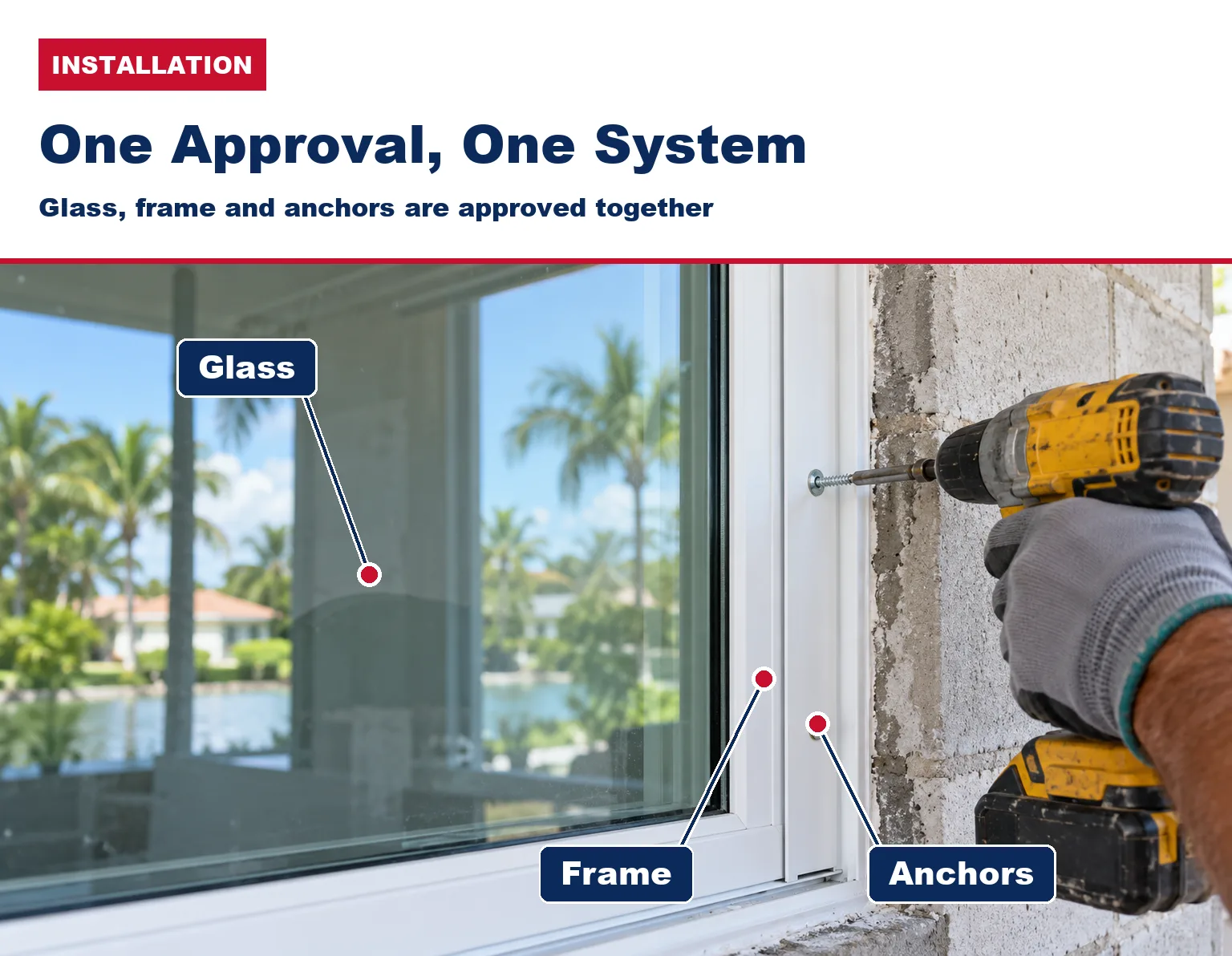
The glass, frame and anchors are approved as one system. Section R609.7.1 requires windows to be anchored per the manufacturer’s published recommendations to reach the design pressure, so strong glass with the wrong anchors does not match the approval.
At USA Home Improvement, customers can receive the Florida Product Approval number for each window and door on request. We sell ES Windows exclusively, every project is permitted, and our installation team holds direct certification from the manufacturer.
Request a free estimate and ask for the approval number of each window and door, or call (877) 554-6373.
Hurricane Windows and Impact Windows FAQs
Are hurricane proof windows real?
“Hurricane proof” is not a code rating. Impact windows are tested against set missiles and wind pressures, and each approval lists the sizes and design pressures the product passed. Judge a window by that missile rating and design pressure, not by the word “proof.”
Do impact windows still need shutters?
Not when the window’s approval covers that opening: a large missile rating for glass within 30 feet of the ground, the opening’s size and design pressure, and HVHZ use in Broward or Miami-Dade. Some approval drawings say it directly: “Impact shutters are not required.”
Do impact windows lower my homeowners insurance?
They can. Approved large missile products on every opening can reach Level A on the wind mitigation form, but each insurer sets its own credit. Keep the approval numbers and permit for the inspector, and ask your insurer what credit applies before you buy.
How can I tell if my current windows are impact rated?
Look for a permanent mark or etching that names the maker. The design pressure and impact rating may sit on a temporary sticker removed after inspection, so match the maker and series to an approval number or the permit record. Our guide explains Cómo saber si sus ventanas y puertas son resistentes a huracanes..
Does Florida law require impact windows?
Not by name: the code requires protected glass openings in the wind-borne debris region and the HVHZ, and impact windows are one way to meet it. Our guide to who Florida’s code requires to have impact protection covers replacement windows, condos and HOAs.
Choose a Window by Its Rating, Not Its Name
If you want windows that protect the opening with no storm prep, choose impact-rated windows with a large missile rating and, in Broward or Miami-Dade, HVHZ approval. If a quote only says “hurricane window,” ask the six questions above before you sign.
Financing options for impact window projects may be available for qualified homeowners through independent third-party providers. Terms, eligibility and availability depend on the program and location.
USA Home Improvement cuenta con licencia (CGC1526707) y seguro, y ha prestado sus servicios a propietarios de viviendas en Florida durante más de 15 años.
Obtenga un presupuesto gratuito o llame al (877) 554-6373.