Saltar al contenido

The 2026 Florida Building Code (9th Edition), effective December 31, 2026, changes only a few rules for windows and doors. Doors sheltered by an overhang now need a Limited Water (LW) rating, and a Florida section on applying the ASTM E1996 impact standard has been deleted.
Skylight energy limits tighten, energy ratings on labels must be certified under an authorized program, and every product approval has to be carried over to the new code. This guide explains each change in plain words and what to ask about the windows and doors in your quote.
For the Miami-Dade permit cutoff and permit timing, read our guide to the 2026 code dates for South Florida homeowners.
The 2026 Code Changes for Windows and Doors at a Glance
These are the main changes in the 9th Edition for residential windows, doors and skylights, according to the Florida Building Commission’s analysis of changes for the Residential code y su analysis of the residential Energy code.
| Change | Sección de código | Lo que significa para ti |
|---|---|---|
| Doors under an overhang | R609.3 | A sheltered door may use a Limited Water (LW) rating only if the overhang is deep enough |
| ASTM E1996 application section | R301.2.1.2.1 | Deleted; glazed openings in windborne debris regions must still be protected |
| Skylight energy limits | Energy Table R402.1.2 | Lower maximum U-factor and a new SHGC limit for skylights |
| Energy rating labels | Energy R303.1.3 | U-factor, SHGC and VT must be certified under an NFRC-licensed agency |
| Product approvals | State product approval | Each approval moves to the new code by self-affirmation, revision or a new application |
Garage doors get a revised garage door wind table; our guide to impact garage doors under the new code covers it. Roof and coastal rules changed too: see the 2026 roofing rules for re-roofs y el 3,000-foot saltwater fastener rule.
USA Home Improvement sells and installs ES Windows aluminum and vinyl impact windows for permitted replacements, plus impact doors, and every project is permitted. Our South Florida guide for impact window shoppers covers styles, frames and costs.
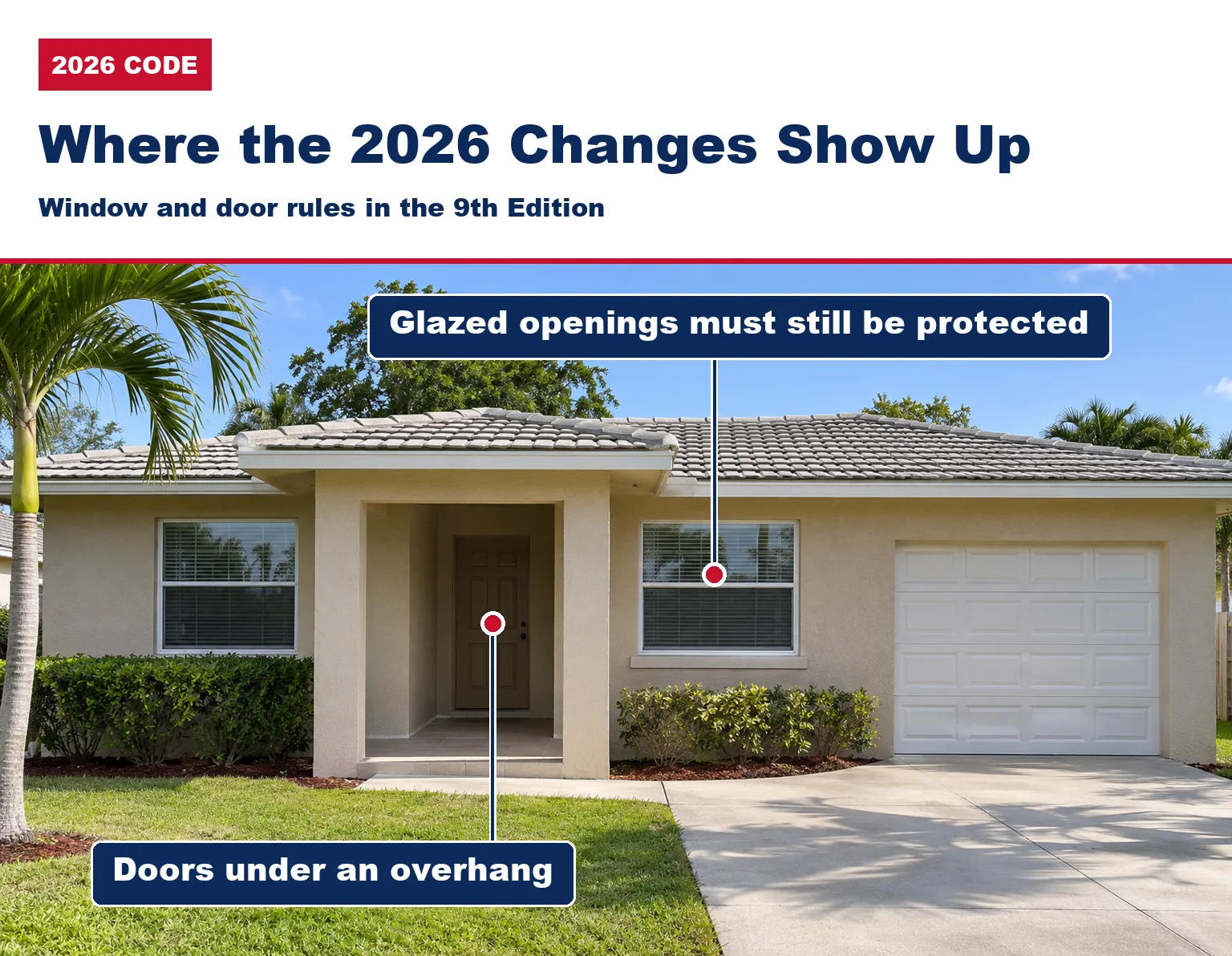
Doors Under an Overhang Now Need a Limited Water (LW) Rating
Windows and doors are normally tested to show how well they keep out wind-driven rain. The 8th Edition let a door protected by an overhang skip that water test. In the 9th Edition, Section R609.3 keeps the exception only for doors labeled with a Limited Water (LW) rating.
The Commission’s analysis puts it this way: “Such doors are now required to have Limited Water (LW) rating as required by AAMA/WDMA/CSA 101/I.S.2/A440.” That standard is the North American Fenestration Standard for windows, doors and skylights. In plain words, the door still needs a water rating on its label.
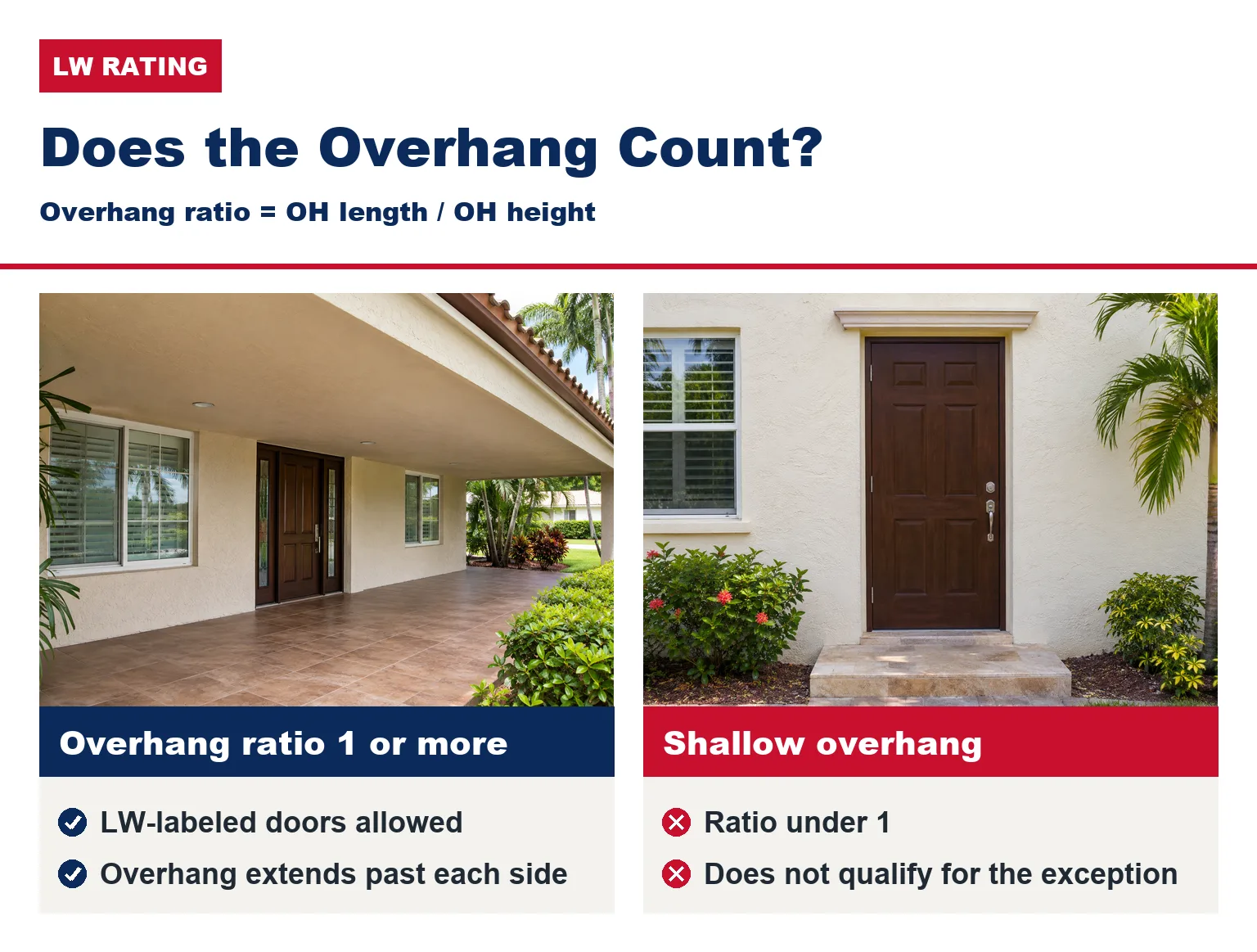
As before, the overhang has to be deep enough. The 2026 Residential code text keeps the overhang (OH) ratio of 1 or more: the OH length, how far the overhang projects out from the door, divided by the OH height, the distance from the door sill to the bottom of the overhang.
For example, an overhang whose bottom sits 8 feet above the sill has to project at least 8 feet. A shallow overhang with a ratio under 1 does not qualify for the exception.
To qualify, the overhang now also has to extend past each side of the door, not just out from it, according to the Commission’s analysis. Two new figures in the code show this, including a door with full-height side walls.
The same change appears in the Building volume, in Section 1709.5.1 and in Section 2411.3.2.1 for windows and doors in the High-Velocity Hurricane Zone (Miami-Dade and Broward). If a covered entry or patio door is part of your project, ask whether its label shows an LW rating or a full water rating.
Keep that question handy when you compare impact entry, French and sliding doors for South Florida homes.
The ASTM E1996 Application Section Is Deleted: What Still Applies
The 9th Edition deletes Section R301.2.1.2.1, “Application of ASTM E1996,” from the Residential code, and the Building volume deletes its matching Section 1609.1.2.2.
In the 8th Edition, that section replaced part of ASTM E1996 with Florida’s own list of wind zones by wind speed, which the standard uses to set a product’s impact test level.
ASTM E1996 is the specification for how exterior windows, doors and impact protective systems must perform when hit by windborne debris in hurricanes. The main protection rule that relies on it stays.
Section R301.2.1.2 of the 2026 Residential code still says exterior glazed openings in windborne debris regions “shall be protected from windborne debris.” It still lists the accepted tests: ASTM E1996 and ASTM E1886, TAS 201, 202 and 203, or AAMA 506, as applicable.
The code defines a windborne debris region as an area within 1 mile of the coastal mean high water line where the ultimate design wind speed is 130 mph or more, or any area where it is 140 mph or more.
Nuestra guía sobre who has to have impact windows in Florida Explica cómo se aplica eso a una dirección.
For the High-Velocity Hurricane Zone, the official analysis of changes does not list changes to TAS 201, 202 or 203, the impact and wind pressure test protocols used in Miami-Dade and Broward. With the Florida wind zone wording gone, ask whether each product’s approval covers the 2026 code.
Energy Changes: Skylight Limits and Certified Energy Labels
The 2026 energy code tightens skylight limits. The maximum skylight U-factor, a measure of how easily heat passes through, drops from 0.75 to 0.60 in Climate Zone 1, according to the Florida Building Commission’s analysis of changes.
A new skylight SHGC limit, a measure of how much solar heat gets in, is set at 0.28 for Climate Zones 1 and 2, down from 0.30. The energy code’s county list places Broward, Miami-Dade and Palm Beach in Climate Zone 1.
These limits also reach replacements. Section R503.1.1.1 says a replacement fenestration unit must meet the U-factor and SHGC values in Table R402.1.2. If you replace a skylight, ask the installer to show its certified U-factor and SHGC.
For ordinary windows and glass doors, the analysis lists only a renamed column and removed footnotes in that table.
The second change is about labels. Section R303.1.3 now says U-factor, SHGC and visible transmittance (VT) must be “labeled and certified by the manufacturer as authorized by an NFRC-licensed independent certification and Inspection Agency (IA).” A product without that certified rating is assigned a default value from the code’s tables.
The same window label also carries the design pressure and approval number; see how to read the label on your windows and doors.
How Window and Door Product Approvals Move to the 2026 Code
Impact windows and doors on a Florida permit are listed with a product approval: a statewide Florida Product Approval, known by its FL number, or a local approval such as a Miami-Dade Notice of Acceptance (NOA). When the code changes, each approval has to be shown to comply with the new edition.
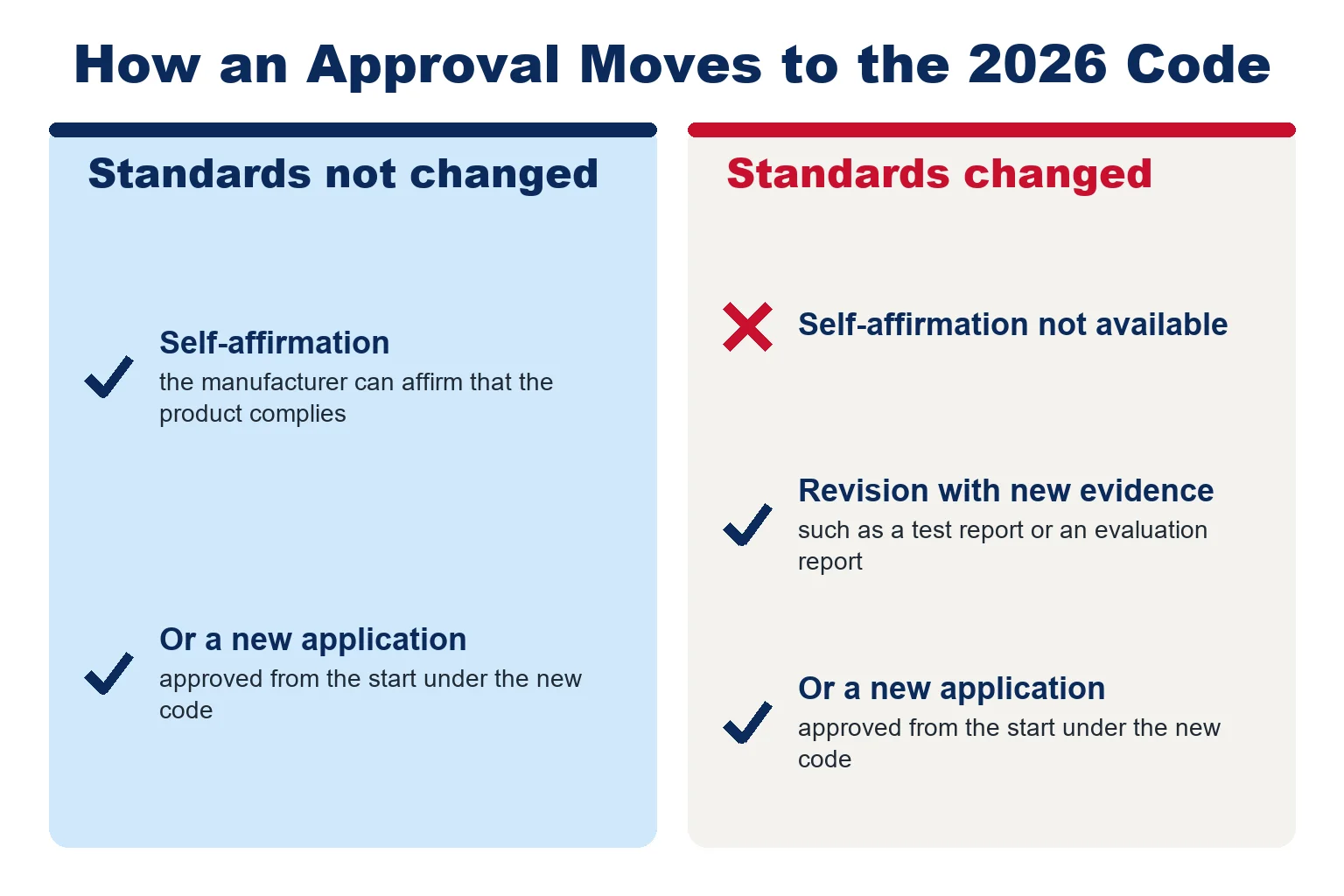
“There are three ways to have your product comply with the new code,” the state’s product approval presentation for the 9th Edition says:
- Self-affirmation: if the standards and restrictions in the new code that apply to the product have not changed, the manufacturer can affirm that the product complies.
- Revision: if those standards or restrictions changed, the manufacturer submits a revision with new evidence, such as a test report or an evaluation report.
- New application: the product is approved from the start under the new code.
The key line for homeowners is short: “Self Affirmation is not available if the standards and restrictions have changed.” Which route a product takes depends on whether the code’s standards for that product changed, and the manufacturer and the approving body decide that.
For a Miami-Dade NOA, ask your contractor or Miami-Dade’s Product Control office how the NOA applies to a permit under the 9th Edition. You can look up any NOA on Miami-Dade’s product approval search, and our guide to impact door rules in Miami-Dade explains how NOAs work for doors.
How to Check a Window or Door Approval Before You Sign
You can check a Florida Product Approval yourself. Work through these steps with your quote:
- Ask for the approval numbers. Los clientes de USA Home Improvement pueden obtener el número de aprobación de producto de Florida para cada ventana y puerta si lo solicitan.
- Search the FL number. On the state’s product approval search, enter the FL number and pick the code version; the search page asks for both.
- Ask which route the approval took. Ask whether it was self-affirmed, revised or newly approved for the 2026 code.
Then ask these questions about the products themselves:
- If my permit is reviewed under the 2026 code and an approval is not updated yet, which approved product would replace it?
- For a door under a porch roof or overhang, does the label show an LW rating or a full water rating?
- Are the U-factor and SHGC on the label certified through an NFRC-licensed agency?
Ask us how each approval in your quote applies to your permit date.
Planning a replacement around the code change? Solicite un presupuesto gratuito para ventanas y puertas resistentes a impactos. or call (877) 554-6373, and ask for the approval number of every product in the quote. Your project may also fit the Florida sales tax refund for impact windows and doors.
2026 Florida Building Code Window and Door FAQs
Does the 2026 Florida Building Code change impact testing for windows?
The official analysis of changes does not list changes to TAS 201, 202 or 203, the HVHZ test protocols. What was deleted is the Florida section that set wind zones for ASTM E1996, so ask whether each product’s approval covers the 2026 code.
Are there new wind speed maps for South Florida in the 2026 code?
The Commission’s Residential analysis of changes does not list a new wind speed map. It says the garage door wind load table was revised “to correlate with changes in ASCE 7-22.” If someone quotes new wind speeds for your county, ask for the code section.
Will impact windows cost more under the 2026 code?
Prices depend on the products, sizes and openings in your quote. Ask whether your quote assumes products whose approvals apply to your permit’s code edition, and read what goes into an impact window price.
Can a window approved under the 2023 code be used on a 2026 code permit?
It depends on the approval. A product moves to the 2026 code by self-affirmation, revision or a new application, and self-affirmation is only available if its standards and restrictions did not change. Ask whether the approval covers the 2026 code, and check the FL number on the state’s search.
Do the 2026 energy rules change for replacement windows?
Section R503.1.1.1 says replacement windows and doors must meet the U-factor and SHGC values in Table R402.1.2. For ordinary windows and glass doors, the Commission’s analysis lists only a renamed column and removed footnotes in that table. The bigger change is that label ratings must be certified through an NFRC-licensed agency.
Before You Sign, Get Each Product’s Approval in Writing
The 2026 code changes for windows and doors are narrow, but they decide which products can go on a permit. Get the approval number for each window and door, check it, and ask how any covered door is rated for water.
Comparar financing choices for new windows and doors. Los propietarios que cumplan con los requisitos pueden acceder a financiamiento a través de proveedores externos independientes. Los términos, la elegibilidad y la disponibilidad dependen del programa y la ubicación.
USA Home Improvement cuenta con licencia (CGC1526707) y seguro, y lleva más de 15 años prestando sus servicios a propietarios de viviendas en Florida. Vendemos exclusivamente ventanas ES, y nuestro equipo de instalación cuenta con la certificación directa del fabricante.
Obtenga un presupuesto gratuito o llame al (877) 554-6373.