 Skip to content

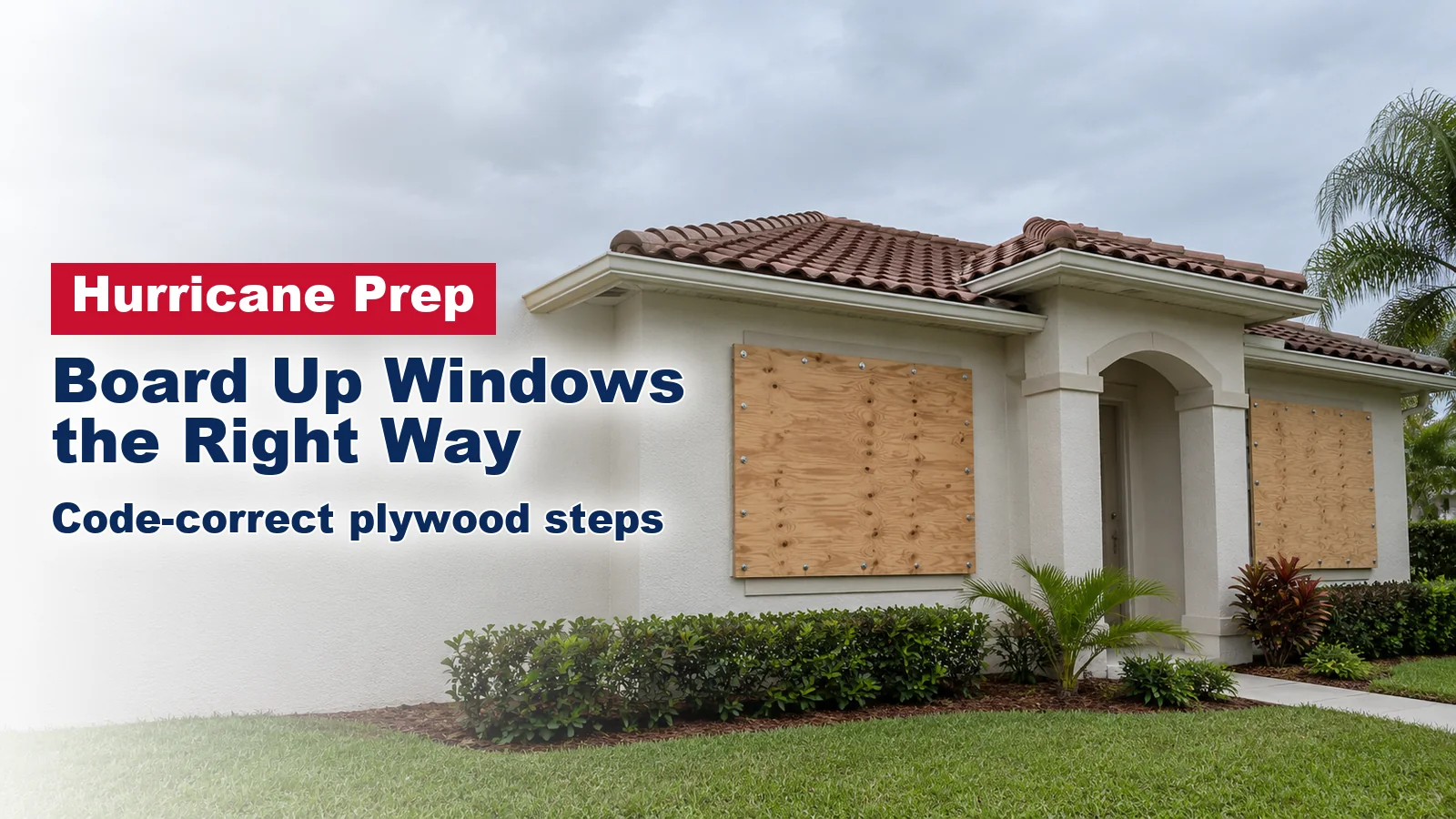
To install plywood over windows for a hurricane, cut exterior-grade plywood 8 inches larger than each opening, pre-drill it, and bolt it to the wall around the window into permanent anchors. Never cut the panel to fit inside the window frame. The Florida Building Code requires the panel to attach to the structure.
This guide covers the code limits, the steps, the right fasteners for concrete block and wood-frame homes, sliding doors, safety and storage. Plywood is an emergency measure, so it also shows when it is time for permanent protection.
What the Florida Building Code Allows for Plywood Window Protection
The Florida Building Code allows plywood as opening protection only when it meets a few clear limits. Pinellas County’s hurricane retrofit guide sums them up, and the FLASH emergency board-up guide adds the practical spec.
| Rule | Requirement | Source |
|---|---|---|
| Panel thickness | Wood structural panels at least 7/16 inch thick | Florida Building Code (via Pinellas County) |
| Recommended plywood | Exterior grade (CDX), 5/8 inch or thicker | FLASH |
| Span | No more than 44 inches between lines of fasteners, for homes with a roof height of 33 feet or less | Florida Building Code (via Pinellas County) |
| Where it attaches | To the structure around the opening, not cut to fit inside it | Florida Building Code (via Pinellas County) |
| Materials not allowed | Particle board | Pinellas County |
Treat 7/16 inch as the legal floor and 5/8 inch as the target. Thicker plywood flexes less when debris hits it. Use plywood only.
Insulation board, window film and window clips are not hurricane protection.
In Miami-Dade and Broward, the stricter High-Velocity Hurricane Zone rules apply, and plywood has no product approval. There it is a last-minute backup while you plan permanent protection such as hurricane impact windows for South Florida homes.
Supplies You’ll Need to Board Up Windows
FLASH lists a short set of tools and hardware for emergency plywood panels. Buy everything before the season, because stores sell out of plywood and anchors once a storm is forecast.
- Tape measure and a marker for labeling
- Circular saw
- Drill and drill bits (masonry bits for concrete block or stucco)
- Hammer and wrench
- Work gloves and eye protection
- Exterior-grade CDX plywood, 5/8 inch or thicker
- Bolts or lag screws, nuts and large washers
- Permanent anchors: galvanized expansion anchors for masonry, plastic-coated anchors for wood frame
- 2×4 lumber and galvanized exterior deck screws if you need to join sheets
Choose corrosion-resistant hardware. Pinellas County calls for it, and salt air near the coast rusts plain steel fast.
How to Install Plywood Over Windows, Step by Step
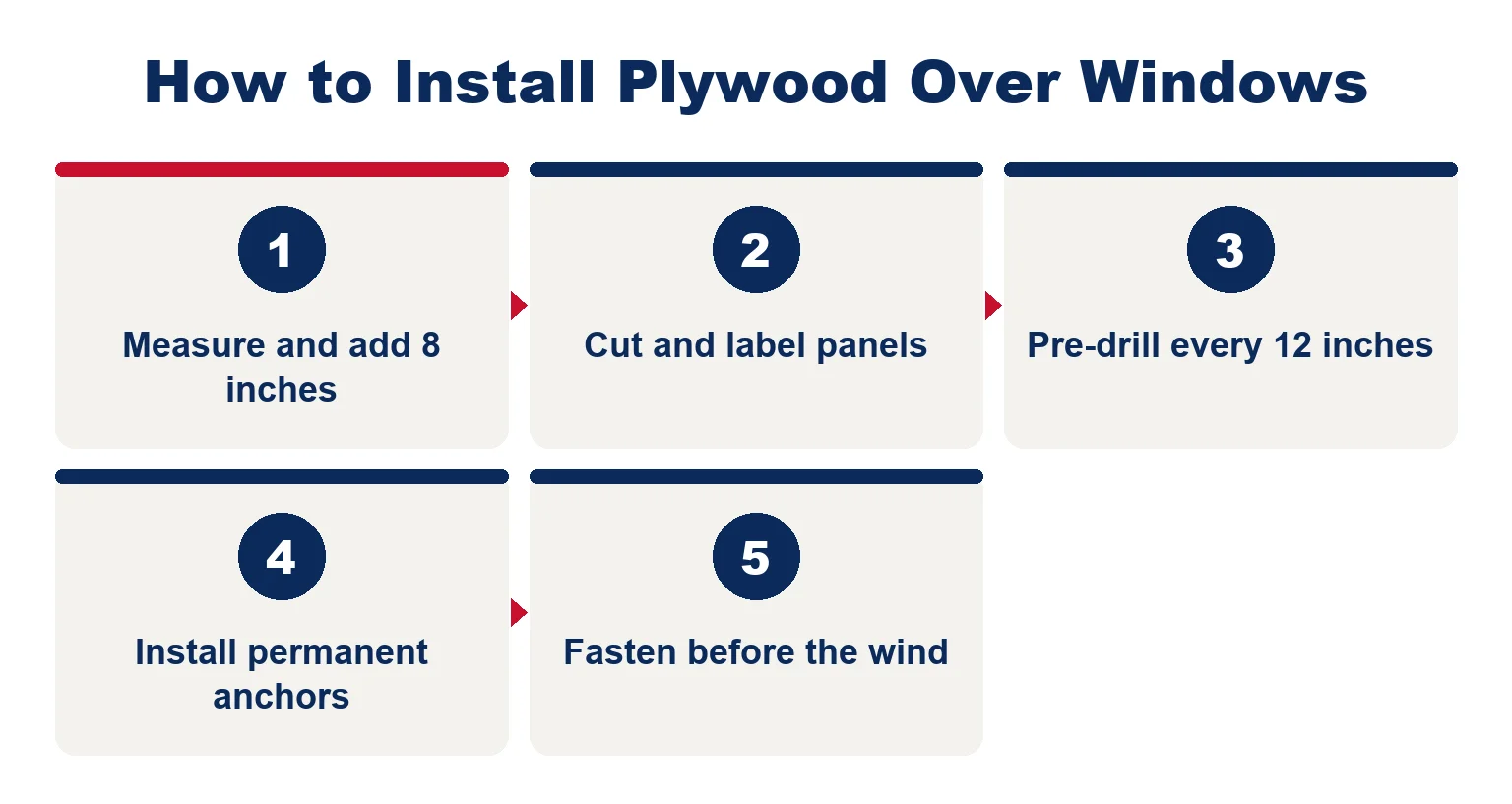
Installing plywood over windows takes five steps, and the first four should be done before hurricane season. When a storm is coming, only the last step is left.
Step 1: Measure Each Opening and Add 8 Inches
Count every window and door with glass, including French doors, sliding glass doors and skylights. FLASH also says to include older garage doors that are not wind or impact resistant, and any vent large enough to let wind in.
Measure each opening horizontally inside the exterior trim, and vertically from the sill to the bottom of the top trim. Add 8 inches to both the height and the width. That gives a 4-inch overlap on every side.
FLASH’s worked example: an opening 5 feet 6 inches wide and 3 feet 7 inches tall needs a panel 6 feet 2 inches by 4 feet 3 inches.
If your window has an extended sill that sticks out at the bottom, measure from the top of the sill to the top of the window and add 4 inches instead of 8.
Step 2: Cut and Label Every Panel
Plywood sheets are usually 4 feet by 8 feet, so work out how many sheets each opening needs before you buy. Cut each panel to its measured size.
Write the name of the opening on each panel, such as “kitchen window” or “master bedroom left”, and draw an arrow that points up. Labeled panels go up in minutes. Unlabeled panels turn into a puzzle in the rain.
Step 3: Pre-Drill the Panels and Mark the Wall
Drill holes the same diameter as your bolts or screws, 2 inches in from the edges at each corner and every 12 inches around the panel. Then hold the panel over the opening and mark the wall through the holes.
If the sill is flush with the wall, fasten the plywood on all four sides. If the sill sticks out at the bottom, fasten the top and the sides. The code allows no more than 44 inches between opposite lines of fasteners.
On most window openings the panel is wider than that, so plywood fastened only around the edges is an emergency measure, not code-rated protection. For protection that meets the code on every opening, use tested shutters or impact windows.
Step 4: Install Permanent Anchors Around Each Opening
Drill the marked spots in the wall and set permanent anchors, so each future storm only takes bolts, not new holes. Pinellas County requires anchors permanently installed on masonry homes, and FLASH calls for permanent anchors on both wall types.
Drill into the wall around the opening. Never drill into the window frame, the glass or decorative trim.
Step 5: Fasten the Panels Before the Wind Picks Up
Line up each labeled panel with its anchors and fasten it with bolts, nuts and large washers. Tighten every fastener, then check that the panel sits flat against the wall with no gaps along the edges.
Put panels up as soon as a hurricane watch is issued for your area and the weather is still calm. Once wind arrives, stop and get inside.
Plywood Boarding for Stucco and Concrete Block Houses
Most South Florida homes are concrete block (CBS) with a stucco finish, and they need masonry fasteners. FLASH calls for expansion bolts with galvanized permanent expansion anchors set into the wall around the opening.
- Use a masonry bit and drill through the stucco into the block behind it.
- For windows 3 feet by 4 feet or smaller, use 1/4-inch expansion bolts.
- For larger windows, use 3/8-inch expansion bolts.
- Expansion bolts should go at least 1 1/2 inches into the wall.
Stucco is only a thin finish coat, so the anchor has to grip the block itself to hold. Never fasten into the window frame or a decorative stucco band around the window.
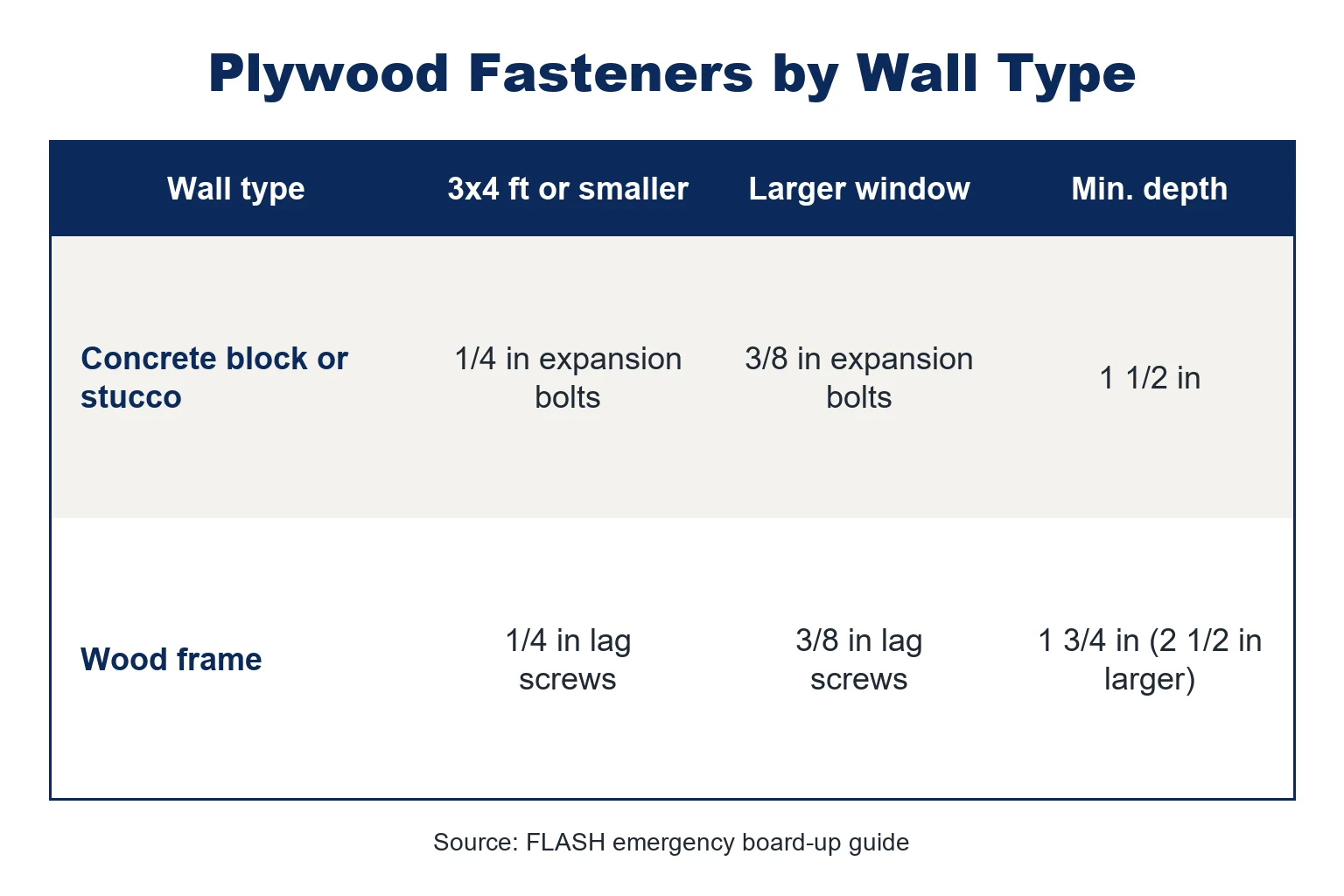
| Wall type | Window 3 ft x 4 ft or smaller | Larger window | Minimum depth |
|---|---|---|---|
| Concrete block / stucco | 1/4 in expansion bolts + galvanized permanent expansion anchors | 3/8 in expansion bolts | 1 1/2 in into the wall |
| Wood frame | 1/4 in lag screws + plastic-coated permanent anchors | 3/8 in lag screws | 1 3/4 in (2 1/2 in for larger windows) |
Source: FLASH Emergency Board Up guide.
Plywood Boarding for Wood-Frame and Vinyl-Sided Homes
On a wood-frame home, the plywood must fasten into the framing around the window, not into siding or trim. Trim is not strong enough to hold a panel in hurricane winds.
- Find the studs and framing around each window before you mark the panel.
- For windows 3 feet by 4 feet or smaller, use 1/4-inch lag screws with plastic-coated permanent anchors.
- For larger windows, use 3/8-inch lag screws that go at least 2 1/2 inches into the wall and framing.
- At a minimum, lag screws should go at least 1 3/4 inches into the wall and framing.
On vinyl siding, drill through the siding into the framing behind it, and make sure every screw reaches solid wood. Pinellas County requires panels on frame homes to be pre-cut and pre-drilled so they attach to the framing around the opening, with all hardware ready.
Joining Plywood Panels for Sliding Glass Doors and Large Openings
Sliding glass doors and other openings bigger than one sheet of plywood need two or more sheets joined into one panel. FLASH’s method:
- Butt the sheets together along one seam.
- Lay a 2×4 along the entire seam on the outside of the panel, with the widest side flat against the plywood.
- Fasten the 2×4 with 10-gauge, 2-inch galvanized exterior deck screws every 4 inches.
Joined panels are heavy and catch wind like a sail, so carry and hang them with at least two people. A wide slider also makes it hard to keep fastener lines within the 44-inch code span.
If a large opening is hard to cover every season, impact sliding glass doors for South Florida homes remove the job for good. For older garage doors, see our guide to bracing your house and garage door for a hurricane.
Safety Tips Before You Climb a Ladder
Boarding up is ladder work with heavy panels and power tools, and most injuries happen in the rush before a storm. Plan the job so you are done well before conditions turn.
- Never install plywood in high winds. A 4 by 8 sheet acts like a sail and can pull you off a ladder. If the wind is already strong, stay inside.
- Use a ladder on firm, level ground, and have a second person hold it and pass up the panels.
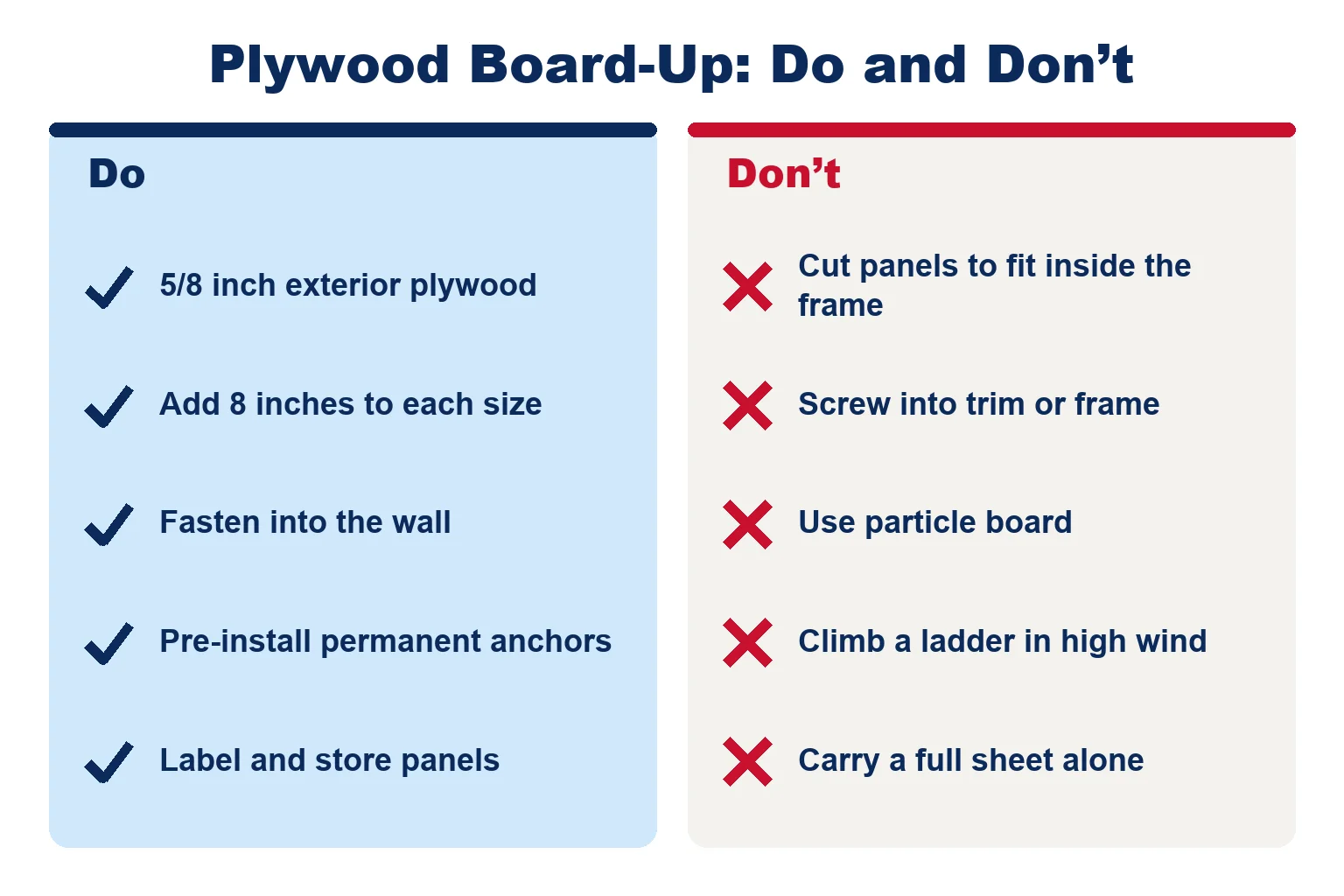
- Do not carry a full sheet up a ladder alone. Pre-cut panels and pre-installed anchors keep ladder time short.
- Wear eye protection and work gloves when cutting and drilling, and let the saw stop before you set it down.
- Keep cords away from water and use outdoor-rated extension cords.
- Leave upper-floor windows to a professional if you cannot reach them safely.
Storing Plywood Panels Between Hurricane Seasons
Store plywood panels flat or upright in a dry place, together with their bolts, nuts and washers. FLASH recommends storing all of it in one location protected from the weather.
- Keep the hardware in a labeled bag or bin with the panels.
- Seal or paint the panels to keep moisture out, as FLASH suggests.
- Take panels down after the storm passes, so you have daylight and a way out.
- Replace warped or split panels before the next season.
- Check that the permanent anchors are clean, and cap them if dirt gets in.
Why Plywood Is a Last Resort for Hurricane Protection
Plywood is the cheapest way to cover windows, but it is an emergency measure. FLASH presents plywood panels as a temporary option for homes without impact-resistant windows and doors or tested and approved shutters.
Plywood only works if someone is home, healthy and has time to put it up. It has no product approval and it blocks your daylight for the whole storm. Our guide on how to protect your windows during a hurricane compares every option side by side.
The permanent fix is to replace the glass. Impact windows protect the opening every day with nobody on a ladder, and impact entry, French and patio doors do the same for glass doors. If you are weighing cost, see impact windows vs hurricane shutters compared.
Approved opening protection can also count toward wind mitigation credits on your insurance, which plywood cannot. Read more about insurance savings from hurricane upgrades, and ways to spread the cost of protection if the upfront cost is what holds you back. Not sure what you have now?
Check whether your windows and doors are hurricane rated.
Plywood Board-Up FAQs
Can I use 1/2-inch plywood for hurricane windows?
Yes, 1/2-inch plywood is above the Florida Building Code minimum of 7/16 inch for wood structural panels, as long as fastener lines are no more than 44 inches apart. FLASH recommends exterior-grade CDX plywood 5/8 inch or thicker, which flexes less, so 5/8 inch is the better choice when you have time to buy it.
Should plywood go inside or outside the window frame?
Outside. The Florida Building Code requires plywood to attach to the structure around the opening, not be cut to fit inside it. Cut the panel 8 inches larger than the opening, so it overlaps the wall by 4 inches on each side, and fasten it into the wall with permanent anchors.
Can I use particle board or insulation board instead of plywood?
Particle board is not allowed under the Florida Building Code. Insulation board and foam panels are not hurricane protection. FLASH’s guide is written for exterior-grade CDX plywood, so buy plywood, and buy it early, because it sells out quickly once a storm is forecast.
When should I put plywood up before a hurricane?
Put it up as soon as a hurricane watch is issued for your area, while the weather is still calm. Follow your county emergency office for timing. If your panels are cut, labeled and pre-drilled and the anchors are already in the wall, the job takes far less time than starting from scratch.
Tired of boarding up every season? Call USA Home Improvement at (877) 554-6373 and we will walk you through impact window and door options for your home.
USA Home Improvement is licensed (CGC1526707) and insured and has served Florida homeowners for more than 15 years.